When should a company build bespoke AI instead of buying software
By Jeremy Ryan, Founder & CEO · November 2026
When should a company build a bespoke AI system instead of buying software? The short answer: build when AI must execute a workflow that is central to your competitive advantage, cannot meet required security or compliance conditions through a vendor, or fails measurable quality and integration tests after a fair trial. Buy when the use case is common, urgency matters more than differentiation, and a mature product meets the operational requirement without expensive workarounds.

- The Real Build Versus Buy Decision
- The Gates That Justify Bespoke AI
- Calculate The Cost Beyond Subscription Pricing
- Build The Differentiating Layer, Not Everything
- Frequently Asked Questions
The Real Build Versus Buy Decision
A bespoke AI system is an application designed around your organization’s data, business rules, integrations, approval paths, and risk requirements. It is not automatically a custom foundation model. In most cases, the sensible build option is an application that uses an existing model through an API or a privately deployed model while adding proprietary retrieval, workflow orchestration, evaluations, permissions, and monitoring.
That distinction changes the decision. A company does not need to choose between a generic chatbot and spending years training a model from scratch. It can buy model access and infrastructure, then build the narrow layer where its operating model is genuinely different.
| Decision Factor | Buying Software Is Usually Stronger | Bespoke AI Is Usually Stronger |
|---|---|---|
| Workflow | Common and standardized | Unique, high value, or tightly controlled |
| Time To Value | Needed in weeks | Can support a structured discovery and delivery period |
| Integration | Existing connectors are sufficient | Required systems, actions, or permissions exceed vendor capabilities |
| Data Controls | Vendor terms and hosting meet requirements | Residency, isolation, retention, or audit requirements are nonnegotiable |
| Quality | A vendor tool meets the threshold consistently | Domain accuracy requires proprietary context and evaluation |
| Ownership | Product capability is not strategic | The workflow creates operating leverage or customer differentiation |
| Operating Capacity | Limited internal technical ownership | Clear ownership exists for engineering, security, data, and support |
The key question is not, “Can we build it?” Almost any organization can commission a prototype. The better question is, “Will ownership of this AI capability produce more value than the cost and responsibility of operating it?”
Consider a standard internal knowledge assistant. If it only searches policies, summarizes documents, and drafts routine responses, a purchased product may be enough. But imagine a system that must interpret contractual obligations, retrieve evidence from several internal systems, identify exceptions, draft an action plan, route it to the correct approver, and write the outcome back to a case-management platform. At that point, the valuable asset is not merely the model’s text generation. It is the controlled workflow around the model.
Start With The Business Outcome, Not The Model
I recommend defining the business outcome before comparing vendors or approving custom development. “Deploy AI for operations” is not a decision-ready objective. “Reduce time to resolve high-risk exceptions while preserving approval evidence and preventing unauthorized system updates” is much more useful.
A decision-ready use case should specify:
• The business process being changed.
• The users and systems involved.
• The actions the AI may recommend, prepare, or execute.
• The quality threshold required before a human must intervene.
• The cost of a wrong answer, missed case, delayed response, or unauthorized action.
• The metric that proves value, such as cycle time, error reduction, conversion, recovered revenue, or analyst capacity.
This framing prevents a common mistake: treating a conversational interface as the product. In many enterprise deployments, the AI interface is the visible surface. The real product is identity management, retrieval quality, workflow controls, audit logs, exception handling, and integration reliability.
Treat Differentiation As A Testable Claim
“Customized” is not the same as “strategically differentiated.” Most software can be configured. The case for bespoke AI becomes stronger only when a generic product would force the business to surrender a valuable process or build so many workarounds that it becomes a fragile custom system anyway.
A workflow is likely differentiating when it affects one or more of these areas:
• Customer experience that competitors cannot easily replicate.
• A proprietary data asset or feedback loop.
• Risk decisions where generic rules are too blunt.
• High-volume operational work with material labor, delay, or error costs.
• Specialized domain logic that determines pricing, eligibility, prioritization, or execution.
For example, a generic support AI may handle routine order questions well. A bespoke system may be justified when support decisions depend on account status, regulated-product eligibility, fraud signals, contract terms, inventory commitments, and escalation policy. The difference is not branding. It is whether the AI can safely act within the actual business process.
The Gates That Justify Bespoke AI
Building should be an escalation decision, not an instinctive response to a disappointing demo. Before commissioning bespoke development, run the buy option through defined gates. If a purchased product passes them, buying is often the lower-risk answer. If it fails critical gates despite reasonable configuration and implementation effort, the evidence for building becomes concrete.
Gate One: The Quality And Exception Test
Evaluate vendor software using realistic work, not polished sample prompts. Build a representative test set of cases from the intended workflow, including routine tasks, edge cases, ambiguous records, incomplete inputs, adversarial instructions, and cases where the correct response is refusal or escalation.
An evaluation harness should include:
A labeled set of representative tasks and expected outcomes.
A scoring rubric for correctness, completeness, policy compliance, tone, latency, and escalation behavior.
A human review process for high-risk decisions.
Regression tests that run after a prompt, model, retrieval, or vendor change.
A documented threshold for production use.
There is no universal accuracy number that automatically mandates custom development. The appropriate threshold depends on the harm from failure. A marketing copy assistant can tolerate more variation than a system preparing sanctions-screening evidence or initiating payments.
One vendor-authored rule of thumb suggests considering custom development when domain accuracy remains below 70% after 60 days of prompt tuning. That should not be treated as a universal benchmark. Still, GetWidget’s discussion of custom AI and data residency makes a useful point: custom development may be justified when an off-the-shelf vendor cannot satisfy data-residency requirements. The broader lesson is that a failed gate must be tied to a real operating requirement, not a preference for owning code.
Gate Two: The Integration Ceiling
An integration ceiling occurs when purchased software can read information but cannot reliably participate in the workflow that creates value. This often appears late in procurement, after a team discovers that the platform cannot write to a required system, enforce a permission model, trigger the right approval sequence, or preserve evidence in the system of record.
Test integrations at the transaction level. Ask whether the product can:
• Read required data with the correct identity and least-privilege access.
• Cite the source record used for a recommendation.
• Write approved outputs back into the target system.
• Support retries, error handling, and manual recovery.
• Respect workflow state, approval authority, retention rules, and audit requirements.
• Handle API limits, service outages, and changing schemas without silent failures.
For Web3 and infrastructure teams, this can become especially important where AI recommendations touch operational controls, wallet processes, or network performance. AI-driven network optimization requires a safe operating model because a correct recommendation can still be unsafe if the automation layer has uncontrolled authority.
Gate Three: Security, Privacy, And Data Residency
A vendor security questionnaire alone does not settle this question. The relevant issue is whether the complete data path meets your requirements: ingestion, storage, model processing, logging, backups, support access, retention, and deletion.
Build or privately deploy when the vendor cannot contractually and technically meet a mandatory condition. Examples may include jurisdictional processing restrictions, prohibition on external model training, strict key-management requirements, isolated environments, or immutable audit evidence.
That does not mean every sensitive use case requires a ground-up system. A company may buy infrastructure, use private connectivity, minimize data sent to the model, tokenize sensitive fields, or keep retrieval within its own controlled environment. The design should be proportionate to the risk.
For instance, organizations building regulated digital-asset workflows may need AI decisions connected to evidence trails, transaction context, and escalation controls. AI-powered compliance tools are most valuable when they fit those operational and audit requirements rather than functioning as an isolated alert generator.
Gate Four: Organizational Ownership
Budget is necessary, but it is not sufficient. Bespoke AI needs durable ownership across product management, software engineering, data engineering, security, legal or compliance review where applicable, and operations.
A project is not operationally ready if nobody owns these questions after launch:
• Who reviews degraded quality or drift?
• Who approves model, prompt, retrieval, and policy changes?
• Who responds when the system produces a harmful or misleading result?
• Who maintains connectors after an internal API changes?
• Who manages user permissions, audit requests, and incident evidence?
• Who can explain the system’s limits to affected teams?
Fair warning: AI-assisted development can shorten implementation work, but it does not eliminate these responsibilities. A system that changes business outcomes must be governed as an operating capability, not treated as a one-time software delivery.
Calculate The Cost Beyond Subscription Pricing
Subscription price is often the least informative number in a build-versus-buy analysis. The decision should compare three to five years of total cost of ownership, alongside the economic value of faster deployment and improved performance.
| Cost Category | Purchased AI Product | Bespoke AI System |
|---|---|---|
| Initial Cost | Subscription setup, implementation, migration, training | Discovery, design, engineering, integration, security review |
| Ongoing Cost | Seats, usage fees, renewals, administration, vendor services | Inference, cloud, monitoring, maintenance, enhancements, support |
| Hidden Cost | Manual exceptions, duplicate data work, process workarounds | Evaluation harnesses, incident response, model changes, technical debt |
| Exit Cost | Data export, workflow migration, retraining, replacement procurement | Refactoring dependencies, documentation gaps, platform migration |
| Value Risk | Product may not fit the process deeply enough | Delivery may be late or solve the wrong problem |
The buy option is frequently underestimated because teams count the annual license but not residual manual work. If a platform automates 80% of a process but forces analysts to manually reconcile the remaining 20%, the exception queue may consume more skilled labor than expected. Add supervisor review, spreadsheet workarounds, duplicate entry, and user frustration, and the apparent bargain changes shape.
The build option is underestimated in the opposite direction. Teams may budget for a prototype but omit regression testing, model monitoring, red-team testing, user support, data quality remediation, and future model substitution. These are not optional extras. They are part of maintaining reliable behavior as data, vendors, policies, and workflows change.
Model The Economics In Scenarios
I suggest using at least three scenarios rather than one average forecast:
Expected case: Planned volume, normal adoption, and anticipated feature scope.
High-volume case: More usage, higher inference costs, more concurrent users, and pressure on latency.
Change case: A model provider changes pricing or behavior, an internal system changes its API, or new compliance controls are required.
A bespoke system is more defensible when it remains viable in the change case, not merely in a favorable spreadsheet. Conversely, buying remains attractive when vendor scale and product maturity absorb volatility that an internal team would otherwise need to manage.
Price Portability Before You Need It
Vendor lock-in is not inherently bad. A focused product can deliver substantial value. The issue is unmanaged dependence.
Before buying, test whether you can export:
• Source documents, metadata, and user-generated records.
• Prompts, policies, configurations, and workflow definitions.
• Evaluation datasets and quality scores.
• Logs and audit evidence needed for continuity.
• Integration logic or documented API mappings.
Also ask whether the system can substitute a different foundation model without rebuilding the entire business workflow. Model portability matters because model performance, availability, cost, and contractual terms can change. A clean separation between application logic and model provider makes both a purchased platform and a bespoke application easier to adapt.
Build The Differentiating Layer, Not Everything
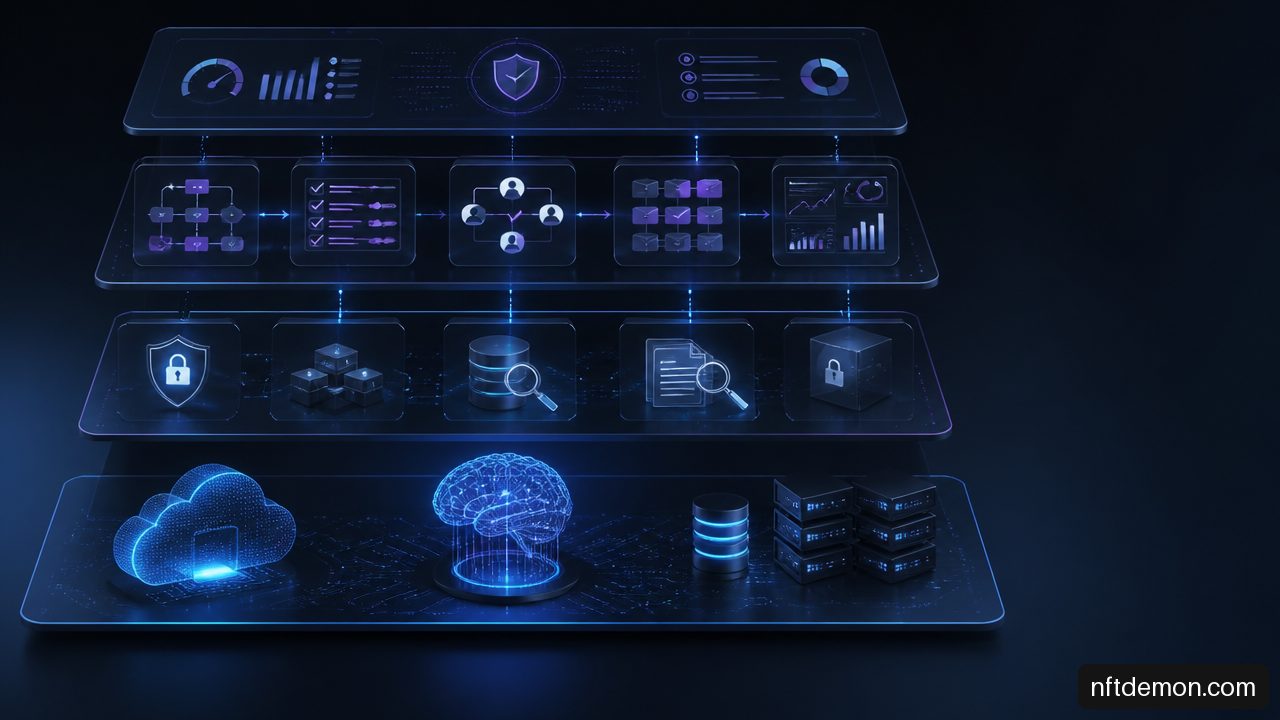
The most practical answer is often hybrid. Buy components that are commodities or require large-scale infrastructure, then build the domain-specific layer where your business rules and data matter.
A hybrid architecture may buy cloud infrastructure, model access, orchestration components, and security tooling while retaining ownership of the organization-specific application layer. Insight Global’s explanation of hybrid AI implementation describes this division between purchased foundations and custom organizational functionality.
What To Buy And What To Build
| Capability | Typical Decision | Why |
|---|---|---|
| Foundation model access | Buy or deploy an existing model | Training from scratch is rarely necessary for a business workflow |
| Cloud compute and observability | Buy | Mature infrastructure reduces operational burden |
| Identity and access management | Buy or extend existing enterprise tools | Centralized controls are usually preferable |
| Proprietary retrieval layer | Build | It should enforce your permissions, source selection, and data boundaries |
| Business rules and approvals | Build | These encode the process that creates value and controls risk |
| Evaluation harness | Build or adapt internally | Quality must be measured against your real work |
| User interface | Configure or build selectively | Choose based on user workflow and adoption needs |
Retrieval-augmented generation is a common example. Instead of training a model on company data, the application retrieves relevant, permission-checked records at the time of a request and provides them as context. This can improve domain relevance while allowing source citations, access controls, and faster updates. It does not solve every problem, however. Poor source data, weak retrieval, or unclear policies will still produce weak outcomes.
For technical teams considering decentralized applications, Machine learning for scalability offers a useful adjacent principle: scale planning should connect model behavior to the actual constraints of the system, including throughput, latency, operational safety, and cost.
Run A Proof Of Value Before A Full Build
A proof of concept proves that a model can produce plausible output. A proof of value proves that the complete workflow produces business value under realistic conditions. Decision makers should fund the latter.
A strong proof of value has four stages:
Discover: Map the workflow, data sources, decision points, exceptions, risk boundaries, and measurable outcomes.
Compare: Test at least one purchased option against a narrowly scoped custom path using the same evaluation cases.
Pilot: Deploy with limited users, human review, monitoring, and rollback procedures.
Decide: Scale, redesign, buy, build, or stop based on measured quality, adoption, economics, and risk.
The stop option matters. If the use case cannot demonstrate value or cannot safely meet its threshold, stopping is better governance than expanding a weak implementation because a budget was approved.
Key Takeaways
Build bespoke AI when the AI-enabled workflow is a strategic asset, purchased products fail measurable quality or integration requirements, and the organization can operate the system for years rather than merely launch it.
• Buy when the use case is common, the vendor meets requirements, deployment speed matters, and your team does not need to own the differentiating layer.
• Separate building an application from training a foundation model. Most companies need the former, not the latter.
• Evaluate purchased software with realistic cases, explicit failure thresholds, and exception handling costs.
• Include residual manual work, portability, monitoring, security, and maintenance in total cost of ownership.
• Prefer a hybrid approach when foundational technology is commoditized but the workflow, data controls, business rules, or integrations are unique.
Frequently Asked Questions
When Should A Company Build A Bespoke AI System Instead Of Buying Software?
Build when the AI system must execute a differentiated workflow, use proprietary data under strict controls, integrate deeply with systems of record, or meet accuracy and governance thresholds that a purchased product cannot satisfy. Do not build merely because a vendor interface is imperfect. First determine whether the gap affects value, risk, or operational viability.
What AI Use Cases Are Poor Candidates For Custom Development?
Common, low-risk functions are usually poor candidates: meeting summaries, basic document drafting, standard knowledge search, routine customer-service triage, and general productivity assistance. If a mature product meets the need with acceptable security and integration, custom ownership may add cost without creating advantage.
How Much Customization Justifies Building?
Customization justifies building when it changes the core workflow rather than the interface. Warning signs include repeated manual workarounds, inability to enforce approval rules, missing system write-backs, unusable permissions, or domain errors that remain unacceptable after reasonable configuration. A customized dashboard alone is rarely enough.
Is Building An AI Application Different From Training A Model From Scratch?
Yes. Building an AI application can mean connecting an existing foundation model to proprietary data, tools, policies, and interfaces. Training a model from scratch requires far more data, compute, expertise, and operational maturity. Most organizations should first assess retrieval, fine-tuning where appropriate, workflow logic, and evaluation before considering model training.
How Should We Calculate Total Cost Of Ownership?
Compare three to five years of implementation, subscriptions or inference, integrations, security, training, administration, evaluation, maintenance, support, and exit costs. For purchased software, include residual manual work. For bespoke systems, include monitoring, incident response, regression testing, and modernization. Then compare those costs with expected business value and downside risk.
What Internal Roles Are Needed To Operate Bespoke AI?
At minimum, assign accountable owners for product decisions, engineering, data quality, security, user support, and model or workflow evaluation. Highly regulated or high-impact uses may also require legal, compliance, risk, and audit participation. The exact team can be small, but the responsibilities cannot be absent.
When Does Data Residency Make Buying Impractical?
Buying becomes impractical when a vendor cannot meet a mandatory requirement for where data is processed or stored, who can access it, how it is retained, or whether it may be used for service improvement. Validate the full data flow, including logs and support operations, before assuming a contractual statement resolves the issue.
What Should A Proof Of Value Include Before We Commit To A Build?
Include realistic data, a defined user group, representative edge cases, an evaluation rubric, human-review rules, system integrations, security boundaries, a rollback plan, and measurable business outcomes. The pilot should answer whether the system works in the actual process, not simply whether a model can generate impressive text.
Sources And References
getwidget.dev — https://www.getwidget.dev/blog/custom-ai-development-vs-off-shelf/
insightglobal.com — https://insightglobal.com/blog/custom-ai-or-off-the-shelf/
NFT Demon Holdings helps enterprises scope, evaluate, and build blockchain programs — start with a free evaluation call.
Talk through your use case
Free evaluation call — objective, constraints, and fit, before any proposal.