Machine learning for dApps scalability, a practical framework
By Jeremy Ryan, Founder & CEO · October 2026
Machine learning for dApp scalability is most useful when it improves a clearly identified bottleneck: transaction routing, congestion forecasting, resource allocation, fraud filtering, or operational decision-making. It does not replace Layer 2 solutions, better smart-contract design, or a sound consensus mechanism. It helps those systems make better decisions under changing network conditions.

The central decision is simple: keep blockchain state transitions deterministic and verifiable, while using machine learning where predictions can reduce waste, waiting time, or unnecessary execution. For most production dApps, that means hybrid architectures rather than putting a large model directly on-chain.
• Identify The Bottleneck Before Adding ML
• Choose The Right ML Execution Architecture
• Apply Predictive Models To Throughput And Latency
• Build A Safe And Measurable ML-Enabled dApp
Identify The Bottleneck Before Adding ML
A dApp can be slow or expensive for very different reasons. Treating scalability as one throughput number leads teams to apply prediction models where architecture changes are actually required. I recommend separating the problem into five bottleneck classes before selecting a model.
| Bottleneck | What Constrains The dApp | Where ML Can Help | Where ML Will Not Help |
|---|---|---|---|
| Execution | Smart-contract computation, storage writes, virtual-machine limits | Pre-screening, batching decisions, transaction ordering policies | Reducing deterministic execution cost by itself |
| Data Availability | Publishing, retrieving, and validating transaction data | Forecasting posting windows and batch sizes | Creating data availability capacity |
| Consensus | Block production, finality, validator coordination | Detecting anomalies and forecasting load | Safely bypassing consensus rules |
| Networking | Peer propagation, mempool visibility, RPC performance | Route selection and provider load balancing | Fixing a poorly connected node network |
| ML Serving | Inference latency, model availability, proof generation | Caching, model selection, confidence calibration | Making an oversized model inexpensive |
Separate Execution Scalability From Prediction Scalability
Execution scalability asks whether the chain or rollup can process state transitions. Prediction scalability asks whether a model can produce a useful recommendation quickly enough to affect those transitions. They are related, but they are not the same engineering task.
Consider a wallet flow that chooses between several rollups. An ML model may predict that one rollup has lower expected confirmation time over the next few minutes. That can improve user experience without changing any rollup’s underlying throughput. If every destination is congested, however, routing intelligence cannot manufacture blockspace. The system still needs queue controls, fee policies, and user-facing expectations.
This distinction also applies to model training. Training a congestion model may require large historical datasets, feature pipelines, and periodic retraining. Serving that trained model for each transaction may take milliseconds off-chain. Training scalability is mainly about data volume, compute, coordination, and update cadence. Inference scalability is about availability, tail latency, cost per request, and verification.
Map The Transaction Journey
A useful diagnostic starts with the path a transaction follows, rather than with the model type. Measure the stages where users actually wait.
- Intent creation: The user or application constructs a transaction.
- Simulation and pricing: The system estimates gas, checks balances, and identifies likely execution outcomes.
- Submission: A wallet, relayer, or backend sends the transaction through an RPC provider or sequencer.
- Propagation and inclusion: The transaction reaches a mempool, sequencer, or block producer.
- Execution and finality: Smart contracts execute, state changes settle, and the application recognizes confirmation.
For each stage, capture median and p95 latency, error rate, retry rate, gas paid, gas wasted, and the rate of reverted transactions. A p95 measure matters because users remember the slowest reasonable experiences, not the average.
The broader blockchain scalability architecture for high throughput consumer applications should be designed first. ML becomes valuable when it is connected to these measured constraints rather than treated as a generic optimization layer.
Do Not Confuse Better Decisions With More Capacity
A simulated blockchain and ML smart-grid study reported a 33% reduction in processing time and a 20% reduction in energy consumption compared with its baseline configuration. Those results are useful signals, not universal performance guarantees. The same study indicated that further optimization was needed at larger node counts.
That caveat is important. A model can reduce avoidable work, but peer communication, proof verification, storage replication, and consensus overhead can rise as the network grows. The right question is not, “Can ML improve scalability?” It is, “Which measurable source of waste can this model remove without adding more coordination cost than it saves?”
Choose The Right ML Execution Architecture
The architecture determines whether a model strengthens a dApp’s operational performance or becomes an expensive dependency. The choice should follow requirements for trust, latency, privacy, model complexity, and gas budget.
Compare On-Chain, Off-Chain, Federated, And Decentralized Designs
| Architecture | Best Fit | Primary Benefit | Primary Constraint |
|---|---|---|---|
| On-chain inference | Small deterministic models with high verification needs | Native transparency and deterministic execution | Gas cost and limited compute |
| Off-chain inference | Routing, forecasting, ranking, and complex models | Fast, low-cost serving | Requires attestation, proofs, or trusted operators |
| Federated learning | Private data held by known participants | Data stays local while updates are aggregated | Aggregator dependence and update coordination |
| Decentralized learning | Peer networks that cannot rely on one coordinator | Removes a dedicated parameter server | Gossip overhead, heterogeneous nodes, and poisoning risk |
On-chain inference is appropriate only when the model is compact, inference is infrequent, and the result must directly control a high-value on-chain state transition. A simple fixed decision tree or constrained scoring function may be feasible. A large neural model called for every swap, game action, or marketplace event usually is not.
Off-chain inference is the practical default for network health prediction. The model can observe mempool conditions, base fees, sequencer performance, RPC latency, and recent block utilization. It returns a recommendation such as a fee range, route, batch size, or delay window. The smart contract should then enforce deterministic boundaries around that recommendation.
For example, a routing service may propose Rollup A. The user or contract can still enforce maximum fees, approved bridge routes, slippage limits, and expiry conditions. The model recommends; deterministic logic decides what is permissible.
Make Off-Chain Results Verifiable Enough
Verifiability is a spectrum, not a binary switch. A dApp does not always need cryptographic proof that every prediction was optimal. It may need proof that an authorized model version generated a result, that its input data was fresh, or that the recommendation remained inside contract-defined constraints.
Common controls include:
• Signed attestations that bind a prediction to a model version, timestamp, input hash, and serving identity.
• Commitment schemes that record the model artifact or configuration before results are used.
• Optimistic challenge windows for outcomes that can be disputed economically.
• Zero-knowledge or verifiable computation proofs where a high-value result must be validated without rerunning the full model on-chain.
Proof systems can reduce trust assumptions, but they add proving time, engineering complexity, and verification expense. There is no broadly accepted, dApp-wide benchmark for proof generation cost across model sizes and chains. Teams should measure it with their actual circuit, hardware, transaction frequency, and finality requirements.
Practical rule: If a prediction changes user experience but not asset custody or settlement validity, signed and auditable off-chain serving may be sufficient. If it authorizes irreversible transfer logic, stronger verification and a deterministic fallback are usually warranted.
When Federated Or Decentralized Learning Is Justified
Federated learning lets participants train locally and send updates to an aggregator. It works best when participants are identifiable organizations, the data is sensitive, and a governed coordinator is acceptable. Think of a consortium where each member contributes network telemetry but cannot share raw logs.
Decentralized learning removes the dedicated parameter server and aggregates through neighboring peers. Research on decentralized learning identifies neighbor degree as an important variable: more neighbors can improve information flow but also increase communication and aggregation cost. Gossip-style methods preserve local data while exchanging model information among peers, yet network-size limits and uneven hardware remain real constraints.
Choose decentralized learning when removing a central coordinator is a genuine product requirement. Avoid it when a reliable aggregator is acceptable and faster convergence, auditability, and operating simplicity matter more than full peer-to-peer coordination.
Apply Predictive Models To Throughput And Latency
Machine learning can help a dApp use available capacity more intelligently. Its strongest near-term use cases are predictive and operational, not autonomous changes to consensus rules.
Predict Congestion, Gas, And Confirmation Time
A congestion model can use recent block utilization, priority fees, transaction arrival rates, mempool depth where available, sequencer status, time patterns, and RPC response times. Its output should be probabilistic: for example, an estimated confirmation-time range at several fee levels.
That is better than presenting a single “correct” gas price. Blockchain conditions can change between prediction and submission. A robust user experience might offer three options:
• Economy: lower fee with a wider expected confirmation window.
• Standard: balanced fee and expected confirmation range.
• Priority: higher fee with an explicit maximum spend limit.
The dApp should show uncertainty when confidence is low. A model trained during ordinary activity may fail during an NFT mint, liquidation cascade, bridge outage, or sudden market event. Distribution shift is not an edge case in public networks. It is a normal operating condition.
Route Transactions Across Chains And Rollups
Transaction routing models can rank destinations using expected fee, expected confirmation time, bridge availability, liquidity depth, failure probability, and policy constraints. This is especially useful when a dApp can settle the same action through multiple compatible networks.
A routing decision should never optimize only for the lowest advertised gas cost. A cheaper route can be worse if the bridge is delayed, liquidity is thin, finality is slower, or the user must make several follow-up transactions. The objective function should include total expected cost and completion probability.
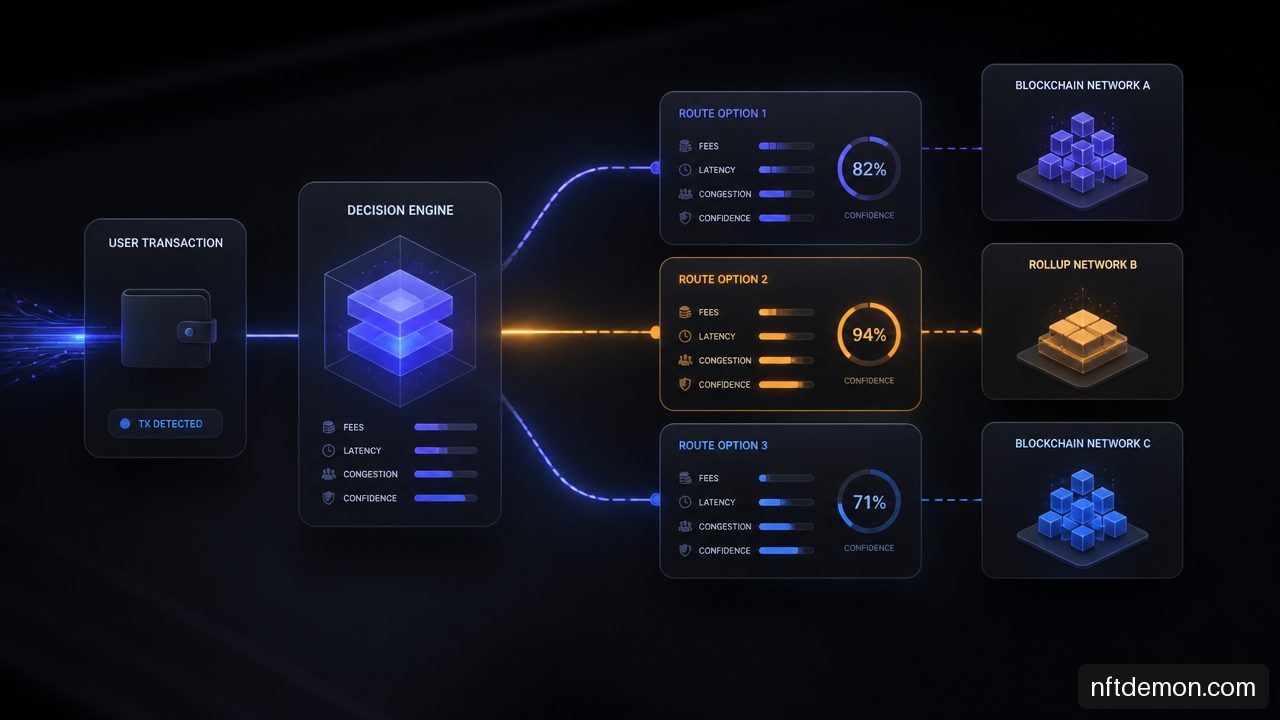
For a consumer dApp, the routing policy can be expressed as:
Expected total cost = network fee + bridge cost + expected retry cost + delay cost + failure risk adjustment.
The model estimates uncertain variables; the product team defines the risk tolerance. A treasury transfer may prefer predictable finality over a marginal fee saving. A gaming action may prefer the fastest available route within a strict cost cap.
Use ML To Protect Capacity, Not Just Spend It
Fraud detection and threat intelligence can preserve capacity by filtering abusive automation, suspicious relayer requests, Sybil behavior, and likely revert patterns before they consume scarce resources. This must be handled carefully. A false positive that blocks a legitimate transaction can be as damaging as a missed malicious one.
Models used for pre-execution screening should produce risk tiers, not opaque final judgments. Low-risk requests can proceed automatically, medium-risk activity can face rate limits or additional checks, and high-risk events can require deterministic safeguards. The related work on training custom ML models for Web3 threat detection is relevant because security and scalability overlap when abusive traffic competes with legitimate users for execution and RPC capacity.
Consensus Assistance Has Strict Boundaries
ML can forecast validator performance, detect anomalous block propagation, estimate likely congestion, and help operators allocate infrastructure. It should not silently determine consensus validity, leader selection, or finality rules unless the protocol can make those decisions deterministic, auditable, and resistant to manipulation.
Why the caution? An attacker may manipulate model inputs through transaction spam, Sybil identities, oracle data, or poisoned training updates. If a model’s recommendation directly affects ordering or access to capacity, the model itself becomes part of the attack surface. Consensus remains a rules-based security system. ML can inform operations around it, but replacing deterministic protocol guarantees with a black-box prediction is a poor trade.
Build A Safe And Measurable ML-Enabled dApp
A production design needs more than a model endpoint. It needs a measurable baseline, constrained decision rights, adversarial testing, and a deterministic way to operate when the model is wrong.
Establish A Benchmark Before Deployment
Measure the non-ML baseline first, then run controlled comparisons. A credible benchmark needs both blockchain and ML metrics.
| Category | Metrics To Track | Why It Matters |
|---|---|---|
| User Experience | Median and p95 completion time, failed-action rate, retries | Reveals whether users actually experience improvement |
| Blockchain Cost | Gas per completed action, revert cost, bridge and relayer fees | Prevents cheap predictions from creating expensive transactions |
| Model Quality | Accuracy, calibration, drift rate, abstention rate | Shows whether the prediction is trustworthy under live conditions |
| Serving Reliability | Inference p95 latency, uptime, stale-response rate | Prevents the ML layer from becoming a new bottleneck |
| Decentralization | Number of serving entities, update concentration, peer traffic | Exposes hidden centralization and coordination costs |
Run experiments across normal load, sustained congestion, partial RPC failure, and adversarial traffic. A model that performs well only during calm conditions does not solve a scalability problem; it documents one.
Design Fallbacks Before The First Prediction
Every ML-assisted action needs a deterministic fallback policy. The fallback should be simpler than the ML path and should not depend on the same data feed or service.
- Set freshness limits. Reject predictions older than a defined threshold.
- Define confidence thresholds. If confidence is too low, abstain rather than guess.
- Use rule-based defaults. Fall back to conservative gas estimates, fixed approved routes, or queue-based rate limits.
- Preserve user agency. Let users choose a manual route or fee option when the model abstains.
- Record decisions. Log model version, inputs, output, confidence, and fallback reason for audit and retraining.
A clear example: if a routing model cannot reach its serving endpoint, the dApp should select a preapproved default rollup or ask the user to choose. It should not repeatedly retry several bridges because an unavailable model left the orchestration layer undecided.
Defend Against Poisoning And Manipulation
Decentralized learning introduces security issues that standard dApp monitoring may miss. A Sybil attacker can create many identities to influence aggregation. A poisoning attacker can submit updates designed to bias a congestion model, weaken fraud detection, or push routing decisions toward a favored venue.
Mitigations should combine protocol and ML controls:
• Identity, stake, reputation, or admission requirements that make mass Sybil participation costly.
• Robust aggregation techniques that reduce the influence of extreme or inconsistent updates.
• Update validation against holdout tests and known-safe behavioral constraints.
• Rate limits and anomaly detection for model-update traffic.
• Independent evaluation data so a coordinated group cannot define its own success metric.
These safeguards support the same principles covered in enterprise blockchain architecture security scalability: availability, integrity, operational controls, and scalability must be designed together.
Key Takeaways
• Machine learning for dApp scalability works best as a decision layer, not a substitute for execution capacity, Layer 2 design, or deterministic consensus.
• Start with a bottleneck taxonomy. Execution, data availability, consensus, networking, and ML serving fail differently and require different interventions.
• Off-chain inference is usually the practical default for gas prediction, transaction routing, congestion forecasting, and operational resource allocation.
• On-chain inference should remain narrow and deliberate. Use it when direct verifiability outweighs the cost of limited computation and gas.
• Training and inference require separate scaling plans. Distributed training may protect data or remove a parameter server, but it also adds communication and governance overhead.
• Benchmark p95 latency, gas per completed transaction, model calibration, serving reliability, and decentralization overhead together. A single throughput number is not enough.
• Fallback policies are mandatory. A stale, unavailable, or low-confidence model must yield to deterministic rules rather than stall critical dApp flows.
Frequently Asked Questions
What Does Machine Learning For dApp Scalability Actually Mean?
It means using predictive or classification models to reduce avoidable delay, cost, or failed work in a decentralized application. Common examples include gas estimation, congestion forecasting, transaction routing, relayer load balancing, fraud filtering, and resource allocation. It does not mean that ML automatically increases a blockchain’s base transaction capacity.
Should ML Inference Run On-Chain Or Off-Chain?
Use off-chain inference for most complex or frequent predictions because it is faster and less expensive. Use on-chain inference only for compact models where deterministic, native execution is essential. For sensitive off-chain decisions, add attestations, commitments, proof systems, or contract-enforced bounds based on the value at risk.
Can ML Increase Transaction Throughput Without Changing Consensus?
It can improve effective throughput by reducing reverts, routing transactions to less congested venues, batching work intelligently, and filtering abusive traffic. It cannot raise the physical execution or data-availability limits of a chain without changes to the underlying protocol or scaling architecture.
How Can A dApp Predict Gas Prices Or Congestion?
A model can analyze recent block utilization, fee trends, transaction arrival rate, mempool indicators, sequencer health, and time-based patterns. The output should be a range with confidence levels, not a guaranteed fee. During abnormal events, the dApp should widen uncertainty or switch to conservative rule-based estimates.
When Is Federated Learning Better Than Decentralized Learning?
Federated learning is better when participants trust a governed aggregator and need a simpler audit trail. Decentralized learning is better when a central parameter server is unacceptable and peers can tolerate gossip coordination. The trade-off is that peer-to-peer aggregation can increase network traffic and make update quality harder to govern.
How Can A dApp Verify An Off-Chain Model Result?
The dApp can verify the serving party’s signature, model version, timestamp, input commitment, and contract-defined output limits. Higher-value actions may justify optimistic disputes or cryptographic proofs. The correct mechanism depends on whether the model merely recommends a route or authorizes an irreversible asset movement.
What Happens When The Model Is Wrong Or Unavailable?
The dApp should abstain when predictions are stale or low confidence, then apply a deterministic fallback. Examples include conservative gas parameters, a preapproved default network, manual user selection, or temporary rate limits. Logging each fallback event also provides evidence for retraining and incident review.
Can Decentralized ML Create New Scalability Problems?
Yes. Distributed training can increase communication overhead, especially when many peers exchange frequent model updates. Heterogeneous devices, inconsistent data, neighbor topology, Sybil identities, and poisoned updates can also reduce performance. Decentralization is not free; it moves cost from a central server into coordination, replication, and security controls.
NFT Demon Holdings helps enterprises scope, evaluate, and build blockchain programs — start with a free evaluation call.
Talk through your use case
Free evaluation call — objective, constraints, and fit, before any proposal.