AI powered AML compliance tools for decentralized exchanges
By Jeremy Ryan, Founder & CEO · September 2026
AI-powered anti-money laundering AML compliance tools for decentralized exchanges help compliance teams identify risky wallet behavior without pretending that a non-custodial protocol can operate like a bank. The practical objective is not to watch every transaction after the fact. It is to make defensible decisions before, during, and after a swap while preserving an evidence trail for investigators, auditors, and regulators.

For decision makers, the central question is straightforward: where can a DEX apply a compliance decision when it does not control customer assets? The answer usually spans the front end, smart-contract interaction layer, analytics pipeline, and investigation workflow. AI can strengthen each layer, but it does not eliminate policy design, human judgment, or the limits of on-chain attribution.
Key Takeaways
The Decision Framework
AI-powered AML systems are most useful when they support a defined operational decision, not when they simply produce a mysterious risk score. A DEX should decide which events justify a block, a warning, enhanced review, or continued monitoring before integrating a model.
The Practical Position
• Screen wallets before interaction when sanctions exposure or known illicit-fund links create a clear policy basis for intervention.
• Monitor transaction sequences over time when the concern is behavioral, such as rapid asset hopping, repeated bridge use, or coordinated wash trading.
• Use protocol controls selectively because immutable smart-contract restrictions can be difficult to correct if attribution data changes or a model produces an error.
• Keep a human review path for high-impact decisions, especially where a score depends on probabilistic clustering rather than a confirmed sanctions designation.
• Measure precision, recall, alert volume, review time, and evidence completeness instead of accepting vendor claims about fewer false positives at face value.
Designing AML Controls For Non-Custodial DEX Flows
Start With The Actual Control Surface
A decentralized exchange generally does not hold a customer balance in the conventional custodial sense. Users sign transactions with their own wallets, and smart contracts execute swaps. That changes what an AML program can realistically do.
I would separate controls into three layers:
| Control Layer | What It Can Do | Best Use Case | Main Limitation |
|---|---|---|---|
| Front end | Screen connecting wallets, display warnings, restrict access to hosted interfaces | Sanctions and high-confidence wallet risk | Users may interact directly with contracts or alternative interfaces |
| Smart contract | Enforce allowlists, deny lists, transfer restrictions, or risk-gated functions | Permissioned pools and regulated products | Rules can be rigid, expensive to update, and difficult to reverse |
| Monitoring and investigations | Trace flows, create alerts, document cases, support reporting decisions | Behavior that emerges across transactions and chains | It is usually reactive rather than preventive |
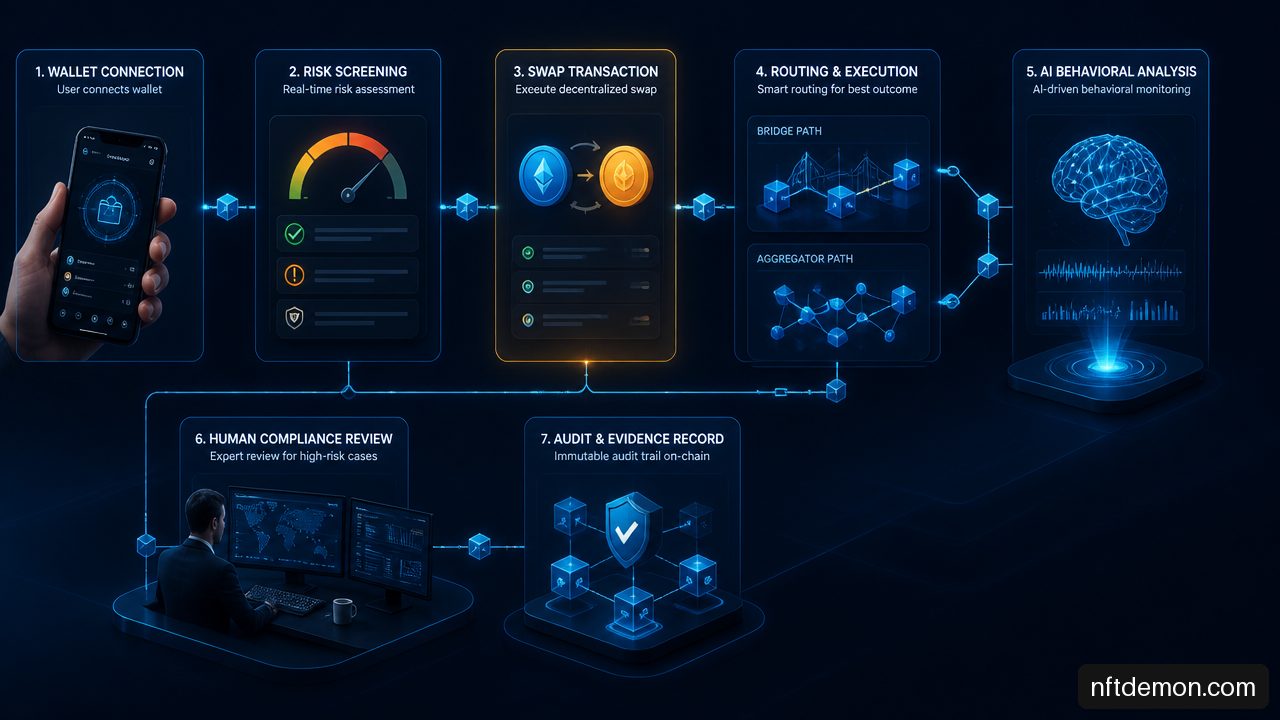
The hosted front end is often the most practical first control point. A user connects a wallet, the application requests a current risk assessment, and the interface decides whether to permit routing, present a warning, or refer the event to compliance review. This does not make the underlying protocol fully compliant by itself. It does establish a visible, controllable service layer where the organization can apply its policy.
Defy, for example, describes AI-powered AML compliance with instant wallet screening and multi-chain support for centralized and decentralized exchanges. That capability matters because a DEX decision often begins with an address, not an account profile. Still, instant screening should mean a bounded technical process: retrieve current risk signals, evaluate policy rules, store the result, and return a decision within the user’s transaction window. It should not be confused with proving that every associated person or entity has been identified.
Treat Wallet Screening And Monitoring As Different Jobs
Wallet screening asks, “What is known or inferred about this address right now?” It may combine sanctions data, exposure to labeled illicit services, direct transaction history, and address clustering. Transaction monitoring asks, “What is happening across this sequence of actions?” Those are related but distinct tasks.
Consider a wallet with no historic risk label that deposits funds from a bridge, executes several swaps through an aggregator, exits to a second bridge, and repeats the sequence across chains in a short period. Static screening may not flag that address. Behavioral monitoring could identify the pattern as a possible layering sequence and create an alert.
DEX-specific monitoring should prioritize activity where risk can compound quickly:
• Rapid pool hopping across multiple assets or protocols
• Repeated swaps that fragment a balance into many smaller amounts
• Bridge transfers immediately followed by swaps and withdrawals
• Use of aggregators that obscure the final liquidity source or destination
• Interactions with addresses linked to mixers, exploit proceeds, or known fraud typologies
• Apparent wash trading, bot coordination, or circular liquidity movement
The appropriate response depends on confidence and potential harm. A confirmed sanctions match may justify immediate access restriction at the hosted interface. A weaker behavioral anomaly may merit a warning, an alert, and enhanced review instead. Treating both signals as equal is how compliance systems either over-block legitimate users or miss urgent exposure.
Embed Controls Carefully In Smart Contracts
Smart contracts can automate parts of AML decision making, including checks tied to permissions, transaction limits, allowlists, and risk conditions. An NYU Stern paper on KYC and AML technologies in decentralized finance describes how smart contracts can automate KYC/AML procedures and risk assessment in DeFi.
That design is best suited to products where participation rules are deliberate: institutional pools, tokenized assets, regulated liquidity venues, or private credit structures. It is less suitable for a broadly permissionless automated market maker where a permanent deny list could be bypassed through direct contract calls, wallet rotation, or third-party routing.
A sensible architecture keeps the model off-chain and the final enforcement rule narrow. For example, an oracle or attestation service can publish a signed eligibility result rather than forcing the contract to interpret every transaction graph. The contract then verifies the attestation and allows access only for the period and function specified. This reduces on-chain complexity, but it creates new dependencies: oracle availability, key management, update procedures, and dispute handling.
For broader product and governance planning, enterprise blockchain strategy consulting compliance should be evaluated alongside AML tooling. The policy question is larger than whether a model can score an address. It is whether the organization can explain why its controls exist, who maintains them, and how exceptions are handled.
How AI Changes Transaction Monitoring And Triage
AI Finds Sequences That Fixed Rules Miss
Rules remain necessary. A rule can flag a direct interaction with a sanctioned address or a transfer exceeding a policy threshold. AI adds value where the signal is distributed across time, protocols, wallets, and chains.
A machine-learning model may score features such as transaction timing, swap frequency, wallet age, graph proximity to risky entities, bridge usage, token path diversity, liquidity pool changes, and counterparty concentration. An anomaly model can identify behavior that deviates from a wallet’s prior activity or from comparable wallets. Graph analytics can look for clusters and fund-flow relationships that are difficult to see in a flat transaction table.
The result should not be “the algorithm says no.” A useful alert should explain the contributing evidence in operational language: funds arrived from a high-risk cluster, crossed two bridges within one hour, used an aggregator for multiple swaps, and reached an address with prior exposure to a mixer. That is a reviewable narrative, not merely a number.
Crystal Intelligence positions evidence-backed compliance and real-time sanctions-risk screening for digital assets as a decision-intelligence workflow. That framing is sound. A risk score without provenance is weak evidence. A score linked to source transactions, address relationships, timestamps, rule versions, and analyst decisions is far more useful in an investigation.
Define “Real Time” Before Buying A Tool
“Real time” is often too vague for procurement. A DEX has different decision windows depending on the control point:
| Decision Window | Typical Event | Practical Requirement |
|---|---|---|
| Pre-connection | Wallet connects to a hosted interface | Fast screening before routes or quotes are exposed |
| Pre-signature | User prepares a swap transaction | Risk response before the user signs and broadcasts |
| Mempool or confirmation stage | Transaction is broadcast or confirmed | Monitoring and alert creation, with limited preventive options |
| Post-trade | Pattern emerges across multiple actions | Investigation, reporting assessment, and risk refresh |
A front-end screening service does not need to reconstruct every cross-chain transaction path during a single page load. It needs a reliable, policy-ready answer in a short enough time to avoid disrupting a legitimate transaction. Deep tracing can continue asynchronously after the swap, updating the case if new risk signals emerge.
Fair warning: public evidence is limited on DEX-specific latency, precision, recall, and false-positive rates. A vendor may claim real-time detection, but decision makers should request a test against representative transaction data and ask what the clock starts and stops on. Is the stated time from transaction broadcast to alert? From wallet connection to decision? From a new sanctions update to enforcement? Those are not interchangeable metrics.
Cross-Chain Analytics Has Hard Boundaries
Cross-chain tracing is essential because laundering activity can move through bridges, wrapped assets, aggregators, and multiple DEXs. Yet it is not magic. Attribution can weaken when bridge deposits and withdrawals are pooled, when assets are wrapped or rebased, when routes split, or when an entity rotates wallets across chains.
A useful control design records confidence separately from risk. For instance, a system may have high confidence that a wallet received funds from a particular bridge contract but only medium confidence that the withdrawal on another chain belongs to the same economic actor. If policy treats both observations as certain, the organization may overreact. If it ignores the connection entirely, it may miss material exposure.
This is also why a single “multi-chain supported” label is insufficient. Ask whether the tool tracks direct bridge links, probabilistic relationships, token wrapping, aggregator routes, and coverage gaps by chain. The choice of infrastructure matters as much as the choice of analytics provider. Teams considering blockchain platform selection for financial institutions should include data availability, finality, smart-contract observability, and bridge dependence in their risk criteria.
Governance, Measurement, And Deployment Decisions
Build An Evidence Trail, Not Just An Alert Queue
An AML alert should create a reproducible record. If a regulator, auditor, or internal investigator asks why an address was flagged, the team should be able to reconstruct the decision using the inputs available at that time.
A case file should capture at least:
• Wallet addresses, transaction hashes, chains, assets, and timestamps
• The risk signals and typologies that triggered the alert
• Relevant transaction-graph paths and attribution confidence levels
• Sanctions or watchlist data versions used in the decision
• Model version, feature set, threshold, and rule configuration
• Analyst notes, escalation actions, approvals, and final disposition
• Any access restriction, warning, or monitoring action applied by the platform
This is where many implementations fail. They collect scores but not the supporting graph evidence. Or they retain the alert but not the model version that created it. That makes later review harder, especially after data labels change or an external provider updates its clustering logic.
Measure Effectiveness With Operational Metrics
False-positive reduction is valuable only if it does not create unacceptable blind spots. I recommend measuring the full decision chain rather than one attractive metric.
| Metric | What It Shows | Warning Sign |
|---|---|---|
| Precision | Share of reviewed alerts that are genuinely useful | High volume of low-value alerts |
| Recall | Share of known suspicious events captured | Quiet alert queue despite known incidents |
| Alert-to-case rate | Whether alerts contain enough evidence for investigation | Analysts close most alerts immediately |
| Review time | Operational burden on compliance staff | Backlogs that outlast the risk window |
| Override rate | Whether human analysts frequently reject model decisions | Poor calibration or unclear policy thresholds |
| Evidence completeness | Whether cases can be reconstructed later | Missing transaction paths or decision metadata |
A pilot should include historical replay and live shadow mode. In replay, the tool processes prior transactions where outcomes are known or reasonably labeled. In shadow mode, it runs beside existing controls without automatically blocking users. Compare what each system catches, what it misses, and how many analyst hours it consumes.
Avoid a full automated block policy until the organization has enough evidence to set thresholds responsibly. A model that identifies subtle laundering signals may be valuable for prioritizing review but unsuitable as the sole basis for denying access. Conversely, a deterministic sanctions match may support an immediate front-end restriction if the legal and policy basis is clear.
Choose A Deployment Pattern That Matches Your Product
The right architecture depends on whether the DEX is permissionless, hybrid, institutional, or integrated with fiat services. There is no universal best stack.
-
Hosted-interface controls fit public DEXs that need a practical way to screen wallets and shape access without changing immutable core contracts.
-
Permissioned smart-contract controls fit institutional pools, tokenized funds, and products where eligibility is part of the design.
-
Hybrid monitoring with case management fits protocols that cannot reliably prevent every interaction but need to identify, document, and respond to suspicious activity.
-
KYC-linked access systems fit products that already maintain customer relationships, though they introduce privacy, data-protection, and user-friction trade-offs.
Success should be evaluated as a business control, not merely a software deployment. The relevant questions include reduction in analyst workload, time to detect meaningful risk, control coverage by chain, quality of evidence, and avoided operational disruption. These criteria align closely with how executives measure blockchain ROI: the return comes from measurable risk reduction and better decisions, not from deploying AI because it is fashionable.
FAQ
What Is An AI-Powered AML Compliance Tool For A Decentralized Exchange?
It is a system that combines blockchain analytics, wallet screening, transaction monitoring, behavioral analysis, and case-management workflows to assess illicit-finance risk around DEX activity. AI is typically used to identify patterns, prioritize alerts, and score risk. It does not replace sanctions data, AML policy, or human investigation.
How Does AML Screening Work On A DEX Without Custody?
Screening usually occurs when a wallet connects to a hosted front end, requests a quote, or prepares a transaction. The platform can screen the address and apply a policy response, such as allowing access, presenting a warning, restricting the interface, or creating an alert. Direct smart-contract interaction may remain technically possible unless the contract itself includes enforcement logic.
Can AI Detect Wallet Laundering Patterns Across Multiple Chains?
It can identify some cross-chain relationships by analyzing bridges, wrapped assets, transaction timing, wallet clusters, and fund-flow paths. Results should include confidence levels because pooled bridges, wallet rotation, aggregators, and incomplete chain coverage can weaken attribution. AI can improve prioritization, but it cannot guarantee complete economic attribution.
What Is The Difference Between Wallet Screening And Transaction Monitoring?
Wallet screening evaluates an address against known or inferred risk signals at a point in time. Transaction monitoring evaluates behavior across a sequence of actions. A wallet may pass screening yet later trigger monitoring because it begins rapid bridge hopping, fragmented swaps, or circular trading activity.
Which AML Controls Can Be Enforced In Smart Contracts?
Smart contracts can enforce allowlists, deny lists, eligibility attestations, transfer limits, function restrictions, and risk-gated access. They work best in controlled or permissioned products. They are less flexible for open protocols because data changes, model errors, and alternate access routes can make permanent restrictions difficult to manage.
How Do AI AML Tools Reduce False Positives In DeFi?
They can combine multiple signals rather than reacting to one rule in isolation. For example, a transaction may receive lower priority if it has a weak proximity signal but no unusual behavior, no adverse wallet history, and no suspicious counterparties. The outcome must be tested through precision, recall, override rates, and analyst review outcomes rather than assumed.
When Should A DEX Block, Warn, Or Monitor A Transaction?
Block or restrict access when there is a high-confidence, policy-defined trigger such as a confirmed sanctions match. Warn when risk is meaningful but uncertain and a user-facing intervention is appropriate. Monitor when the signal is behavioral, developing, or insufficient for immediate action. The policy should specify thresholds, approval authority, escalation routes, and documentation requirements before alerts begin.
Sources And References
Verified External Sources
-
Defy — Blockchain Solutions & Anti-Money Laundering: https://www.getdefy.co/en
-
NYU Stern — KYC/AML Technologies in Decentralized Finance: https://www.stern.nyu.edu/sites/default/files/2024-07/Glucksman_Sak_2024.pdf
-
Crystal Intelligence — Decision Intelligence for Digital Assets: https://crystalintelligence.com/
NFT Demon Holdings helps enterprises scope, evaluate, and build blockchain programs — start with a free evaluation call.
Talk through your use case
Free evaluation call — objective, constraints, and fit, before any proposal.