AI driven network optimization blockchain, a safe operating model
By Jeremy Ryan, Founder & CEO · October 2026
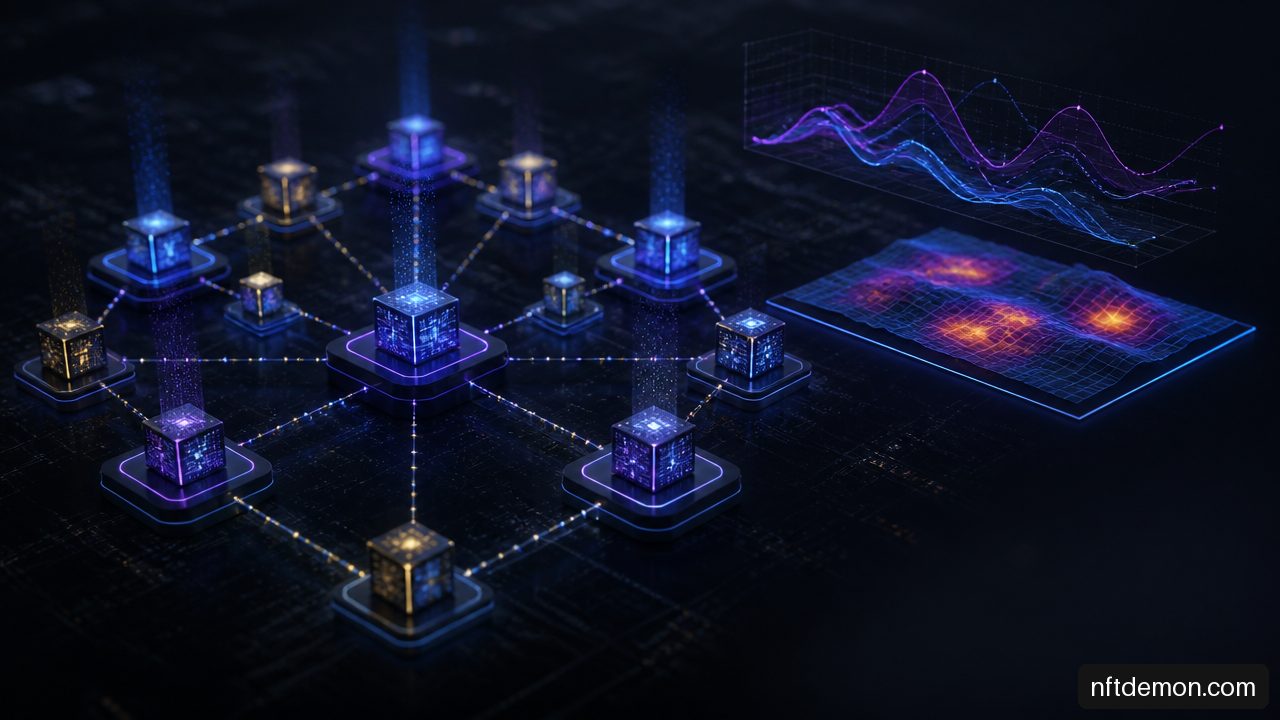
AI driven network optimization blockchain systems use machine learning to forecast network conditions and recommend or automate bounded operational decisions. The value is not that AI magically fixes scalability. The value is that it can turn noisy telemetry into earlier, more precise action: routing transactions before congestion peaks, allocating capacity where demand is moving, or flagging validator and node behavior that deserves review.
For decision makers, the central question is not whether AI can improve throughput or latency. It is whether an optimizer can do so without creating a new concentration point, a manipulable control plane, or an opaque path into consensus behavior. I recommend treating the AI layer as a constrained decision-support and operations system first, then expanding automation only after it proves reliable under production-like stress.
• What AI Optimizes In Blockchain Networks
• Designing The AI Control Plane
• Measuring Performance Without Fooling Yourself
• Deploying A Safe Optimization Program
Key Takeaways
• AI is most credible when it improves an operational decision with measurable inputs and bounded consequences, such as Layer 2 routing, capacity allocation, congestion forecasting, or anomaly triage.
• Consensus-critical decisions should remain deterministic and independently verifiable. An AI model may recommend a change, but protocol authority should be constrained by governance, policy, and hard-coded limits.
• Throughput alone is a weak success metric. I would evaluate end-to-end confirmation time, tail latency, failed transactions, fees, energy use, model overhead, and decentralization indicators together.
• Reinforcement learning, graph neural networks, and generative models address different problems. Combining them without a clear control model creates unnecessary complexity.
• Every AI optimizer needs a safe fallback policy for stale telemetry, model disagreement, distribution shift, node outages, and suspected data poisoning.
The operating principle is simple: use AI to make the network more observable and adaptable, not less accountable.
What AI Optimizes In Blockchain Networks
Start With The Actual Bottleneck
Blockchain performance problems are rarely one-dimensional. A network can have adequate average throughput while users face high fee volatility, delayed inclusion, unreliable cross-domain routing, or overloaded validators during demand spikes. An optimizer should begin by identifying which constraint actually affects the business outcome.
| Network Problem | AI Contribution | Useful Decision Output | When To Avoid Full Automation |
|---|---|---|---|
| Mempool congestion | Short-term demand forecasting | Admission, batching, or routing recommendation | When telemetry is incomplete or easily spoofed |
| Layer 2 capacity imbalance | Predicted sequencer or rollup load | Traffic distribution or capacity reservation | When routing changes create settlement risk |
| Validator performance variation | Behavioral scoring and anomaly detection | Review queue or bounded assignment recommendation | When scores directly remove validators without due process |
| Transaction graph concentration | Graph-based flow analysis | Detect hubs, hotspots, or correlated activity | When labels are weak and false positives are costly |
| Adaptive protocol parameters | Reinforcement learning in simulation | Candidate parameter ranges | When a model can alter consensus rules directly |
Consider a payment application operating across several Layer 2 systems. Static routing may send users to the lowest current fee venue, only for that venue to become congested minutes later. A forecasting model can estimate near-term confirmation delay, fee pressure, and sequencer capacity, then recommend a route based on the user’s actual service objective. For a consumer payment, that might mean confirmation speed. For a treasury transfer, finality and risk controls may matter more than a marginal fee difference.
This is where AI has a practical edge over fixed thresholds. A static alert might trigger when pending transactions exceed a fixed count. A predictive model can account for transaction complexity, time-of-day patterns, validator availability, and recent growth rate. It can estimate that a queue is likely to clear naturally or, alternatively, that it is about to spill into a costly congestion event.
Match The Model To The Decision
Reinforcement learning is appropriate when the system repeatedly selects actions and receives measurable feedback. A routing policy, for example, can be rewarded for reducing confirmation time and cost while penalized for failed settlement, excessive route switching, or concentration on a single provider. Deep Q-networks and proximal policy optimization are often discussed for adaptive resource allocation because they can learn action policies from repeated states and rewards.
Graph neural networks are useful when the relationships matter as much as the individual nodes. Blockchain peer connections, transaction flows, liquidity paths, validator relationships, and cross-chain dependencies can all be represented as graphs. Temporal graph models add the missing ingredient: behavior changes over time. They can help identify whether a current spike resembles routine demand or an unusual pattern developing across connected entities.
Generative models serve a different role. They are especially useful for simulation and testing, not necessarily direct control. The Generative AI-enabled Blockchain Networks research describes how generative models can create blockchain workload patterns for evaluating network resource-allocation strategies. That matters because live blockchain history is not enough to test every failure mode. A model trained only on ordinary conditions may look excellent until a flash mint, liquidation cascade, or memecoin-driven transaction burst changes the workload distribution.
AI Complements Conventional Scaling
AI is not a replacement for sharding, execution optimization, better peer-to-peer networking, Layer 2 systems, or improved database architecture. Those approaches change the system’s structural capacity. AI helps decide how to use available capacity under changing conditions.
| Approach | Primary Function | Strength | Limitation |
|---|---|---|---|
| Static parameter tuning | Sets fixed operating rules | Simple and auditable | Performs poorly when demand shifts quickly |
| Sharding | Splits workload across partitions | Increases parallel capacity | Adds cross-shard coordination complexity |
| Layer 2 scaling | Moves execution or transactions off the base layer | Can reduce base-layer pressure | Introduces sequencing, bridging, and liquidity trade-offs |
| AI optimization | Predicts conditions and selects bounded actions | Adapts to variable workloads | Depends on telemetry quality and safe controls |
The right decision is often additive: use structural scaling to establish capacity, then apply AI where variability causes operational waste. If a network has no credible baseline performance, no reliable telemetry, or unresolved architectural bottlenecks, an AI program is premature.
Designing The AI Control Plane
Keep Learning Off Chain And Authority Deterministic
Most model training and inference should run off chain. On-chain execution is expensive, slow relative to many operational decisions, and difficult to update safely. More importantly, every consensus participant must be able to verify consensus-critical behavior deterministically. A non-deterministic or opaque model cannot quietly become part of the rule set that determines valid blocks.
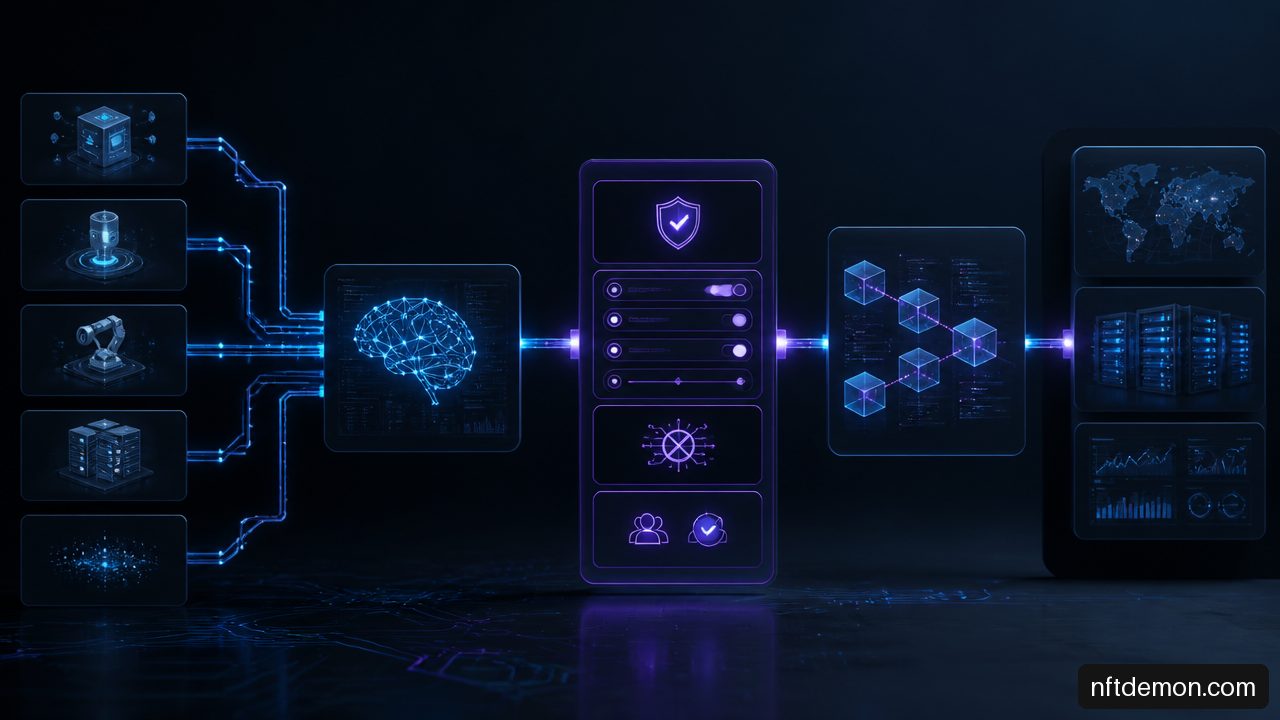
I would separate the system into three layers:
Observation layer: collects signed or authenticated telemetry from nodes, mempools, sequencers, validators, RPC endpoints, and application services.
Intelligence layer: runs forecasts, optimization models, simulations, and anomaly detection outside the consensus path.
Authority layer: applies explicit policy constraints, human approval requirements, smart contract permissions, and deterministic execution rules.
An AI system may forecast that a shard should receive more capacity. The authority layer should still reject any recommendation outside predefined limits. For example, it may cap a change to a small percentage per interval, require multi-party approval above a threshold, and revert automatically if finality delays worsen.
The AI consensus optimization proposal from IJERT discusses adapting validator selection, block size, block interval, and validator count to network conditions. Those are meaningful research directions, but they illustrate why governance boundaries matter. Changing such parameters can affect throughput, hardware requirements, propagation delays, and validator participation at the same time.
Choose Centralized, Federated, Or Distributed Learning Deliberately
A centralized optimizer is easier to operate and audit internally, but it can become a concentration point. Federated learning allows participants to train collaboratively while retaining local data, though it introduces update-validation and coordination challenges. Fully distributed learning can reduce dependence on a central operator but is difficult to keep consistent, efficient, and resistant to adversarial updates.
The IEEE Communications Society’s work on AI-empowered blockchain optimization identifies federated learning and deep reinforcement learning as proposed approaches for collaborative optimization, node allocation, and shard management.
Choose centralized learning when the network is permissioned, data sensitivity is manageable, and an accountable operator already manages service-level objectives. Consider federated learning when several institutions have useful local telemetry but cannot pool raw data. Avoid fully distributed model updates unless the team can validate contributions, manage model versioning, and tolerate additional communication overhead.
Treat Telemetry As An Attack Surface
A model is only as trustworthy as its inputs. Attackers may attempt to inflate congestion signals, manipulate validator-quality indicators, create misleading routing observations, or poison training data. This is not an abstract concern. If the optimizer’s action can move economic value or traffic, its data pipeline becomes a target.
Use signed telemetry, provenance records, anomaly filters, delayed promotion of new models, and independent data sources. A recommendation should become less authoritative when data quality falls. That logic also applies to agent security: teams building automated responders should study securing private key storage for AI agents before allowing an optimizer to sign transactions or invoke operational contracts.
Measuring Performance Without Fooling Yourself
Benchmark The Whole System, Not Just The Model
A reported gain means little without a workload, baseline, hardware profile, test duration, and failure conditions. A model can reduce average latency while worsening the 99th percentile. It can lower observed fees by routing only easy transactions elsewhere. It can improve a simulator while adding enough inference and telemetry overhead to erase the benefit in production.
The IAES hub optimization study combines reinforcement learning, mixed-integer linear programming, and graph neural networks for blockchain hub placement, routing, and congestion management. Its experimental design used Ethereum and Bitcoin datasets. These are useful signals that hybrid optimization can be evaluated against real transaction histories, but they are not proof of universal production performance.
A credible evaluation should record at least the following:
• Network performance: throughput, median and tail confirmation latency, block propagation delay, reorganization rate, failed transactions, and backlog duration.
• Economic outcomes: effective fee paid, fee volatility, routing cost, slippage where relevant, and revenue or cost displacement across network participants.
• AI overhead: inference latency, compute cost, memory use, telemetry bandwidth, retraining frequency, model distribution cost, and energy consumption.
• Security and decentralization: validator concentration, correlated routing behavior, false-positive rates, override frequency, and the effect of bad or missing inputs.
Test Counterfactuals And Failure Behavior
The best baseline is not “no AI” in the abstract. Compare the optimizer with the current static policy, a simple heuristic, an operations team using dashboards, and any existing routing or load-balancing logic. Run the same workload across each approach. Include normal demand, predictable spikes, abrupt shocks, degraded nodes, and adversarially corrupted data.
For example, imagine a congestion forecaster trained on six months of steady activity. A large token event creates transaction behavior unlike anything in its training set. The model confidently routes traffic toward a venue that appears inexpensive but is about to saturate. A robust system detects high prediction uncertainty, freezes automated route changes, reverts to deterministic policy, and alerts an operator. A weak system continues acting on stale confidence until users see failed or delayed transactions.
This is why I would require confidence thresholds and fallback rules before measuring upside. Performance without recovery behavior is not operational readiness.
Build A Reproducible Evaluation Record
Each experiment should preserve model version, feature definitions, data windows, random seeds where applicable, baseline configuration, infrastructure specification, and confidence intervals. Record the cost of data collection and inference separately from chain-level energy use. This allows a technical committee to answer the questions that matter: Did the model improve the network, or did it simply move cost outside the metric boundary?
For high-impact recommendations, add a shadow mode. The model makes recommendations, but the existing control policy remains active. Compare simulated outcomes to actual outcomes over a meaningful period. Only then should bounded automation begin.
Deploying A Safe Optimization Program
A Practical Rollout Sequence
Choose one measurable decision. Start with congestion forecasting, anomaly triage, or advisory routing. Do not begin with autonomous consensus changes.
Define the non-AI baseline. Document current thresholds, routing rules, human interventions, and service objectives before training a model.
Create action boundaries. Specify what the optimizer can recommend, what it can execute, maximum change sizes, cooldown periods, and approval requirements.
Run offline and shadow evaluations. Use historical replay, synthetic workloads, and live shadow mode before any policy reaches production automation.
Automate gradually. Start with reversible, low-impact actions. Expand only when results hold across ordinary and adverse conditions.
Review drift and governance continuously. Retire or retrain models when behavior changes, telemetry degrades, or incentives shift.
Put Circuit Breakers Around Agent Actions
An optimizer that can call smart contracts, rebalance funds, or change service configuration needs more than a confidence score. It needs explicit authority boundaries. Rate limits, spending limits, timelocks, multi-signature approvals, and transaction simulation should be normal controls, not emergency additions.
For smart-contract-connected operations, implementing time-locked circuit breakers for AI agents provides a useful control pattern: allow a proposed action to be inspected and stopped before irreversible execution. For enterprise deployments, permissioning frameworks for AI agents should define which wallets, contracts, transaction types, and value thresholds an agent may access.
Know When Not To Use AI
Avoid AI-driven automation when a deterministic policy already performs adequately, the available data is sparse or untrusted, the cost of a wrong action is irreversible, or governance cannot explain who is accountable for overrides. A smaller model with narrow authority is usually more valuable than a sophisticated autonomous system that nobody can audit.
The strategic opportunity is real, but it is not generic. AI-driven optimization earns its place when it improves a specific network decision, survives adversarial testing, and fails safely when its assumptions break.
Frequently Asked Questions
What Does AI Driven Network Optimization Mean In A Blockchain Context?
It means using machine learning and optimization methods to forecast blockchain network behavior and improve decisions about routing, capacity, congestion, validator operations, or resource allocation. The model should inform or execute only actions that are bounded by deterministic policy.
Can AI Increase Blockchain Throughput Without Changing Consensus?
Sometimes. AI can improve effective throughput by reducing avoidable congestion, routing transactions to available execution environments, batching work, or allocating resources more efficiently. It cannot overcome a hard protocol capacity limit indefinitely. Structural scaling still matters.
How Can Reinforcement Learning Optimize Validator Selection?
A reinforcement-learning policy can evaluate network state and select among permitted validator assignments or resource allocations based on a reward function. The reward must include security and decentralization penalties, not just speed. Otherwise, the model may favor a small set of high-performing validators and increase concentration risk.
How Do Graph Neural Networks Predict Blockchain Congestion?
They model relationships among nodes, transaction flows, hubs, shards, or liquidity paths. A temporal graph model can observe how those relationships change over time and estimate where load is likely to concentrate next. Its usefulness depends on graph quality and the timeliness of data ingestion.
Should The AI Optimizer Run On Chain Or Off Chain?
In most cases, training and inference should run off chain. On-chain components should enforce verifiable policy constraints, store commitments where needed, or execute deterministic outcomes. Keeping model logic off chain reduces cost and preserves the ability to update models without making opaque inference part of consensus.
What Happens When The Model Makes A Bad Prediction?
The system should reduce or suspend automation when confidence is low, data is stale, or monitored outcomes deviate from expected ranges. A safe fallback policy returns operations to a known deterministic rule set and creates an audit event for review.
Can Attackers Manipulate An AI Blockchain Optimizer?
Yes. They may target telemetry, training data, model updates, or the incentives embedded in the reward function. Defenses include authenticated data sources, outlier detection, redundant signals, model-update validation, restricted action permissions, and independent monitoring.
How Does AI Optimization Compare With Layer 2 Scaling And Sharding?
Layer 2 systems and sharding add structural capacity or parallelism. AI helps determine how to allocate and route demand across that capacity. The strongest designs generally use AI as an adaptive operational layer on top of sound scaling architecture, rather than presenting it as a substitute.
Sources And References
IEEE Communications Society — Next Generation Blockchain: AI-Empowered Optimization
IJERT — Scalable and Energy-Efficient Blockchain Consensus Using AI Optimization
NFT Demon Holdings helps enterprises scope, evaluate, and build blockchain programs — start with a free evaluation call.
Talk through your use case
Free evaluation call — objective, constraints, and fit, before any proposal.