Permissioning frameworks for restricting AI agent crypto wallet spending limits in enterprises
By Jeremy Ryan, Founder & CEO · September 2026

Permissioning frameworks for restricting AI agent crypto wallet spending limits in enterprises should be treated as a security and governance system, not a wallet setting. An AI agent that can request payments, sign transactions, or interact with smart contracts needs bounded authority: a defined budget, permitted destinations, approved assets, limited duration, and a reliable way to stop it immediately.
A useful design starts with one principle: the agent should receive only the authority required for its assigned task, for only as long as that task requires it. A balance cap alone is not enough. An agent may remain under its transaction limit while sending funds to an unapproved contract, splitting one purchase into many transfers, or using a risky bridge route.
Define The Enterprise Permissioning Model
A permissioning framework is the set of technical controls, approval rules, operating roles, and evidence requirements that determine whether an AI agent may execute a wallet action. It answers five questions before a signature is created:
- Who or what is acting? Identify the agent, service, delegated key, and wallet account.
- What can it spend? Specify the asset, denomination, per transaction cap, and cumulative budget.
- Where can it transact? Restrict recipients, merchants, contracts, contract methods, and approved chains.
- When can it act? Apply task windows, session expiry, operating hours where appropriate, and automatic expiration.
- What happens when risk changes? Route the action to approval, deny it, freeze permissions, or trigger incident response.
Treat Delegation As A Bounded Authorization
An enterprise should not give an agent unrestricted custody merely because the agent performs a low value operating task. Instead, I recommend treating every grant as a bounded authorization. The permission should include the task, budget, counterparty scope, time window, and escalation conditions.
For example, an agent assigned to pay approved cloud inference providers might receive authority to spend up to $500 in a rolling 24 hour window, only in USDC, only to allowlisted provider wallets, and only through a named contract method. A request to swap USDC for another asset or send funds to a new address should fail closed or require human approval.
This is broader than a spend cap. GOAT Network notes that wallet limits alone may not bind a payment to the intended resource or prevent concurrent overspending. That distinction matters. A valid amount sent through the wrong route is still a control failure.
Separate Caps, Allowances, And Approvals
These terms are often used interchangeably, but they solve different problems.
| Control | What It Restricts | Best Use | Primary Limitation |
|---|---|---|---|
| Per transaction cap | Maximum value of one action | Containing a single erroneous or malicious payment | Does not stop repeated small payments |
| Aggregate or rolling cap | Total spend in a moving period | Limiting total exposure over time | Requires atomic tracking across concurrent requests |
| Allowance | Authority to use a particular asset or contract | Narrow delegated smart contract access | Can be dangerous if broad or left active |
| Approval workflow | Actions above defined risk thresholds | Exceptions, new counterparties, high value transfers | Can slow legitimate automation |
| Authorization envelope | Amount, destination, resource, timing, count, and conditions | High assurance agent payment workflows | Requires more policy design effort |
A well designed framework combines these controls rather than choosing one. Crossmint describes per transaction limits, rolling caps, and recipient allowlists as layered spend controls. For enterprise deployment, the policy should also consider contract risk and transaction path, not simply wallet destination.
Define The Roles Before Configuring Technology
Technical controls fail when nobody owns policy decisions or emergency actions. The operating model should separate responsibilities where practical.
| Role | Core Responsibility | Should Not Solely Control |
|---|---|---|
| Policy owner | Defines budgets, allowed use cases, and risk tiers | Production signing keys |
| Approver | Reviews exceptions and elevated transactions | Policy changes and final execution alone |
| Signer or custody service | Executes authorized signatures | Business justification for spending |
| Treasury operator | Funds wallets and reconciles balances | Agent policy approval without review |
| Incident responder | Freezes access and coordinates containment | Routine payment authorization |
This split creates friction by design. That is appropriate when software can move irreversible value. Organizations already designing governance for enterprise blockchain networks can adapt many of the same separation of duty concepts to agent wallet policies.
Key Takeaways
• Give agents a delegation, not open ended wallet authority.
• Combine amount limits with destination, asset, contract method, timing, and execution count restrictions.
• Evaluate policy before signing, then preserve evidence of the decision and outcome.
• Design for parallel transactions, retries, changing counterparties, and emergency revocation.
• Keep test, operating, and treasury funds in separate wallets with different policy strength.
Build Limits That Resist Evasion
A basic cap is necessary, but it is easy to overestimate its protection. If an agent can submit ten $100 transactions at nearly the same moment, a $100 per transaction cap does not necessarily limit loss to $100. The framework must control total committed value, not only completed transactions.
Use A Layered Budget Model
I recommend defining at least four independent budget dimensions:
- Per transaction cap: The maximum value of one transfer, swap, contract call, or payment.
- Rolling cap: The maximum cumulative value in a moving period, such as 24 hours.
- Session cap: The maximum amount available during one delegated task or session.
- Lifetime delegation cap: The maximum an agent can spend before a fresh grant is required.
A rolling cap is usually stronger than a calendar day limit because it avoids a simple midnight boundary problem. An agent that spends its full daily budget at 11:59 p.m. and again at 12:01 a.m. has bypassed the intended economic constraint without violating two calendar based rules.
Turnkey documents that policy evaluation can deny signing when transaction value exceeds a configured spending cap. That enforcement point is important: denial must happen before the signature is issued, not after the transaction is already broadcast.
Account For Concurrency And Pending Commitments
Concurrency is the weak point in many otherwise sensible policies. Consider an agent orchestrator that launches five worker processes. Each worker checks a remaining $1,000 budget, then independently prepares a $400 transaction. If the system deducts budget only after onchain settlement, all five may be authorized. The theoretical limit was $1,000; the authorized exposure becomes $2,000.
The policy engine should reserve budget atomically at authorization time. A practical flow is:
- Normalize the transaction into a common value currency using a defined valuation source and timestamp.
- Evaluate policy against available budget minus pending reservations.
- Create an immutable authorization record with a unique request identifier.
- Reserve the proposed amount before returning signing approval.
- Release or reconcile the reservation when the transaction is rejected, expires, fails, or settles.
Fair warning: cross chain settlement complicates this model. A bridge transaction can be successful on its origin chain but delayed, failed, or redirected later in the route. For this reason, bridge usage often deserves its own lower budget, stricter approval threshold, and a dedicated wallet rather than inclusion in ordinary operating spend.
Bind The Payment To The Intended Outcome
Recipient allowlists reduce risk, but an allowlisted address alone may not identify the intended purchase. One counterparty can deploy multiple contracts; a contract can expose several methods; a transaction can contain calldata that changes the business effect.
For higher risk workflows, use an authorization envelope that binds the payment to attributes such as:
• Approved chain and network identifier
• Asset and maximum asset amount
• Recipient, merchant, contract, or verified resource identifier
• Allowed contract method selector
• Maximum execution count
• Expiration time and nonce
• Required delivery, service, or workflow reference where technically available
This matters for contract interaction. An agent may be approved to call a billing method on a vendor contract but not to invoke an asset approval method that grants broad token access. Contract method rules are a meaningful control, especially for wallets interacting with DeFi protocols, bridges, or vendor settlement contracts.
Choose The Right Enforcement Architecture
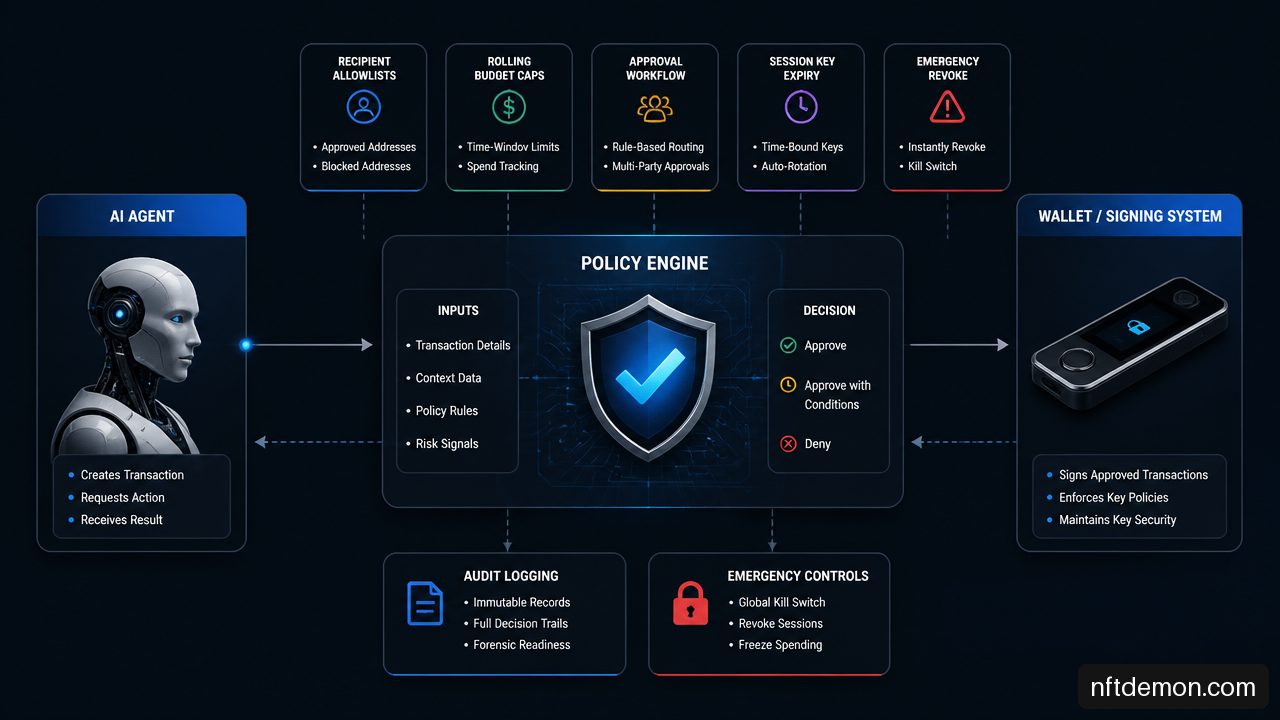
The safest pattern is policy first: evaluate the request before transaction construction is finalized and before signature generation. Prompt instructions, application code checks, and post transaction monitoring all help, but none should be the final barrier.
Compare Enforcement Options By Failure Mode
| Architecture | How It Works | Appropriate When | Key Trade Off |
|---|---|---|---|
| Offchain policy engine | A service evaluates requests before permitting signing | Enterprises need rich logic, identity integration, and audit workflows | The signer must reliably refuse bypass attempts |
| Smart account | Wallet contract enforces rules onchain before execution | Policy must be verifiable and portable across systems | Chain support, gas costs, and contract design complexity matter |
| Session key | Temporary delegated key operates within constrained parameters | Short lived, repetitive agent tasks need low friction | Revocation and expiry handling must be disciplined |
| Multisig | Multiple parties approve a transaction | Treasury moves and infrequent high value transfers | Usually too slow for autonomous micro payments |
| Embedded wallet policy | Wallet provider enforces centrally managed permissions | A platform requires operational simplicity and managed controls | Vendor design and recovery mechanics require review |
OpenFort argues that spend caps, allowlists, approval workflows, isolated signing, and audit records should be enforced in the signing path. I would treat that as the minimum architectural standard for a production agent wallet.
Smart Accounts And Session Keys
A smart account is a programmable wallet contract. It can require a policy module to validate a transaction before the wallet executes it. This can be useful when an enterprise needs onchain enforceable controls that remain effective even if an offchain application is compromised.
A session key is a temporary signing credential with restricted authority. It is often effective for a defined workflow, such as an agent paying a fixed set of suppliers during a 30 minute procurement session. The session key should carry a short expiry, a narrow budget, and a revocation handle. Avoid a session key that can call arbitrary contracts or persists beyond the task window.
Multisig remains appropriate for treasury and policy change authority, not necessarily for every agent payment. Requiring a quorum for a $10 recurring service charge defeats the efficiency of automation. Requiring a quorum to increase the agent's budget, add a new destination, or move funds from treasury to an operating wallet is usually more proportionate.
Segregate Wallets By Economic Purpose
Do not let an experimental agent wallet share liquidity with operating or treasury funds. A three wallet model makes policy clearer:
| Wallet Class | Purpose | Suggested Control Posture |
|---|---|---|
| Test wallet | Simulation, integration testing, and new contract validation | Minimal funded balance, short expiry, no treasury connectivity |
| Operating wallet | Approved recurring agent activity | Rolling cap, allowlists, scoped session keys, monitoring |
| Treasury wallet | Reserve assets and strategic holdings | Multisig or equivalent quorum, strict approvals, no direct agent delegation |
Migration between these tiers should be explicit. A workflow tested successfully is not automatically ready for production. Move it only after the counterparty, contract method, reconciliation process, approval path, and emergency freeze process have been reviewed.
Operationalize Governance, Audit, And Recovery
The technical framework becomes reliable only when policy changes, exceptions, and incidents follow a repeatable operating process. This is where managing permissions and upgrades in enterprises becomes directly relevant: permission changes are material risk events, not routine configuration edits.
Tier Approval Thresholds By Actual Risk
“Large transaction” is too vague for enterprise policy. A $5,000 stablecoin payment to an established allowlisted vendor may be lower risk than a $500 approval to an unfamiliar smart contract. Use a risk matrix that evaluates the transaction across multiple conditions.
| Risk Factor | Lower Risk Example | Higher Risk Example | Typical Policy Response |
|---|---|---|---|
| Asset | Approved stablecoin | Volatile or thinly traded token | Reduce cap or require approval |
| Counterparty | Established allowlisted vendor | New destination | Require approval and verification |
| Chain | Approved production network | New or unreviewed network | Deny or use test wallet only |
| Contract | Known billing method | Arbitrary contract call | Method restriction or manual review |
| Route | Direct payment | Cross chain bridge or swap | Lower budget and elevated review |
An approval threshold should therefore be dynamic. For example, an agent may autonomously pay an allowlisted stablecoin invoice under $1,000, require one approver for payments from $1,000 to $10,000, and require a separate treasury approval for any bridge, swap, or new contract interaction regardless of nominal amount.
Preserve An Evidence Chain, Not Just A Transaction Log
A blockchain transaction hash proves that an onchain event occurred. It does not prove why the agent initiated it, whether policy approved it, or who changed the rule that allowed it. Enterprise auditability needs a connected evidence chain.
For each payment attempt, retain:
• Agent identity, software version, and delegated key or session identifier
• Request intent, business reference, and selected wallet
• Raw transaction details and normalized risk attributes
• Policy version, rule evaluation results, and any denied conditions
• Approver identity, approval timestamp, and exception rationale when applicable
• Signing identity, authorization identifier, and budget reservation state
• Onchain transaction hash, execution status, settlement result, and reconciliation record
Retention periods and privacy handling depend on jurisdiction, contractual duties, and internal compliance policy. There is no universal retention period for this specific use case. The practical test is whether the enterprise can reconstruct a disputed payment months later without relying on volatile application logs.
Make Revocation Fast And Specific
“Revoke access” is not one action. The organization needs to know which artifact holds the permission and how quickly it can be neutralized.
| Permission Artifact | Revocation Action | Operational Consideration |
|---|---|---|
| Session key | Disable the key or invalidate its session | Confirm queued requests cannot complete after revocation |
| Token allowance | Reduce allowance to zero or remove approval | Check whether separate allowances exist across contracts |
| Smart account module | Disable the module or change policy state | Ensure emergency authority cannot be controlled by the agent |
| Embedded wallet policy | Update or disable provider policy | Test propagation timing and administrative access controls |
| Agent credentials | Rotate or disable service credentials | Preserve evidence before destroying incident data |
Fireblocks describes delegation layers that can combine spend limits, merchant allowlists, time restrictions, contract method rules, and revocation. The key enterprise question is not merely whether revocation exists. It is whether the team can execute it in minutes, verify it worked, and stop pending approvals or queued transactions.
Every program should run a controlled freeze exercise. Disable a test agent, revoke its session, cancel outstanding authorization requests, and verify that a previously valid transaction now fails before signing. If the team cannot demonstrate that result, the emergency process is still theoretical.
Implement In Phases Instead Of Granting Broad Autonomy
A staged rollout reduces the chance that policy gaps become losses.
- Map use cases: Identify each agent task, asset, chain, counterparty, contract method, and expected payment frequency.
- Set the default deny posture: Permit only named actions rather than trying to block every dangerous action.
- Deploy isolated test wallets: Validate policy behavior against realistic transaction payloads and retry patterns.
- Introduce low value production budgets: Use limited operating wallets, short lived delegation, and heightened monitoring.
- Add exception workflows: Define who approves new recipients, increased caps, contract changes, and cross chain activity.
- Measure and review: Inspect denied requests, near cap behavior, policy overrides, stale permissions, and reconciliation exceptions.
For organizations coordinating several stakeholders, blockchain governance frameworks for consortiums can offer a useful model for defining decision rights before technical permissions are distributed.
Frequently Asked Questions
What Is A Permissioning Framework For AI Agent Crypto Wallet Spending Limits?
It is a combined technical and governance model that defines what an AI agent may spend, where it may send funds, which assets and contracts it may use, how long permission lasts, and when human approval is required. Strong frameworks enforce those decisions before signing.
How Do You Stop An AI Agent From Overspending A Crypto Wallet?
Use a per transaction cap plus a rolling aggregate cap, session budget, and lifetime delegation cap. Track pending authorizations atomically so parallel requests cannot each spend against the same remaining budget. Keep the operating wallet separately funded from treasury reserves.
What Should Be Allowlisted In An Enterprise Agent Wallet Policy?
Allowlist recipients, approved chains, assets, contract addresses, permitted contract methods, and where possible the merchant or resource being purchased. A recipient address alone may be insufficient when one contract supports multiple actions.
Should Spending Limits Be Enforced Onchain Or Offchain?
Use both when the risk justifies it. Offchain policy engines can integrate identity, business workflow, and detailed audit rules. Smart accounts can provide enforceable onchain restrictions. The essential requirement is that the signing authority cannot bypass the policy decision.
How Do Session Keys, Smart Accounts, And Multisig Compare?
Session keys suit temporary, narrow agent tasks. Smart accounts suit programmable policy enforcement and delegated execution. Multisig suits treasury transfers, policy changes, and elevated actions requiring shared human accountability. Many enterprises use all three at different layers.
How Can An Enterprise Revoke AI Agent Payment Permissions Quickly?
Maintain a documented runbook that identifies every permission artifact: session keys, token approvals, wallet policy modules, embedded wallet controls, and agent credentials. Revoke the applicable artifact, freeze the wallet where possible, cancel pending work, and test that new signing requests fail.
What Audit Logs Should Be Kept For Agent Wallet Transactions?
Keep the agent identity, request intent, transaction payload, policy version, evaluation decision, approvals, signer identity, budget reservation, onchain result, and reconciliation status. The goal is to reconstruct both the decision and the final settlement outcome.
What Is The Safest Way To Let An AI Agent Make Payments Autonomously?
Start with a separately funded operating wallet, short lived delegated authority, strict allowlists, low rolling caps, policy enforcement before signing, and an emergency freeze path. Expand authority only after the workflow has demonstrated predictable behavior and complete reconciliation.
Sources And References
• OpenFort — AI Agent Wallet Compliance: Custody and Control. https://www.openfort.io/blog/ai-agent-wallet-compliance-custody-controls
• Turnkey Docs — Agentic Wallets. https://docs.turnkey.com/solutions/company-wallets/agentic-wallets
• Crossmint — How to Add Payments to Your AI Agent. https://www.crossmint.com/learn/add-payments-to-ai-agents
• GOAT Network — AI Agent Spending Controls: Build an Authorization Envelope. https://www.goat.network/news/ai-agent-wallet-spending-controls
• Fireblocks — Fireblocks Vs. Privy. https://www.fireblocks.com/report/compare-agent-wallets
NFT Demon Holdings helps enterprises scope, evaluate, and build blockchain programs — start with a free evaluation call.
Talk through your use case
Free evaluation call — objective, constraints, and fit, before any proposal.