Securing private key storage within automated AI agent execution environments
By Jeremy Ryan, Founder & CEO · September 2026
Securing private key storage within automated AI agent execution environments starts with one nonnegotiable design rule: the agent must be able to request an authorized cryptographic action without being able to read, copy, or transmit the private key. This distinction determines whether a compromised prompt, container, orchestrator, or host becomes an inconvenience or a catastrophic custody failure.
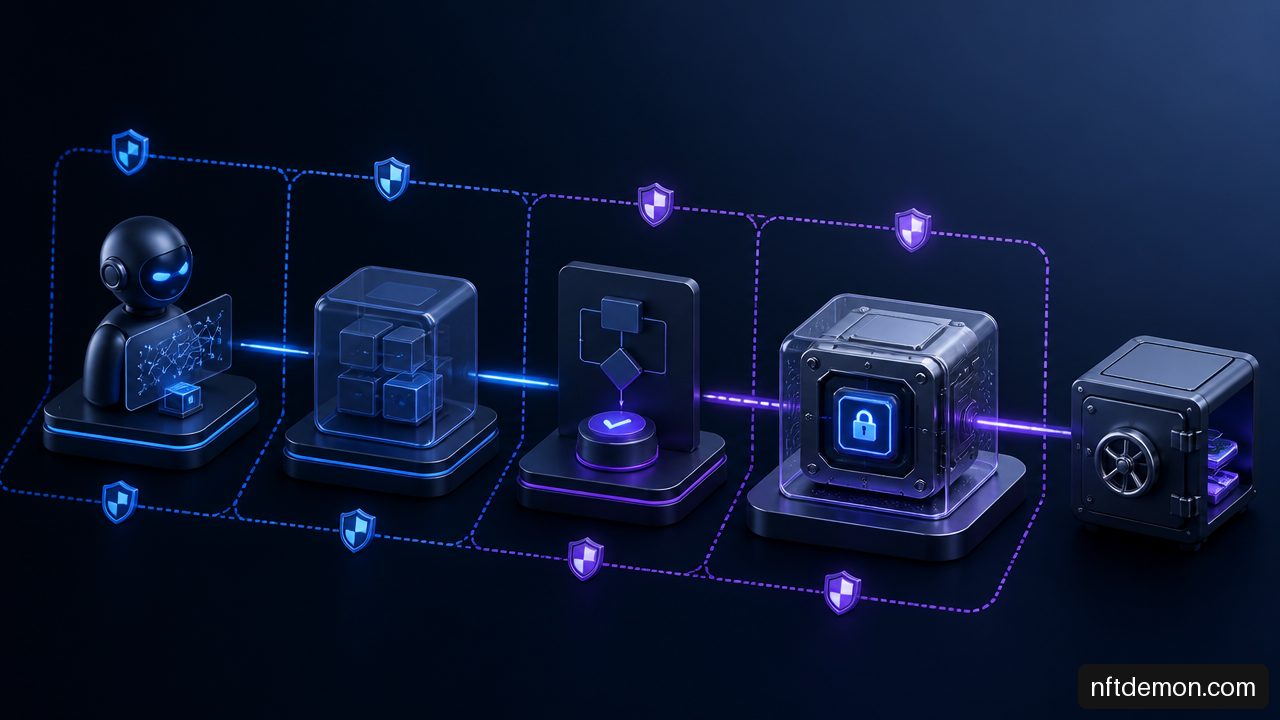
For decision makers, the question is not simply where a key is encrypted at rest. The more important question is: what systems can ever access plaintext key material, and under what conditions? A credible answer requires clear trust boundaries, sign-only custody, policy enforcement, short-lived authority, and recovery procedures that work when an autonomous workflow behaves unexpectedly.
Key Takeaways
Threat Model the Agent, Runtime, Host, and Key Store
Separate the Four Compromise Scenarios
An automated AI system has several distinct security boundaries. Treating them as one generic “agent environment” is a common design error.
| Compromised Component | Likely Attacker Capability | What Should Still Be Protected | Primary Control |
|---|---|---|---|
| Model or prompt layer | Manipulate tool calls and transaction requests | Raw private key and unrestricted signing authority | Transaction policy and approval limits |
| Agent orchestrator | Change task routing, retries, or identity bindings | Key export and cross-agent access | Workload identity and scoped authorization |
| Container or virtual machine | Read process memory, mounted files, and environment data | Persistent key material | No-read-path signer and no secret mounts |
| Host or node administrator | Inspect workloads and storage | Keys held outside general-purpose software | HSM, TPM sealing, or remotely managed signing service |
| Key store or signer policy | Authorize improper signing | Asset limits and recovery controls | Segregation of duties, audit review, and revocation |
A compromised model can be dangerous even when it cannot extract a key. Consider an agent instructed to “rebalance” a treasury wallet. If its signer accepts any transaction payload, a prompt injection can produce a valid but malicious transfer. The private key remains protected, yet the business outcome is still unacceptable.
That is why key custody and transaction authorization must be separate controls. The first answers, “Can the agent obtain the key?” The second asks, “Can the agent use a protected signer for this specific action?”
The distinction matters for enterprise systems as much as blockchain. A Git commit-signing key could be protected while an agent is still prevented from signing releases outside an approved repository. A certificate issuance key could remain in hardware while policy restricts issuance to specific domains and validity periods. The signer becomes a policy enforcement point, not merely a cryptographic utility.
Why Environment Variables Fail in Agent Runtimes
Environment variables are convenient because they travel easily through local development, CI systems, container platforms, and orchestration tools. That convenience is exactly the problem.
A private key stored in an environment variable may appear in process inspection output, crash reports, debugging tools, shell history, container metadata, build logs, support bundles, or a child process inherited by the agent. A tool-enabled agent can also unintentionally disclose the value if it can execute diagnostic commands or serialize its runtime context.
The IETF Agent Identity Protocol draft’s storage hierarchy places HSM or TPM custody first, operating system keychains second, and encrypted files last; it explicitly prohibits agent private keys in environment variables and plaintext configuration files. That hierarchy is useful because it reflects increasing exposure to general-purpose software.
Fair warning: replacing an environment variable with a Kubernetes secret volume does not create true key isolation. It may improve operational handling, but once the file is mounted into the agent container, the workload can generally read it. That is storage distribution, not sign-only custody.
Model Compromise Is Not the Same as Key Theft
A well-designed system assumes an agent can be influenced by unreliable inputs. Retrieval content, email attachments, webpages, user messages, tools, and external APIs can all alter what an agent requests.
I recommend defining a narrow request contract between the agent and the signer. The request should include the intended operation, identity, destination, value or scope, expiration, nonce, and policy context. The signer should reject ambiguous requests, stale requests, replayed requests, and actions outside the agent’s assigned authority.
This pattern limits harm even when the model chooses poorly. It also produces a useful audit record: not just that a signature happened, but which workload asked, what it asked to sign, which policy approved it, and which key version was used.
Choose a No-Read-Path Key Architecture
Make Signing an API, Not a Secret Retrieval Operation
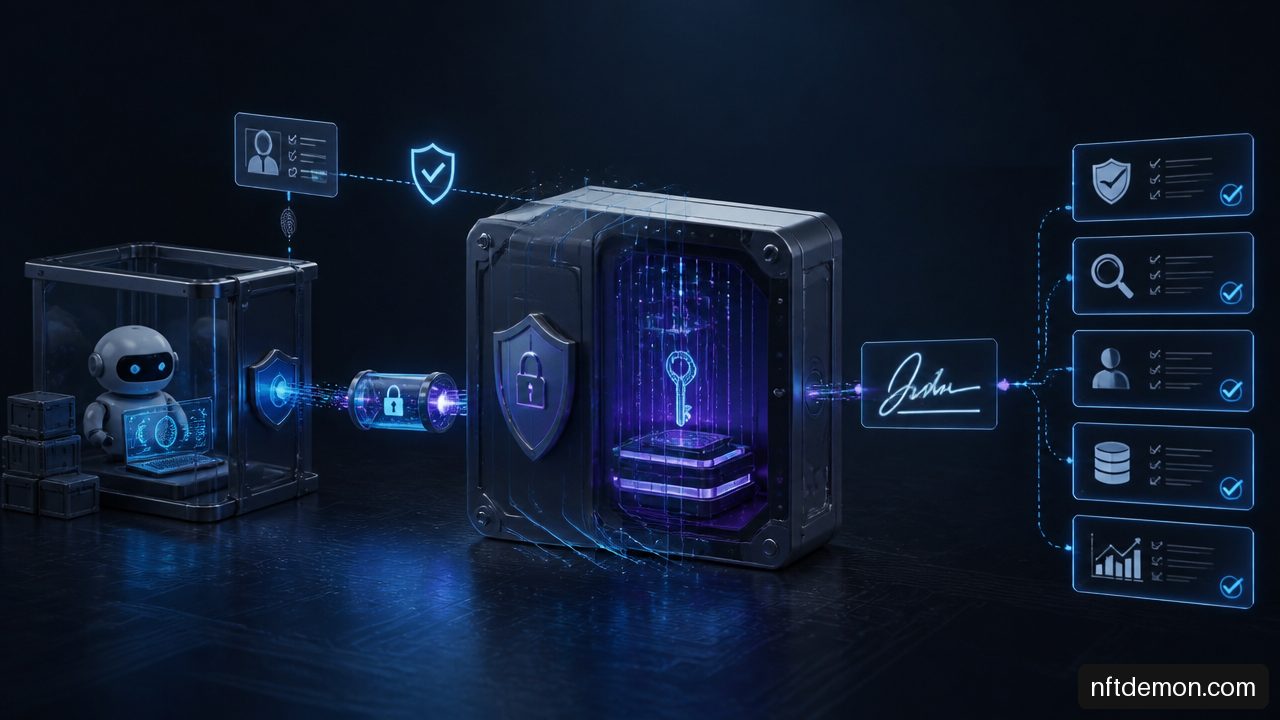
The safest operational pattern is no-read-path custody. The agent authenticates to a signer, sends a digest or structured payload, and receives a signature only if policy allows it. There is no API endpoint for getPrivateKey, no mounted PEM file, and no plaintext key in the agent’s prompt context.
OWASP’s Key Management Cheat Sheet recommends storing keys in an HSM or isolated cryptographic service and states that normal application code should not read cryptographic keys directly. For agent systems, that recommendation should be treated as a baseline architecture rather than an aspirational hardening step.
A practical signing request flow looks like this:
-
The orchestrator issues the workload a short-lived identity token tied to the specific job.
-
The agent sends a structured signing request to a dedicated signer or wallet service.
-
The signer validates workload identity, policy, rate limits, destination rules, and transaction semantics.
-
The protected key signs inside an HSM, TPM-backed service, or enclave.
-
The signer returns only the approved signature and an audit event.
-
The job identity expires, preventing later reuse if runtime data is copied.
This approach keeps the model loop out of the key custody boundary. For a blockchain agent wallet, the policy might cap transfers, restrict token contracts, require allowlisted destinations, and impose a human approval threshold above a defined value. For API authentication, the same policy could limit endpoint families, request methods, or cloud resources.
Select Storage Based on the Threat Model
There is no single storage option that fits every agent workload. The correct choice depends on whether the agent is hosted, ephemeral, regulated, offline, or able to tolerate a remote dependency.
| Deployment Condition | Preferred Key Custody Pattern | When It Fits | When to Avoid It |
|---|---|---|---|
| High-value wallet, certificate authority, exchange, or regulated signer | HSM or managed isolated signing service | Persistent keys with strict audit and policy needs | Avoid only when latency or offline operation makes it technically impossible |
| Self-hosted agent on dedicated hardware | TPM-sealed key or HSM | A device-specific trust boundary is acceptable | Avoid if workloads move frequently between hosts |
| Cloud agent with sensitive signing | Attested enclave plus KMS-wrapped key material | Key use must be tied to measured code and runtime state | Avoid if attestation operations cannot be reliably governed |
| Local developer automation or low-impact service | OS keychain or secure private-key store | Human-controlled machine with limited autonomous authority | Avoid for unattended, high-value transaction signing |
| Emergency or constrained legacy deployment | Encrypted file wrapped by a KEK | Temporary bridge while custody architecture is upgraded | Avoid as a permanent design for autonomous production agents |
A TPM is useful when keys should be sealed to a particular machine state. An HSM is generally better for centralized signing services, multi-tenant controls, and stronger separation from application software. An enclave narrows the execution boundary further by allowing plaintext key material to exist only within isolated memory during an approved signing operation.
For server-wallet designs, MetaMask’s guidance for AI agent server wallets describes keeping the signing key in a secure environment and tying key release to execution policy and enclave handling. That is the core architectural lesson: availability for authorized signing does not require key visibility to the agent.
Use Attestation-Bound Release for Sensitive Workloads
Attestation lets a key service evaluate evidence about what code is running and where before releasing wrapped key material or permitting a signing operation. In simplified terms, the enclave produces a measurement of its approved code and configuration. The key service verifies that evidence against an expected policy. Only then can the signing flow proceed.
This is particularly valuable when containers are deployed automatically. A standard container image tag such as agent-signer:latest is not trustworthy evidence of runtime integrity. It can be retagged, rebuilt, or launched with altered environment settings. Attestation is stronger because it binds authorization to a measured workload rather than a label.
The trade-off is operational complexity. Teams need versioned policies for approved measurements, a process for legitimate software updates, and an emergency path when attestation infrastructure is unavailable. For example, if a signer cannot validate a newly deployed enclave measurement, it should fail closed for high-value keys rather than silently fall back to a readable software key.
Encrypted Storage Is Not the Same as Isolation
Encryption at rest protects a stolen disk or database snapshot. It does not automatically protect a key from the process that decrypts it. If an agent container can call a decryption API and retrieve plaintext, an attacker who controls that container may be able to do the same.
A stronger design uses a data encryption key, or DEK, to encrypt each private key at rest. The DEK is then wrapped by a separate key encryption key, or KEK, held in a hardware-backed key management system. The signer unwraps only what it needs, only inside the approved boundary, and only for as long as required.
Openfort’s agent wallet architecture describes private keys encrypted at rest under a per-wallet DEK wrapped by an HSM-backed Cloud KMS key, with plaintext available only briefly in enclave memory. This is a useful model because it separates wallet-specific encryption from the higher-value wrapping authority.
Control Container and Memory Exposure
Design Against the Container Failure Modes
Containerized agents concentrate several risks in one place: tools, task state, credentials, temporary files, logs, and outbound network access. The table below turns broad warnings into concrete engineering checks.
| Exposure Path | Failure Mode | Mitigation |
|---|---|---|
| Environment variables | Child process, debug output, or metadata reveals a key | Remove keys from environment variables entirely |
| Mounted secret files | Agent code or shell tool reads the file | Use remote sign-only service instead of a readable mount |
| Process memory | Crash dump, debugger, or host compromise recovers plaintext | Minimize plaintext lifetime and isolate signing execution |
| Logs and traces | Request payload or exception includes secret material | Redact fields, block raw payload logging, and test failure paths |
| Shared volumes | Retry worker or unrelated sidecar accesses key material | Use per-workload storage and restrictive filesystem permissions |
| Network egress | Compromised agent exports data to external endpoint | Allowlist signer and required service destinations only |
The hardware keystore analysis of AI agent signing workflows notes that agent systems often begin with keys in plaintext files, environment variables, or container memory before moving to hardware-backed custody. That transition matters because hardware keystores can remove the private key from general-purpose software rather than merely encrypting a file the software later reads.
Zeroize and Minimize Plaintext Lifetime
If a private key must exist in memory, it should exist for the shortest practical interval. In an enclave-based design, encrypted material can remain outside the enclave, then be decrypted into enclave memory for one signature, cleared immediately afterward, and never returned to the caller.
Zeroization is not a magic guarantee. Managed runtimes, compiler optimizations, memory paging, and crash diagnostics can complicate secure clearing. Still, minimizing copies is worthwhile. Avoid converting key bytes into strings, avoid placing them in general logging objects, disable core dumps where appropriate, and use cryptographic libraries designed to keep key operations within protected implementations.
The practical goal is not to promise impossible perfection. It is to ensure that an attacker must defeat the hardware or the signer policy rather than simply inspect a container’s memory.
Use Delegation for Autonomous Jobs
Permanent private keys and short-lived delegated credentials solve different problems. A persistent signing key is appropriate when a service must maintain stable identity, such as a wallet address, certificate authority, or software release identity. A delegated credential is preferable when an agent only needs temporary authority to complete one bounded job.
For example, a procurement agent might receive a token valid for ten minutes, limited to creating a purchase order below a set amount. If the job retries, the orchestrator issues a new token after checking the current policy. If the agent is compromised, the credential expires quickly and cannot be used to sign unrelated actions.
This approach changes recovery. Instead of rotating a root key after every suspicious event, teams can revoke a workload identity, terminate the job, and deny future delegation. Root key rotation remains necessary after suspected custody compromise, but it should not be the first and only containment mechanism.
For organizations integrating blockchain workflows into existing systems, integrating blockchain with existing enterprise systems should include mapping agent identities, approval systems, and audit controls before any signer is connected to production funds.
Frequently Asked Questions
What Is the Safest Way to Store Private Keys for AI Agents?
For high-value or persistent signing, use an HSM, isolated signing service, or an attested enclave-backed signer where the agent has sign-only access. The agent should authenticate to the signer and request a narrowly defined operation rather than retrieve key material.
Should an Agent Ever Be Allowed to Read Its Own Private Key?
Usually, no. A private key readable by the agent is also readable by any attacker who gains equivalent access to the agent runtime. There may be constrained legacy cases, but those should be treated as temporary exceptions with minimal authority and a migration plan.
Are Environment Variables Safe for Private Keys in Agent Runtimes?
No. Environment variables can leak through process inspection, debugging, inherited subprocesses, orchestration metadata, and logs. They are particularly risky for tool-enabled agents that can execute commands or inspect their own environment.
Is an HSM Better Than a TPM for Agent Signing Workloads?
It depends on deployment. An HSM is usually stronger for centralized, multi-tenant, policy-controlled signing. A TPM is useful when keys should be sealed to a particular machine and measured boot state. For distributed cloud agent jobs, an attested remote signing service may be more manageable than tying keys to individual hosts.
When Is an Operating System Keychain Enough for Automated Agents?
An OS keychain can be reasonable for lower-risk local automation on a controlled machine, particularly where a human user remains involved. It is not a strong choice for unattended agents controlling high-value wallets, privileged cloud resources, or certificate issuance.
How Do Enclaves Help Protect Keys Used by AI Agents?
Enclaves reduce the software boundary that can access plaintext key material. A properly designed enclave signer can decrypt or unwrap a key only inside isolated memory, perform the signature, return the result, and clear the key from active memory. Attestation can further require that only approved measured code receives access.
What Should Be Rotated: the Key, the Wrapping Key, or Both?
Rotate delegated credentials frequently, rotate root private keys when policy or compromise risk requires it, and rotate wrapping keys on a defined cryptographic lifecycle. The exact schedule depends on the system. A wallet identity may be costly to rotate, while a KEK can often be rotated through rewrapping without changing the public signing identity.
Can an AI Agent Sign Transactions Without Ever Seeing the Private Key?
Yes. That is the preferred design. The agent sends a transaction request to a policy-enforcing signer, which validates the request and signs within protected custody. The agent receives the signed transaction or a denial, never the private key.
For blockchain programs, these controls should sit alongside enterprise blockchain architecture security and scalability decisions such as identity boundaries, transaction governance, monitoring, and recovery authority. The strongest architecture is not simply one with encrypted keys. It is one where a compromised agent cannot turn protected custody into unrestricted execution.
Sources
• OWASP — Key Management Cheat Sheet
• IETF — Agent Identity Protocol: Agentic Authentication and Authorized ...
• MetaMask Docs — Design server wallets for AI agents with ERC-8004
• Openfort — Agent wallets for AI agents
• arXiv — Hardware Keystores for AI Agent Signing Workflows
The operating model should be tested as rigorously as the cryptography. Review signer policy changes, simulate a compromised container, rehearse credential revocation, and verify that audit records support rapid investigation. Those are the operational controls for a production blockchain deployment that keep a protected key from becoming an ungoverned signing authority.
NFT Demon Holdings helps enterprises scope, evaluate, and build blockchain programs — start with a free evaluation call.
Talk through your use case
Free evaluation call — objective, constraints, and fit, before any proposal.