Implementing time locked circuit breakers on automated AI agent smart contract calls
By Jeremy Ryan, Founder & CEO · September 2026
Implementing time locked circuit breakers on automated AI agent smart contract calls means treating the AI system as an untrusted proposer, not as an unrestricted onchain operator. The model may identify an opportunity, construct calldata, and request a transaction. It should not be able to move funds, upgrade logic, alter oracle sources, or change risk parameters without deterministic controls between its recommendation and blockchain execution.

Key Takeaways
What Decision Makers Should Approve
A workable control model has a simple premise: an AI agent can propose, but deterministic systems decide whether, when, and how a smart contract call executes. This is not a cosmetic distinction. A transaction recommendation generated at 10:00 may be unsafe at 10:15 because prices, liquidity, collateral values, oracle data, permissions, or contract state have changed.
I recommend approving these baseline requirements before authorizing an agent to interact with production contracts:
• Place high consequence calls behind a queue and execution delay enforced onchain.
• Give a separate guardian role authority to pause functions and cancel queued actions.
• Require a policy engine to validate the intended target, function selector, value, token exposure, slippage, gas ceiling, and risk limits before scheduling.
• Re simulate a queued call immediately before execution, because the original simulation is only a snapshot.
• Aggregate limits across related calls so an agent cannot convert one prohibited large action into dozens of permitted small ones.
• Separate proposal, approval, execution, pause, and cancellation permissions.
The security case is practical, not theoretical. OpenAI’s EVMbench work evaluates AI agents on smart contract security tasks including vulnerability detection, patching, and exploitation. That makes unrestricted execution authority a poor default, even when the agent is intended to perform routine operations.
Build The Control Boundary Before The Agent Reaches The Chain
Separate Request Time From Chain Execution Time
The most common architectural error is applying a delay when the agent generates an idea rather than when the blockchain executes a call. That creates the appearance of review without enforcing a real execution boundary.
Consider an agent that detects a treasury rebalancing opportunity. It produces a recommendation, waits for an hour, then signs and broadcasts a transaction directly from an authorized wallet. The hour did not protect the protocol. The decision was delayed, but the final transaction still bypassed the review, cancellation, and state validation controls that matter.
The delay must attach to an immutable transaction intent at the execution layer. A useful queue record includes:
| Field | Purpose | Why It Matters |
|---|---|---|
| Target contract | Identifies the contract to call | Prevents redirecting approved intent to a different contract |
| Function selector and calldata hash | Binds the exact operation | Stops silent changes to parameters after approval |
| Value and token limits | Caps economic exposure | Limits native token and token transfer risk |
| Earliest execution time | Enforces the time lock | Creates a genuine review and cancellation window |
| Expiry time | Invalidates stale intent | Prevents execution after market conditions have moved |
| Nonce or operation ID | Establishes uniqueness | Supports replay protection and auditability |
| Policy attestation | Records passed controls | Makes the decision path inspectable |
The agent may create this intent offchain, but the contract should only accept it from a trusted policy executor or scheduler. The execution contract then rejects the call until the delay has elapsed and all onchain conditions still hold.
This approach mirrors the core premise of PACE’s policy attested approach to safe AI agent execution: untrusted planning should remain separate from deterministic, attestable safety enforcement. The model can be sophisticated. The enforcement path should be boring, explicit, and reproducible.
Define Roles That Do Not Collapse Into One Key
A single agent key that can propose, queue, execute, cancel, and unpause is not a controlled system. It is a single point of failure with extra steps.
A stronger pattern assigns distinct responsibilities:
-
Agent proposer: submits a structured action request but cannot execute it directly.
-
Policy engine: evaluates hard rules, generates an attestation, and either rejects or queues the request.
-
Timelock controller: stores approved operations and blocks early execution.
-
Executor: calls the timelock after the delay, ideally through a constrained service or permissionless execution function.
-
Guardian or multisig: can pause protected functions and cancel queued operations.
-
Governance authority: changes policy limits, roles, or contract upgrades through its own delayed process.
For a production protocol, this role map should be part of the operating model, not hidden in deployment scripts. Teams designing institutional workflows can apply the same thinking used in designing governance for multi-party blockchain networks: authority needs explicit scope, evidence, and escalation paths.
Decide Which Calls Are Never Immediate
Not every automated action needs the same delay. A market making bot may need bounded, frequent execution. A proxy upgrade should almost never be instantaneous. The decision criterion is not whether an action is “automated.” It is whether a bad execution is irreversible, economically material, difficult to detect, or hard for users to escape.
| Action Class | Default Treatment | Illustrative Delay Range | Reasoning |
|---|---|---|---|
| Contract upgrades | Timelock plus public queue and cancellation | 48 to 72 hours | A flawed upgrade can alter every downstream rule |
| Treasury transfers | Timelock, multisig approval, spend cap | 24 to 72 hours | Large transfers have direct loss exposure |
| Oracle source changes | Timelock plus oracle sanity checks | 24 to 72 hours | Data source manipulation can corrupt pricing and liquidations |
| Risk parameter changes | Timelock with bounded change limits | 12 to 48 hours | Leverage, collateral, and fee changes can create cascading effects |
| Routine swaps within a mandate | Rate limit, notional cap, price guard | Seconds to minutes | Some strategies require responsiveness but still need bounded exposure |
| Emergency pause | Immediate guardian authority | No delay | The goal is to stop harm, not wait for consensus |
These ranges are policy examples rather than an industry standard. Sensitive governance actions often use delays of roughly 24 to 72 hours, but the correct duration depends on user exit needs, market volatility, liquidity, and the protocol’s ability to respond to an active exploit. A 72 hour delay for an upgrade may be reasonable; a 72 hour delay before pausing a compromised vault is not.
Design A Layered Time Locked Circuit Breaker
Give Each Control A Different Job
A timelock is not a circuit breaker, and a pause switch is not a rate limiter. Combining them without understanding their separate roles produces gaps that attackers and malfunctioning agents can exploit.
| Control | Stops Or Delays | Best Use | Main Limitation |
|---|---|---|---|
| Timelock | Execution of approved sensitive actions | Upgrades, treasury movements, governance changes | Does not stop damage that occurs before an action is queued |
| Emergency pause | Selected contract functions immediately | Exploits, oracle anomalies, abnormal loss events | Can disrupt legitimate operations and does not remove queued actions alone |
| Rate limit | Frequency or cumulative exposure | Repeated trades, withdrawals, mints, or calls | Can be bypassed if limits are scoped too narrowly |
| Policy engine | Calls outside deterministic rules | Target allowlists, slippage, spend limits, selector restrictions | Must be kept simple enough to audit |
| Multisig | Single key abuse | Emergency authority and sensitive approvals | Can be slow or socially compromised if procedures are weak |
Devancore’s discussion of smart contract risk identifies time locks, circuit breakers, pre execution checks, and role separation as controls for finality and governance abuse risk. The operational implication is that no one mechanism should be expected to carry the entire safety burden.
For example, a DeFi lending agent may be authorized to adjust a collateral factor within a narrow corridor. The policy engine prevents values outside that corridor. A timelock provides review for the proposed change. A rate limit prevents repeated “small” changes from accumulating quickly. A pause stops new borrowing if oracle data becomes suspicious. A guardian can cancel the queued parameter update if a new vulnerability appears during the delay.
Build The Queue, Cancel, And Execute Flow
The queue execute pattern should be intentionally asymmetric. It should be easy for the agent to submit a proposal within policy, harder to execute it, and easier still for an authorized guardian to stop it.
-
Normalize the request. Convert the agent’s natural language reasoning or strategy output into structured fields: target, selector, calldata, value, asset exposure, deadline, and declared business purpose.
-
Run preflight validation. Simulate the call against current chain state. Check allowlists, role permissions, balances, lending health factors, slippage, price deviation, and expected state effects.
-
Apply aggregate limits. Measure the action against rolling limits by wallet, asset, protocol, strategy, and time window.
-
Queue the immutable operation. Store a hash of the exact request, schedule time, expiry, nonce, policy version, and simulation metadata.
-
Notify reviewers. Send the human readable summary, calldata decode, estimated value at risk, simulation result, and cancellation instructions to the appropriate operations channel.
-
Allow cancellation. A guardian or multisig should be able to cancel before execution, with cancellation irrevocably marking the operation ID as unusable.
-
Revalidate before execution. Simulate again against current state. Execute only if policy remains valid, the action is within its time window, and the circuit breaker is not active.
-
Record the result. Store execution outcome, state references, policy version, and any exception used for later review.
A queued transaction is not a commitment to execute. It is a commitment to keep an action reviewable until it expires, executes safely, or is cancelled.
That distinction is vital for decision makers. A queue without revocation creates a waiting room for bad outcomes. A cancel function without strict role separation can become another path for governance abuse.
Use Emergency Bypass Sparingly
There are legitimate cases where waiting is more dangerous than acting: revoking a compromised role, pausing a draining vault, or disabling an oracle adapter that is visibly corrupted. But an emergency override that can upgrade arbitrary code or transfer the treasury instantly effectively nullifies the timelock.
I recommend defining emergency bypasses by action type, not by vague statements about urgency. A narrow design might permit a guardian multisig to:
• Pause borrowing, minting, withdrawals, or selected swap routes.
• Revoke a compromised agent credential or executor role.
• Cancel all queued actions from a specified proposer.
• Reduce a limit to zero or tighten a risk ceiling.
It should not ordinarily permit the same emergency role to upgrade arbitrary implementations, move unrestricted assets, change ownership, or unpause itself without a delayed review. Research on AI harm has specifically recommended spending limits, multisig, sandboxing, and kill switches before granting agents blockchain access; see the safeguards outlined in 4 New Vectors Of AI Harm. The point is to preserve a path to containment without creating a hidden superuser.
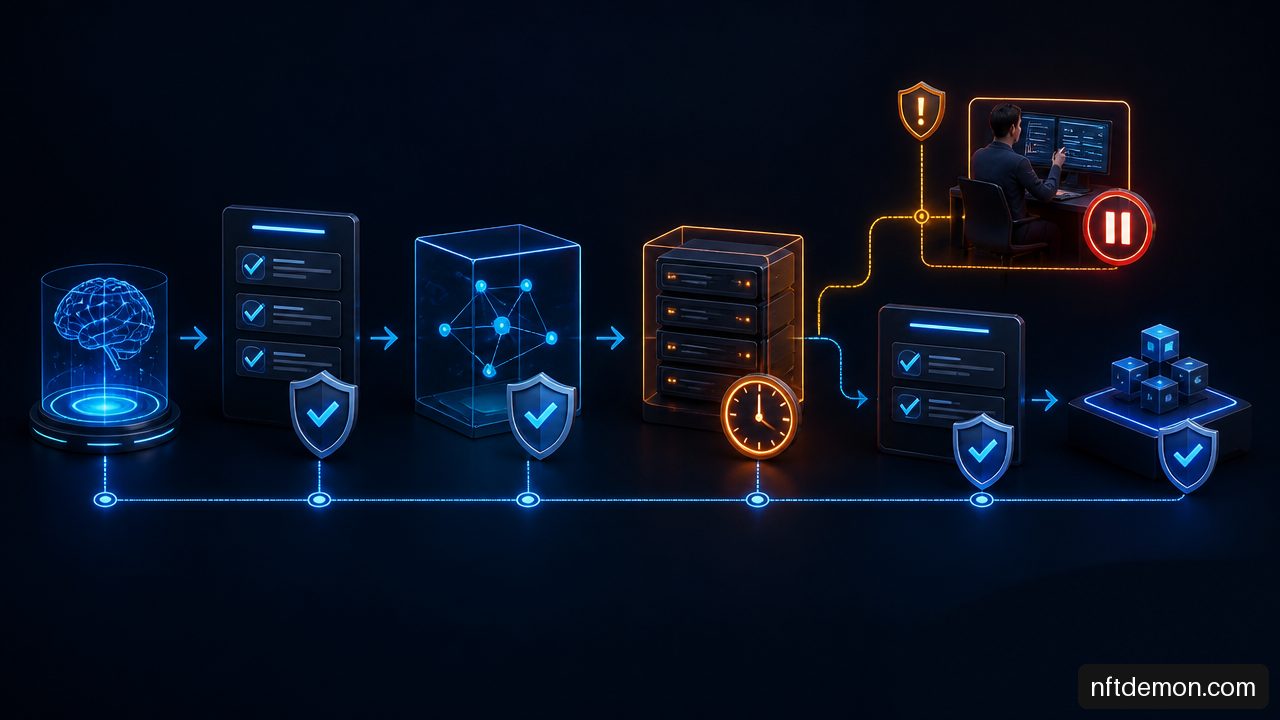
Handle State Drift, Replay, And Split Transaction Abuse
Treat Delayed Intent As Perishable
A time lock creates a useful review window, but it also creates state drift. The world can change between scheduling and execution. Prices move. Liquidity disappears. An oracle becomes stale. A user repays debt. Another governance proposal changes the same parameter. A contract upgrade modifies expected behavior.
That is why validation must happen twice.
At queue time, preflight simulation answers: Was this action safe when proposed? At execution time, a second simulation asks: Is this exact action still safe now? If the answer changes, the executor should fail closed, leave a clear event trail, and require the agent to submit a fresh request.
A practical expiry is as important as a minimum delay. Suppose an agent queues a 2 percent collateral factor reduction during calm conditions. Thirty six hours later, a price shock has already stressed borrower positions. Executing the old instruction may trigger liquidations the original simulation did not predict. A short expiry and execution time health checks are safer than assuming the queue preserves validity.
Block Replay And Intent Substitution
Every queued operation needs a unique operation ID. The ID should bind the target, value, calldata hash, predecessor dependency if any, salt or nonce, policy version, chain ID, and expiration. Once executed or cancelled, it must never become executable again.
The policy layer should also reject calls when the policy version is no longer current. Otherwise, an agent could queue an action under an old permissive policy and execute it after governance has tightened limits. This is particularly relevant where policies govern token allowlists, oracle confidence thresholds, or maximum daily spend.
A small implementation detail matters here: do not allow a generic executor to replace calldata after an operation has been queued. If an operation hash covers only the target address and function selector, an attacker may preserve the approved function while changing the amount, recipient, or encoded risk parameter.
Stop Small Calls From Becoming A Large Bypass
Rate limits must measure the economic effect of related calls, not just the size of one transaction. Otherwise, an agent limited to a $100,000 treasury transfer could schedule ten $99,000 transfers across different routes, tokens, or wallets.
Use cumulative controls across several dimensions:
• Per asset and asset group, including wrapped or economically equivalent assets.
• Per destination, beneficiary, bridge route, and protocol integration.
• Per rolling period, such as 15 minutes, 24 hours, and seven days.
• Per strategy or agent identity, including delegated executor addresses.
• Per correlated action type, such as swap plus transfer plus bridge.
This is partly an engineering judgment problem. There is no universal formula for identifying every economically equivalent action. Start with the highest value assets and most dangerous routes, then test whether a sequence of individually compliant calls can violate the intended portfolio or treasury limit.
That operational discipline belongs alongside operational controls for blockchain deployment, where monitoring, access paths, alerts, and recovery procedures are treated as production requirements rather than post deployment chores.
Test For Failure, Not Just Success
Before mainnet deployment, run adversarial scenarios that deliberately try to break the control stack:
-
Queue a valid transaction, then change the relevant oracle price before execution.
-
Pause the contract after an operation is queued and confirm execution fails.
-
Cancel an operation and attempt to replay it with the same nonce, altered calldata, and a different executor.
-
Submit a sequence of small actions that collectively exceed a daily exposure limit.
-
Simulate a compromised agent proposing allowed calls at maximum permitted frequency.
-
Trigger emergency authority and verify that it can contain damage without gaining arbitrary upgrade or treasury powers.
-
Test notification failures. A review window is weaker if no one receives the queue alert.
The goal is not to prove that every incident is preventable. It is to prove that a bad recommendation, compromised key, prompt injection attempt, or market anomaly has a bounded blast radius and a credible recovery path.
Frequently Asked Questions
How Does A Timelock Differ From A Circuit Breaker?
What Is A Time Locked Circuit Breaker For AI Agent Smart Contract Calls?
It is a layered control system in which sensitive agent requested calls are queued for delayed execution, while a separate pause mechanism can immediately halt protected functions during abnormal conditions. The time lock supports review and cancellation. The circuit breaker supports containment.
Where Should The Delay Be Enforced In An AI Agent Transaction Pipeline?
Enforce it onchain between approved scheduling and contract execution. Delaying the model’s recommendation is not enough because the final signer or executor could still send a materially different transaction immediately.
Which Smart Contract Calls Should Always Be Delayed?
As a default, delay upgrades, treasury movements, privileged role changes, oracle source changes, and material risk parameter changes. Avoid blanket delays for actions that must respond within seconds, but constrain those actions with hard notional caps, slippage controls, price guards, and rate limits.
How Should Teams Handle Queued Agent Actions?
Can An AI Agent Queue A Transaction But Not Execute It Immediately?
Yes. That is the recommended model for consequential actions. The agent can submit a structured request to a policy engine, which queues a valid operation in a timelock controller. Execution occurs only after the delay and a second validation check.
How Do Humans Cancel A Pending Agent Action?
Assign a guardian or multisig a narrowly scoped cancel role. Cancellation should permanently invalidate the operation ID, emit an event, and preserve the reason for cancellation. The cancel role should not automatically confer unrestricted execution or upgrade privileges.
What Happens If Chain State Changes During The Delay Window?
The queued action may become stale, unsafe, or simply fail. Re simulate at execution time and bind the operation to an expiry. If current state violates policy, reject the execution and require a newly proposed action.
How Do You Stop An Agent From Splitting One Large Action Into Many Small Ones?
Use aggregate rate limits across assets, destinations, time windows, strategy identities, and correlated transaction sequences. Test the controls with multi transaction attack paths, not just single transaction thresholds.
How Long Should Time Locks Be?
How Long Should A Treasury Or Upgrade Time Lock Be?
A 24 to 72 hour range is often used for sensitive governance actions, but there is no universal safe duration. Choose a longer window when users need time to assess and exit before an upgrade or treasury move. Choose a shorter delay only when the action is tightly bounded and the operational cost of waiting exceeds the residual risk. Emergency pause authority should remain immediate but narrowly scoped.
Sources And References
• OpenAI — Introducing EVMbench
• arXiv — 4 New Vectors Of Ai Harm
• arXiv — PACE: Policy-Attested Contract Execution for Safe AI Agents ...
• Devancore — Smart Contract Risk in Financial Markets
NFT Demon Holdings helps enterprises scope, evaluate, and build blockchain programs — start with a free evaluation call.
Talk through your use case
Free evaluation call — objective, constraints, and fit, before any proposal.