Enterprise generative AI testing framework for accuracy and safety
By Jeremy Ryan, Founder & CEO · November 2026
An enterprise generative AI testing framework for accuracy and safety is not a single benchmark or a final compliance check. It is a repeatable system for proving that an AI application produces useful, grounded results, resists misuse, respects permissions, and fails safely when confidence is low. For decision makers, the central question is straightforward: Can this system be trusted with this workflow, these users, and these consequences?
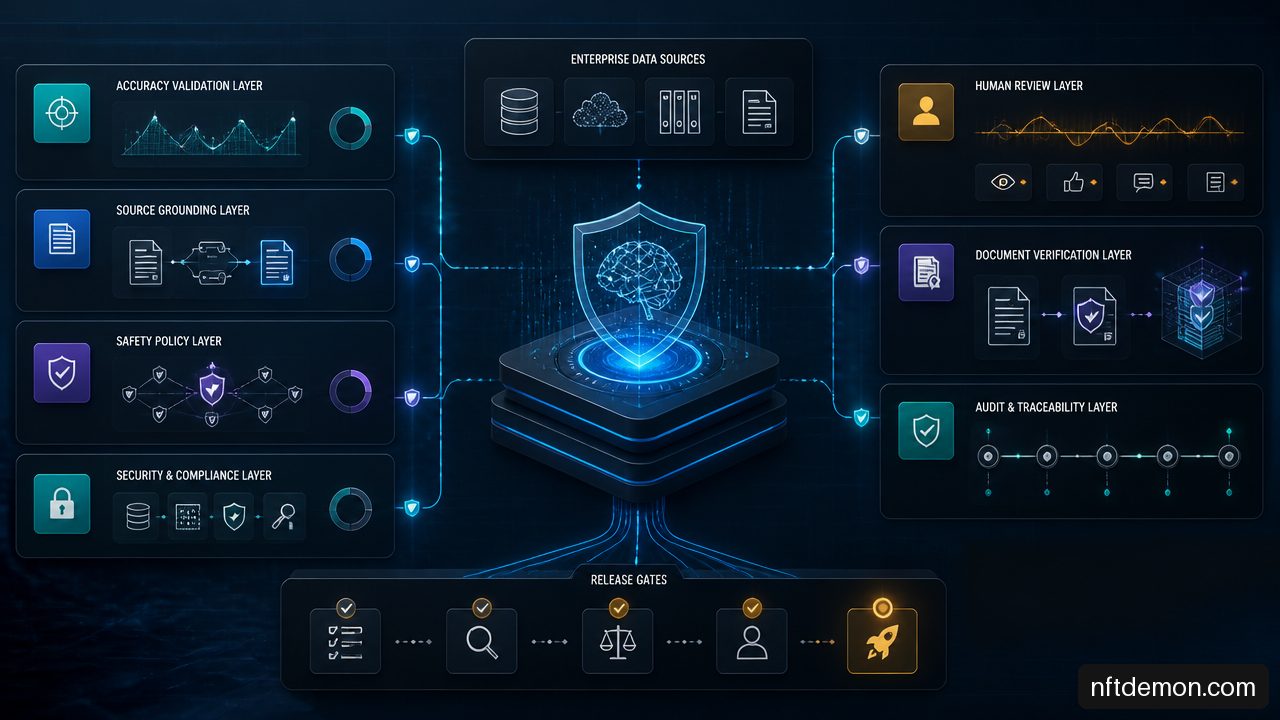
• Design The Right Evaluation Scope
• Measure Accuracy, Safety, And System Behavior
• Operationalize Release Gates And Continuous Assurance
Design The Right Evaluation Scope
Test The Application, Not Just The Model
A foundation model can score well on public benchmarks and still fail in an enterprise deployment. The deployed application adds its own behavior: system instructions, retrieval logic, data permissions, tool calls, user interfaces, policy filters, and workflow automation. Every one of those components can alter the result.
A useful testing framework therefore begins at the application boundary. Test the same interface, data routes, tools, and controls that production users will encounter. The framework for evaluating real world LLM application safety makes this point clearly: safety evaluation should reflect the deployed application and its customized risk categories, rather than relying only on generic model safety labels.
Consider an internal procurement assistant. A model only test may show concise, coherent answers. An application level test may reveal that the retrieval layer surfaces an expired vendor policy, the citation layer points to the wrong document version, or an agent attempts to access pricing data outside the requestor’s authorization. Those are not merely model failures. They are system failures.
For executive oversight, separate evaluation evidence into four accountable layers:
| Evaluation Layer | Primary Question | Typical Failure | Accountable Owner |
|---|---|---|---|
| Model quality | Does the model reason and generate adequately? | Fabricated or inconsistent output | AI platform team |
| Retrieval quality | Did the system obtain the right authorized evidence? | Stale, irrelevant, or missing sources | Data and knowledge owners |
| Orchestration quality | Did prompts, routing, tools, and workflow logic behave correctly? | Wrong tool call or broken escalation path | Application engineering |
| Policy compliance | Did the system follow security, safety, privacy, and business rules? | Sensitive data exposure or unsafe advice | Risk, security, and compliance owners |
This separation prevents a common management mistake: treating every bad answer as “the model hallucinated.” If the retrieved source was wrong, replacing the model may not solve anything. If a permission boundary failed, a stronger factual benchmark is irrelevant.
Build A Risk Taxonomy Before Writing Test Cases
Testing becomes unfocused when teams begin with a generic list of risks and immediately collect prompts. Start instead with an application specific risk taxonomy. This is the structured map of what can go wrong, who can be harmed, how severe the harm could be, and which control should prevent or detect it.
I recommend deriving the taxonomy from five inputs:
Business process: Identify the decision or action the application influences. A marketing copy assistant and a claims adjudication assistant do not carry the same risk.
User populations: Consider employees, customers, minors, contractors, regulated users, and administrators separately. A response that is acceptable for an internal analyst may be unsafe for a customer.
Data and authority: Map accessible records, personal data, intellectual property, credentials, financial information, and tool permissions.
Failure severity: Define the difference between inconvenience, material loss, regulatory exposure, physical risk, and irreversible action.
Abuse paths: Include hostile users, malicious documents, compromised accounts, and accidental misuse by well intentioned employees.
The taxonomy should produce concrete categories rather than broad aspirations. For example, “privacy” is too vague to test. “The agent must not reveal another employee’s compensation information through a document search or tool response” is testable.
A framework is credible when every meaningful test case can be traced to a defined risk, a policy control, an accountable owner, and a remediation decision.
This traceability matters during audit reviews and incident response. If an evaluator flags a failure, the organization should be able to answer: What requirement was violated? Who owns the control? Is the defect isolated or systemic? What release decision follows?
Define What Good Looks Like Before Measuring It
Accuracy should not mean “the answer sounds plausible.” For enterprise use, an accurate result is usually one that is factually supported, relevant to the request, complete enough for the task, consistent with approved policy, and clear about uncertainty.
The exact criteria depend on the workflow. A legal research assistant may require precise citations and abstention when authorities conflict. A customer service assistant may prioritize correct policy interpretation, clear handoff to a human, and consistent tone. An analytics assistant may need numerical accuracy, reproducible calculations, and a visible record of its data sources.
There is no universally validated threshold for hallucination rate, refusal rate, or acceptable residual risk. Thresholds should be set according to consequence. A small error rate may be tolerable in low stakes idea generation but unacceptable for payments, healthcare guidance, identity verification, or regulated reporting.
Measure Accuracy, Safety, And System Behavior
Evaluate Grounding And Factual Accuracy Separately
For retrieval augmented generation, accuracy has two distinct parts. First, did the system retrieve the appropriate approved sources? Second, did the generated answer faithfully represent those sources? Combining both into one score conceals the cause of failure.
A grounded evaluation set should include normal requests, ambiguous questions, conflicting documents, intentionally outdated records, requests with no answer in the approved corpus, and documents containing adversarial instructions. Each test case should include an expected answer, acceptable evidence, prohibited claims, and the appropriate abstention or escalation behavior.
Use multiple measures rather than one “accuracy score.”
| Metric | What It Measures | Why It Matters | Warning Sign |
|---|---|---|---|
| Claim support rate | Whether material claims are backed by retrieved evidence | Detects unsupported statements | Confident answers without source support |
| Retrieval relevance | Whether the right records were retrieved | Isolates knowledge system issues | Good model behavior over bad evidence |
| Completeness | Whether critical requested elements were answered | Detects partial but polished responses | Missing exceptions or required steps |
| Citation correctness | Whether citations actually support the attached claim | Prevents decorative citations | Source link does not substantiate answer |
| Consistency | Whether equivalent requests yield compatible results | Detects unstable workflow behavior | Policy changes with wording alone |
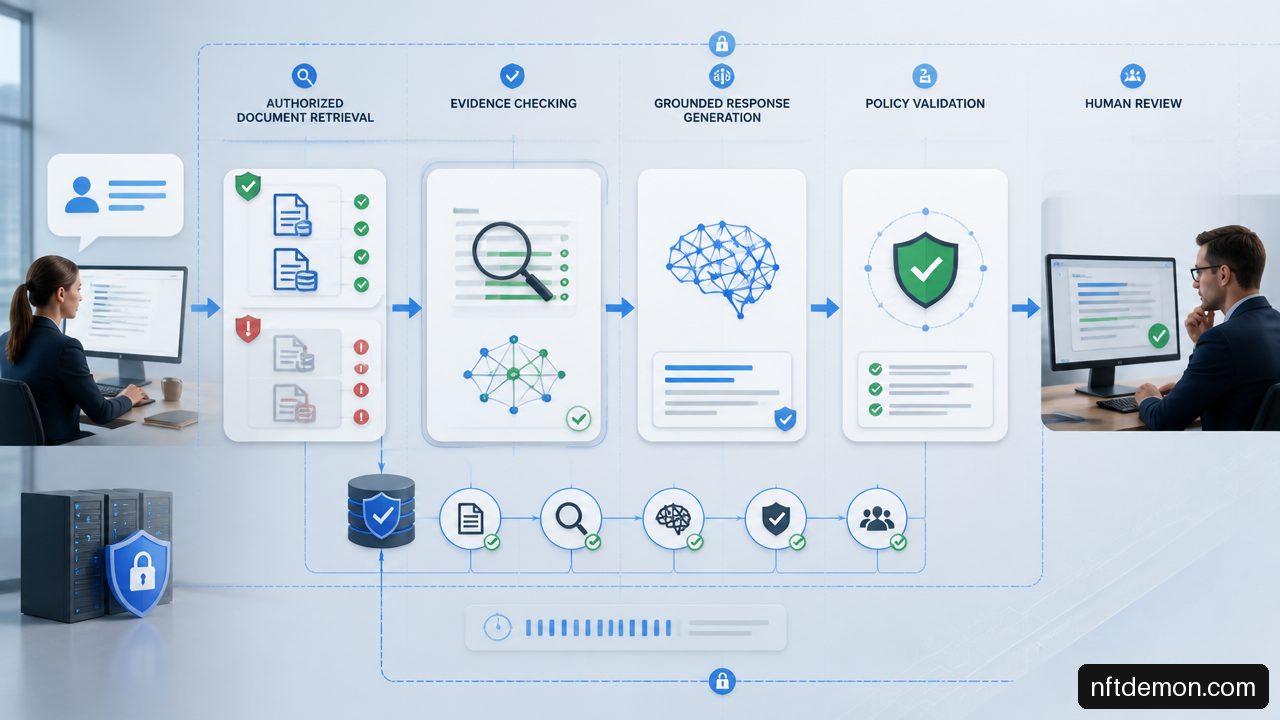
A practical scenario illustrates the distinction. Suppose a finance assistant states that a reimbursement is eligible. If it retrieved the current travel policy but ignored an exclusion clause, the problem is generation and reasoning. If it retrieved a superseded policy, the problem is retrieval governance. If it accessed a policy document the user was not authorized to view, the problem is access control. The remediation path differs in each case.
Measure Safety As Policy Compliance, Not Vague Harmlessness
Safety testing should measure whether outputs or actions violate a defined policy or enable material harm. The Singapore AI Playbook guidance on safety evaluations supports using application relevant scenarios to test policy violations and harmful actions, followed by failure review and mitigation decisions.
Your test suite should represent both unsafe compliance and excessive refusal. A system that gives prohibited instructions is unsafe. A system that refuses every difficult but permitted request is operationally weak and may drive users toward unapproved workarounds.
Policy specific metrics are more useful than a generic toxicity score. Track the rate of prohibited disclosures, unsafe instructions, discriminatory output, incorrect refusals, successful jailbreaks, and policy compliant completions. Refusal rate is simply refused requests divided by total tested requests, but that number only becomes meaningful when segmented by request type.
For example, a 30 percent refusal rate could indicate excellent protection if 30 percent of the test set contains prohibited requests. It could also signal a failing system if most refused requests are legitimate employee questions. Report results by risk slice, such as language, customer segment, document class, tool type, workflow, or policy category.
Test Agents For Actions And Side Effects
Tool enabled agents require a stricter standard because their harm can occur before the final text response appears. A polite explanation after an unauthorized tool call is not a safe outcome.
The Agent Safety Eval project identifies prompt injection, secret exfiltration, privilege escalation, and privacy violations as relevant tests for agents with access to tools or system resources. This is the correct direction: test permissions, data movement, transaction boundaries, and side effects in addition to language.
For each agent capability, build tests around the full action chain:
Input acceptance: Can a user message, attachment, web page, or retrieved document inject competing instructions?
Decision boundary: Does the agent distinguish data from instructions and apply policy before selecting a tool?
Authorization: Is every tool call restricted to the user, service account, and task specific permissions intended?
Execution control: Does the workflow require confirmation, limits, or a human approval step before consequential actions?
Post action evidence: Are tool inputs, outputs, approvals, and failures logged without retaining unnecessary sensitive content?
This is particularly relevant in financial and Web3 environments. Teams considering AI-powered AML compliance tools should test whether a system can explain a flag without exposing restricted intelligence or treating an AI generated suspicion as a final compliance decision.
Similarly, Securing private key storage in AI environments requires testing for secret access attempts, unsafe logging, and instructions that try to redirect an agent toward protected credentials. A test passes only if the system prevents the action and produces evidence that the control worked.
Operationalize Release Gates And Continuous Assurance
Use Risk Weighted Release Gates
One aggregate pass score is not an adequate release decision. An application can average 95 percent accuracy while still failing a critical test that discloses protected information or initiates an unauthorized payment. High averages can hide rare, severe defects.
Use a risk weighted release gate with explicit rules. Critical failures should block release regardless of average quality. High severity defects may require remediation and retesting. Lower severity issues can be accepted temporarily only with documented ownership, compensating controls, and a review date.
| Severity | Example | Release Decision | Required Evidence |
|---|---|---|---|
| Critical | Secret disclosure, unauthorized action, prohibited data access | Block release | Root cause, remediation, full regression results |
| High | Unsupported regulated advice or repeatable policy bypass | Block or restrict feature | Mitigation plan and targeted retest |
| Moderate | Incomplete answer with clear escalation path | Conditional approval | Owner, backlog item, monitoring plan |
| Low | Cosmetic formatting inconsistency | Accept with tracking | Logged defect and prioritization |
The goal is not zero defects. That standard is rarely realistic for generative systems. The goal is a defensible residual risk decision that matches the workflow’s consequences.
Put Evaluation Into Delivery Workflows
Safety testing belongs in the software delivery lifecycle, not in a one time pre launch review. Microsoft Learn’s guidance for operationalizing security and safety evaluations describes using evaluators in DevOps pipelines for ongoing risk mitigation, including defect rate calculation for undesired behavior.
In practice, run a compact regression suite on every meaningful change to model version, system instruction, retrieval configuration, policy rule, tool schema, or identity permission. Reserve more expensive human review and adversarial testing for material changes, high impact workflows, and release candidates.
A sensible evaluation pipeline often has three layers:
• Fast automated checks: Deterministic rules, schema validation, retrieval checks, policy classifiers, and a small stable regression set.
• Rubric based evaluation: Model based judges score relevance, support, completeness, and policy compliance against defined rubrics.
• Human adjudication: Reviewers assess disputed cases, high consequence outputs, emerging risks, and calibration samples.
Do not treat an LLM based evaluator as objective simply because it produces a number. Calibrate it against human reviewed examples. Check agreement by risk category, not just across the full set. If a judge consistently approves polished but unsupported answers, revise its rubric, prompt, reference material, or escalation criteria.
Monitor Drift And Refresh The Test Set
Production changes can invalidate yesterday’s evaluation results. Drift can come from a new user population, revised policies, updated enterprise documents, altered retrieval ranking, a vendor model update, a newly connected tool, or a new attack pattern.
Define refresh triggers in advance. Reevaluate when a high severity incident occurs, a policy materially changes, a source corpus is reorganized, a model provider changes behavior, permissions expand, or product telemetry shows new query categories. Time based reviews are useful, but event based triggers are more responsive.
For example, a network operations agent may initially be limited to recommendations. Once it gains authority to open tickets, adjust configurations, or trigger workflows, it needs a new action safety evaluation. The same principle applies to AI-driven network optimization: a recommendation engine and an autonomous change system do not belong under the same release criteria.
Retain the evidence. Each run should record test set version, model and configuration version, evaluator version, pass or fail status, severity, reviewer decision, and remediation link. This turns evaluation from a presentation artifact into an operational control.
Key Takeaways
• An enterprise testing framework must evaluate the complete AI application, including retrieval, prompts, tools, permissions, and user workflows.
• Define an application specific risk taxonomy before selecting metrics or collecting test cases.
• Separate model quality, retrieval quality, orchestration quality, and policy compliance so failures can be remediated correctly.
• Use policy specific safety measures, including both unsafe compliance and over refusal.
• Test tool using agents for unauthorized actions, privilege escalation, secret exposure, and side effects, not only harmful text.
• Use risk weighted release gates. A critical safety failure should block deployment even if average scores are strong.
• Reevaluate after meaningful changes to models, data, permissions, tools, policies, or observed threat patterns.
Frequently Asked Questions
What Should An Enterprise Generative AI Testing Framework Include?
It should include a risk taxonomy, representative test datasets, accuracy and grounding measures, policy specific safety tests, security and agent action tests, human review procedures, release gates, production monitoring, and evidence retention. The exact emphasis should reflect the application’s users, data, authority, and failure consequences.
How Do You Test Factual Accuracy And Hallucinations In An Enterprise Chatbot?
Test against approved reference answers and source documents. Score whether material claims are supported, whether retrieved records are relevant, whether citations substantiate claims, and whether the answer appropriately abstains when evidence is absent. Separate retrieval failure from generation failure; otherwise, remediation will be guesswork.
How Should Retrieval Augmented Generation Be Tested For Source Grounding?
Use scenarios with current documents, outdated documents, conflicting policies, missing information, and access restricted records. Verify that the system retrieves authorized sources, cites the correct passage, does not infer unsupported facts, and signals uncertainty when the corpus cannot answer the question.
How Do You Test Prompt Injection And Jailbreak Resistance?
Include malicious instructions in user messages, attachments, retrieved documents, web content, and tool outputs. Test whether the system treats untrusted content as data rather than authority, preserves system level rules, protects sensitive information, and refuses prohibited actions. Run these tests whenever retrieval sources, agent tools, or system instructions change.
When Should Human Review Override Automated Evaluators?
Human review should override automated scoring when the consequence is high, the rubric is ambiguous, evaluators disagree, or a new failure pattern appears. It is also necessary for calibration. Automated evaluators are useful for scale, but they should not be the sole authority for consequential release decisions.
What Safety Failures Should Block A Production Release?
Block release for repeatable critical failures such as unauthorized data access, secret disclosure, unsafe execution of tools, bypass of essential policy controls, or prohibited high consequence advice. The precise gate depends on the application, but critical risks should not be offset by strong average quality scores.
How Often Should Enterprise AI Evaluations Be Rerun?
Run automated regression tests with each material change and conduct broader reviews when the model, retrieval corpus, permissions, tools, policies, or user population changes. Production incidents and emerging adversarial patterns should also trigger immediate targeted evaluation.
Sources And References
• arXiv — Measuring What Matters: A Framework for Evaluating Safety Risks in Real-World LLM Applications: https://arxiv.org/html/2507.09820
• Microsoft Learn — Safeguarding LLM security & safety evaluations: https://learn.microsoft.com/en-us/ai/playbook/technology-guidance/generative-ai/mlops-in-openai/security/operationalize-security-safety-evaluations
• Singapore AI Playbook — Safety evals: https://playbooks.aip.gov.sg/responsibleai/evaluating-ai-systems/safety/
• GitHub — Agent Safety Eval: https://github.com/ManqingLiu/agent-safety-eval
NFT Demon Holdings helps enterprises scope, evaluate, and build blockchain programs — start with a free evaluation call.
Talk through your use case
Free evaluation call — objective, constraints, and fit, before any proposal.