Integrating automated KYC and AML verification inside transfer hooks
By Jeremy Ryan, Founder & CEO · October 2026

Integrating automated KYC and AML verification inside transfer restriction hooks means turning compliance policy into an enforceable condition of token movement, not a promise made by a frontend. The practical objective is straightforward: a transfer should proceed only when the sender, recipient, wallet relationship, and transaction context satisfy the policy currently in force.
For regulated assets, that distinction matters. A polished application can block an unverified user, but another wallet, contract call, bridge route, or administrative pathway may still reach the token contract. The restriction must therefore sit in the movement path itself. I recommend treating the transfer hook as the final policy enforcement point, while keeping identity verification, risk analysis, and sensitive evidence outside the chain.
- Build The Right Compliance Architecture
- Turn Verification Into Deterministic Transfer Decisions
- Operate For Revocation, Privacy, And Failure
- Key Takeaways
- FAQ
- Sources
Build The Right Compliance Architecture
Keep Live Provider Calls Outside The Hook
A transfer hook should not attempt to perform live KYC, sanctions, or AML API calls during a Solidity transaction. Smart contracts execute deterministically against blockchain state. They do not have ordinary, native access to external web services, and a transfer cannot safely wait for a provider to return a screening result.
The better pattern is asynchronous:
- An investor or institution completes identity verification off chain.
- A compliance service performs the required checks and applies business rules.
- An authorized issuer, relayer, oracle, or registry administrator publishes a narrowly scoped eligibility attestation on chain.
- The transfer hook reads that on chain state and either permits or rejects the movement.
This is not merely an engineering convenience. It separates a slow, confidential, probabilistic process from a fast, public, deterministic one. The hook should answer a bounded question: does current policy permit this proposed state transition? It should not become a document vault, screening engine, or case management system.
A token can consult a registry or compliance module before allowing a transfer, as described in ChainScore Labs’ registry and compliance module pattern for RWA transfers. That architecture is particularly useful when policy changes more often than the token’s accounting logic.
Consider a tokenized private fund. The off chain system may confirm that a beneficial owner passed identity verification, is eligible for the offering, and has bound two approved wallets to the same investor profile. The contract does not need the owner’s passport, address, screening score, or case notes. It only needs claims such as: wallet valid, investor category valid, jurisdiction permitted, credential unexpired, and wallet not frozen.
Separate KYC Approval From AML Risk Decisions
“KYC approved” is not the same as “every transaction is AML cleared.” KYC establishes who the customer or entity is and may establish attributes such as legal status, residency, accreditation, and beneficial ownership. AML controls may require additional analysis of counterparty exposure, sanctions changes, wallet risk, transfer velocity, source of funds, or unusual behavior.
Conflating these processes produces weak policy design. A permanently whitelisted wallet can become high risk after onboarding. Conversely, a legitimate verified institution may need a transaction held for review because it exceeds a configured exposure threshold.
A useful division of responsibility is shown below.
| Control Layer | Primary Question | Best Location | Typical Output |
|---|---|---|---|
| Identity verification | Who controls this wallet? | Off chain KYC workflow | Verified identity and wallet binding |
| Eligibility policy | May this investor hold this asset? | Registry or compliance module | Jurisdiction, investor type, lockup, ownership status |
| AML monitoring | Does this movement create unacceptable risk? | Off chain monitoring and risk engine | Approve, hold, freeze, escalate |
| Final enforcement | Can this state transition execute now? | Transfer hook | Allow or deterministic restriction code |
This design also clarifies where automation belongs. AI-powered AML compliance tools for decentralized exchanges can help prioritize alerts, score behavior, and route cases, but the token contract should consume a signed or published decision rather than attempt to reproduce a complex analytical model on chain.
Choose The Standard Around The Operating Model
There is no universally superior restricted token standard. The right choice depends on policy complexity, interoperability requirements, governance expectations, and how much of the compliance stack must remain replaceable.
| Approach | Best Fit | Strength | Caution |
|---|---|---|---|
| ERC 1404 style interface | Simple restricted assets needing clear failure reasons | Standardized restriction codes and messages | Does not itself solve identity lifecycle management |
| ERC 3643 style architecture | Permissioned securities or institutional tokenization | Identity registries and modular compliance structure | More operational components to govern |
| Custom ERC 20 hook or module | Bespoke rules and existing token infrastructure | Maximum flexibility | Requires disciplined testing and upgrade controls |
| Chain specific hook system | Programs using a chain’s native transfer extension | Enforcement close to asset movement | Portability may be limited |
ERC 1404 remains useful when a product needs predictable diagnostics.
Its
restriction
code model in the ERC 1404 specification provides that
detectTransferRestriction returns a code for a proposed
transfer, with nonzero codes representing restrictions. The important
implementation principle is consistency: the actual transfer path must
reach the same decision for the same state and inputs.
For a decision maker, the question is less “which standard has the most features?” and more “where will policy live, who changes it, and how do we prove every asset movement uses it?” A lean token plus an independently governed compliance module may be preferable when rules evolve. A more integrated identity architecture may be appropriate when the issuer needs formalized investor claim management across several instruments.
Turn Verification Into Deterministic Transfer Decisions
Design Attestations That Are Narrow, Expiring, And Revocable
An on chain authorization should be an eligibility claim, not a copy of an identity record. At minimum, bind the claim to a wallet address, a policy or asset scope, an effective time, an expiration time, and a status that supports revocation.
A practical record may include:
• Wallet address or wallet identifier
• Policy version and asset identifier
• Eligibility flags such as verified, accredited, or jurisdiction allowed
• Issued at and expires at timestamps
• Revocation or freeze status
• Issuer or signer identity
• A reference identifier that connects to a confidential off chain audit record
Avoid publishing raw names, documents, residential addresses, detailed screening results, or adverse media notes. Public blockchains are poor locations for personal data because contract state may be copied, indexed, and retained indefinitely. Hashes are not automatically private either. If an input has limited possible values, it can sometimes be guessed and matched. Use data minimization, access controlled systems, and selective disclosure where the design permits it.
There is no single established freshness interval for compliance attestations. The interval should follow the asset’s liquidity, risk tolerance, legal obligations, and operational ability to rescreen. A long lived private asset might accept a longer eligibility period with immediate revocation capability. A liquid instrument exposed to frequent counterparties may need much shorter validity windows and more frequent updates.
Fair warning: an expiration date alone is not a sanctions control. If a wallet becomes prohibited between scheduled refreshes, the system needs an expedited freeze or revocation path. That is why freshness and revocation should be designed together.
Make The Hook Check Both Parties And The Full Transfer Surface
A compliant transfer() function is not enough. The same
policy should cover every route that changes balances or beneficial
ownership. Transfer checks can be placed in the token movement path,
including mint, burn, and transfer operations, as outlined in
ChainScore
Labs’ guidance on token movement checks.
The complete surface usually includes:
• transfer and transferFrom
• Minting, including primary issuance and distributions
• Burning, redemption, and cancellation
• Batch transfers and contract mediated settlement
• Bridge deposit, bridge release, and wrapped asset minting
• Forced transfers, recovery, seizure, or court ordered movements
• Administrative migration and upgrade paths
The hook should normally evaluate both sender and recipient. Sender checks address frozen status, lockups, balance availability, and sender eligibility. Recipient checks wallet approval, investor limits, jurisdiction, concentration limits, and recipient eligibility. The amount and transfer type may add further policy conditions.
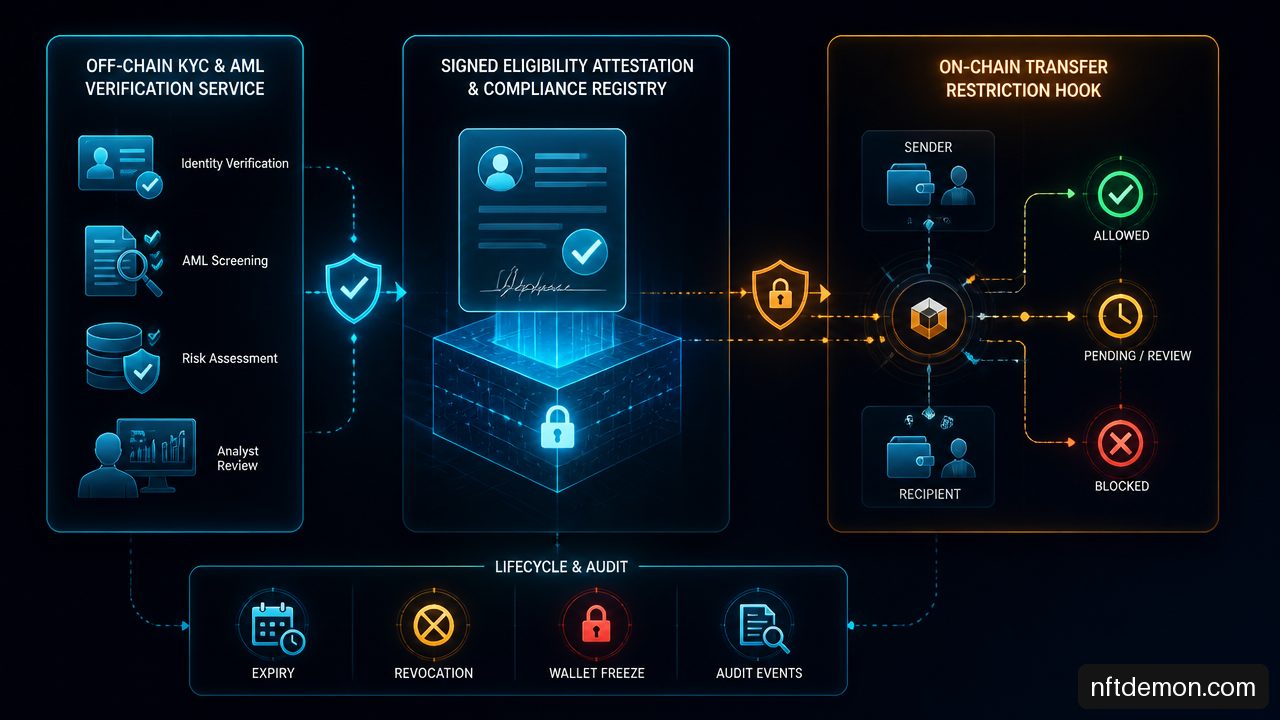
A forced transfer deserves special attention. Some regulated instruments require an issuer to recover assets from a lost wallet, fulfill an enforcement order, or process an estate event. That route should not silently bypass controls. It should use a separately authorized policy path, emit a dedicated event, require appropriately separated permissions, and preserve a reason reference for later audit.
The same principle applies to AI operated wallets. Permissioning frameworks for restricting AI agent crypto wallet spending limits are relevant because a verified entity can still delegate limited authority to an automated agent. Identity eligibility does not automatically authorize unlimited automated spending.
Use Restriction Codes Without Exposing Sensitive Reasons
The contract should return a small, stable set of machine readable
outcomes. For example, 0 may indicate allowed, while other
codes identify sender ineligible, recipient ineligible, expired
credential, wallet frozen, lockup active, jurisdiction prohibited, or
amount limit exceeded.
Do not put “sanctions match,” “adverse media,” or investigative details in a public error string. Those disclosures can create privacy, legal, and operational problems. A better approach is to return a neutral code such as “wallet unavailable for transfer,” then give authorized compliance staff a confidential correlation identifier through the off chain system.
Version the policy and log the decision context. A transfer event or rejection telemetry record should identify the token, sender, recipient, amount, restriction code, policy version, relevant credential version, and timestamp. The off chain system can then correlate that event to the underlying screening decision without publishing the evidence itself.
Operate For Revocation, Privacy, And Failure
Decide Fail Closed Or Fail Open Before An Outage
A hook cannot query a provider in real time, but it can encounter stale registry data, a delayed relayer, a signer outage, or an expired attestation. Decide in advance whether the system rejects or permits transfers in those states.
| Condition | Fail Closed Response | Fail Open Response | Decision Consideration |
|---|---|---|---|
| Credential expired | Reject transfer | Permit temporarily | Regulated instruments usually favor rejection |
| Provider outage | Continue using valid current attestation | Permit despite unknown status | Depends on remaining validity and legal risk |
| Revocation update delayed | Freeze exposed wallet or asset class | Allow until next update | Delay can create material compliance exposure |
| Monitoring alert unresolved | Hold or reject defined transfer type | Allow and review later | Depends on alert severity and transaction finality |
For most permissioned assets, fail closed is the defensible default once an authorization is expired, revoked, or indeterminate. It prioritizes compliance over liquidity. Yet this is a business and legal decision, not a universal technical rule. For example, a redemption obligation with a narrow settlement window may need an emergency, tightly governed exception path rather than an unrestricted fail open policy.
Document who may activate emergency controls, how long they last, what evidence is required, and how the action is reviewed. A global pause can be necessary, but it is a blunt instrument. Per wallet freezes, per asset controls, and controlled redemption routes usually offer more precise risk containment.
Centrifuge’s modular extension documentation describes Hook Managers that can automate account actions and interact with transfer restriction hooks. That modularity is valuable when operational systems must freeze, unfreeze, or whitelist addresses without repeatedly changing the core token contract.
Govern Wallet Binding And Administrator Authority
Wallet binding is where abstract compliance rules meet messy real operations. A verified person or institution may use several wallets. A wallet may be compromised. A custodian may hold assets for many beneficial owners. An investor may rotate keys after a security incident.
The registry should support controlled additions and removals rather than assume one identity equals one wallet forever. It should also prevent one wallet from being ambiguously assigned to incompatible profiles. For institutional holders, the authorized holder may be a legal entity, while transaction authority sits with one or more operational wallets. Model that distinction explicitly.
Use role separation for sensitive actions:
• A verification authority issues or renews eligibility claims.
• A compliance authority freezes or revokes a wallet.
• A policy authority changes transfer rules and thresholds.
• A security authority can pause under defined emergency conditions.
• A governance mechanism reviews high impact administrative actions.
Multi signature authorization, timelocks where appropriate, event logs, and narrowly scoped roles reduce the chance that one compromised administrator can rewrite the compliance perimeter. The correct design depends on response time requirements. A sanctions related freeze may need immediate execution, while a broad policy upgrade may warrant delay and review.
Test The Bypass Paths, Not Just The Happy Path
Testing should prove that policy enforcement is invariant across all
movement routes. A unit test showing an unverified wallet cannot call
transfer() is necessary but incomplete.
Build scenario tests for at least the following conditions:
- An eligible sender transfers to an ineligible recipient.
- An expired attestation is rejected after time advances.
- A wallet is frozen after approval and cannot send or receive under the defined policy.
transferFromcannot bypass sender and recipient checks through an allowance.- Minting cannot issue directly to an ineligible wallet.
- Bridge withdrawal cannot release tokens without recipient verification.
- An administrative recovery uses its distinct authority and emits its distinct audit event.
- A registry update cannot be front run to exploit an old or newly added status.
Also test the operational pipeline: delayed relayer messages, duplicate attestations, replayed signatures, revoked signers, policy upgrades, clock boundaries, and inconsistent states between registry and token. These are not exotic concerns. They are normal failure modes in systems that combine external compliance processes with irreversible transactions.
Finally, integrate the token policy with enterprise identity and record systems carefully. Blockchain integration architecture for ERP, CRM, and identity systems provides useful context for designing those system boundaries. The goal is not to mirror every enterprise record on chain. It is to create a reliable, auditable path from an approved off chain decision to a minimal on chain authorization.
Key Takeaways
• Put enforcement in the token movement path, not only in the application interface.
• Keep KYC evidence, screening results, and case notes off chain; publish only minimal, scoped eligibility claims.
• Treat KYC identity verification and transaction level AML risk assessment as related but separate controls.
• Use asynchronous verification, signed attestations, registry updates, and deterministic hook checks instead of attempted live API calls.
• Define expiry, rescreening, revocation, freezes, and outage behavior before launch.
• Cover every balance changing route, including delegated transfers, minting, burning, bridges, and administrative recovery.
• Make decisions observable through restriction codes, policy versions, and auditable event records without exposing sensitive investigative details.
FAQ
Should KYC And AML Screening Happen Inside The Smart Contract Transfer Hook?
No. The hook should enforce the current on chain authorization. Identity verification, screening, risk scoring, and case review should occur off chain, with the resulting eligibility or restriction status published to a contract readable registry.
Can A Solidity Contract Call A KYC Or Sanctions Screening API Directly?
Not in the ordinary web API sense. Contracts execute against blockchain state and cannot safely perform synchronous HTTP requests during transfer execution. Use an authorized relayer, oracle, signer, or registry update process instead.
What Should The Transfer Hook Verify On Chain?
Verify the claims necessary to make a deterministic transfer decision: wallet status, sender and recipient eligibility, credential freshness, revocation status, applicable lockups, policy version, and any on chain amount or holding limits.
How Often Should A Compliance Attestation Expire?
There is no universal interval. Set it based on asset liquidity, jurisdictional obligations, investor type, monitoring capability, and tolerance for stale data. Pair any expiration period with an immediate revocation path for material changes.
What Happens When A Previously Approved Wallet Becomes Sanctioned?
The compliance operation should revoke or freeze the wallet as quickly as its control design allows. The hook then rejects future movements according to policy. The incident process should also address pending settlements, linked wallets, custody exposure, and required reporting.
Is ERC 1404, ERC 3643, Or A Custom Hook Better?
Choose ERC 1404 for clear restriction diagnostics in simpler designs, ERC 3643 style systems for structured permissioned token architectures, and custom hooks where policy needs are specific. The best option is the one that makes every movement path enforceable and governance responsibilities explicit.
How Can A System Explain A Rejected Transfer Without Leaking Private Data?
Return a neutral restriction code and a general user facing message, such as expired authorization or recipient unavailable. Keep the detailed screening rationale in access controlled off chain records linked by a confidential reference identifier.
Sources
• EIP Tools + ERC 1404 — Simple Restricted Token: https://eip.tools/eip/1404
• Centrifuge Docs — Modular extensions: https://docs.centrifuge.io/developer/protocol/features/modularity/
• ChainScore Labs — How to Set Up Security Token Transfer Restrictions and Whitelists: https://chainscorelabs.com/guides/real-world-asset-rwa-tokenization/security-token-standards/setting-up-transfer-restrictions-and-whitelisting-systems
• ChainScore Labs — How to Implement KYC/AML On Chain for RWAs: https://chainscorelabs.com/guides/economic-impact-and-financial-systems/real-world-asset-tokenization/how-to-implement-kyc-aml-on-chain-for-rwas
NFT Demon Holdings helps enterprises scope, evaluate, and build blockchain programs — start with a free evaluation call.
Talk through your use case
Free evaluation call — objective, constraints, and fit, before any proposal.