Celebrity NFT launch, legal and technical controls
By Jeremy Ryan, Founder & CEO · November 2026
A credible celebrity NFT launch requires more than artwork, a recognizable name, and a mint page. When assessing what legal and technical controls should support a celebrity NFT launch, I recommend treating it as a coordinated consumer product, intellectual-property program, financial-risk review, and security deployment. The NFT itself may be simple. The surrounding promises, promotional campaign, rights chain, payment flow, and administrative controls are where most material risk sits.

- Build The Legal Control Architecture
- Engineer The Technical Control Architecture
- Operate The Launch As A Controlled Program
- Key Takeaways
- FAQ Section
- Sources And References
Build The Legal Control Architecture
The legal work should begin before a collection name, supply number, or promotional script is finalized. I would separate review into four decisions: the asset being sold, the sale mechanics, the marketing statements, and the obligations that continue after minting. That structure prevents a common error: approving artwork and celebrity likeness while leaving the economic claims and contract powers largely unreviewed.
Classify The Product Before Selling It
An NFT is not automatically a security. Still, its label does not resolve the legal question. The relevant analysis turns on design, circumstances, and what purchasers are led to expect. The Congressional Research Service notes that NFT advertising, contractual terms, copyright representations, valuation claims, and fractionalization can create separate legal risks, as explained in its Congressional Research Service report on NFT legal considerations.
I would ask counsel to document a product-classification memorandum before launch. It should test whether buyers are contributing value to a common enterprise while expecting profits primarily from the efforts of the celebrity, issuer, management team, or a continuing development organization. The answer depends on facts, not branding.
| Design Choice | Why It Raises Scrutiny | Practical Control |
|---|---|---|
| Fractional interests in a high-value NFT | Resembles shared exposure to an underlying asset | Obtain securities analysis before offering or promoting it |
| Promised buybacks or price support | Can create an expectation that the issuer will protect value | Avoid promises of floors, liquidity, or repurchase programs |
| Revenue sharing from licensing or media deals | May look like a passive economic return | Analyze as a possible regulated offering before launch |
| Ongoing team promises to increase resale value | Links purchaser profit expectations to managerial efforts | Focus communications on defined utility, not appreciation |
This is where the line between a digital collectible and an investment-style offering can become blurry. Consider a collection promoted as granting access to an album preview. That may be a consumer benefit. Add a statement that holders will share in future music revenue, receive periodic distributions, and benefit from management efforts to raise the floor price, and the structure changes materially.
For projects with fractionalization, revenue rights, pooled proceeds, or similar features, the decision may be to redesign the offering, limit availability, use an appropriate exemption, or not proceed. The broader issues are addressed in this guide to legal aspects of real-world asset tokenization, particularly where digital ownership starts to represent rights beyond a collectible.
Build A Rights Matrix, Not A Folder Of Releases
A celebrity may control their own name and likeness but not every asset included in an NFT. A photograph can involve photographer rights. A song can involve composition, sound-recording, performer, producer, and publisher rights. Sports footage, studio clips, fashion marks, archival interviews, and sponsor logos can each require separate permissions.
I recommend a written rights matrix that maps each asset to its legal owner, licensed use, territory, term, media, exclusivity status, approval process, and restrictions on blockchain use. It should include the public-facing assets and less obvious elements such as metadata descriptions, traits, thumbnails, promotional trailers, social posts, and marketplace banners.
| Asset Or Identity Element | Clearance Question | Control Evidence |
|---|---|---|
| Celebrity name, image, voice, signature | Does the issuer have express commercial NFT rights? | Executed name, image, and likeness license |
| Artwork and character designs | Who owns copyright and derivative-work rights? | Assignment or license with blockchain display rights |
| Music and audio clips | Are master and publishing uses both cleared? | Separate rights confirmation where applicable |
| Brand names and logos | Is the trademark use approved for the specific collection? | Trademark license and approval record |
| Collaborator appearances | Are likeness and publicity rights covered? | Talent release and territorial scope |
Publicity rights are predominantly governed by state law rather than a single comprehensive federal statute. Commercial use of a real person’s identity should therefore be cleared through an appropriate license, as outlined in Lowenstein Sandler’s analysis of publicity risks in NFTs. That license should explicitly cover minting, marketplace display, secondary-market display, advertising, social media, virtual environments, and any intended use of voice or synthetic likeness.
Buying an NFT should not silently transfer copyright. The consumer terms, metadata, marketplace listing, and marketing copy must say the same thing. If holders receive only a limited personal-display license, say so plainly. If commercial use is allowed, define the scope, revenue cap if any, prohibited uses, termination conditions, and whether the permission survives transfer.
Review Promotion As Its Own Legal Product
Disclosing compensation is necessary in relevant circumstances, but disclosure does not cure an otherwise misleading message. I would impose a separate review gate for every public claim involving scarcity, access, ownership, resale, royalties, future development, or value.
The reported litigation involving Cristiano Ronaldo and Binance illustrates why celebrity promotion can become central to consumer and investor allegations. The allegations are not findings of liability, but the Associated Press report on the Ronaldo Binance NFT lawsuit shows how public promotional activity can become a focal point in a dispute. Reporting by NBC News also connected the matter to the question of celebrity compensation disclosure when promoting securities or crypto assets in its coverage of the Ronaldo NFT promotion lawsuit.
A workable approval process should require signoff on campaign copy, captions, video scripts, livestream talking points, influencer briefs, affiliate terms, and community-manager responses. Statements such as “guaranteed access,” “only going up,” “royalties forever,” or “the team will make this valuable” should be blocked unless they are both accurate and legally supportable. Fair warning: even casual Discord or X posts can contradict carefully drafted terms.
Engineer The Technical Control Architecture
Legal promises become fragile when the smart contract and metadata do something else. The technical objective is simple: the collection must behave as described, and no individual administrator should be able to silently change material behavior.
Match Smart Contract Behavior To The Offering Terms
The smart contract should define the supply ceiling, mint price, mint timing, wallet limits, payment destination, transfer restrictions if any, and authorized administrative functions. I would not allow the legal team to review a prose summary alone. The deployed bytecode, verified source code, contract address, metadata behavior, and consumer terms should be reconciled before the mint opens.
A mismatch can be consequential. If terms promise a fixed supply of 5,000 but the contract owner can mint another 10,000 without restriction, the scarcity claim is technically incomplete. If the NFT promises a permanent benefit but the issuer can change metadata or revoke access without disclosed criteria, the buyer has not received what the marketing implied.
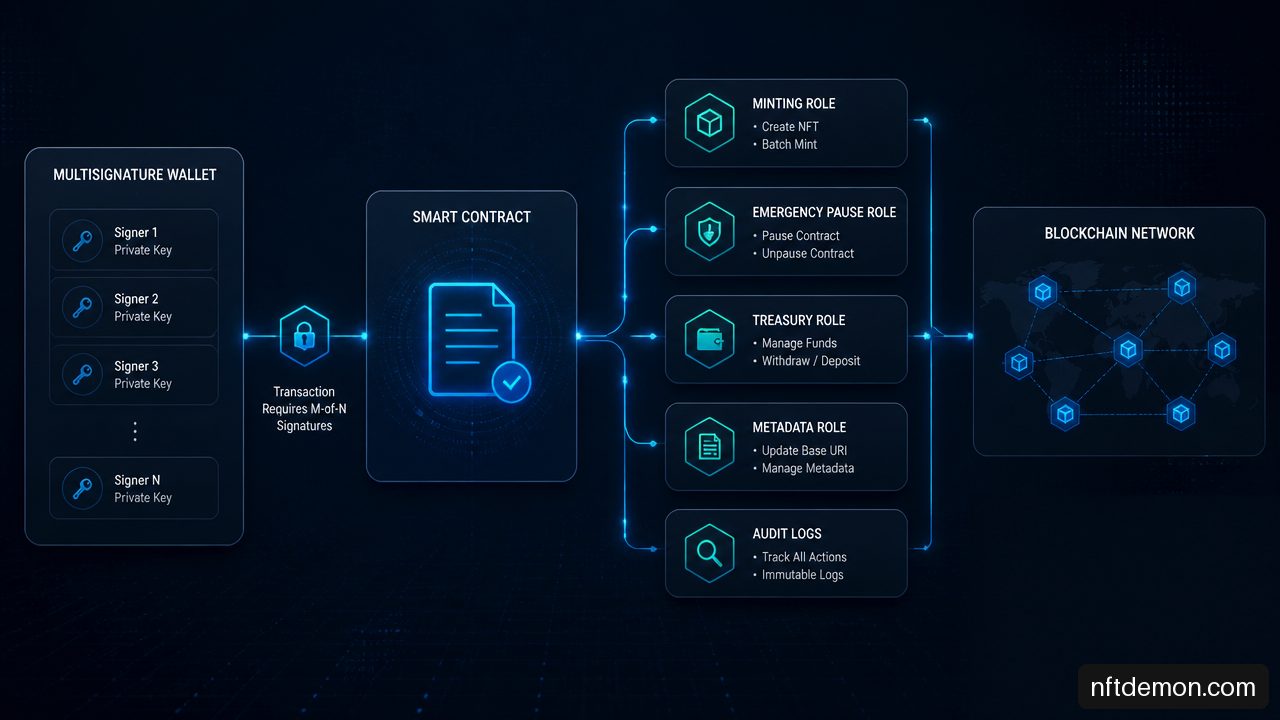
Use role-based access control to separate responsibilities:
• Mint administrator: Opens and closes mint phases within preapproved parameters.
• Pause authority: Can halt minting or transfers only under defined emergency conditions.
• Treasury authority: Moves proceeds only after required approvals.
• Metadata authority: Updates permitted fields while preserving an auditable record.
• Upgrade authority: Exists only if the collection genuinely needs upgradeability and buyers are told about it.
For a straightforward collectible, immutable logic is often easier to explain and less exposed to governance abuse. Upgradeable contracts may be appropriate where a real technical need exists, such as complex access integration, but they require stronger controls because an upgrade can change holder economics or permissions after sale.
Protect Privileged Keys And Treasury Movement
A single deployer wallet should not control minting, pausing, upgrades, metadata, and withdrawals. I recommend a multisignature wallet for privileged functions, with signers held by separate authorized parties and documented approval thresholds.
The governance design should answer practical questions before an incident occurs:
- Who can approve an emergency pause?
- How many approvals are needed to withdraw proceeds?
- Can the contract be upgraded after minting, and under what notice process?
- Where are recovery procedures stored if a signer loses access?
- Who can communicate publicly if a key is compromised?
A two-of-three multisignature arrangement may be practical for a smaller launch, but it can create continuity risk if one signer becomes unavailable and another is compromised. A larger project may use three-of-five approvals with separate keys held by the issuer, legal or finance leadership, technical leadership, and an independent security custodian. There is no universal threshold. The appropriate design depends on treasury size, urgency requirements, and whether the contract can cause irreversible harm.
Key custody needs a deployment runbook: hardware-backed key storage where feasible, signer identity verification, transaction simulation, documented address checks, and a prohibition on approving transactions from informal chat summaries. The launch team should rehearse the compromised-key scenario. If an attacker obtains a mint authority key, the recovery plan may require pausing eligible functions, revoking the affected role, publishing the official contract status, and preserving logs for investigation.
Make Metadata Durable And Auditable
Metadata is not decorative. It is the layer that tells wallets and marketplaces what the NFT is, what image or media it displays, and sometimes what benefit it represents. When metadata can change, the issuer should distinguish acceptable corrections from material changes.
Content-addressed storage can provide a useful integrity control because the content identifier changes if the referenced file changes. That does not eliminate all risk, but it helps detect silent alteration. A project can combine it with a controlled hosting strategy, redundant backups, and a published metadata policy.
I would define three categories in advance:
| Metadata Category | Example | Change Policy |
|---|---|---|
| Immutable core facts | Token ID, supply, original artwork hash | Never change after reveal |
| Correctable factual data | Misspelled trait name, broken display link | Correct with logged justification |
| Material holder terms | Access rights, commercial license, rarity classification | Do not change without explicit authority and notice |
Independent testing should cover more than whether a mint button works. It should test supply boundaries, payment calculations, failed transactions, reentrancy protections where relevant, allowlist proofs, wallet caps, pause behavior, withdrawal permissions, metadata links, and administrative role changes. An external security review may be prudent when code is custom, funds are substantial, or the contract includes upgrades, staking, token gating, or revenue allocation. An audit is not a guarantee. It is evidence that an independent reviewer examined a defined scope.
Operate The Launch As A Controlled Program
The most durable launches use control owners, written escalation paths, and preapproved public statements. The contract is only one component. Payment providers, marketplaces, customer support, community moderators, and the celebrity’s own channels create additional points of failure.
Control Eligibility, Bots, And Geographic Access
An allowlist can control who accesses a pre-sale phase, but it does not prove that every wallet belongs to a unique person. A determined actor can use many wallets in a sybil attack. The right level of friction depends on the collection’s objective.
For a low-cost public collectible, a modest wallet cap and transparent queue may be sufficient. For a limited, high-demand drop tied to exclusive benefits, stronger measures may be justified: wallet-age requirements, rate limiting, bot detection, signed eligibility records, purchase caps, delayed reveals, or identity checks where legally and commercially appropriate.
Avoid promising “fair access” unless the process has a defensible definition. A queue can fail. An allowlist can be leaked. A payment processor can decline legitimate buyers. Publish the eligibility rules, the recourse process, and the issuer’s discretion to cancel clearly abusive transactions.
Territorial restrictions should be designed at the product stage, not added as a footer after marketing begins. U.S. securities, consumer-protection, sanctions, privacy, payment, and marketplace rules may point to different availability decisions. If a launch excludes a jurisdiction, marketing teams must not target residents there, and technical controls should support the restriction where practical. Geoblocking alone is not a complete compliance strategy, but it may be one operational layer.
For programs with regulated features, compliance by design in tokenization offers a useful framework for embedding eligibility and transfer decisions into the product rather than relying solely on post-sale monitoring.
Define Liability Boundaries And Customer Terms
The issuer, celebrity, marketplace, wallet provider, payment processor, developer, and marketing agency should have clear responsibilities. A celebrity endorsement agreement should cover approval rights, required disclosures, prohibited statements, content takedown cooperation, indemnity allocation, and crisis communications. It should not assume the celebrity is responsible for code security or that the developer is responsible for every public statement.
Consumer terms should address at least the following:
• What the buyer receives and does not receive, including copyright and commercial-use rights.
• Mint price, cryptocurrency-payment volatility, taxes, fees, refund policy, and failed-transaction treatment.
• Supply, mint limits, reveal mechanics, and the possibility of technical interruption.
• Whether royalties are requested, how they are represented, and the fact that secondary-market implementation can vary.
• Platform dependence, wallet responsibility, prohibited uses, dispute process, and modification rights.
Royalty language deserves special care. A smart contract can express royalty information, but marketplaces may not uniformly honor it. The project should avoid representing royalties as guaranteed revenue to the celebrity or as a permanent obligation buyers can rely on across every resale venue.
If the economic design moves beyond a collectible, the analysis becomes more demanding. Decision-makers considering shared revenue, tokenized participation, or fractional interests should evaluate the specific framework for issuing regulated digital securities before publication, not after a campaign creates expectations.
Prepare For The First Bad Day
An incident-response plan should exist before public minting. It does not need to be theatrical. It needs named owners, decision authority, and a credible sequence of actions.
| Incident | Immediate Containment | Decision Owner | Public Communication Focus |
|---|---|---|---|
| Compromised privileged key | Pause affected functions and revoke role if possible | Technical lead and multisignature signers | Official contract status and buyer safety steps |
| Accidental over-mint | Stop minting and preserve transaction records | Contract owner and legal lead | Supply impact, remediation path, timing |
| Metadata error | Freeze nonessential changes and verify source files | Metadata owner and rights lead | What changed, what did not, and correction timing |
| Counterfeit collection | Report impersonation and publish verified contract address | Brand lead and marketplace liaison | How buyers identify the authentic collection |
| Bot-driven sellout | Preserve logs and assess rule enforcement | Operations lead and legal lead | Eligibility policy and complaint process |
The recovery decision should not be improvised in a group chat. For example, an emergency pause can protect buyers after an exploit, but using it for ordinary market volatility could undermine trust and contradict the collection’s stated decentralization or permanence. The plan should distinguish security containment from commercial disappointment.
Key Takeaways
• I would treat the NFT, promotion, payment flow, rights package, and post-sale operations as one connected launch program rather than separate workstreams.
• A documented rights matrix is the practical control that turns celebrity likeness, copyright, music, trademark, and collaborator clearances into an auditable approval process.
• Securities risk depends on the NFT’s design and promotion. Revenue rights, fractionalization, buyback language, and promises of managerial efforts require heightened scrutiny.
• Promotional disclosures matter, but they do not make unsupported scarcity, valuation, ownership, or resale claims safe.
• Smart-contract authority should be limited through role separation, multisignature approvals, testing, deployment verification, and a plan for key compromise.
• Metadata, terms, marketplace descriptions, and contract behavior should communicate the same holder rights. Inconsistency is both a technical and consumer-protection problem.
• A launch team should decide in advance how it will handle botting, counterfeit accounts, over-minting, wallet compromise, and marketplace or payment-provider disruptions.
FAQ Section
Does A Celebrity NFT Automatically Count As A Security?
No. The analysis depends on the structure and circumstances of the offering, including what purchasers are buying, how the NFT is marketed, and whether purchasers are led to expect profits from the efforts of others. A static collectible with clearly defined personal-display rights presents a different profile from a fractionalized NFT carrying revenue-sharing or buyback features.
What Rights Must Be Cleared Before Using A Celebrity’s Identity?
The project should clear the celebrity’s name, image, likeness, voice, signature, biography, and any other identifying element used commercially. It should also clear separate rights in photography, music, video, logos, fashion, sports footage, character art, and collaborator appearances. The exact license should define territory, duration, media, approval rights, and post-sale display rights.
Does Buying An NFT Transfer Copyright Ownership?
Usually, no. NFT ownership and copyright ownership are separate unless the governing terms expressly transfer copyright. Most projects should state whether holders receive a personal license, a limited commercial license, or no content license beyond necessary display of the NFT.
Which Smart Contract Functions Should Require Multisignature Approval?
At minimum, use multisignature approval for treasury withdrawals, mint-supply changes, role grants, upgrade authorization, emergency pause administration, and metadata controls capable of altering material information. The more irreversible or economically significant the function, the stronger the approval threshold should be.
How Should The Launch Handle Royalties On Secondary Sales?
Describe royalties as a requested or technically signaled payment mechanism, not as a universal guarantee. Marketplace policies and implementation can vary. Terms should identify the intended royalty rate, recipient, and limitations without suggesting that every future resale on every platform will produce a payment.
What Happens If A Deployer Key Is Compromised?
The response depends on contract design. A prepared team may pause affected functions, revoke the compromised role through a multisignature process, rotate authorities, verify the official contract address, preserve evidence, and notify holders. If the contract gives one key unrestricted control and lacks recovery options, remediation may be limited. That is why privileged-function design matters before launch.
Sources And References
• Congressional Research Service + Non-Fungible Tokens (NFTs): https://www.congress.gov/crs-product/R47189
• Lowenstein Sandler + A Haystack in a Hurricane: The Legal Risks of Depicting Real People in Your NFT: https://www.lowenstein.com/news-insights/publications/articles/a-haystack-in-a-hurricane-the-legal-risks-of-depicting-real-people-in-your-nft-savare-polito
• Associated Press + Cristiano Ronaldo faces $1B class-action lawsuit for promoting Binance NFTs: https://apnews.com/article/ronaldo-binance-lawsuit-nft-crypto-09a034a90785390800cbc254ce0a2f68
• NBC News + Cristiano Ronaldo sued for $1 billion after promoting NFTs from crypto exchange Binance: https://www.nbcnews.com/news/us-news/cristiano-ronaldo-sued-1-billion-promoting-nfts-crypto-exchange-binanc-rcna127451
NFT Demon Holdings helps enterprises scope, evaluate, and build blockchain programs — start with a free evaluation call.
Talk through your use case
Free evaluation call — objective, constraints, and fit, before any proposal.