Compliance by design in tokenization, build controls into every transfer
By Jeremy Ryan, Founder & CEO · October 2026
Compliance by design in tokenization means treating legal, privacy, and operational controls as product requirements from the first architecture decision. It is not a final review before launch. For decision makers, the practical objective is clear: make compliant behavior the normal system path, while ensuring exceptions are governed, evidenced, and legally enforceable.

- Define Compliance Before You Write Code
- Map Legal Obligations Across the Token Lifecycle
- Design the Control Architecture Around Identity, Privacy, and Exceptions
- Key Takeaways
- FAQ Section
- Sources/References
Define Compliance Before You Write Code
Compliance Is a Lifecycle Discipline
A token can represent a security, fund interest, bond, deposit claim, membership interest, receivable, or another contractual right. The blockchain record does not decide what the instrument is. Its economic purpose, legal documentation, issuer structure, investor rights, and distribution model do.
That distinction matters because a token labeled as a “utility” token may still be regulated as a financial instrument if its substance says otherwise. A Frontiers in Blockchain analysis of compliance by design and legal enforceability emphasizes that code cannot independently settle a token’s legal nature or enforceability against third parties. Smart contracts can automate rules. They cannot replace a legal claim, an enforceable agreement, or a valid regulatory structure.
For that reason, we should begin with the legal instrument and work inward toward the technical implementation. The U.S. Securities and Exchange Commission highlights the need to assess classification, responsible entities, governing agreements, token rights, and transfer characteristics when structuring tokenized financial instruments. The SEC’s tokenization discussion is useful here because it frames token design as more than a software decision.
The Difference Between Compliance By Design and Compliance After the Fact
Post transaction compliance asks whether a problematic transfer can be identified after settlement. Compliance by design asks whether the transfer should have been technically possible at all.
Consider a tokenized private fund interest. A post transaction process might review wallet activity, discover that a purchaser was ineligible, and then begin remediation. A compliance by design approach evaluates eligibility before settlement, records the relevant approval evidence, and blocks a transfer if the recipient fails a required rule.
| Design Approach | What Happens | Main Limitation or Benefit |
|---|---|---|
| Post transaction review | Monitoring identifies issues after settlement | May leave the issuer with remediation, legal, and reputational exposure |
| Wallet allowlisting only | Approved addresses can receive tokens | Does not necessarily prove beneficial ownership or current eligibility |
| Compliance by design | Identity, eligibility, transfer, reporting, and exception rules are built into workflows | Requires stronger governance, integrations, and testing before launch |
The goal is not to make every token permanently nontransferable. It is to make each permitted transfer meet the conditions that apply to that instrument, that holder, and that jurisdiction.
Start With a Legal and Product Requirements Trace
Before selecting a chain, wallet model, or token standard, create a requirements traceability record. This connects each legal obligation to a business rule, technical control, test case, operational owner, and evidence artifact.
A useful record might link a private placement transfer restriction to a smart contract transfer check, an investor registry, an eligibility credential, a failed transfer test, and a compliance approval log. If a rule changes, the organization can identify what needs to be updated and who must approve it.
This is where enterprise blockchain strategy consulting and compliance becomes a practical design concern rather than a policy exercise. Strategy should answer what the organization can lawfully issue, who can hold it, who can operate the system, and how evidence will survive scrutiny.
A useful test: If counsel changes a transfer restriction, can the product team identify the affected code, procedures, investor notices, tests, and records without reconstructing the project from memory?
Map Legal Obligations Across the Token Lifecycle
Translate Rules Into Specific System Functions
The highest value work in compliance by design is translation. Legal language often defines rights, prohibitions, conditions, and remedies. Systems need explicit inputs, decisions, actions, logs, and escalation paths.
The following lifecycle map is a decision framework, not a universal legal template. Requirements vary with the instrument, offering structure, jurisdictions, and regulated parties involved.
| Lifecycle Stage | Typical Compliance Question | Possible System Control | Evidence to Retain |
|---|---|---|---|
| Structuring | What is being issued and by whom? | Issuer and instrument configuration approval | Legal analysis, governing documents, board approvals |
| Onboarding | Is the investor identified and eligible? | KYC workflow, accreditation or suitability verification where relevant | Verification status, expiry dates, consent records |
| Wallet binding | Who controls this address and for whom? | Verified wallet association and beneficial owner record | Wallet attestation, custody account mapping |
| Issuance | Can this investor receive this amount? | Supply limits, eligibility check, allocation approval | Subscription record, issuance event, allocation log |
| Transfer | Is this transfer allowed now? | Sender and recipient screening, jurisdiction logic, holding limits | Decision result, rule version, transaction reference |
| Corporate action | Who is entitled to vote, receive income, or receive notices? | Record date snapshot and holder registry reconciliation | Snapshot, calculation outputs, notices |
| Redemption | Can tokens be burned and payment released? | Redemption validation and settlement workflow | Redemption request, burn record, payment confirmation |
| Suspension | Must activity stop immediately? | Freeze, pause, or transfer restriction authority | Trigger, authorization, scope, restoration decision |
KYC, AML, sanctions screening, monitoring, and reporting cannot be reduced to a single onboarding checkbox. Chainalysis notes that tokenized asset platforms may need holder KYC, wallet sanctions screening, suspicious transaction monitoring, and regulatory reporting. Chainalysis’s asset tokenization compliance overview supports that broader lifecycle view.
Separate Investor Eligibility From Wallet Ownership
A verified wallet is not automatically a verified investor. This distinction becomes critical when the holder is a custodian, nominee, fund administrator, corporate treasury, or omnibus account.
Suppose a regulated custodian holds a tokenized bond through one wallet for multiple underlying clients. The wallet may be approved, but the issuer may still need to know whether each beneficial owner meets holding restrictions, investor qualification rules, or jurisdictional conditions. The answer depends on the legal structure and intermediary obligations. A flat wallet allowlist is often too simple.
A more resilient model stores separate relationships:
• Legal holder: the entity recorded as holding the token or account.
• Beneficial owner: the person or entity with the economic interest, where disclosure is required.
• Wallet controller: the party able to sign transactions.
• Authorized delegate: a manager, adviser, custodian, or agent with limited authority.
This separation also makes wallet replacement manageable. If an investor loses access to a wallet, the organization needs a controlled process to verify identity, revoke the prior wallet association, approve a replacement address, and preserve the investor’s rights.
Handle Cross Border Transfers Before They Occur
Cross border distribution introduces overlapping questions: issuer location, asset location, investor residence, intermediary location, trading venue, and the jurisdictional reach of applicable rules. No single technical geofence resolves all of them.
Use a decision sequence before allowing a transfer:
- Identify the instrument’s legal classification in each relevant jurisdiction.
- Identify the issuer, manager, custodian, broker, transfer agent, and platform roles.
- Determine whether the recipient is eligible under the offering terms and local rules.
- Assess whether the transfer changes the distribution status, investor count, disclosure duty, or resale restriction.
- Define the evidence needed to show why the transfer was accepted or rejected.
In the European Union, tokenized financial instruments may remain within established financial market rules rather than automatically falling under a separate crypto asset regime. Cambridge University Press research on legal structures of tokenised assets examines this relationship between tokenized assets and EU regulatory categories.
Fair warning: jurisdictional analysis is not a one time launch task. A transfer to a new country, a new intermediary, or a new investor class can change the compliance question materially.
Design the Control Architecture Around Identity, Privacy, and Exceptions
Keep Sensitive Personal Data Off Chain
Public and broadly replicated ledgers are poorly suited to storing identity documents, home addresses, tax identifiers, detailed source of funds evidence, or raw screening results. Immutability is useful for proof and audit trails. It becomes a liability when personal data must be corrected, minimized, or protected.
A practical architecture usually keeps sensitive information in a controlled off chain system and puts only limited references or cryptographic proofs on chain. Depending on the design, the chain may hold a token balance, a credential status reference, a hashed identifier, a rule version, or a transaction event. The identity vault should hold the underlying personal data, documentary evidence, consent records, and decision rationale.
Verifiable credentials can support this approach. Instead of exposing a passport number or full investor file during each transaction, a credential may attest that the recipient has passed a specified eligibility check. The transfer service verifies the credential’s issuer, status, scope, and expiry date.
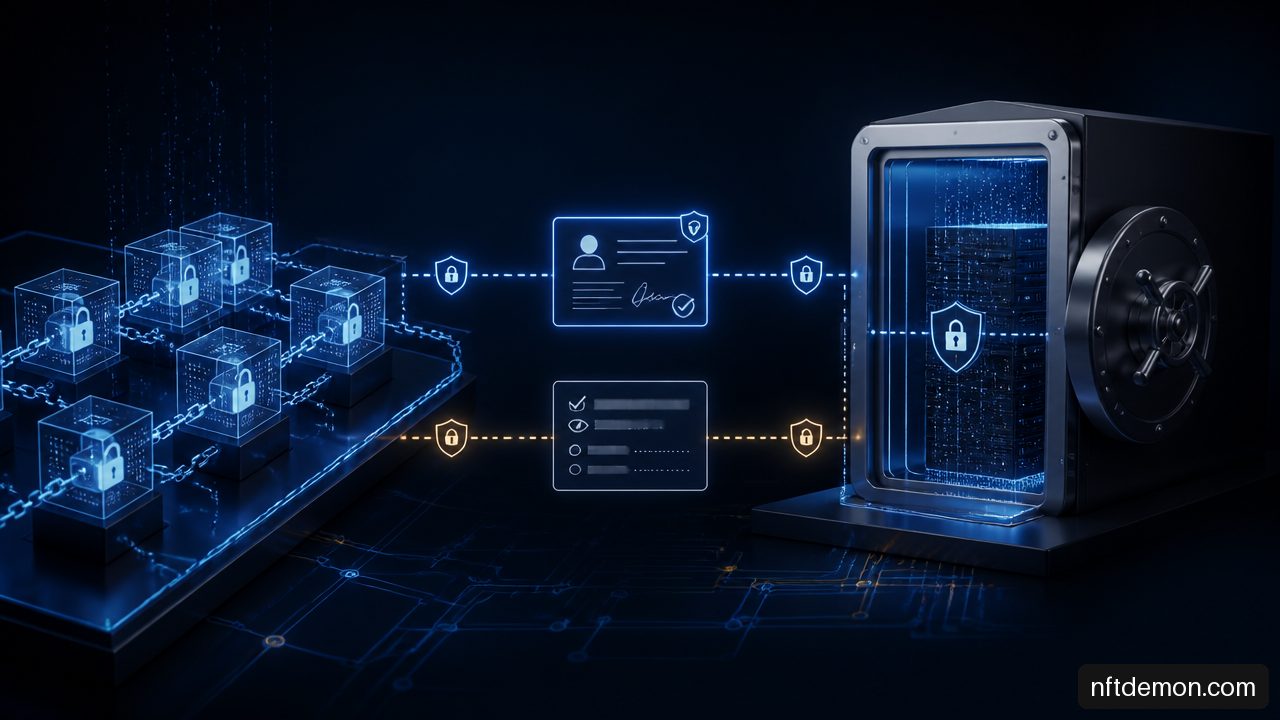
This is selective disclosure, not anonymity. Compliance teams must still be able to access necessary information through authorized procedures. The appropriate balance depends on applicable privacy standards, financial crime obligations, and the operational role of intermediaries.
Build for Failure Modes, Not Just Happy Paths
A transfer rule that works only when every service is available is not a complete control. Tokenized systems need preapproved operational responses for failure events.
| Failure Event | Immediate Control | Recovery Decision |
|---|---|---|
| Sanctions alert or confirmed match | Pause relevant transfers or wallet activity while escalation occurs | Determine whether to freeze, reject, report, or restore access under authorized procedures |
| Expired or revoked credential | Block new transfers and flag affected holdings | Reverify investor status, renew credentials, or apply contractual remediation |
| Lost private key | Disable prior wallet authority after identity verification | Bind a replacement wallet and migrate or reissue rights under documented authority |
| Erroneous transfer | Preserve evidence and prevent further unauthorized movement where possible | Assess contractual remedies, administrative powers, and legal enforceability before reversal |
| Oracle or screening service outage | Fail closed for regulated transfers or use a formally approved contingency path | Reconcile queued activity and document exceptions before final settlement |
The ability to freeze, burn, reissue, or reverse tokens is not simply a feature decision. It changes governance and investor expectations. Legal documents should specify who holds these powers, which events trigger them, what notice is required, and whether an independent approval is needed. Without that alignment, an “admin key” can become an ungoverned concentration of operational and legal risk.
Test the Controls and Govern Their Change
Testing should prove more than successful transfers. It should test whether prohibited paths fail reliably. This includes attempts to transfer to an expired credential, an unapproved wallet, an ineligible investor, a sanctioned address, or a recipient above a concentration limit.
A useful assurance cycle has four parts:
- Trace: Link legal requirements to product specifications, code modules, procedures, and ownership.
- Test: Run positive, negative, boundary, and outage scenarios in a controlled environment.
- Approve: Obtain documented legal, compliance, security, and operational signoff for material releases.
- Monitor: Review transfer exceptions, rule changes, credential expiry, administrative actions, and reconciliation breaks.
Smart contract upgrades deserve special caution. An upgrade can modify transfer logic, wallet permissions, or investor rights. For a token migration, preserve a snapshot of holdings, the applicable rule version, outstanding restrictions, and entitlement records. Then provide a documented migration path that does not silently alter the legal rights represented by the token.
Operational ownership matters as much as code. A durable blockchain operating model for ownership compliance assigns decision rights for rule changes, credential issuers, emergency pauses, access controls, incident escalation, and reconciliations. AML monitoring may also benefit from carefully governed analytics workflows, including AI-powered AML compliance tools, but automated risk signals should not replace accountable human review where a decision has legal consequences.
Key Takeaways
• Start with legal reality, not token terminology. The asset, rights, issuer, and offering structure determine the compliance design.
• Map every obligation to a lifecycle control. Issuance, transfer, corporate actions, redemption, suspension, and reporting all require separate decisions and evidence.
• Do not equate a wallet with an investor. Beneficial ownership, custody, delegated authority, and wallet control can be different relationships.
• Keep sensitive identity data off chain whenever possible. Use controlled systems, selective disclosure, encryption, and tightly governed access.
• Design exceptions before launch. Lost keys, sanctions events, credential revocation, incorrect transfers, and service outages are operating conditions, not hypothetical edge cases.
• Maintain proof that law and code match. Requirements traceability, test evidence, approvals, version histories, and operational logs create the record that a serious program needs.
FAQ Section
What Does Compliance By Design Mean in Tokenization?
It means embedding applicable legal, financial crime, privacy, investor eligibility, and operational requirements into the token product and its lifecycle workflows. Controls are designed before issuance rather than bolted on after a problematic transaction occurs.
Is a Tokenized Security Regulated Like the Underlying Security?
Often, yes. Tokenization does not automatically remove an instrument from the rules that apply to comparable traditional securities. The exact treatment depends on the instrument’s substance, rights, issuing structure, offering, and jurisdictions involved.
Which Rules Should Become Smart Contract Controls?
Rules that can be objectively evaluated at transfer time are strong candidates: approved recipient status, holding periods, transfer limits, jurisdiction flags, wallet permissions, and supply limits. Subjective judgments, investigations, and legal interpretation should remain in governed human workflows, even if system signals inform those decisions.
Can a Compliant Wallet Transfer Tokens to Another Wallet?
Not necessarily. The receiving wallet must be separately evaluated under the applicable rules. It may belong to a different controller, custodian, beneficiary, or jurisdiction. A compliant transfer model checks both sides of the transaction and the transfer context.
What Happens When an Investor Credential Expires?
The system should generally prevent new restricted activity until the credential is renewed or reviewed. Whether existing holdings can remain, be frozen, or be redeemed depends on the token terms, legal obligations, and the reason for expiry. Those outcomes should be documented before launch.
Can a Smart Contract Reverse an Erroneous Transfer?
It may be technically possible if the contract includes administrative authority, but technical possibility is not enough. Any reversal or reissuance should be supported by contractual terms, governance approval, evidence preservation, and a legal assessment of affected rights.
How Should Tokenized Assets Handle Multiple Jurisdictions?
Assess the issuer, asset, investor, intermediary, and transfer jurisdictions together. Then apply a rule set that identifies prohibited distributions, eligibility conditions, resale restrictions, reporting duties, and escalation points. When the answer is uncertain, block automated execution until authorized review occurs.
Sources/References
• U.S. Securities and Exchange Commission — Tokenization Takes on Financial Services and Capital Markets: https://www.sec.gov/files/ctf-written-antonio-lanotte-global-blockchain-business-council-051425.pdf
• Frontiers in Blockchain — Compliance by design or law by decree? A comparative analysis of tokenization: https://www.frontiersin.org/journals/blockchain/articles/10.3389/fbloc.2026.1934036/full
• Chainalysis — What Is Asset Tokenization? Definition, Process & Compliance: https://www.chainalysis.com/glossary/asset-tokenization/
• Cambridge University Press — Legal Structures of Tokenised Assets: https://www.cambridge.org/core/journals/european-journal-of-risk-regulation/article/legal-structures-of-tokenised-assets/5D3537D89F9AD858339424E1D60D7C43
NFT Demon Holdings helps enterprises scope, evaluate, and build blockchain programs — start with a free evaluation call.
Talk through your use case
Free evaluation call — objective, constraints, and fit, before any proposal.