What executives should include in a long term NFT strategy
By Jeremy Ryan, Founder & CEO · September 2026

What executives should include in a long-term NFT business strategy is not a list of blockchain features or a plan for a single digital collectible drop. I recommend treating NFTs as a controlled digital product category: one that may connect identity, access, intellectual property, customer loyalty, payments, and community engagement.
The central question is simple: what durable customer or operating value exists after the initial mint? If the answer depends primarily on resale excitement, scarcity rhetoric, or a short campaign window, the program may create attention without creating a sustainable business asset.
Start With A Business Model, Not A Token
An NFT is a unique blockchain token that can represent ownership, access rights, provenance, membership status, or a license. That technical definition matters, but it does not decide whether the product makes commercial sense. The token should be the delivery mechanism, not the strategy.
A better starting point is the business problem. For example, a hospitality group may need a portable membership credential that unlocks priority booking, event access, and partner benefits. A media company may need a way to authenticate limited digital editions and manage fan access. A manufacturer may need a digital certificate connected to a physical product’s provenance or servicing history.
Grant Thornton’s guidance on NFT business success supports this order of operations: define what the organization intends to accomplish first, then retrofit infrastructure and risk management around that objective. That sequence prevents a common failure mode: building a token program and trying to invent its purpose after launch.
Define The Durable Value Exchange
I would require every NFT proposal to state the value exchange in one sentence:
The customer receives a specific, usable benefit; the company receives a measurable commercial, operational, or relationship outcome.
That statement should be tested against the following decision model.
| Strategic Element | Executive Question | Strong Signal | Warning Sign |
|---|---|---|---|
| Customer value | What does ownership enable? | Access, service, verification, status, or rights | “It may increase in value” |
| Business outcome | What changes for the company? | Retention, verified demand, reduced fraud, licensing revenue | General brand awareness only |
| Time horizon | Does value persist after launch? | Benefits renew or evolve over time | Value expires once the campaign ends |
| Economic design | How is the program funded? | Product margin, membership revenue, partner funding | Reliance on speculative resale |
| Operational fit | Who operates the benefits? | Named owner and service workflow | No team owns fulfillment |
A tokenized membership may work when a company already has a credible benefit engine: events, priority inventory, education, partner offers, premium support, or authenticated goods. It is less likely to work when the organization has no ongoing service to offer and expects the NFT itself to create demand.
Separate Utility First Design From Investment Like Design
Executives should distinguish between an NFT designed as a consumer product and one that could be perceived as an investment oriented asset. There is no universal formula that eliminates legal risk. Regulatory analysis must reflect jurisdiction, marketing language, rights attached to the token, payment structure, and the broader facts of the offering.
Still, design choices matter. A utility first program generally focuses on consumable benefits and avoids emphasizing price appreciation, trading volume, passive income, or future profit expectations. Its communications describe what holders can do, not what they might earn.
| Utility First Design | Investment Like Risk Signals |
|---|---|
| Access to events, products, services, or content | Promotional emphasis on appreciation or returns |
| Benefits tied to active participation or membership | Promises of passive financial gain |
| Transparent limits on rights and redemption | Vague claims that a team will “build value” later |
| Pricing tied to product value and delivery costs | Scarcity engineered primarily to stimulate trading |
| Clear consumer terms and support channels | Marketing aimed at speculation rather than use |
Consider a sports organization issuing tokens that provide ticket presale access, merchandise authentication, and season long voting on nonmaterial fan experiences. That is easier to explain as a product and membership system than a token promoted as a chance to profit from the organization’s future efforts. The difference is not merely semantic. Product design, disclosures, and campaign messaging should all reinforce the same purpose.
Choose A Revenue Model That Survives Quiet Markets
A long-term NFT strategy should remain viable when trading activity is low. Executives should model at least three conditions: launch demand, normal demand, and weak demand. If the operating model collapses under normal or weak demand, it is not durable.
Potential revenue models include:
• Primary sales tied to limited products, memberships, or authenticated editions.
• Subscription or renewal fees for ongoing premium utility.
• Partner funded benefits, where third parties pay for access to a verified customer segment.
• Licensing revenue when rights are clearly structured and commercially managed.
• Cost reduction from provenance, entitlement verification, or fraud prevention workflows.
Secondary market royalties can be included, but they should be treated as uncertain upside rather than baseline operating revenue. Marketplace rules, transfer pathways, and technical enforcement can affect whether royalties are collected. A board level policy should decide whether portability, resale control, customer trust, or recurring revenue is the higher priority.
Build Governance Across Corporate Control Points
NFT programs fail when teams treat them as a marketing activation with a smart contract attached. A token can create obligations across product delivery, consumer protection, intellectual property, financial reporting, tax, data use, and cyber incident response.
KPMG’s 2022 framework identifies 10 dimensions for operationalizing an NFT strategy: digital rights, marketing, contracting, enabling technology, cyber protection, governance, talent, data, financial reporting, and tax and compliance. The KPMG inspired control framework is not the relevant source here, however, the broader executive lesson is clear: governance must be cross functional, not siloed. For long horizon planning, Built In’s executive NFT strategy guidance specifically supports thinking years ahead, combining utility and community engagement, establishing wallet infrastructure, and articulating regulatory positions before launch.
Establish Decision Rights Before Minting
Create a steering group with named decision rights rather than a loose advisory committee. The program owner may sit in product, digital, loyalty, or innovation, but key control functions should have formal approval gates.
| Control Point | Core Decision | Practical Evidence Required |
|---|---|---|
| Legal | What rights are sold and what promises are made? | Terms, disclosures, license language, marketing review |
| Finance | How are proceeds, liabilities, and royalties tracked? | Revenue policy, reporting workflow, audit trail |
| Tax | Which taxes apply across issuance and resale activity? | Jurisdictional analysis and transaction records |
| Cybersecurity | How are contracts, wallets, and admin keys protected? | Threat model, access controls, incident plan |
| Product | How is utility delivered and supported? | Service blueprint, owner, service levels |
| Data privacy | What wallet and identity data is collected? | Data map, retention policy, consent model |
| Brand | What behavior and content standards apply? | Messaging guardrails and escalation process |
A useful governance gate is simple: no mint occurs until the company can explain who owns each promise made to the holder. If an NFT includes event access, a team must own admission verification. If it includes digital content, someone must manage availability. If it includes partner benefits, contracts must define who pays, who fulfills, and what happens when a partner exits.
Make Intellectual Property Terms Readable
Many NFT disputes begin with an avoidable ambiguity: buyers assume they own the underlying art, brand, or commercial rights when they actually own a token associated with it.
Terms should state, in plain language:
• Whether the buyer receives ownership of the token only, a personal license, or commercial usage rights.
• Whether the holder may display the associated media publicly or use it in business activity.
• Whether derivative works, sublicensing, artificial intelligence training uses, or trademark use are permitted.
• What happens to access rights if the token is transferred, burned, lost, or stolen.
• Whether the issuer may update utility, retire services, or replace technical infrastructure.
KPMG’s NFT planning approach is not the source for this point. Instead, the IP Business Academy’s research project on NFTs in company IP strategy supports the need for actionable attention points on opportunities and risks for high level company decision makers. The executive implication is that IP language belongs in product design, not in a last minute legal appendix.
Treat Accounting And Tax As Design Inputs
Finance teams need transaction level visibility from day one. NFT proceeds may involve cryptocurrency conversion, deferred obligations for future utility, royalty reporting, refunds, token redemptions, and multi jurisdictional tax questions. Exact treatment depends on the facts and applicable standards, so companies should seek qualified accounting and tax advice before launch.
This changes product design. For instance, a perpetual membership with undefined future benefits may create more complex obligations than a clearly scoped annual access pass. A program that accepts only crypto may also create reconciliation and treasury processes that differ from familiar card payments. The finance function should therefore influence pricing, refund policy, utility duration, and payment rails early.
Design For Product Lifecycle, Security, And Retention
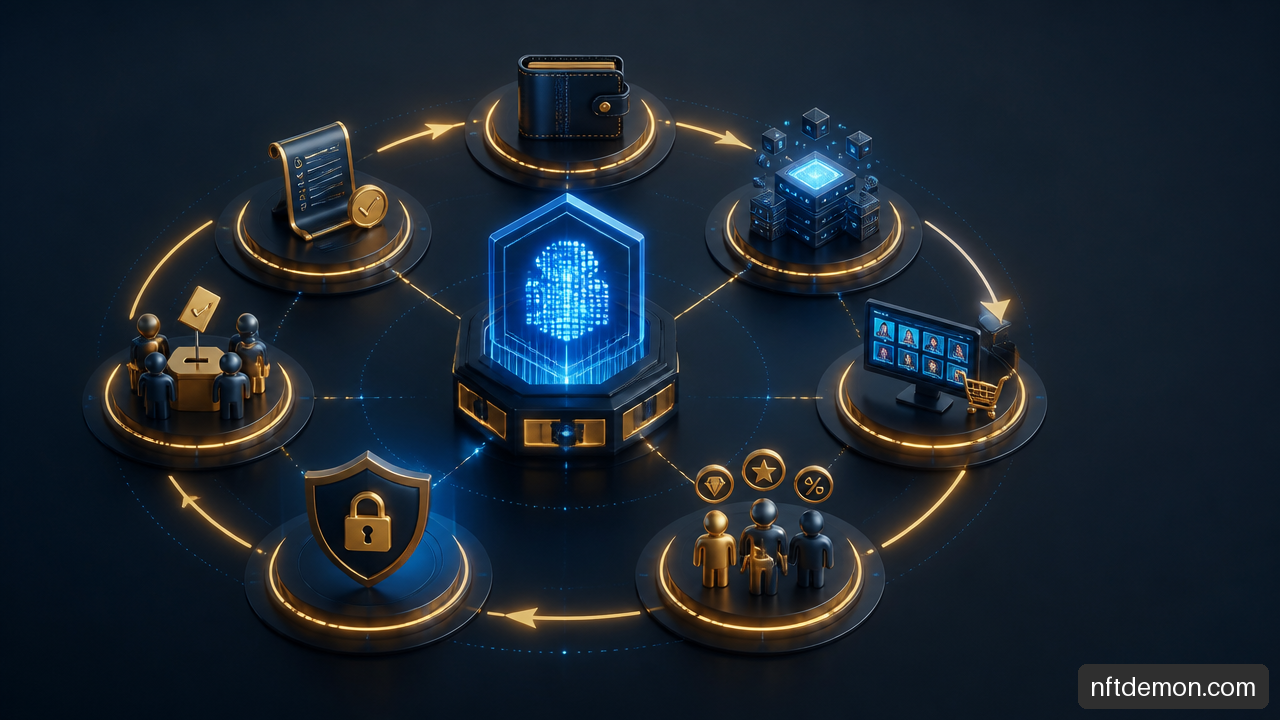
A durable NFT program needs a lifecycle plan. The token may be permanent on a blockchain, but the experience around it is not automatically permanent. Wallet providers change. Marketplaces alter policies. A hosting provider can fail. A smart contract may contain a flaw. A brand may discontinue the benefit that made the token valuable.
Plan For Platform Dependency And Metadata Persistence
An NFT usually points to media, attributes, or utility data stored elsewhere. If the media or metadata disappears, the token can remain visible while its practical meaning deteriorates. This is why executives should ask not just “Which chain should we use?” but “What must still work five years from now?”
A lifecycle plan should specify:
-
Chain selection: Evaluate security assumptions, transaction costs, developer availability, ecosystem support, and customer familiarity.
-
Metadata approach: Document where media and metadata are stored, who controls them, how changes are approved, and how continuity is maintained.
-
Marketplace contingency: Preserve the ability to communicate with holders and support transfers if a preferred marketplace changes fees, delists assets, or shuts down.
-
Migration policy: State whether the company can issue replacement tokens or new credentials if technology support changes.
-
Sunset policy: Explain what happens when utility ends, including notice periods, customer support, and archival access.
A luxury goods company, for example, may use an NFT as an authenticity credential. The credential should remain verifiable even if the company changes marketplace partners. The buyer’s proof of authenticity cannot reasonably depend on a marketing platform remaining in business forever.
Select Wallet And Custody Around The Customer Journey
Wallet design is a strategic customer experience decision. A self custody model may provide greater customer control, but it can also create support burdens involving lost access, phishing, signature confusion, and transaction errors. A custodial or embedded wallet can reduce friction, though it may increase the company’s operational responsibility and create additional privacy and security considerations.
Choose based on audience behavior:
• Use familiar embedded onboarding when the customer base is mainstream and the NFT is part of a broader loyalty experience.
• Consider self custody options when customers are already sophisticated digital asset users and portability is central to the value proposition.
• Avoid forcing wallet complexity where the customer receives no meaningful benefit from blockchain based ownership.
Security controls should include independent smart contract review where appropriate, multi party approval for administrative actions, protected key management, phishing education, transaction monitoring, and a tested incident response process. Fair warning: after a wallet compromise, technical recovery may be impossible. The response plan must focus on containment, customer communication, evidence preservation, and practical remediation options rather than assuming assets can simply be reversed.
Build Retention After The Mint
Community engagement should be designed as a retention system, not as a chat room attached to a launch. The objective is to give holders recurring reasons to remain active without making promises the business cannot sustain.
A useful retention cadence might include quarterly utility releases, partner privileges, product previews, recognition for participation, and optional renewal paths. Track whether holders actually redeem benefits, not just whether they hold tokens.
Jay Schulman’s enterprise NFT strategy outline supports defining revenue goals, customer engagement metrics, risk management, technical quality, and long-term utility planning before implementation. That emphasis is practical: an NFT program should be judged like a product portfolio, with adoption, service quality, retention, and unit economics measured over time.
Frequently Asked Questions
What Is The Best NFT Business Model For A Brand?
The best model is the one where token ownership improves an existing value exchange. Membership, authenticated products, ticketing, licensing, and premium access can work when benefits are credible and operationally supported. Avoid a standalone collectible model if there is no continuing utility, content, or customer relationship strategy behind it.
How Do Executives Decide Whether An NFT Is Utility First Or Speculative?
Review the holder benefit, marketing language, pricing logic, and expected source of value. A utility first NFT gives customers a defined use regardless of resale prices. A speculative design relies heavily on scarcity, trading, future appreciation, or vague promises that the issuer will create value later.
What Legal Risks Should Be Reviewed Before Launching NFTs?
Review consumer terms, intellectual property rights, advertising claims, securities related considerations, sanctions and anti money laundering exposure where applicable, privacy obligations, tax treatment, refund rules, and jurisdiction specific rules. Legal counsel should assess the complete offering, not only the smart contract.
How Should A Company Handle NFT Royalties?
Treat royalties as a policy choice with uncertain collection. Define the royalty rate, intended use of proceeds, marketplace assumptions, reporting process, and customer disclosures. Do not build the core financial model around royalties unless the company has verified that its selected transfer environments can support the intended approach.
What Happens If A Marketplace Changes Rules Or Closes?
The company should still be able to communicate with customers, verify ownership, deliver benefits, and support transfers through an alternative path. This requires a marketplace contingency plan, independent records of program terms, and a clear approach to metadata and wallet compatibility.
How Should Companies Protect Wallet Linked Customer Data?
Collect only the data required to deliver the product. A public wallet address may be visible on chain, but connecting it to a named customer, purchase history, location, or behavioral profile can create additional privacy obligations. Separate identity data from blockchain activity where feasible, define retention limits, and communicate the purpose of data collection clearly.
When Should A Company Avoid NFTs Altogether?
Avoid NFTs when conventional accounts, databases, tickets, or loyalty systems deliver the same outcome with less friction. A token is not automatically more trustworthy, more engaging, or more profitable. Use it when decentralized ownership, verifiable provenance, transferable rights, or interoperable credentials create a material advantage.
Sources
• Built In — VaynerNFT’s Head of Strategy: An Executive’s Guide to NFTs: https://builtin.com/blockchain/guide-to-NFT-VaynerNFT
• Grant Thornton — How to achieve NFT business success: https://www.grantthornton.com/insights/articles/media-entertainment/2022/how-to-achieve-nft-business-success
• IP Business Academy — NFTs in IP strategy of a company: New research project at MIPLM: https://ipbusinessacademy.org/research-project-nfts-in-ip-strategy-of-a-company
• Jay Schulman — NFT Digital Ownership: Enterprise Strategy and Business Implement...: https://jayschulman.com/blog/nft-digital-ownership-enterprise-strategy-and-business-imple
NFT Demon Holdings helps enterprises scope, evaluate, and build blockchain programs — start with a free evaluation call.
Talk through your use case
Free evaluation call — objective, constraints, and fit, before any proposal.