What components belong in a production ready enterprise blockchain architecture
By Jeremy Ryan, Founder & CEO · September 2026
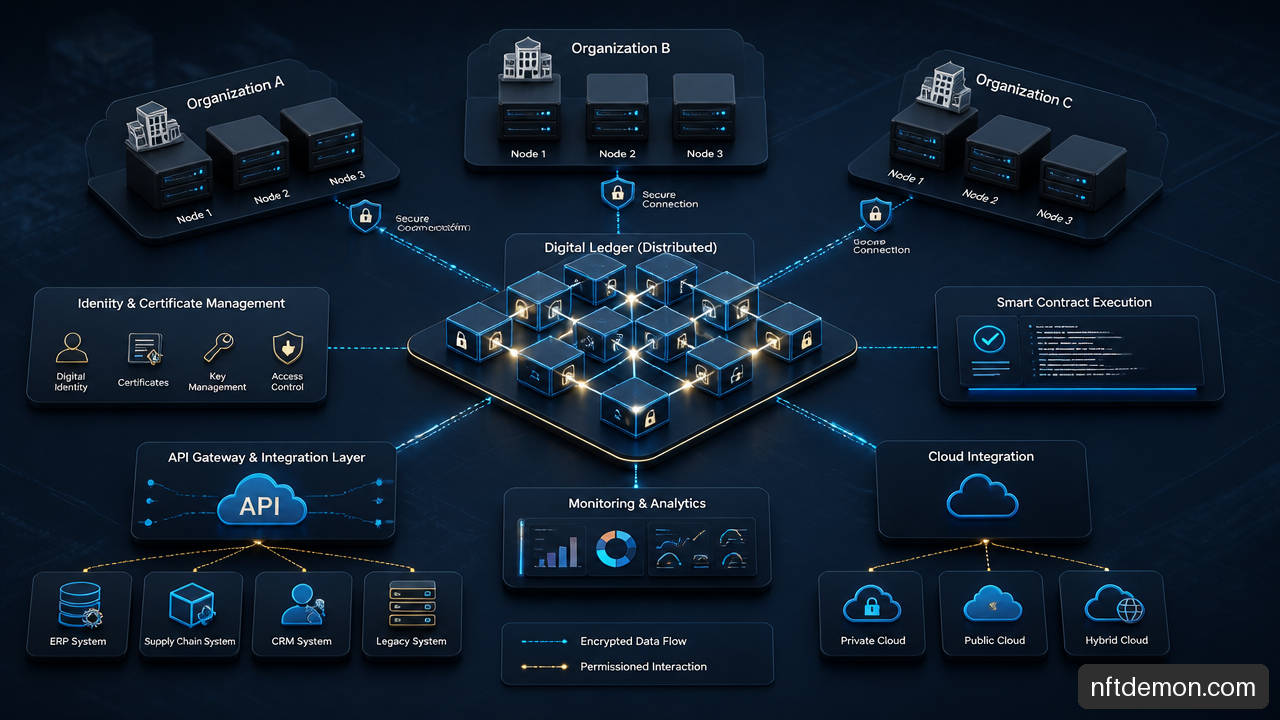
When decision makers ask what components belong in a production-ready enterprise blockchain architecture, the answer is broader than nodes, a distributed ledger, and smart contracts. A deployable system must combine shared transaction processing with identity controls, governance, enterprise integration, data rules, observability, recovery, and tested operating procedures. The chain is only one part of the system.
A useful rule is simple: if a component is required to prevent an unauthorized action, resolve a cross-company dispute, recover from a failure, or explain a business outcome to an auditor, it belongs in the architecture. It should not live only in a policy document or an implementation team's assumptions.
The Core Ledger And Execution Components
A production architecture starts with the functions that create a shared, verifiable record. ISO 23257 identifies recurring DLT functions that include ledger management, transaction ordering and consensus, node and network management, identity and key management, smart contract execution, APIs, integration interfaces, and operations functions. The standard treats operations and administration as first-class architecture concerns, not post-launch extras. See the ISO 23257 reference architecture overview for that functional model.
Ledger Management And Data Model
The ledger is the authoritative record of transactions that participants have agreed to share. It needs a deliberate data model, not a collection of fields copied from an existing database.
For each record type, define:
• The business asset or event it represents
• The permitted state transitions
• The organization or role permitted to submit each transition
• The evidence required to validate the transaction
• The parties entitled to view the data
• The retention and correction approach
Ledger immutability does not mean erroneous inputs become harmless. If a shipment status is posted incorrectly, the normal remedy is a compensating transaction that references the original record and records the correction. Deleting or silently overwriting history defeats the audit purpose of the ledger.
I would also separate the business state from the technical transaction state. A purchase-order dispute might remain open as a business matter even after the transaction that created it has achieved ledger finality. Conflating those states produces brittle workflows and confusing dashboards.
Consensus, Ordering, And Finality
The consensus mechanism determines how authorized nodes order transactions and agree on the ledger state. In an enterprise setting, the decision should follow the consortium's trust model, legal relationships, availability needs, and fault assumptions.
| Decision Area | Production Question | Architectural Consequence |
|---|---|---|
| Participant trust | Are node operators known legal entities? | A permissioned consensus model is usually appropriate. |
| Finality | When can downstream systems act on a transaction? | APIs and event consumers need finality-aware processing. |
| Fault tolerance | How many node failures or unavailable members can the network tolerate? | Topology, quorum rules, and failover plans must reflect that threshold. |
| Transaction throughput | Is demand steady, bursty, or deadline-driven? | Capacity testing must include peak and degraded conditions. |
| Governance | Who can add, suspend, or remove a validator? | Membership rules must be enforced through policy and administration controls. |
A common integration error is treating every emitted event as permanently settled. A receiving system may process an event, experience a timeout before recording its acknowledgment, and receive the same event again after retry. The correct design assumes duplicate delivery is possible at system boundaries.
Use an immutable business identifier, transaction identifier, idempotency key, and event sequence where the platform supports them. Downstream services should record processed events and reject duplicates safely. They should also distinguish “submitted,” “ordered,” “committed,” and “final for business use” states. The exact sequence depends on the platform, but the design principle does not.
Smart Contracts And Controlled Change
Smart contracts or chaincode encode shared business rules. In production, they require the same discipline as financial or safety-critical application code, with extra attention to irreversibility and multi-party approval.
A contract package should include:
-
A defined state model and permission model
-
Input validation, authorization checks, and predictable error handling
-
Threat modeling for privileged functions and unexpected state transitions
-
Independent code review and repeatable automated tests
-
Versioning, upgrade approval, migration, and rollback procedures
-
A business fallback when rollback cannot undo already committed transactions
Consider a contract that changes eligibility rules for a trade-finance workflow. Replacing the code may be technically simple, but existing records can be in states the new logic no longer recognizes. The migration plan must specify whether old records remain under the old rules, are transformed through an approved migration transaction, or are closed before the upgrade. “Deploy the new version” is not a production plan.
The Hyperledger Architecture Working Group's permissioned architecture taxonomy identifies consensus, smart contracts, communication, data store abstraction, crypto abstraction, identity services, policy services, APIs, and interoperation as distinct building blocks. That separation is useful because it prevents a single platform feature from being mistaken for the entire operating model.
Trust, Identity, And Governance Controls
Permissioned participation is not merely a login screen. It is a chain of trust that establishes who may operate nodes, submit transactions, approve changes, access restricted data, and perform emergency actions.
Identity Lifecycle And Key Management
Enterprise identity services should integrate with the organization's established user directory where practical, while still issuing network credentials that bind a participant, organization, role, and authorized attributes. An enterprise certificate authority and attribute-based access control are recognized infrastructure services in the enterprise blockchain reference system architecture description.
Architecture documentation should explicitly cover the full identity lifecycle:
• Identity proofing and approval before credential issuance
• Certificate, key, and wallet provisioning
• Role and attribute assignment
• Hardware security module or managed key service usage where warranted
• Key rotation schedules and certificate renewal
• Immediate revocation procedures for staff departures, compromised keys, and member suspension
• Emergency access with dual authorization and review logging
A key ceremony belongs here as well. It defines who generates sensitive keys, how custodians are approved, where recovery material is held, how access is logged, and how the organization proves no single individual can bypass agreed controls. This is architecture because it affects recoverability and trust, not just compliance paperwork.
Crypto abstraction is valuable when an organization needs to evolve algorithms or cryptographic modules without rebuilding every application component. That does not eliminate migration work, but it reduces unnecessary coupling between business logic and a single cryptographic implementation.
Policy Services And Consortium Governance
Governance becomes visible when the first incident, upgrade, or member dispute occurs. Until then, informal agreement can appear sufficient. It is not.
A production consortium needs named decision rights for:
| Governance Decision | Required Owner Or Approval Group | Technical Enforcement Point |
|---|---|---|
| Adding or removing a member | Membership authority | Identity issuance and node admission workflow |
| Changing endorsement or validation rules | Designated participant approval group | Policy service and contract configuration |
| Approving smart contract upgrades | Contract governance group | Version deployment and approval controls |
| Accessing restricted records | Data-rights owner | Attributes, channels, collections, or encryption rules |
| Declaring an incident | Incident commander and participant contacts | Support runbook and communications process |
| Executing disaster recovery | Recovery authority | Backup, node restoration, and quorum procedures |
Data rights should be resolved before records are written. Ask who may read, write, retain, export, correct, and disclose each data element. A consortium may agree that all members can see a product identifier but only the buyer and seller can view commercial terms. The network needs a technical mechanism that matches that agreement, whether that means restricted channels, private data patterns, application-layer encryption, or off-chain controlled storage.
Network Topology And Communication
The network topology defines where nodes run, which organizations operate them, how they communicate, and how the system behaves when a member becomes unavailable. Avoid concentrating all critical nodes under one administrative domain if the business purpose is shared trust across independent organizations.
At minimum, document:
• Node roles and organization ownership
• Geographic and cloud-region placement
• Network segmentation and firewall rules
• Secure peer communication and certificate validation
• Load balancing for APIs and event delivery
• Validator or ordering-node quorum requirements
• Member-exit and node-replacement procedures
The communication layer is not a commodity detail. It carries consensus messages, transactions, and ledger synchronization between nodes. Latency, packet loss, certificate failures, and partial partitions can all change application behavior. A production test should therefore include a node outage and a network impairment scenario, not only a clean throughput benchmark.
Data, Integration, And Interoperability Layers
Enterprise blockchain applications almost never operate alone. They connect to ERP platforms, CRM systems, warehouse tools, payment services, document repositories, analytics platforms, and identity providers. That makes the integration boundary one of the most likely locations for inconsistent state.
On-Chain, Off-Chain, And Retention Decisions
Put data on-chain when multiple parties need a shared, tamper-evident record and the information is appropriate for long-term replicated retention. Keep data off-chain when it is large, sensitive, frequently changing, subject to deletion requirements, or needed only by one party.
| Data Type | Usually Better Placement | Reason |
|---|---|---|
| Asset identifiers and status changes | On-chain | Participants need a shared history of state transitions. |
| Large media files or engineering documents | Off-chain with on-chain hash or reference | Replication is inefficient and access may need tighter control. |
| Personal information | Minimized or off-chain | Privacy, disclosure, and retention obligations may conflict with broad replication. |
| Contract terms visible to limited parties | Restricted ledger data or encrypted off-chain storage | Access rights may differ across consortium members. |
| Analytics copies | Off-chain data platform | Reporting workloads should not burden transaction processing nodes. |
An on-chain hash can prove that an off-chain document has not changed from the referenced version, but it does not guarantee the document remains available. The architecture therefore needs repository durability, access controls, retention schedules, backup procedures, and a policy for what happens when a document is legally deleted or access must be withdrawn.
APIs, Event Processing, And Replay Protection
API gateways, message brokers, event consumers, and workflow middleware translate ledger events into enterprise actions. They should be treated as reliability components, not simple connectors.
A sound integration layer provides:
• Authenticated API access and scoped service identities
• Schema versioning and compatibility rules
• Idempotent commands and event consumers
• Dead-letter handling for messages that cannot be processed
• Retry behavior that does not create duplicate business actions
• Correlation identifiers across blockchain, middleware, and enterprise applications
• Reconciliation jobs that compare ledger state with system-of-record state
For example, a ledger event may instruct an ERP system to release payment. If the ERP call succeeds but the middleware process crashes before recording success, a retry must not release payment twice. The receiving service should enforce an idempotency key, while reconciliation detects and resolves any state mismatch. This is a business-control issue, not merely a software-engineering preference.
Interoperability And Abstraction
Interoperability should be designed where it is economically justified, not added as vague future-proofing. A network might need to exchange verified status with another ledger, share data with a regulator, or migrate an application component without rewriting all integrations.
Data store abstraction and crypto abstraction reduce dependence on a specific underlying service. An API abstraction layer can similarly prevent every ERP integration from coupling directly to one vendor's transaction format. However, abstraction adds operating cost and can conceal platform-specific behavior such as finality timing or privacy constraints.
Choose abstraction when multiple systems are expected, regulatory portability is material, or a platform change would create unacceptable business disruption. Avoid excessive generalization when a tightly scoped deployment has one stable ledger and a short, well-defined lifecycle. The objective is controlled change, not theoretical portability.
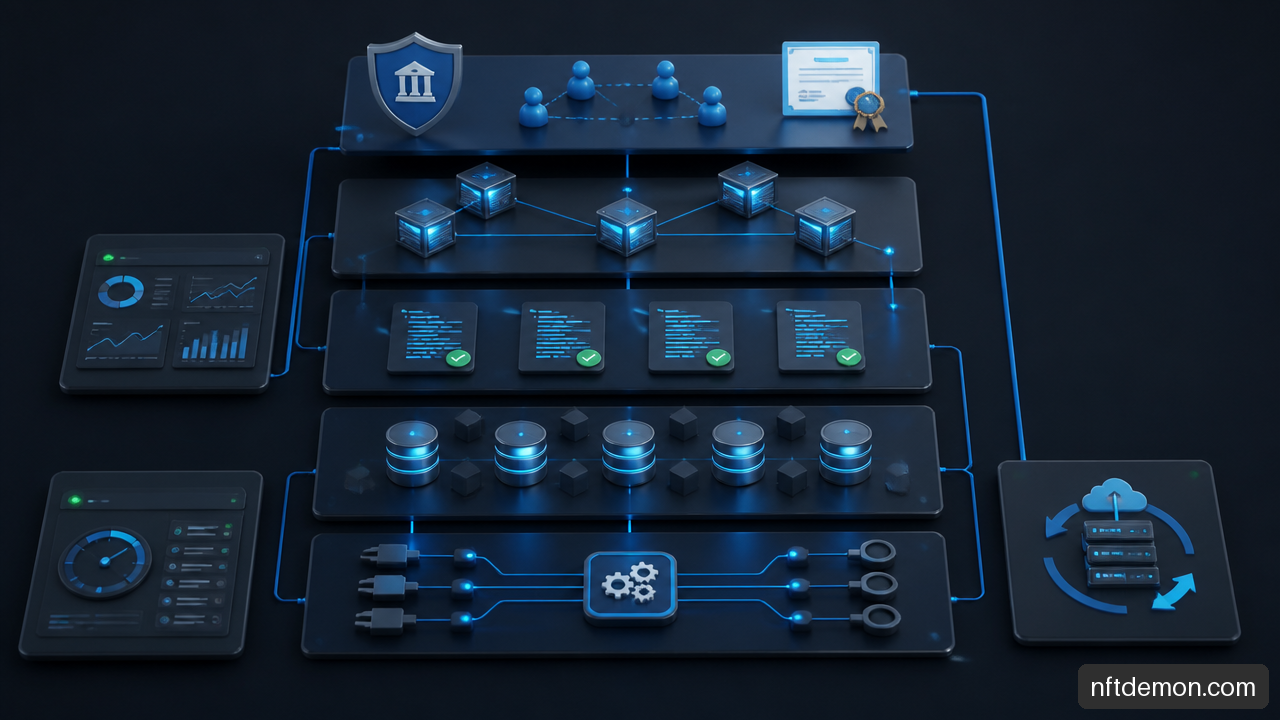
An OMG cloud customer architecture for blockchain also places the enterprise user directory, enterprise applications, and enterprise data around the blockchain environment. That framing is useful: blockchain should be designed as part of an existing operating estate, not as an isolated technology island.
Operations, Resilience, And Production Readiness
A production-ready enterprise blockchain architecture has an operating model that can detect problems, preserve evidence, restore service, and coordinate multiple organizations during an incident.
Cross-Layer Observability
Node uptime alone is not enough. A node can be healthy while transactions queue, a certificate nears expiration, an event consumer fails, or a smart contract rejects a new class of transactions.
I recommend one observability model spanning these signal groups:
• Business signals: transaction acceptance rate, exception volume, workflow completion time, and reconciliation failures
• Ledger signals: block or transaction commit status, finality delay, rejection reasons, backlog, and synchronization lag
• Node signals: availability, CPU, memory, disk capacity, peer connectivity, and certificate status
• Integration signals: API latency, failed deliveries, retry volume, dead-letter queues, and duplicate-event suppression
• Key and security signals: privileged actions, failed authentication, key rotation status, revoked credentials, configuration changes, and anomalous access patterns
Logs need synchronized timestamps, correlation IDs, tamper-resistant retention, and clear access rights. When a dispute occurs, the organization should be able to trace a business request from the user action through middleware, smart contract execution, ledger commitment, and downstream system update.
Backup, Recovery, And Failure Design
Disaster recovery is not satisfied by a backup job. It requires proof that the network can restore its critical functions within the business recovery objectives.
Test at least these cases:
-
Loss of one noncritical node
-
Loss of a validator, ordering, or consensus participant within the permitted fault threshold
-
Credential compromise followed by revocation and reissuance
-
Corrupted or unavailable off-chain document repository
-
A failed smart contract upgrade requiring containment or rollback procedures
-
Member departure, including data-access changes and node decommissioning
-
Regional outage affecting a cloud deployment zone
Capacity tests should mirror the proposed production topology. A single-node test environment cannot reveal quorum behavior, cross-region latency, certificate-chain issues, or the operational friction of coordinating several members. Fair warning: there is no universally correct transactions-per-second target. A claims-processing network handling complex validation may prioritize predictable finality and auditability over raw transaction throughput. A retail token platform may make the opposite trade-off.
Go-Live Gates That Can Fail
Production readiness should be expressed as pass-or-fail evidence, not a slide labeled “ready.” An enterprise guide on production enterprise blockchain architecture summarizes the ISO-style functional view and emphasizes governance, identity, monitoring, recovery, and integration as part of the production system.
A practical go-live package should demonstrate:
• Signed governance, data-rights, and member-responsibility approvals
• Tested identity issuance, rotation, revocation, and emergency-access procedures
• Threat-modeled and reviewed smart contracts with approved upgrade controls
• Finality-aware integrations that pass duplicate-event and partial-failure tests
• Capacity evidence under expected load and degraded node conditions
• Recovery drills with measured outcomes against business objectives
• Monitoring dashboards, alert thresholds, escalation paths, and support coverage
• Runbooks for incidents, member exit, certificate expiry, node replacement, and contract failure
A production blockchain is ready when its operators can explain not only how a transaction succeeds, but how the system responds when identity, connectivity, code, data, or governance fails.
Key Takeaways
• A production-ready enterprise blockchain architecture combines the ledger, consensus mechanism, smart contracts, nodes, identity services, policy controls, APIs, integration middleware, off-chain data services, and operations tooling.
• Permissioned networks require lifecycle controls for identities and keys, including issuance, rotation, revocation, recovery, and emergency access.
• Consensus decisions matter because they define finality, fault tolerance, and how integration systems must handle retries and duplicate events.
• Smart contracts require controlled versioning, migration plans, approval workflows, and compensating procedures for committed transactions.
• Data placement must reflect privacy, retention, disclosure, performance, and availability requirements. A hash reference is not a substitute for off-chain repository governance.
• Consortium governance needs technical enforcement points for membership, data rights, upgrades, incident response, and disaster recovery.
• Production readiness is demonstrated through drills and evidence: degraded-mode capacity tests, recovery exercises, identity revocation tests, and replay-aware integration tests.
Frequently Asked Questions
What Components Must Be Permissioned In An Enterprise Blockchain?
Participant identities, node admission, transaction-submission rights, smart contract administration, access to restricted data, and governance actions should be permissioned. Public visibility may be appropriate for selected proofs or verification records, but enterprise workflows generally require authenticated entities and enforceable roles.
What Should Go On-Chain Versus Off-Chain?
Put shared state changes, integrity proofs, and records requiring multi-party auditability on-chain. Keep large files, sensitive personal data, mutable operational data, and analytics workloads off-chain unless there is a specific reason to replicate them. Use references or hashes only when the off-chain repository has its own availability and retention controls.
How Should We Handle Duplicate Transactions And Replay Issues?
Use idempotency keys, unique business identifiers, transaction correlation IDs, event-processing records, and reconciliation processes. Integrations should assume a message may be delivered more than once or that a downstream system may succeed before the upstream process records the result.
Do Smart Contracts Need Rollback Controls?
They need an approved change and containment strategy, though a literal rollback may not be possible after transactions are committed. The plan may involve a contract upgrade, migration transaction, pause authority, compensating transaction, or a business process that resolves affected records under documented rules.
What Monitoring Is Required Before Go-Live?
Monitor business outcomes, ledger commitment and delay, node health, API and event-processing failures, certificate status, privileged actions, security events, and recovery indicators. Alerts should route to accountable teams with documented escalation paths rather than merely populate a dashboard.
How Should A Consortium Handle Member Exit?
The governance agreement and architecture should define who approves the exit, how credentials are revoked, when nodes are decommissioned, what data the departing member retains, how quorum is preserved, and how affected contracts or access rules are updated. This procedure should be rehearsed before it is needed.
What Testing Proves Production Readiness?
No single test proves readiness. The strongest evidence combines functional testing, smart contract review, identity lifecycle drills, integration retry tests, load tests on production-like topology, node-failure exercises, disaster-recovery restoration, security validation, and formal go-live approval against stated criteria.
Sources And References
• ISO Library — ISO 23257: Blockchain and DLT - Reference Architecture: https://iso-library.com/standard/23257/
• Hyperledger Architecture, Volume 1 — Hyperledger Architecture Working Group: https://8112310.fs1.hubspotusercontent-na1.net/hubfs/8112310/Hyperledger/Offers/Hyperledger_Arch_WG_Paper_1_Consensus.pdf
• PMC — Blockchain Reference System Architecture Description for Enterprise Applications: https://pmc.ncbi.nlm.nih.gov/articles/PMC7696017/
• OMG — Cloud Customer Architecture for Blockchain: https://www.omg.org/cloud/deliverables/CSCC-Cloud-Customer-Architecture-for-Blockchain.pdf
• kryptomindz.com: https://kryptomindz.com/guides/enterprise-blockchain-architecture-guide/
NFT Demon Holdings helps enterprises scope, evaluate, and build blockchain programs — start with a free evaluation call.
Talk through your use case
Free evaluation call — objective, constraints, and fit, before any proposal.