Web3 brand strategy focused on customer engagement and measurable outcomes
By Jeremy Ryan, Founder & CEO · November 2026

A web3 brand strategy focused on customer engagement and measurable outcomes is not a token launch plan. It is a customer strategy that uses decentralized infrastructure only where it creates a better reason for people to return, participate, share feedback, or spend more over time.
For decision makers, the question is simple: what customer behavior should this program change, and how will we prove it changed? If that answer is vague, a branded NFT, loyalty token, or token gated community can become an expensive novelty. If it is specific, Web3 can provide direct participation, portable membership, transparent rewards, and new feedback loops that conventional loyalty systems often struggle to create.
- Build A Customer First Web3 Strategy
- Design Engagement Around Real Customer Value
- Measure Outcomes, Not Wallet Activity Alone
- Key Takeaways
- Frequently Asked Questions
- Sources And References
Build A Customer First Web3 Strategy
A useful Web3 strategy starts with a business problem, not a chain, marketplace, wallet provider, or token format. I recommend defining the program around one audience, one target action, and one commercial or customer outcome before selecting technology.
For example, a media brand may want paid subscribers to attend more live events. A consumer brand may want repeat buyers to submit product feedback. An entertainment company may want fans to move from passive social follows to verified membership and early access. These are different jobs, so they require different incentives, UX flows, and measurement plans.
A decentralized feature is only justified when it improves the exchange between the brand and the customer. That may mean portable proof of membership, transparent reward eligibility, co creation rights, token gated access, or a collectible that carries status across multiple experiences.
Start With Positioning And Customer Motivation
Before choosing an NFT, token, or community platform, define the promise in customer language. “Join our Web3 community” is not a promise. “Get early access to limited releases and influence which designs return next season” is a promise.
Practitioners discussing Web3 marketing have emphasized the same basic discipline: clear positioning and customer motivation should come before selecting Web3 marketing tactics. That advice is especially relevant when leadership is being presented with a technology led proposal. A customer does not wake up wanting to connect a wallet. They want access, recognition, participation, utility, entertainment, or a better deal.
I would frame the strategic decision around four questions:
- Who is the narrowest valuable audience? Define a group with a shared need, such as repeat customers, premium subscribers, collectors, event attendees, or members of a creator community.
- What behavior matters most? Choose a behavior that can be observed, such as completing onboarding, purchasing again, attending an event, contributing feedback, referring a qualified user, or voting on a product decision.
- What value does the customer receive? The benefit should be immediate enough to justify enrollment and durable enough to encourage return behavior.
- What business result should improve? Tie the program to activation, retention, repeat purchase, referral quality, support cost, customer lifetime value, or incremental revenue.
This structure prevents a common failure mode: treating the blockchain record as the product. It is not. The record is infrastructure. The customer experience is the product.
Choose The Right Participation Mechanism
Not every customer engagement problem requires the same Web3 mechanism. A branded digital collectible may work well for recognition and membership. Token gated access may be stronger when the objective is recurring participation in premium content, events, or product drops. A governance process can make sense when customers have credible input into a product roadmap or creative direction.
| Mechanism | Best Fit | What To Measure | When To Avoid It |
|---|---|---|---|
| Digital collectible | Status, membership, event attendance, recognition | Claim rate, repeat participation, holder retention, downstream purchase behavior | When the collectible has no clear benefit after minting |
| Token gated access | Premium experiences, education, communities, limited releases | Access usage, return visits, conversion to paid products, renewal | When wallet ownership creates unnecessary barriers for casual users |
| Points or token rewards | Repeated actions, referrals, contributions, loyalty behavior | Completion quality, fraud rate, repeat behavior, reward redemption | When incentives can attract low quality activity more easily than valuable customers |
| Community voting | Product input, creative participation, member ownership | Eligible voter participation, proposal quality, implementation follow through | When leadership is unwilling or unable to honor meaningful input |
For brands working across consumer experiences, a focused enterprise NFT strategy with measurable outcomes can help clarify whether digital ownership is being used for access, loyalty, provenance, community participation, or a combination of these roles.
Fair warning: combining every mechanism in a single launch is usually a mistake. The more steps a participant must understand, the harder it becomes to identify why they abandoned the experience. Start with one clear value exchange, then expand only after evidence supports it.
Treat Identity, Consent, And Privacy As Core Design Work
Wallet activity is a behavioral signal. It is not proof of customer identity, intent, or value.
One customer may use several wallets. Multiple people may share a custodial wallet. A wallet may belong to an automated reward collector rather than a real customer. Conversely, a valuable customer may refuse to connect a wallet because they do not want an unfamiliar technical requirement attached to a purchase.
That is why wallet to CRM identity resolution should be voluntary and purpose limited. A sound flow explains what will be connected, why it is needed, what benefits the customer receives, and how the data will be used. The brand should store only the information required to operate the program and respect the customer’s ability to withdraw from marketing communications where applicable.
A practical identity model often separates three layers:
• Anonymous on chain activity: A wallet claims, votes, transfers, or accesses a token gated experience.
• Consented customer identity: A customer chooses to associate an email address, account, or loyalty ID with a wallet for a stated benefit.
• Business reporting identity: Aggregated reporting connects program participation to outcomes without exposing more personal data than the analysis requires.
This distinction protects both trust and analytical accuracy. A wallet count may reveal product adoption. It cannot, by itself, tell leadership whether the program acquired high value customers, retained existing customers, or merely rewarded people who were already highly engaged.
Design Engagement Around Real Customer Value
The strongest Web3 programs make participation feel useful before they ask participants to learn new technical behavior. That requires reducing friction and designing rewards around durable value rather than short term speculation.
Map The Customer Journey, Including Technical Friction
Every added technical step is a funnel stage. Wallet creation, email verification, signature approval, gas fees, recovery phrases, bridge transactions, and unclear network prompts can all reduce conversion. Measuring only the final mint or claim hides the real problem.
Consider a fan membership experience. A customer sees a campaign, creates an account, receives a wallet, claims a membership collectible, and uses it to access an early ticket window. If completion falls sharply after wallet setup, the issue may not be the reward. The issue may be an unfamiliar onboarding flow, unclear privacy language, or a transaction prompt that appears risky.
Track the journey as a sequence:
- Invitation viewed
- Landing page engaged
- Account created or authenticated
- Wallet connected or wallet created
- Signature or transaction approved
- Membership, reward, or collectible claimed
- Benefit redeemed
- Target behavior repeated
The useful operational question is not “How many wallets connected?” It is “At which step do qualified customers stop, and why?” A short customer survey, support ticket review, session replay tools, and usability testing can reveal the reason behind the numbers.
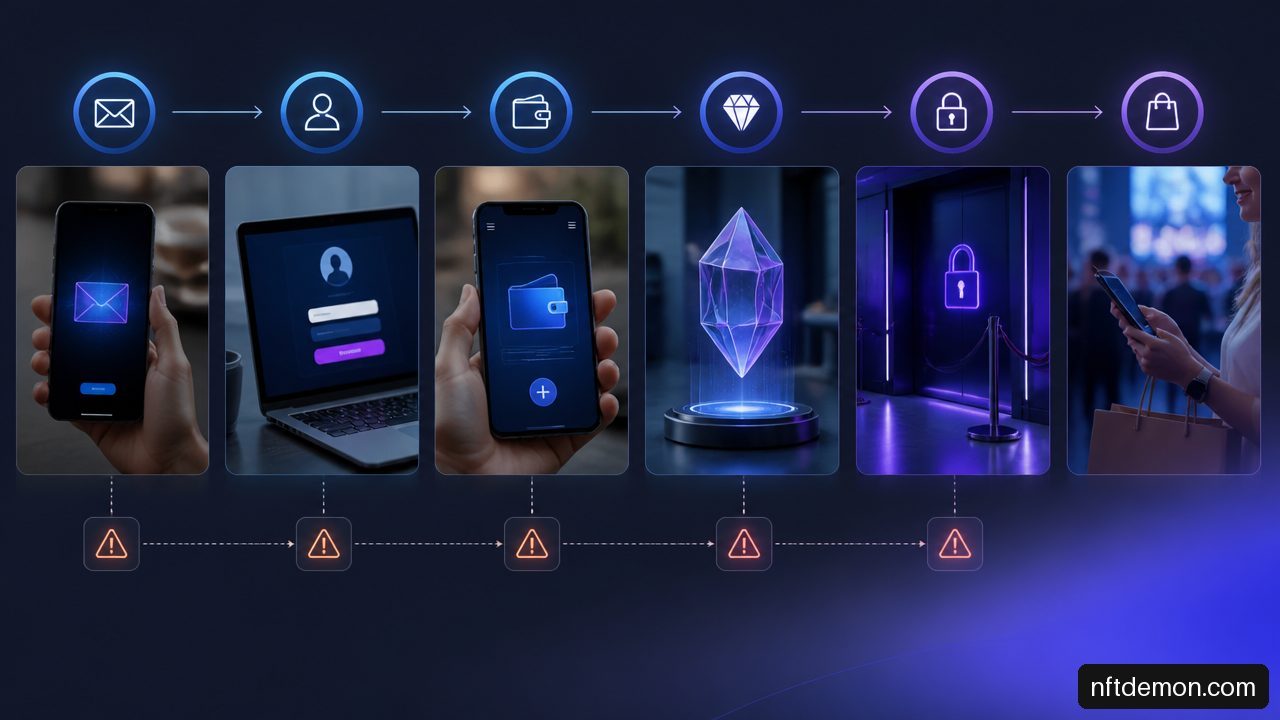
A no cost embedded wallet or email based onboarding route may be appropriate for a mainstream consumer campaign. A self custody flow may be appropriate for an existing crypto native community that values control and portability. The decision should follow the audience’s expectations, not ideology.
Build Community Participation Without Rewarding Noise
Community building is not synonymous with growing a Discord server or increasing token holder totals. A large community can contain inactive accounts, bots, duplicate wallets, incentive hunters, and people who arrived solely for an airdrop.
A credible Web3 community gives members a reason to contribute beyond extracting a reward. That could include early product feedback, access to experts, creative challenges, event participation, peer recognition, or a meaningful role in selecting future benefits.
I recommend defining participation quality before launch. For example:
• A referral counts only when the referred user completes a first valuable action, not when they merely register.
• A community contribution counts when it is reviewed, used, or positively rated, not when it is posted.
• A governance vote counts as a participation signal only when the voter was eligible before the proposal snapshot and passes basic anti Sybil checks.
• A reward claim is not treated as loyalty unless it is followed by a relevant return action, such as attendance, purchase, renewal, or contribution.
Anti Sybil controls should match the risk. Low value programs may use rate limits, email verification, device checks, and capped rewards. Higher value programs may need eligibility windows, purchase history, reputation scoring, manual review, or staged benefit release. The goal is not to eliminate every duplicate identity. It is to prevent manipulated participation from driving business decisions.
Separate Ownership, Usage, And Economic Activity
Brands often collapse three different signals into one: owning a digital asset, using a benefit, and trading the asset. They are not interchangeable.
| Signal Type | What It Can Indicate | What It Cannot Prove |
|---|---|---|
| Ownership | Membership eligibility, collection interest, claim completion | Product usage, identity, loyalty, or revenue contribution |
| Usage | Access redemption, attendance, content engagement, feature adoption | Long term retention or incremental financial value |
| Economic activity | Demand, liquidity, resale interest, speculation | Customer satisfaction, brand affinity, or repeat purchase |
Secondary market activity deserves particular caution. A rising floor price or high trading volume may attract attention, but it may also create speculation, disappointment, customer support burden, or reputational risk. If customers interpret a brand asset as an investment, the brand can inherit expectations it never intended to create.
For global organizations, NFT strategy consulting for global brands should include decisions about utility, transferability, geographic considerations, customer disclosures, and whether resale dynamics support or undermine the intended brand relationship.
The better metric is benefit usage. If a digital collectible grants access to exclusive content, measure whether members actually access the content and whether that usage predicts a valuable downstream outcome. Ownership alone is only the start of the story.
Measure Outcomes, Not Wallet Activity Alone
The measurement system should make it possible to decide whether to scale, revise, or stop the program. I recommend using a measurement tree that starts with one behavior and ends with one business outcome.
Build A Measurement Tree Before Launch
A simple structure prevents teams from drowning in dashboards.
| Measurement Layer | Question It Answers | Example Metric |
|---|---|---|
| Brand health | Is the program improving trust, awareness, or perception? | Sentiment among participants, qualified reach, feedback themes |
| Customer behavior | Are customers completing and repeating the desired action? | Activation rate, benefit redemption, repeat attendance, repeat purchase |
| Financial impact | Did the program create economic value beyond its cost? | Incremental revenue, retention lift, CPA, support cost change, CLV trend |
Sia Partners, METAV.RS, and Zealy argue that Web3 community objectives should connect to acquisition, retention, awareness, innovation, revenue, and dedicated measurement. That is the right direction, but leadership should go one step further by assigning each metric a role: diagnostic, leading, or outcome.
For example, wallet connection rate is diagnostic. It reveals onboarding performance. Benefit redemption may be a leading indicator because it shows the customer received the intended value. Incremental repeat purchase is an outcome metric because it indicates whether the experience changed commercial behavior.
Do not treat all metrics as equal. A campaign can have excellent claim rates and still fail if customers do not return, buy, renew, or participate in a way that matters to the business.
Estimate Incremental Value With A Comparison Group
The central measurement challenge is the counterfactual: what would participants have done without the Web3 program?
Highly engaged customers are more likely to join optional programs. If they spend more afterward, the program may have helped, but they may also have been high value customers before enrolling. Without a comparison group, a brand can easily mistake selection bias for return on investment.
A practical pilot compares participants with similar non participants. Match people where possible by prior purchase frequency, tenure, product category, geography, subscription status, channel, and historical engagement. Then compare the change in the chosen outcome over the same period.
Startupik recommends that Web3 programs evaluate outcomes such as activation, retention, conversion, referrals, repeat purchase, and support cost rather than only community activity, including comparison with similar non participants in its engagement guidance: a one segment, one action, one outcome pilot creates a more credible test structure.
The strongest design is randomized eligibility when feasible. For instance, invite half of a qualifying customer segment to an early access membership experience and retain the other half as a holdout group for the initial test period. Randomization is not always practical, but even a carefully selected comparison group is better than claiming ROI from participant behavior alone.
Set Scale, Revise, And Stop Rules
A pilot needs decision rules before launch. Otherwise, teams rationalize weak results because the campaign generated attention or because the technology is strategically interesting.
Zigpoll recommends hypothesis driven Web3 initiatives that combine feedback, on chain data, and business KPIs such as CLV, retention, incremental revenue, CPA, repeat purchase, and sentiment. The implication is practical: decide what evidence will justify a larger investment.
A pilot scorecard might include:
• Scale: The program shows acceptable onboarding completion, benefit usage, and a meaningful positive difference in the target business outcome compared with the selected comparison group.
• Revise: Customers value the benefit, but friction, identity resolution, or reward design prevents broad participation. Simplify the UX before expanding reach.
• Stop: Participation is driven primarily by low quality reward collection, the program cannot demonstrate customer or financial value, or brand risk exceeds the benefit.
Social Strategy Hub similarly argues that Web3 ROI measurement should combine engagement indicators with direct sales, community growth, sentiment, and other business outcomes. Its numerical claims should not be treated as universal benchmarks, but the underlying principle is sound: ROI cannot be inferred from one activity metric.
For multi chain programs, asset management can complicate both reporting and customer experience. A plan for unified liquidity aggregation for multi-chain brand assets may be necessary when customers hold, use, or transfer brand assets across more than one blockchain environment.
The strategic standard is demanding but fair: a Web3 initiative should make the customer relationship more useful, more participatory, or more measurable than the alternative. If it cannot do that, the technology is adding complexity without adding value.
Key Takeaways
• Build the program around one customer segment, one behavior, and one measurable business outcome.
• Choose NFTs, tokens, token gated access, or governance only when the mechanism improves a specific customer value exchange.
• Treat wallet connections and on chain activity as behavioral signals, not proof of identity, loyalty, or incremental value.
• Measure technical friction across the full journey, including wallet creation, signing, claiming, and benefit redemption.
• Separate digital asset ownership, benefit usage, and secondary market activity in reporting.
• Use anti Sybil rules before counting wallet growth, referrals, votes, or reward claims as genuine engagement.
• Compare participants with similar non participants, or use a holdout group, to estimate whether outcomes improved because of the program.
• Scale only when customer value, operational feasibility, and measurable business impact align.
Frequently Asked Questions
What Does A Web3 Brand Strategy Mean For Customer Engagement?
It means using decentralized tools to create a better customer relationship through membership, access, participation, ownership, transparent rewards, or portable identity. The strategy should begin with a customer behavior and business outcome, not with the decision to issue an NFT or token.
Which Customer Problem Should A Web3 Loyalty Program Solve?
Choose a problem where conventional loyalty is weak or difficult to differentiate. Examples include rewarding verified event attendance, recognizing high value community contributions, providing portable membership benefits, or gathering structured product input from committed customers. Avoid Web3 loyalty when a simple existing loyalty feature can solve the problem with less friction.
Should A Brand Use NFTs, Tokens, Or Token Gated Access?
Use digital collectibles when recognition, membership, or provenance matters. Use token gated access when recurring privileges are the central value. Use reward points or tokens when repeated verified actions need incentives. Avoid transferable assets if speculative trading would distract from customer utility or create unwanted financial expectations.
How Can A Brand Connect Wallet Activity To CRM Records?
Use a voluntary consent flow that explains the purpose and benefit of linking a wallet to an account. Keep wallet activity and personal identity distinct unless connection is necessary. A customer should be able to participate anonymously where possible, while opting into identified personalization or loyalty benefits when appropriate.
Are Wallet Holders And Discord Members Reliable Engagement Metrics?
Not on their own. They may include inactive users, duplicate wallets, bots, or people seeking rewards. Use them as diagnostic metrics, then validate quality through benefit usage, repeat behavior, qualified referrals, customer feedback, and downstream business outcomes.
How Can A Brand Measure Whether NFT Holders Buy More Often?
Compare holders with similar non holders using prior purchase behavior, customer tenure, segment, and other relevant factors. Measure changes over a defined period rather than looking only at total spending after minting. If possible, use randomized invitations or a holdout group to reduce selection bias.
Does Secondary Market Trading Prove Customer Loyalty?
No. Trading can indicate interest, scarcity, or speculation, but it does not prove that holders use the product, value the brand, or make repeat purchases. Track benefit redemption and customer retention separately from resale volume.
Sources And References
Sia Partners, METAV.RS, and Zealy — Web3 & Customer Engagement
https://www.sia-partners.com/system/files/document_download/file/2023-07/WP%20Web3%20&%20Customer%20engagement%20-%20SiaXperience%20x%20METAV.RS%20x%20Zealy.pdfStartupik — Web3 Customer Engagement: Platforms and Strategies
https://startupik.com/how-to-utilize-web3-platforms-for-enhanced-customer-engagement/Zigpoll — 12 Smart Web3 Marketing Strategies for Executives
https://www.zigpoll.com/content/12-smart-web3-marketing-strategies-strategies-executiveReddit, r/defi — How are Web3 Companies Doing Their Marketing?
https://www.reddit.com/r/defi/comments/1llzpuz/how_are_web3_companies_doing_their_marketing_for/socialstrategyhub.com
https://socialstrategyhub.com/web3-brands-marketing-and-data-in-2026/
NFT Demon Holdings helps enterprises scope, evaluate, and build blockchain programs — start with a free evaluation call.
Talk through your use case
Free evaluation call — objective, constraints, and fit, before any proposal.