Unified liquidity aggregation for multi chain brand assets
By Jeremy Ryan, Founder & CEO · October 2026

Unified liquidity aggregation patterns for fragmented multi-chain brand assets are not primarily a branding problem. They are a market-structure problem. A token, membership pass, loyalty asset, or branded stable-value instrument can share a name and ticker across networks while having different contracts, different redemption assumptions, different bridge dependencies, and radically different executable liquidity.
For decision makers, the practical objective is simple: make legitimate brand assets easier to acquire, sell, transfer, and redeem without pretending that every representation is identical or every liquidity pool is equally reliable. I recommend treating liquidity aggregation as a controlled execution system, not as a cosmetic cross-chain interface.
• Key Takeaways And Decision Frame
• Model Asset Identity Before Aggregating Liquidity
• Choose The Right Unified Liquidity Pattern
• Build Route Selection Around Execution And Finality
• Operate The System As A Risk And Recovery Program
Key Takeaways And Decision Frame
I would begin with one principle: a unified user experience does not prove unified liquidity. A branded asset may appear in wallets on Ethereum, a Layer 2, and an application-specific chain, but that does not establish that a holder can exchange one version for another at a predictable price, within a defined time, and under acceptable trust assumptions.
A sound architecture separates three questions that are too often collapsed into one:
| Decision Layer | Core Question | What Can Go Wrong If Ignored |
|---|---|---|
| Asset identity | What exact token and claim is being traded? | A user receives an unofficial, unsupported, or economically different representation. |
| Liquidity discovery | Where is executable inventory available now? | A route quotes nominal balances or thin pools that cannot fill the requested order. |
| Settlement finality | When is the transaction actually complete and irreversible? | The swap appears complete while a bridge message, redemption, or delivery remains pending. |
The distinction matters because liquidity fragmentation raises price impact for larger trades. Chainlink notes that fragmented depth can contribute to higher slippage and less efficient pricing when capital is spread across separate markets. That is the commercial case for coordination, but not a reason to erase route-level risk.
I would use the following operating definition:
Unified liquidity aggregation is the controlled discovery, comparison, execution, and settlement of asset liquidity across multiple chains, venues, and representations through a single decision layer.
The word controlled is doing real work. A reliable system discloses the asset contract, source venue, settlement path, expected completion time, price impact, fees, and trust assumptions before the user signs. It does not merely show a favorable headline quote.
For enterprise teams, this work should connect to a broader enterprise NFT strategy with measurable outcomes. Liquidity design affects more than trading. It determines whether a customer can enter a membership program, whether a collector can exit fairly, and whether a treasury can reconcile supply across environments.
What Success Actually Looks Like
A successful multi-chain design is not necessarily the one with the fewest visible chains. It is the one that delivers predictable outcomes across the chains that matter.
I would measure success through these outcomes:
• Executable depth: the amount that can be traded at defined price-impact thresholds for the exact contract and chain.
• Route reliability: the percentage of initiated routes that settle within the promised time and complete without manual intervention.
• Representation clarity: the percentage of user-facing quotes that identify canonical status, bridge or issuer, and redemption conditions.
• Capital efficiency: the amount of liquidity required to sustain service levels without seeding every network with excessive isolated inventory.
• Commercial accessibility: the ability to convert the exact representation into the desired asset, including a supported off-ramp where that matters.
There is no authoritative universal benchmark proving that one unified-liquidity architecture always produces better slippage, lower latency, or higher capital efficiency. Results depend on the pools, bridges, chains, execution model, and order size. That uncertainty should lead to instrumentation, not vague promises.
Model Asset Identity Before Aggregating Liquidity
The most expensive mistake is to use a ticker as an identity system. A ticker is a label. It is not proof of issuer authority, custody, redemption rights, supply controls, or interoperability.
Define The Asset As A Four-Part Record
I recommend modeling every supported representation as a structured record:
| Identity Field | Why It Matters | Example Decision |
|---|---|---|
| Brand and asset class | Establishes the intended commercial product | Is this a loyalty point, collectible, governance token, or settlement asset? |
| Chain and contract address | Distinguishes one deployed token from another | Is this the official contract on the selected network? |
| Representation type | Identifies the economic and technical mechanism | Is it canonical, wrapped, escrow-backed, or burn-and-mint? |
| Settlement and redemption route | Reveals how value moves or exits | Can it be redeemed, bridged, swapped, or off-ramped under defined rules? |
Plexo Institute makes the essential point: liquidity and off-ramp availability must be checked for the exact asset representation and chain, not inferred from a shared ticker or brand name. That constraint should appear in the product model, risk policy, and customer interface.
Consider a brand that issues a canonical membership token on Ethereum, an officially bridged representation on an L2, and a separate promotional token on another chain. All three may display the same logo. Only one may be redeemable for benefits. Only one may have meaningful liquidity. A router that treats them as automatically fungible can create a support, legal, and reputational problem in a single transaction.
Canonical, Wrapped, And Native Supply Models
A brand should explicitly choose its representation policy before deploying liquidity. Three common patterns have different consequences.
| Model | Mechanism | Best Fit | Main Trade-Off |
|---|---|---|---|
| Canonical issuance | One authoritative chain hosts the primary supply | High-value assets with strict governance | Cross-chain access can depend on bridging or settlement delays. |
| Wrapped representation | A token on one chain represents custody or control elsewhere | Broad distribution where bridge infrastructure is accepted | The holder inherits bridge, custody, and representation risk. |
| Native burn-and-mint | Supply is destroyed on one chain and created on another under protocol rules | Assets designed for controlled multi-chain movement | The model requires strong authorization and supply-monitoring controls. |
I would avoid independent, same-named token deployments unless they are deliberately separate products. Independent issuance can be appropriate for regional loyalty programs or chain-specific utility, but then the distinction must be obvious. Shared branding should not imply automatic interchangeability.
Treat Off-Ramps As A Product Constraint
An asset can have a visible balance and still be commercially unusable for the holder’s purpose. If a user needs to sell into a supported stablecoin, pay a supplier, or reach a regulated fiat conversion channel, the final route matters as much as the first swap.
This is where choosing between public and permissioned blockchains becomes relevant. A permissioned settlement environment may improve control and compliance, while public networks can broaden distribution and secondary-market access. The liquidity system should make that boundary explicit rather than forcing every holder through an opaque conversion path.
Choose The Right Unified Liquidity Pattern
“Unified liquidity” describes several materially different architectures. I would not select one based on interface simplicity alone. The right pattern depends on asset identity, volume concentration, acceptable trust assumptions, and tolerance for asynchronous settlement.
Router And Aggregation API Pattern
A router queries multiple exchanges, bridges, and liquidity sources, then proposes a route. It does not necessarily create shared capital; it makes existing fragmented capital easier to discover and access.
LI.FI describes how a single integration can connect multiple bridges and DEX aggregators for cross-chain execution. Its documentation further shows that bridge, exchange, and solver routes can be exposed through one application interface.
This pattern is usually the fastest way to improve user experience because it reduces manual venue selection. It is appropriate when the brand wants broad distribution but does not want to operate a cross-chain settlement network.
Fair warning: a router can make fragmentation less visible without making it disappear. The product must still reveal the route components and protect users from stale quotes, weak liquidity, and unsupported representations.
Solver And Intent-Based Pattern
In an intent model, the user states the desired outcome: for example, “receive 500 units of the canonical asset on Chain B, spending no more than a defined amount on Chain A.” A solver competes or is selected to fulfill that outcome, potentially using its own inventory, liquidity sources, or bridge relationships.
Cross-chain aggregation extends beyond ordinary single-network DEX routing and can use solvers or interoperability layers. This is useful because a normal DEX aggregator typically optimizes across venues within one chain; it does not independently resolve the transfer and settlement problem between chains.
I would choose solvers when user experience is the strategic priority and the organization can enforce clear execution constraints. Avoid a poorly governed solver model when asset transfer rules are complex, settlement disputes are likely, or no party has operational ownership of failed execution.
Shared Liquidity Hub Or Unified Pool Pattern
A shared-liquidity pattern coordinates capital across chains instead of funding completely separate pools everywhere. Chainlink describes how liquidity hubs and unified-pool patterns can coordinate isolated capital, including approaches that maintain native-asset liquidity across supported chains.
This can reduce the need to overcapitalize every satellite market. It is often attractive when a brand has predictable demand corridors, such as a primary marketplace chain and two consumer-facing networks.
The trade-off is concentration. A hub becomes a more important operational and security dependency. If its pricing, settlement, or message-validation layer fails, multiple markets can be affected at once. I would use this pattern only with explicit reserve policy, independent monitoring, withdrawal controls, and an orderly fallback mode.
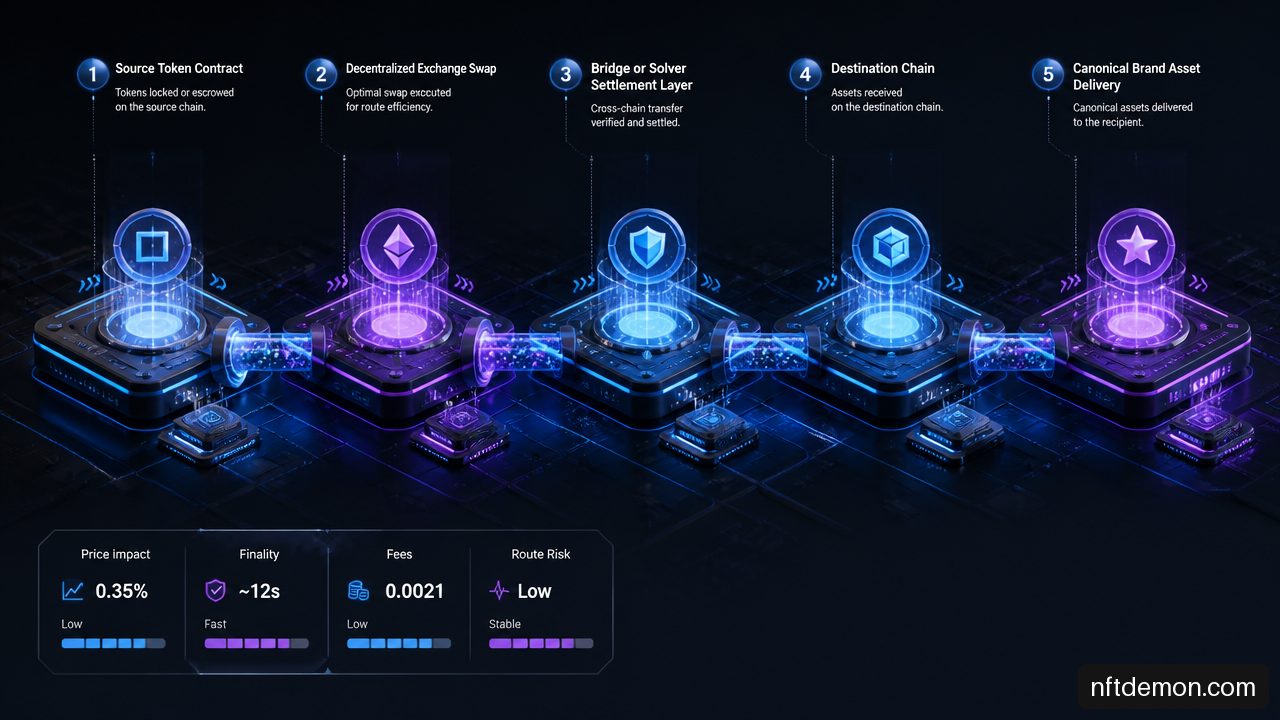
Common-State Or Ecosystem Interoperability Pattern
Some ecosystem-level designs aim to reduce fragmentation through shared interoperability assumptions, coordinated state, or common settlement layers. This can improve the experience for assets that intentionally remain inside a connected network family.
The strategic limitation is scope. A brand that expects users, exchanges, and partners across unrelated ecosystems still needs a policy for external routing. Ecosystem cohesion is valuable, but it is not universal portability.
Build Route Selection Around Execution And Finality
The best quote is not always the lowest displayed price. A route that saves a small amount but uses a slower, less final, or less trusted settlement path may be inappropriate for a high-value brand asset.
Score Routes Across Multiple Objectives
I recommend a route-level risk score rather than a single price ranking. The score should combine commercial, technical, and settlement factors.
| Route Factor | What To Measure | Decision Implication |
|---|---|---|
| Effective price | Swap output after fees, gas, and bridge charges | Reject routes that look cheap before costs but not after them. |
| Executable inventory | Fillable depth at the requested size | Avoid relying on total value locked or nominal supply alone. |
| Price impact | Expected movement from consuming pool depth | Split routes or cap order size when impact exceeds policy. |
| Settlement latency | Expected time to completed delivery | Match to the user’s deadline and asset sensitivity. |
| Finality confidence | Reversal, reorganization, or message-completion assumptions | Require stronger thresholds for redemptions and treasury transfers. |
| Failure probability | Historical and current route health signals | Route around halted, congested, or degraded dependencies. |
| Trust model | Custody, validator, solver, and admin assumptions | Display material assumptions before authorization. |
Under the hood, the system should first normalize asset identity, then query eligible venues, then simulate route segments. A segment might include a source-chain swap, bridge transfer, destination-chain swap, and final delivery. The aggregator should calculate expected output after each segment, not merely append a bridge fee to a swap quote.
For example, a holder may exchange a brand token on Chain A for a stablecoin, bridge the stablecoin, then acquire the canonical brand token on Chain B. The route should report whether the user will receive a native asset, a wrapped asset, or an issuer-controlled representation. That is not a technical footnote. It is the transaction.
Quote Disclosure Should Be Non-Negotiable
Before signature, I would disclose at least the following:
Exact input and output contracts, including chain identifiers and representation type.
Source venues and execution steps, such as swap, bridge, solver fulfillment, or internal liquidity transfer.
All-in costs, including gas, protocol fees, bridge fees, solver fees, and expected price impact.
Expected completion window and what event defines completion.
Minimum received amount, stale-quote behavior, cancellation limits, and recovery path.
Material trust assumptions, especially custody or third-party execution dependencies.
This disclosure is also an integration requirement. The routing layer must connect to customer identity, entitlement, accounting, and support systems without exposing sensitive operational data. A well-designed blockchain integration architecture for ERP and CRM systems helps separate on-chain execution from internal records, customer communication, and reconciliation workflows.
Operate The System As A Risk And Recovery Program
Aggregation becomes credible when failure handling is designed before volume arrives. Cross-chain execution is often asynchronous. A user may have completed the source transaction while the destination delivery is delayed, rejected, or awaiting a relayer, solver, or bridge condition.
Build A Failure Matrix
I would define an owner, detection signal, user message, and recovery action for each route failure.
| Failure Mode | Detection Signal | Immediate User Treatment | Recovery Action |
|---|---|---|---|
| Stale quote | Price moves beyond quoted tolerance | Prevent execution or require re-approval | Refresh route and recalculate minimum output. |
| Partial fill | One swap segment fills below required amount | Show pending or partially completed status | Complete eligible remainder, refund where rules permit, or escalate. |
| Stuck cross-chain message | Source confirmed but destination event absent | Provide transaction state and route reference | Retry through approved mechanism or initiate controlled recovery. |
| Bridge halt | Dependency status changes during execution | Stop new route intake | Offer safe wait, cancellation, or alternate approved path. |
| Representation mismatch | Output contract fails policy validation | Block delivery before finalization | Return funds or reroute only with explicit authorization. |
A brand should not promise instant settlement unless it controls every component needed to make that promise. In many cases, the better product language is “submitted,” “source confirmed,” “in settlement,” and “delivered.” Those states reduce confusion during delays and create a usable audit trail.
Monitor The Right Metrics
Total liquidity is a weak operating metric because it can include inactive, inaccessible, or unsupported inventory. I would monitor a smaller set of decision-grade indicators:
• Route completion rate by chain pair, asset representation, and order-size band.
• Median and tail settlement time, especially the slowest completed routes.
• Quote-to-fill variance, including slippage and fee deviations.
• Executable inventory at defined price-impact thresholds.
• Failed-message aging and time to resolution.
• Liquidity concentration by venue, bridge, solver, and custody assumption.
• Off-ramp availability and conversion success for each supported representation.
These metrics create a feedback loop. If a smaller chain repeatedly produces delayed settlement and poor fills, the answer may not be more liquidity. It may be to limit order sizes, improve disclosures, subsidize a specific corridor, or remove that route until the underlying conditions improve.
Migrate Without Breaking Market Confidence
When moving from independent chain pools to a more unified design, I would stage the migration rather than abruptly draining old markets.
Publish the canonical asset and representation policy.
Inventory every contract, pool, bridge route, market maker, and redemption dependency.
Seed the preferred routes before reducing legacy liquidity.
Apply order caps and route monitoring during the transition.
Keep a visible migration window with clear conversion terms.
Retire unsupported representations only after holders have a practical path to exit or convert.
The commercial lesson is straightforward: liquidity migration is also customer migration. Treat it as a product change with communications, support, accounting, and incident response—not as a smart-contract deployment.
Frequently Asked Questions
What Does Unified Liquidity Aggregation Mean For A Brand Asset On Several Blockchains?
It means a routing and settlement layer can discover, compare, and execute eligible liquidity paths across chains while preserving the differences between contracts and representations. It does not mean all supply is automatically pooled or fungible.
Are Two Tokens With The Same Brand And Ticker Automatically Interchangeable?
No. They may differ in issuer authority, bridge backing, redemption rights, liquidity, and off-ramp availability. I would require a contract-level identity policy before presenting any conversion route.
When Is A Shared Liquidity Pool Better Than Separate Pools On Every Chain?
A shared model is generally stronger when demand is concentrated across a few predictable corridors and isolated pools would be too thin. Separate pools can be preferable where chains serve distinct customer groups, regulatory regimes, or asset utilities.
How Should Slippage Be Calculated For A Cross-Chain Route?
Calculate it across every executable segment: source swap, bridge conversion if applicable, destination swap, and all associated fees. A single displayed swap price is incomplete when the route spans multiple liquidity venues.
What Should A Cross-Chain Quote Show Before A User Signs?
It should show input and output contracts, route steps, expected output, minimum output, fees, expected settlement time, price impact, and meaningful trust assumptions. If those details cannot be shown clearly, the route is not ready for high-value use.
What Happens If A Cross-Chain Message Is Delayed Or Partially Completes?
The interface should show a precise state rather than claiming completion. Recovery depends on route design, but a production system needs documented rules for retries, refunds, escalation, and manual review.
How Can A Brand Detect Fake Or Stale Liquidity?
Validate approved contracts and venues, monitor actual fillable depth, simulate quotes, compare quoted and executed output, and track pool activity over time. Visible balances and total value metrics should not be treated as proof of executable inventory.
Sources And References
• LI.FI — Liquidity Aggregation & Orchestration across all chains: https://li.fi/defi
• LI.FI — Documentation: https://docs.li.fi/llms.txt
• Gate Learn — Liquidity Aggregation: https://www.gate.com/learn/articles/the-0-1-of-chain-abstraction/3435
• Chainlink — Multi-Chain Liquidity Integration: https://chain.link/article/multi-chain-liquidity-integration
• Plexo Institute — Multi-Chain Liquidity and Bridges: https://plexo.institute/explains/multi-chain-liquidity-and-bridges
NFT Demon Holdings helps enterprises scope, evaluate, and build blockchain programs — start with a free evaluation call.
Talk through your use case
Free evaluation call — objective, constraints, and fit, before any proposal.