Verifiable credentials and DIDs for AI agent authentication, architecture and deployment
By Jeremy Ryan, Founder & CEO · September 2026
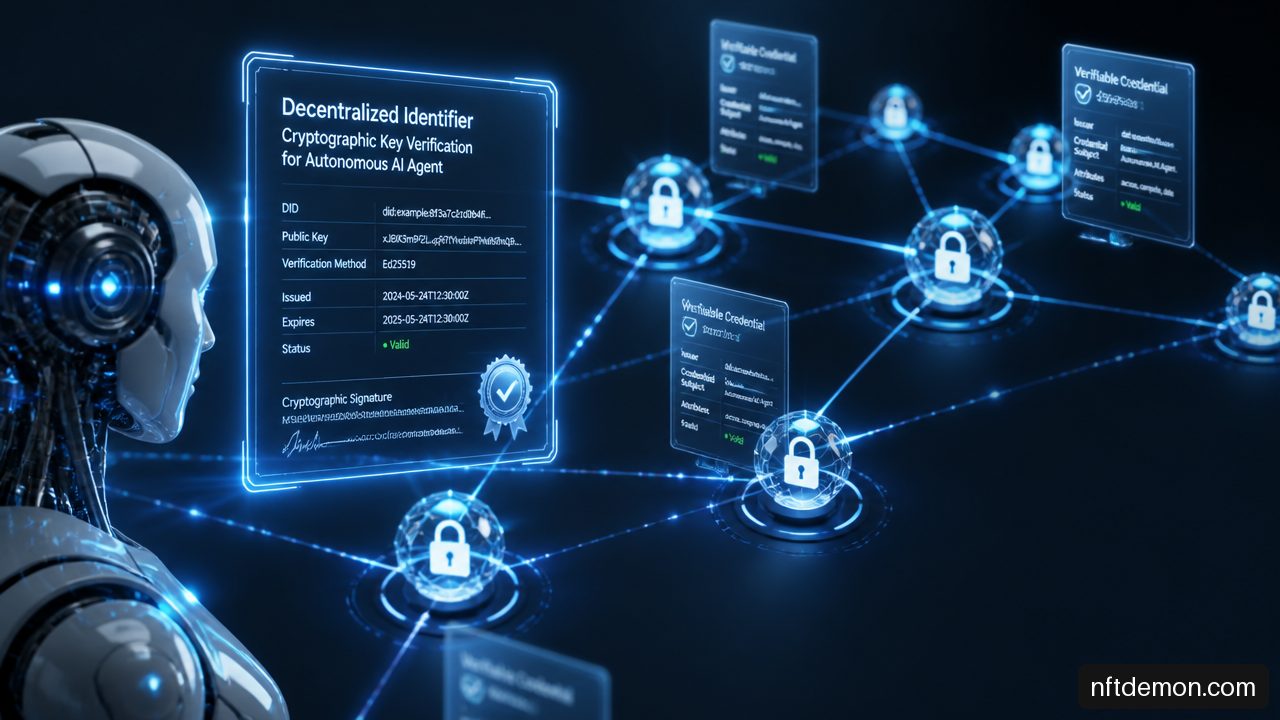
As autonomous AI agents transition from isolated conversational tools into multi-step operational systems that interact with financial endpoints, production databases, and enterprise APIs, traditional identity mechanisms are collapsing under new structural demands. Static API keys, centralized OAuth tokens, and shared service accounts were engineered for predictable, human-driven or static software workloads. When applied to dynamic AI agents executing tasks across multi-tenant ecosystems, these centralized patterns expose enterprise environments to credential leakage, ambient authority abuse, and untraceable delegation chains. Solving this challenge requires a cryptographically verifiable, decentralized identity architecture capable of validating both an agent's digital identity and its precise administrative boundary. Utilizing verifiable credentials and decentralized identifiers DID for AI agent authentication provides a unified framework for cross-organizational trust, machine-readable delegation, and cryptographically sound access control.
Key Takeaways
• Decentralized Cryptographic Identity: Decentralized identifiers (DIDs) assign autonomous software agents globally unique, self-sovereign cryptographic identities that eliminate reliance on single centralized identity providers. • Tamper-Evident Authority: Verifiable credentials (VCs) supply cryptographically signed attestations that define an agent's precise permissions, origin, operational constraints, and delegating principal. • Decoupled Verification: Relying parties can validate an agent's identity and capabilities on first contact without querying a centralized directory or maintaining direct integrations with the issuing authority. • Zero-Trust Delegation: Combining challenge-response protocols with short-lived credentials limits ambient authority and protects against token replay, key leakage, and credential misuse. • Production Interoperability: Enterprise deployments combine DID resolution, status checking, and workload identity envelopes to maintain real-time auditability across multi-cloud environments.
The Trust Architecture for Autonomous AI Agents
Why Legacy Identity Protocols Fall Short for Agentic Workloads
Traditional machine-to-machine authentication protocols depend on persistent secrets or centralized authentication servers. In standard enterprise configurations, software applications communicate through API keys, mutual TLS (mTLS) certificates, or OAuth 2.0 client credentials. While effective for static services, these models fail when deployed across complex AI agent networks for three primary reasons:
- Ambient Authority Excess: An API key grants broad access to a system regardless of who initiated the action or what specific sub-task the agent is executing.
- Directory Lock-in: Centralized Identity Providers (IdPs) require both communicating parties to exist within the same tenant or maintain federated trust agreements, creating severe friction in cross-organizational workflows.
- Delegation Blindness: Traditional tokens cannot easily represent multi-hop delegation, making it difficult for a downstream service to determine whether an agent acts on behalf of a human executive, an automated schedule, or a secondary agent.
When an AI agent executes actions autonomously, the recipient system must answer two fundamental security questions: Which specific entity is presenting this request? and What cryptographically verifiable mandate grants this entity authority to act? Legacy identity infrastructure bundles these concerns into brittle sessions, creating systemic vulnerabilities.
Dissecting DIDs and VCs in Machine Authentication
Decentralized Identifiers (DIDs) and Verifiable Credentials (VCs) separate identity from authorization while remaining bound by public-key cryptography. A DID functions as a persistent, globally unique URI that resolves to a DID document containing the agent's public keys, authentication algorithms, and active cryptographic endpoints. This allows an agent to prove ownership of its identifier without consulting a centralized vendor or database.
Complementing the identifier, a Verifiable Credential acts as a digital attestation issued by an authority (such as an enterprise IT department or a primary user) to the agent. This credential contains cryptographically signed statements—referred to as claims—detailing what the agent is authorized to do, maximum transaction bounds, target resources, and expiration windows. According to the W3C Verifiable Credentials Data Model v2.0, issuer/holder/verifier roles, tamper-evident credentials, presentations, and status-related credential verification enable verifiable machine claims across distributed topologies.
Establishing the Zero-Trust Boundary for Autonomous Agents
Zero-trust architecture dictates that no software component, whether internal or external, should be implicitly trusted. For AI agents, applying zero-trust requires verifying identity and authorization for every discrete API call or transactional event. Instead of trusting an agent because it resides on an internal virtual network or holds a session cookie, the receiving system treats the agent as an untrusted subject until valid cryptographic proofs are supplied.
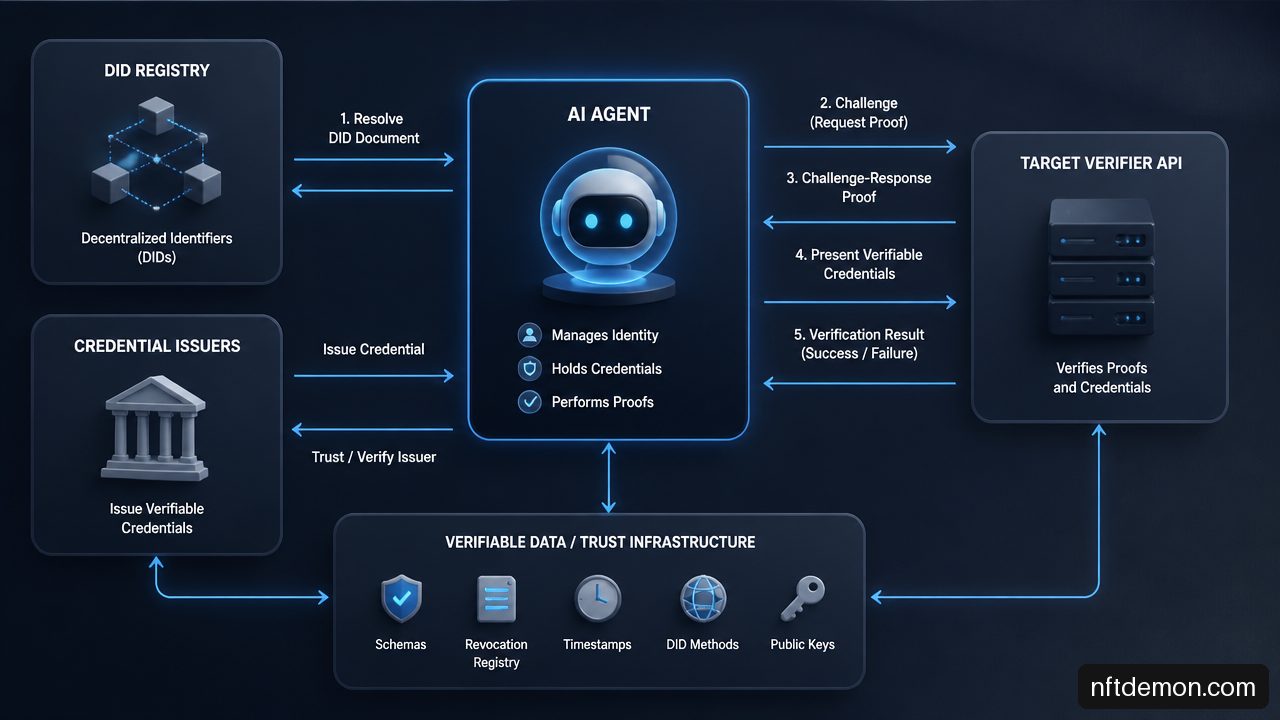
+-----------------------+ +-----------------------+ | Issuer (IdP) | | Verifier (Target API) | +-----------------------+ +-----------------------+ | ^ | Issues Signed VC | Verifies Proof & v | Challenge Nonce +-----------------------------------------------------------+ | Holder (AI Agent) | | - Controls Private Key bound to DID | | - Stores Verifiable Credentials in Secure Agent Wallet | +-----------------------------------------------------------+
By leveraging verifiable credentials and decentralized identifiers DID for AI agent authentication, organizations move the trust boundary from perimeter defenses directly into the payload. The trust travels with the data, ensuring that relying parties validate claims independently.
Technical Mechanics of DID-Based Agent Authentication
Cryptographic Key Resolution and DID Documents
To authenticate an agent without contacting a central directory, a relying party resolves the agent's DID to obtain its public cryptographic key material. According to the W3C Decentralized Identifiers specification, DID documents, resolution, verification material, and update behavior form the technical backbone of decentralized identifiers used in agent authentication.
When an agent presents a claim, it references its DID (for example, did:peer:123... or did:ion:123...). The verifier passes this string to a resolver, which returns the structured DID Document. This document explicitly declares which public key corresponds to authentication assertions:
{ "@context": ["https://www.w3.org/ns/did/v1"], "id": "did:example:agent42", "verificationMethod": [{ "id": "did:example:agent42#key-1", "type": "Ed25519VerificationKey2020", "controller": "did:example:agent42", "publicKeyMultibase": "z6MkpTHR8VNsBxY..." }], "authentication": [ "did:example:agent42#key-1" ] }
Because the public key is explicitly declared in the resolved document, the verifier can immediately validate signatures generated by the agent's private key without ever exposing raw secrets over the wire.
Step-by-Step Challenge-Response Authentication Sequence
Simply presenting a public DID document or standard credential is insufficient for authentication; an attacker could capture and replay an agent's public material. To prove active operational possession of the private key tied to the DID, agents execute a challenge-response protocol during session establishment or transaction execution.
- Challenge Issuance: The verifier server issues a cryptographic nonce, timestamp, and target domain context to the requesting agent.
- Payload Construction: The agent constructs a Verifiable Presentation (VP) containing the requested Verifiable Credentials and appends the verifier's challenge nonce.
- Digital Signing: The agent signs the combined payload using the private key corresponding to the public key published in its DID document.
- Presentation Submission: The agent sends the signed Verifiable Presentation to the verifier's endpoint.
- Cryptographic Validation: The verifier resolves the agent's DID, retrieves the target public key, verifies the signature against the nonce, and verifies that the timestamp falls within acceptable limits.
- Policy Evaluation: The verifier checks whether the underlying credentials remain unrevoked and whether the signed claims satisfy local access rules.
Comparing DID Methods for Enterprise Agent Deployments
Not all DID methods behave identically. Selection depends on requirements for latency, decentralization, cost, and ledger dependency. Analyzing how different DID methods perform for agent workloads provides clarity on implementation choices:
| DID Method | Underlying Infrastructure | Resolution Speed | Ledger Dependency | Optimal AI Agent Use Case |
|---|---|---|---|---|
did:key |
Purely algorithmic (pubkey self-encoding) | Microseconds (< 1ms) | None | Short-lived, ephemeral microservice agents |
did:peer |
Direct peer-to-peer agreement | Fast (< 5ms) | None | Multi-agent collaborative networks and private agent-to-agent communication |
did:ion |
Bitcoin (Sidetree Layer-2) | Variable (cached) | Public Ledger | High-assurance, persistent corporate enterprise agent identities |
did:cheqd |
Cosmos SDK Blockchain | Fast (< 100ms) | Permissionless Ledger | Commercial agent networks requiring custom trust registries |
did:web |
Domain Name System (HTTPS) | Moderate (DNS lookup) | Web Infrastructure | Existing web services transitioning to decentralized identity |
For enterprise systems prioritizing architectural performance, evaluating a blockchain integration architecture for identity systems helps clarify where ledger-anchored DIDs vs. peer-to-peer DIDs fit within existing infrastructure.
Verifiable Credentials and Scoped Delegation Models
The Agentic Trust Triangle: Issuer, Holder, and Verifier
Decentralized credential frameworks operate through a three-node architectural relationship known as the Trust Triangle:
• Issuer: An entity (e.g., Enterprise HR, Active Directory, Identity Provider) that asserts facts about a subject and signs them with its private key. • Holder: The AI agent that receives credentials from issuers, stores them in a secure agent wallet module, and presents them upon request. • Verifier: The target service or API that receives the presented credential, checks the issuer's signature, and enforces access control rules.
In research published by Indicio on the agentic web, issuer-signature verification, portable credentials, and first-contact trust allow agents operating across organizational boundaries to establish authority without pre-configured database syncs. The verifier does not need a direct integration with the issuer; it only needs to trust the issuer's cryptographic public key, which can be validated via a shared trust registry.
Encoding Human Mandates into Machine-Readable VCs
When a human user instructs an AI agent to execute complex tasks—such as procuring inventory, managing financial assets, or reconfiguring network routes—the human delegates a portion of their own authority. Rather than passing raw user OAuth tokens, the system generates a scoped, delegation-specific Verifiable Credential.
This delegation credential explicitly lists parameters such as:
• Delegator Identity: did:example:human-user-99
• Delegatee Identity: did:example:procurement-agent-01
• Permitted Operations: ["purchase_order:create", "invoice:approve"]
• Financial Cap: {"currency": "USD", "max_limit": 5000}
• Time Window: {"not_before": "2026-03-30T00:00:00Z", "not_after": "2026-03-30T23:59:59Z"}
When evaluating risk during technical planning, performing an enterprise blockchain supply chain identity assessment ensures that delegated credentials strictly match operational guidelines across multi-tier supplier networks.
Comparing OAuth Tokens, API Keys, and Verifiable Credentials
To clarify structural advantages, let us compare standard authorization instruments against Verifiable Credentials for agent workflows:
| Feature / Dimension | Static API Keys | OAuth 2.0 Access Tokens | Verifiable Credentials (VCs) |
|---|---|---|---|
| Issuance Model | Manual generation in portal | Centralized Auth Server (IdP) | Decentralized Issuer signing |
| Verification Method | Direct DB lookup by server | Introspection or public JWKS | Local signature & cryptographic proof verification |
| Cross-Domain Trust | Non-existent (siloed) | Requires explicit federation | Native (trust anchored via issuer signature) |
| Delegation Visibility | Zero (shared account) | Limited (embedded scope strings) | Explicit multi-level delegation chains |
| Offline Validation | No | Requires cached public keys | Fully supported via offline signature verification |
| Revocation Check | API Key deletion | Token revocation list / short TTL | Status lists / Revocation bitmaps |
As demonstrated in Microsoft Learn's documentation on Entra Verified ID, the DID-based issuance, presentation, and verification flow for verifiable credentials provides a standardized path for enterprise trust. This framework decouples credential validation from centralized session databases, giving machine workloads portable assertions.
Operationalizing Agent Verification, Status, and Revocation
Live Verification Pipeline for Autonomous Requests
When an AI agent presents a payload to an API endpoint, the target server runs the request through a automated verification pipeline. The pipeline executes sequentially to minimize unnecessary computation:
- Syntax & Schema Validation: Ensure the incoming payload matches the expected JSON-LD or JWT credential format.
- Challenge & Nonce Matching: Validate that the signed challenge matches the active session nonce issued by the verifier, ruling out replay attempts.
- DID Resolution: Resolve the holder's DID document to pull public key material for cryptographic signature checking.
- Credential Integrity Verification: Verify the mathematical signature of the issuer against the claims payload.
- Issuer Trust Check: Verify that the issuer's DID is listed within the verifier's trusted issuer registry or governing policy network.
- Revocation & Expiry Check: Confirm that the current timestamp is within the credential's valid window and check status registers.
- Policy Enforcement: Apply fine-grained business logic (e.g., verifying that requested spend limits match credential constraints).
[Incoming Request] | v (1. Check Schema & Format) ---> [Fail] -> Reject (400 Bad Request) | v (2. Verify Challenge Nonce) --> [Fail] -> Reject (401 Unauthorized) | v (3. Resolve DID & PubKey) ----> [Fail] -> Reject (404 Resolver Error) | v (4. Check Issuer Signature) ---> [Fail] -> Reject (403 Forbidden) | v (5. Query Status List) --------> [Revoked] -> Reject (403 Revoked) | v [Grant Access to Business Logic]
Credential Revocation, Expiry Windows, and Status Lists
In fast-moving agent environments, authority state changes rapidly. If an agent exhibits anomalous behavior or a delegating employee leaves the firm, their credentials must be neutralized quickly. Traditional Certificate Revocation Lists (CRLs) are too heavy for high-frequency machine calls. Modern implementation patterns utilize bitstring status lists (e.g., W3C StatusList2021 or Bitstring Status List v1.0).
Under this architecture, an issuer maintains a compressed bitstring published at a public URI or stored on a decentralized network. Each issued credential contains a direct reference to a specific bit index in that list:
• Index Value 0: Credential Valid
• Index Value 1: Credential Revoked / Suspended
When verifying an agent request, the verifier fetches or reads from a local cache of the compressed bitstring and inspects the single bit corresponding to the credential. This mechanism enables status checks without leaking transaction contexts or creating direct runtime dependencies on issuer databases.
Mitigating Key Rotation Drift and Replay Attacks
Machine workloads are exposed to key compromise if private key management is mishandled. Agents must store cryptographic key material within hardware security modules (HSMs), confidential computing enclaves, or secure local vaults. When an agent rotates its key pair, it appends an update operation to its DID document.
If a verifier relies on stale DID document caches, valid requests signed by new keys may be rejected (key rotation drift). To mitigate key drift and replay vulnerabilities, enterprise systems enforce strict operational guardrails:
• Short Time-to-Live (TTL): Issue verifiable presentations with strict 5-minute validity windows to narrow exploitation windows. • Mandatory Nonce Binding: Require every agent signature to incorporate a fresh, single-use server nonce. • Selective Resolution Refresh: Trigger forced re-resolution of a DID document whenever a signature verification fails before outright rejecting the request. • Replay Detection Caching: Maintain a distributed bloom filter of recently processed nonces to block duplicate presentations immediately.
Enterprise Deployment Architectures and Implementation Patterns
Authorization Envelopes Over Machine Workload Identities
In enterprise cloud environments (such as Kubernetes, AWS, or Azure), agents run within execution environments secured by SPIFFE/SPIRE, AWS IAM Roles, or Managed Workload Identities. Decentralized identity solutions complement existing infrastructure rather than replacing low-level transport security.
Guidance from the Cloud Security Alliance highlights an emerging agent authorization envelope layering DIDs and VCs over workload identity to secure cross-domain machine actions. In this layered approach, SPIFFE or mTLS secures transport-layer trust between nodes, while the agent authorization envelope carries DID-backed credentials inside the application payload. This allows application services to process business authorizations independently of cloud network policies.
Integrating Blockchain Infrastructure with Decentralized Identity
Decentralized identity protocols can operate completely offline using peer-to-peer relationships (did:peer). However, enterprise ecosystems spanning multiple organizations often require public or permissioned ledger roots to resolve DIDs, manage trust registries, and maintain immutable audit logs.
Deciding between permissioned enterprise ledgers and public distributed networks impacts network governance, throughput, and operational privacy. Decision makers evaluating these trade-offs should evaluate choosing between public and permissioned blockchains to align network latency requirements with enterprise security mandates.
When a public or permissioned ledger hosts a trust registry, verifiers query the ledger to confirm that an issuer's DID is officially recognized by industry consortia or corporate compliance groups. This maintains decentralization while enforcing strict ecosystem governance.
Balancing Selective Disclosure with Audit Compliance
Zero-knowledge proofs (ZKPs) and selective disclosure mechanisms (such as SD-JWT or BBS+ Signatures) permit an AI agent to prove specific attributes without revealing full underlying credentials. For instance, an agent can cryptographically prove that its spending authorization exceeds $1,000 without exposing the total account limit, the identity of the executive who authorized the credential, or sensitive internal account numbers.
However, in regulated industries (such as financial services, healthcare, and defense), total privacy creates tension with mandatory audit requirements. Security engineers must carefully weigh this trade-off:
• Selective Disclosure Advantages: Protects proprietary enterprise logic, minimizes data leakage across third-party APIs, and maintains compliance with data privacy regulations. • Auditability Requirements: Requires complete visibility into transaction history, exact identity trails, and clear delegation paths to settle compliance disputes and perform forensic investigations.
To balance these competing priorities, architectural teams deploy hybrid attestation models. Under this design, agents submit selectively disclosed presentations to third-party endpoints while generating a fully encrypted audit record—signed by the agent's DID—sent directly to internal immutable logging services.
Frequently Asked Questions
What is the difference between a DID and a Verifiable Credential for an AI agent?
A Decentralized Identifier (DID) is a cryptographically verifiable URI that identifies the AI agent and points to its public keys and service endpoints. A Verifiable Credential (VC) is a signed attestation issued to the agent that proves specific claims, permissions, attributes, or delegating mandates. The DID provides the identity foundation, while the VC defines what that identity is allowed to do.
How does an AI agent prove key ownership without calling a central identity server?
The relying party sends a cryptographic challenge (nonce and timestamp) to the agent. The agent signs this challenge using its private key and returns the signature within a Verifiable Presentation. The relying party resolves the agent's DID to retrieve its public key and validates the signature locally. This proves the agent possesses the private key without requiring real-time communications with a central database.
Why are Verifiable Credentials better than standard OAuth tokens for agent delegation?
OAuth tokens depend on a centralized Authorization Server and are typically locked to a specific domain or tenant. They struggle to represent complex, multi-hop delegation chains across different platforms. Verifiable Credentials carry cryptographic signatures from issuers directly inside the credential payload, allowing any relying party to verify authorization offline or across organizational boundaries without pre-configured database synchronization.
How does an enterprise revoke an agent's authority in real time?
Enterprises utilize bitstring status lists or lightweight credential status registries. The issuer updates a status bit at a specific index location hosted on a public or permissioned endpoint. When a verifier evaluates an incoming request, it checks the corresponding status bit. If the bit is set to revoked or suspended, the verifier rejects the request immediately.
Can an AI agent use credentials granted to its human principal?
An agent should not directly hold or sign with a human user's private keys. Instead, the system uses a delegation model where the human signs a Verifiable Credential designating the agent's DID as a delegate. The credential defines exact constraints, such as spending caps or time limits, ensuring the agent acts within explicit boundaries while preserving clear audit attribution.
Which DID methods work best for high-speed AI agent authentication?
For ultra-fast, internal, or ephemeral microservice communications, did:key or did:peer provide sub-millisecond generation and resolution without ledger lookups. For persistent cross-organizational enterprise agents requiring key rotation and long-term resolution, ledger-backed or web-anchored methods like did:ion, did:cheqd, or did:web are preferred.
How do DID-based credentials prevent replay attacks during automated API requests?
Replay protection is enforced by embedding verifier-specific, single-use challenge nonces and tight expiration timestamps inside signed Verifiable Presentations. Relying parties validate that the signature matches the active session nonce and reject duplicate submissions using local or distributed bloom filters.
Sources and References
• W3C - Decentralized Identifiers (DIDs) v1.0: https://www.w3.org/TR/did-core/ • W3C - Verifiable Credentials Data Model v2.0: https://www.w3.org/TR/vc-data-model-2.0/ • Microsoft Learn - Introduction to Microsoft Entra Verified ID: https://learn.microsoft.com/en-us/entra/verified-id/decentralized-identifier-overview • Indicio - Identity, Commerce, and the Agentic Web: https://indicio.tech/wp-content/uploads/2026/09/Indicio_Identity_and_the_Agentic_Web_Sept8_26.pdf • Cloud Security Alliance - Agentic Identity: Emerging Standards and Security Guidance: https://labs.cloudsecurityalliance.org/research/csa-slack-20260916-225950-csa-styled/
NFT Demon Holdings helps enterprises scope, evaluate, and build blockchain programs — start with a free evaluation call.
Talk through your use case
Free evaluation call — objective, constraints, and fit, before any proposal.