Production deployment checklist for enterprise blockchain systems
By Jeremy Ryan, Founder & CEO · September 2026

A production deployment checklist for an enterprise blockchain system should prove more than whether nodes can start and smart contracts can execute. It should show that the network can preserve trusted records, withstand component failures, control privileged actions, reconcile with enterprise systems, and recover under pressure.
For decision makers, the central question is simple: can this system operate safely when real business processes, counterparties, and regulated data are involved? We recommend treating production readiness as an evidence review, not a ceremonial go live meeting. Every critical control should have an owner, a test result, an operating procedure, and an explicit acceptance threshold.
Set Production Criteria Before The Cutover
A pilot demonstrates potential. Production establishes accountability. Before scheduling deployment, we recommend defining measurable go or no go criteria that business, IT, legal, security, and consortium members can approve.
Confirm The Operating Model And Governance Rights
An enterprise blockchain is not merely software. It is a shared operating model. Whether the platform is Hyperledger Fabric, Corda, or another permissioned network, participants need agreed rules for membership, transaction validation, node operations, data access, upgrades, and disputes.
The governance model should answer these questions in writing:
• Who may admit, suspend, or remove a member organization?
• Which parties may operate peers, validator nodes, ordering nodes, or equivalent consensus services?
• What approval threshold is required for a smart contract upgrade, configuration change, or emergency pause?
• Who owns incident coordination when a participant’s system creates network wide disruption?
• What happens to records, certificates, access rights, and support responsibilities when a consortium member exits?
• Which SLA applies to each party, including support hours, transaction-processing expectations, and escalation duties?
Legal preparation should be connected to these operational questions, not maintained as a separate document. The Blockchain Council’s guidance on legal considerations for business blockchain deployments highlights privacy engineering, governance, liability, and compliance planning before launch. That matters because an unclear controller role or liability provision becomes an operational problem during a breach, dispute, or data-subject request.
Set Objective Go Or No Go Thresholds
“Testing passed” is not a production criterion. Define the measurement, the required value, the observation period, and the person authorized to accept risk. The thresholds should reflect the business process rather than an arbitrary transactions-per-second target.
| Readiness Area | Example Acceptance Criterion | Why It Matters |
|---|---|---|
| Transaction performance | The agreed peak transaction volume completes within the business latency limit for a sustained test window | A brief benchmark can hide queue growth and consensus delays |
| Ledger integrity | Reconciliation finds no unexplained differences between approved source records and ledger state | Trusted records lose value if adjacent enterprise data disagrees |
| Node resilience | Loss of a defined node or availability zone does not violate the agreed service objective | Node redundancy is useful only when failover behavior is proven |
| Recovery | A restore drill meets the approved recovery time and recovery point objectives | A backup is not evidence until restoration works |
| Security | No unresolved critical findings, and approved exceptions have owners and expiry dates | Open exceptions otherwise become permanent production risk |
| Operations | On call ownership, runbooks, monitoring, and escalation paths are exercised | A technically healthy network can still fail during an unmanaged incident |
Fair warning: there is no universal production throughput number. A supply chain workflow that posts a few signed provenance events per minute has a different requirement from a settlement workflow with strict end-of-day deadlines. For example, a network may meet average latency goals while still failing the business process if a backlog delays ERP posting past a warehouse cutoff.
Validate Smart Contract Lifecycle Controls
Smart contract or chaincode review must address its future state, not just its initial deployment. An audited contract can still create a production incident if the team cannot safely upgrade, pause, replace, or retire it.
We recommend that each production contract have:
-
A versioned source repository, immutable build artifact, software bill of materials where applicable, and approved deployment record.
-
Documented upgrade authority, including required member approvals and the effect of a delayed or dissenting consortium participant.
-
Explicit handling for schema evolution. New fields, changed validation rules, and updated state models should not strand older records or dependent applications.
-
An emergency control appropriate to the business risk, such as a circuit breaker, transaction type disablement, or controlled pause. This should be narrowly scoped; a broad administrator override can undermine the trust model.
-
A remediation plan for irreversible writes. On a ledger, “rollback” often means writing a compensating transaction, restoring surrounding services, or deploying a corrected contract version. Deleting a bad transaction is usually neither possible nor desirable.
A practical test is to simulate an erroneous rule release. Confirm who can stop new affected transactions, how users are informed, how the error is corrected, and how the team distinguishes valid historical records from corrective entries.
Secure Identities, Keys, And Deployment Authority
Production blockchain security depends on cryptographic identity. If an attacker obtains an organization administrator certificate, node key, or smart-contract deployment authority, the compromise may have network-level consequences.
Separate Build, Approval, And Signing Duties
A standard CI/CD pipeline is not enough when deployment changes a shared ledger. The pipeline should build and test artifacts, but it should not automatically possess unrestricted production signing keys.
The Blockchain Council’s guidance on a controlled smart contract deployment pipeline supports gated stages, least privilege, protected signing, and post-deployment observability. The underlying principle is separation of duties:
• Developers create code and propose a release.
• Automated runners build reproducible artifacts and execute approved tests.
• Independent approvers authorize promotion into production.
• A restricted signing service, KMS, HSM, hardware wallet, or multi-party process signs the approved action.
• Operators deploy only the approved artifact, then record the resulting transaction identifiers and configuration versions.
An artifact promotion gate is the control that ties these steps together. The production deployment must use the exact artifact that passed testing, identified by an immutable digest or equivalent release identifier. Without that gate, a build agent or last-minute rebuild can introduce different code after approval.
Apply Least Privilege To Every Identity
RBAC should distinguish network administrators, node operators, release approvers, security reviewers, application service accounts, read-only auditors, and business users. Avoid shared administrator accounts. They weaken accountability and complicate certificate revocation when staff or counterparties change.
The checklist should verify:
• Multi-factor authentication for privileged administrative access.
• Separate identities for people, services, nodes, and automation.
• Short-lived credentials where the platform supports them.
• Certificate revocation procedures and a tested way to distribute updated trust material.
• Restricted network paths to management interfaces, certificate authorities, RPC endpoints, and observability systems.
• Tamper-evident audit logs for configuration changes, membership actions, privileged API use, and deployment approvals.
Credentials also have a lifecycle. Set a certificate and secret rotation schedule that is aligned with node maintenance windows and membership policy. Rotation can be disruptive if an expired certificate prevents a peer from reconnecting or if one participant has not updated its trust store. Test the sequence in a production-like environment before making it routine.
Threat Model The Off-Chain Perimeter
The ledger is only one part of the system. APIs, identity providers, message queues, document stores, mobile applications, oracles, and cloud control planes can all change the integrity of the workflow.
Consider a claims process where the ledger stores an approved event but an oracle supplies a policy status from an external system. If the oracle returns stale information, the transaction can be correctly signed and permanently recorded while still representing the wrong business outcome. The checklist should identify each dependency, its data freshness requirement, its fallback behavior, and whether transactions must stop when that dependency is unavailable.
Prove Network Resilience And Data Integrity
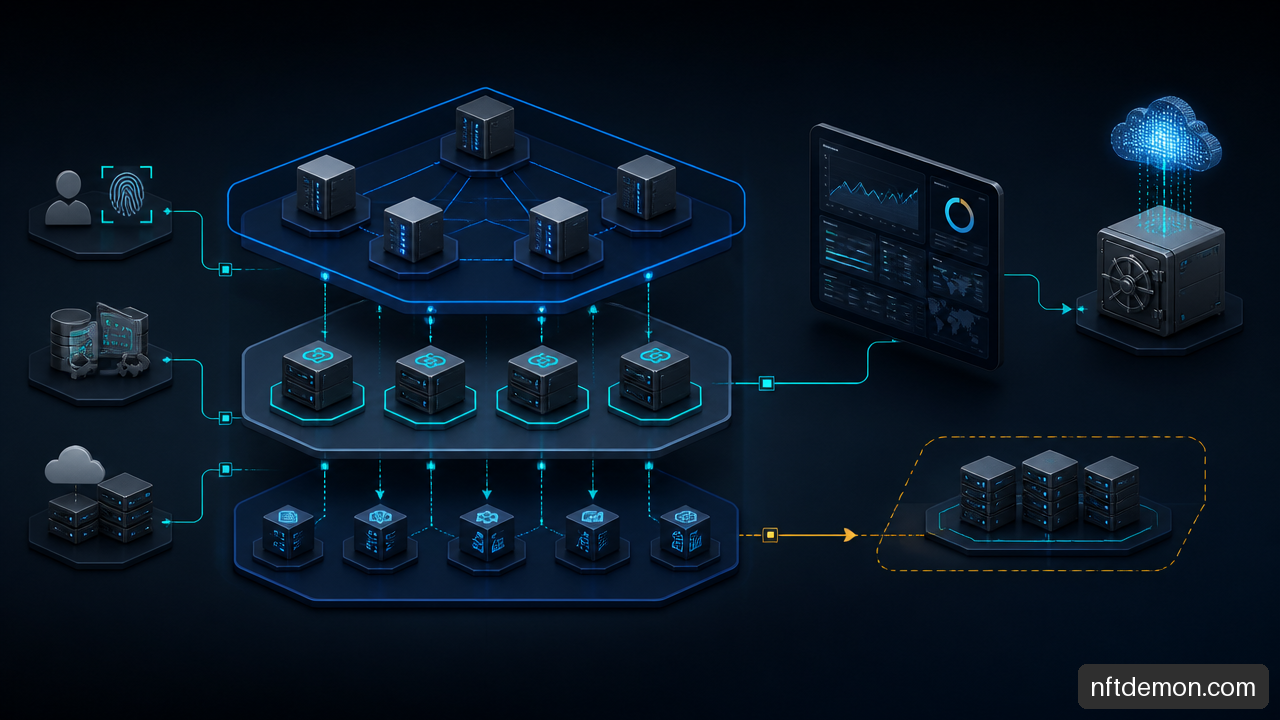
High availability is often described as “run redundant nodes.” That is incomplete. Consensus-layer resilience, application-layer resilience, and data-recovery resilience fail in different ways and require separate tests.
Test Consensus Failover Separately From Application Failover
Validator or ordering-node failure affects transaction ordering, block finality, and network quorum. Application failures affect API access, user sessions, job processing, and integration delivery. A load balancer may keep an application endpoint available even while the consensus mechanism cannot safely make progress.
Chainlaunch.dev identifies redundant nodes, tested backups, RBAC, and monitoring as foundational production operations controls for blockchain projects. The exact number and placement of nodes should depend on the consensus mechanism, fault model, participant structure, and contractual availability target.
Test failure modes individually:
-
Stop a peer, validator, or ordering node and verify whether consensus, endorsement, and block delivery continue as designed.
-
Isolate a zone, region, or participant network segment to expose assumptions about DNS, certificates, firewall rules, and quorum.
-
Fail an API gateway or integration worker while consensus remains healthy, then confirm retry behavior does not create duplicate business actions.
-
Restore a node from approved procedures and verify catch-up, ledger synchronization, certificate validity, and monitoring coverage.
-
Simulate an unavailable oracle or identity provider and confirm the system either fails safely or applies an explicitly approved degraded mode.
Reconcile On-Chain And Off-Chain State
A blockchain transaction can be final while the enterprise process is incomplete. This commonly occurs when a ledger event is committed but an ERP update, CRM workflow, document generation, or downstream notification fails afterward.
Use a reconciliation job to compare authoritative business records, ledger state, and integration outcomes. It should detect, categorize, and route exceptions rather than silently retry forever. Key checks include:
• Each approved source event has one expected ledger transaction.
• Each ledger transaction has the expected external reference and processing status.
• Identity mappings remain consistent across enterprise directories, participant certificates, and application accounts.
• Event consumers have processed messages exactly as the workflow requires, with idempotency controls for retries.
• Private data, hashes, and externally retained documents remain linked to the correct record version.
Cryptographic hashing proves that a known input corresponds to a recorded hash. It does not prove that the input was correct, current, authorized, or mapped to the right customer. That distinction should shape testing priorities.
Make Observability Blockchain Specific
Infrastructure dashboards alone cannot establish ledger health. Monitor the chain as a transaction system and as a distributed network.
| Signal | What To Monitor | Escalation Example |
|---|---|---|
| Consensus health | Quorum status, leader changes, ordering errors, block production gaps | Alert when blocks stop or transaction finality exceeds the agreed limit |
| Node synchronization | Peer height, lag against the leading node, gossip or replication errors | Investigate when a node remains behind beyond the accepted window |
| Contract execution | Rejected transactions, endorsement failures, contract errors, gas or resource limits where applicable | Escalate a sudden rejection-rate increase after a release |
| Integration integrity | Failed events, queue depth, replay counts, reconciliation exceptions | Pause nonessential submissions if duplicate risk rises |
| Security activity | Privileged logins, certificate changes, denied access, unusual signing requests | Trigger incident response for unexpected administrative actions |
Post-deployment verification should be deterministic: compare expected ledger height, peer synchronization, contract version, approved configuration, membership state, emitted events, and reconciliation results against the deployment record. “The dashboard looks green” is not sufficient evidence.
Execute Cutover, Verification, And Operational Handoff
The cutover plan should turn readiness evidence into a controlled sequence. It needs a launch owner, named decision makers, clear communications, and rollback triggers that are agreed before the launch window.
Use A Phased Cutover With Explicit Stop Conditions
Start with a limited participant group, controlled transaction types, or a constrained business region when the operating model permits it. The purpose is not to prolong a pilot indefinitely. It is to limit blast radius while validating real identities, real integration data, and actual support processes.
A practical cutover sequence is:
-
Freeze nonessential configuration changes and confirm the approved artifact versions.
-
Take and verify backups of node data, configurations, certificates, deployment metadata, and necessary off-chain records.
-
Deploy through the approved signing and promotion path.
-
Run deterministic technical checks and complete a business reconciliation sample.
-
Admit the initial user group and monitor defined thresholds for an agreed observation period.
-
Expand access only after formal acceptance, or activate the preapproved rollback and communications plan.
Rollback triggers should be concrete. Examples include sustained transaction latency beyond the business limit, failure to maintain consensus requirements, an unreconciled material record discrepancy, a critical access-control defect, or a restore test failure. The correct response may be a contract pause, endpoint isolation, participant suspension, compensating transaction, or broader service reversal. Match the action to the failure.
Complete The Operational Handoff
Production support begins at go live, not after it. Hand off runbooks that explain how to inspect node health, revoke identities, rotate certificates, replay integration events, execute a reconciliation job, manage a smart-contract incident, and engage consortium decision makers.
The following artifacts should be accessible to authorized teams:
• Current architecture and data-flow diagrams.
• Node inventory, ownership, dependencies, and recovery instructions.
• Contract and configuration version register.
• Contact matrix for security, legal, business operations, participant organizations, and incident leadership.
• Known-risk register with accepted exceptions, expiry dates, and accountable owners.
• Restore drill evidence and a scheduled retest date.
An orderly handoff is also where decision makers verify that service ownership has moved from project mode to operational accountability. If no team owns a 2 a.m. certificate failure or a contested transaction, the system is not production ready.
Key Takeaways
A production blockchain launch is defensible when the organization can prove not only that the ledger works, but also who controls it, how it fails, and how business operations recover.
• Treat governance, legal obligations, technical controls, and business acceptance as one release decision.
• Require artifact promotion gates and controlled signing so automated build systems do not directly control production authority.
• Test consensus-node failures separately from API, integration, and application failures.
• Verify identity mapping, oracle behavior, event delivery, and reconciliation between the ledger and enterprise records.
• Define numerical or observable cutover thresholds, rollback triggers, and restore-drill requirements before the launch window.
• Establish contract upgrade, emergency pause, incident ownership, and consortium exit procedures before production traffic begins.
Frequently Asked Questions
What Should Be On A Production Deployment Checklist For An Enterprise Blockchain System?
Include governance approvals, legal and privacy review, node architecture, key management, RBAC, contract lifecycle controls, integration testing, performance evidence, monitoring, backups, restore drills, cutover criteria, rollback actions, and operational handoff. The checklist should attach evidence and owners to each item.
What Makes A Blockchain Deployment Production Ready In An Enterprise Environment?
Production readiness means the network can process authorized business activity within agreed service limits, maintain integrity through failures, and operate under accountable governance. A functional demonstration is not enough if identity revocation, incident response, or reconciliation remains undefined.
How Do We Secure Validator Nodes, Peers, And Administrator Access Before Go Live?
Use segmented networks, hardened hosts, restricted management access, separate privileged identities, MFA, RBAC, audit logging, and protected signing keys. Test certificate revocation and recovery, because access control that works only during normal operations is incomplete.
What Key Management Setup Is Best For Production Blockchain Deployments?
The appropriate setup depends on the platform and risk profile, but production keys should generally be protected by a KMS, HSM, hardware-backed signing method, or multi-party approval flow. Avoid allowing CI runners or shared administrator accounts to hold unrestricted production signing authority.
How Do We Validate Smart Contracts Before Production Deployment?
Validate business rules, permissions, failure paths, dependency behavior, upgrade compatibility, and emergency controls. Then test the deployed contract version through the same promotion and signing process planned for production. The release procedure itself is part of the control.
What Should A Blockchain Disaster Recovery Plan Include?
Document backup scope, retention, storage protection, recovery objectives, restore procedures, dependency recovery order, node rejoining steps, certificate requirements, and communications responsibilities. Run restore drills rather than assuming backups are usable.
How Should A Consortium Blockchain Handle Governance, Approvals, And Upgrades?
Define voting thresholds, change categories, required notice, emergency authority, dispute handling, onboarding and offboarding rules, and responsibility for shared incidents. Contract upgrades should be approved under the same governance model that governs membership and configuration changes.
Sources And References
• Blockchain Council — Smart Contract Testing and Deployment Pipeline
• Blockchain Council — Legal Considerations for Business Blockchain Deployments
• Chainlaunch.dev — 87% of Blockchain Projects Die Before Production: 5 Gaps
NFT Demon Holdings helps enterprises scope, evaluate, and build blockchain programs — start with a free evaluation call.
Talk through your use case
Free evaluation call — objective, constraints, and fit, before any proposal.