Operational controls for a production blockchain deployment
By Jeremy Ryan, Founder & CEO · September 2026

A production blockchain deployment needs more than secure code and a functioning consensus mechanism. It needs operating controls that keep keys protected, nodes trustworthy, transactions accountable, and recovery possible when an outage or security event occurs. When decision makers ask what operational controls are required for a production blockchain deployment, the practical answer is a coordinated system of governance, access control, cryptography, node operations, monitoring, change management, and continuity planning.
The blockchain ledger may be tamper evident, but the systems around it are not automatically safe. A compromised administrator account can alter validator settings. A leaked signing key can authorize an irreversible transaction. A third party API can provide an incomplete or manipulated blockchain view. Production readiness means controlling these failure paths before value, customer data, or critical business processes depend on the system.
Key Takeaways
• Treat custody, validator operations, smart contract administration, and application infrastructure as separate control domains. They may interact, but they should not share unrestricted access.
• Require multi factor authentication, least privilege, named accounts, time bound elevation, and independent approval for high impact actions.
• Use HSM backed keys, multisig approval policies, transaction limits, and distinct hot, warm, and cold operational roles. Multisig is valuable, but it is not a complete custody control by itself.
• Run an internal full node when blockchain state informs balances, settlement, sanctions screening, liquidation, entitlement, or any other critical decision.
• Monitor both infrastructure events and blockchain specific events: signing attempts, validator status, contract upgrades, abnormal transaction patterns, balance threshold breaches, and confirmation delays.
• Test recovery as an operating capability, not a document. A useful drill restores node state, keys, administrator access, deployment tooling, and decision authority in the right order.
Establish Governance And Operational Boundaries
Production controls begin with an accountable operating model. This is not administrative overhead. It determines who may make irreversible changes, who can move assets, who can suspend activity, and who has authority during an incident.
Define The Systems That Need Different Controls
A blockchain program often fails by treating every technical component as one environment. In reality, at least four environments carry different risks.
| Operational Domain | Primary Risk | Required Control Focus |
|---|---|---|
| Validator or consensus nodes | Loss of availability, faulty participation, consensus disruption | Hardened hosts, configuration control, peer monitoring, recovery procedures |
| Treasury and custody systems | Theft, unauthorized transfers, key loss | HSMs, multisig, transaction policies, segregated duties |
| Smart contracts and deployment tooling | Irreversible logic defects or unauthorized upgrades | Code review, approval gates, deployment records, emergency authority |
| Application APIs and user services | Account compromise, data exposure, unreliable transaction submission | API authentication, rate limits, secure secrets, audit logging |
This separation matters because a validator operator should not automatically have the ability to sign treasury transfers, and a treasury approver should not be able to upgrade a production smart contract. Combining these roles creates a single point of human failure even when the cryptographic hash and consensus mechanism are functioning exactly as designed.
For example, an enterprise may operate permissioned nodes for a supply chain ledger while maintaining a public chain wallet for settlement. The node team needs access to peer configuration, logs, and certificate renewal. The settlement team needs constrained authority to approve transfers. Giving both teams the same cloud administrator account is expedient, but it eliminates meaningful accountability.
Create A Control Owner For Every Critical Action
Each production action should have an owner, an approver, an execution path, and retained evidence. The relevant actions usually include validator onboarding, node upgrades, wallet policy changes, address allowlist changes, contract deployments, contract upgrades, emergency pauses, key recovery, and third party API changes.
The Primechain blockchain security control framework identifies governance, management commitment, coordination, and compliance as elements of the blockchain control environment. That framing is useful because technology controls deteriorate when no one owns the decision to enforce them.
I would require a production control matrix before go live. It should answer four questions for every sensitive action:
- Who may request the action?
- Who independently approves it?
- Who executes it, and through what authenticated system?
- What evidence proves the action was authorized and completed correctly?
A change ticket alone is not sufficient if it does not identify the target chain, contract address, node group, wallet, expected transaction hash, rollback option, and approvers. Blockchain changes can be irreversible. The operational record must be detailed enough to reconstruct intent after the fact.
Map Blockchain Controls To Enterprise Control Families
Blockchain deployments should fit into existing security and audit programs rather than become an exception to them. A practical mapping is shown below.
| Enterprise Control Family | Blockchain Application |
|---|---|
| Access control | RBAC, MFA, privileged session recording, access reviews |
| Cryptography and key management | HSMs, key generation ceremonies, backup controls, signing policies |
| Operations security | Node hardening, patching, backups, capacity management, runbooks |
| Change management | Peer reviewed upgrades, deployment approvals, emergency change rules |
| Logging and evidence | Immutable audit records, SIEM ingestion, transaction and admin event retention |
| Contingency planning | Node restoration, key recovery, alternate providers, incident communications |
An academic blockchain control framework similarly organizes controls around information security policies, physical security, key management and cryptography, computer operations, and logical access controls. That control framework for blockchain security is a useful reminder that blockchain does not replace foundational security disciplines.
Protect Keys, Privileged Access, And Production Changes
A production blockchain system is only as defensible as its signing and administration paths. Private keys, seed material, recovery artifacts, API credentials, and privileged cloud access should be treated as high impact secrets, not ordinary configuration values.
Build Key Custody Around Policy, Not Just Wallet Type
Hot, warm, and cold controls should reflect the operational purpose of funds and keys.
| Key Tier | Appropriate Use | Core Controls | Avoid When |
|---|---|---|---|
| Hot | Limited automated withdrawals, market operations, frequent settlement | Tight balance limits, automated monitoring, HSM or managed signing, destination policies | Large reserves or transactions requiring discretionary review |
| Warm | Scheduled operations with human authorization | Multisig, approval workflow, limited connectivity, transaction review | Instant user withdrawals where latency is a hard requirement |
| Cold | Long term reserves and recovery material | Offline generation, geographically separated custody, documented recovery ceremony | Daily operational transactions |
Multisig reduces the chance that one compromised key can move assets, but it does not prevent poor signer hygiene, collusion, malware on multiple endpoints, or a fraudulent transaction that every signer approves. For critical functions, the stronger design combines role separation, transaction policy controls, and HSM backed key management. The enterprise multisignature guidance from Hacken specifically supports combining multisig policies with separation of roles and HSM based protection.
A treasury policy should define maximum transaction values, address allowlists, velocity limits, required approvers, emergency halt authority, and an escalation path for exceptions. Consider a payroll wallet that must pay approved contractors weekly. The normal policy might permit transfers only to pre approved addresses within a defined ceiling. A request to add a new address and send a high value transfer should require a separate verification process, not simply more signatures on the same transaction.
Key rotation deserves nuance. Many public blockchain addresses cannot be rotated in place because the address is derived from the key. In those cases, rotation means creating a new key and address, migrating assets or permissions, updating allowlists and contracts, then retiring the old signing authority. That migration itself must be controlled. Rotating hastily without testing dependent systems can cause failed deposits, stranded permissions, or rejected settlement instructions.
Enforce Privileged Access And Separation Of Duties
Privileged access should use named accounts, MFA, least privilege, and temporary elevation where technically possible. Shared administrator credentials remove attribution and should not be accepted for production operations.
The Blockchain Operational Risk Assessment recommends 2FA for administrative access and partner API changes, two person approval for sensitive administrative functions, and segmented administrative roles so hot and cold access are not held by the same individual. These controls address a central blockchain risk: one person should not be able to create, approve, and execute a high impact action without independent review.
Use two person approval for actions such as:
• Adding or removing validator nodes
• Changing consensus, peer, or RPC configuration
• Deploying or upgrading a smart contract
• Modifying wallet thresholds, signer sets, or destination allowlists
• Restoring key material or activating emergency signing authority
• Disabling monitoring, logging, or transaction controls
Access review must be scheduled and event driven. The BSSC General Security and Privacy Guidelines v2 calls for privileged access reviews at least every six months and production access reviews annually. I would also review access immediately after role changes, contractor departures, mergers, security incidents, or changes in custody responsibility. A six month review is a floor, not a reason to wait when an employee changes teams tomorrow.
Restrict Data And Secret Exfiltration
Production blockchain environments contain more than keys. They may hold customer identifiers, wallet mappings, transaction review records, compliance case data, node configuration, and smart contract deployment secrets.
DLP should monitor and block unauthorized exports through email, web storage, and removable media. The BSSC guidance also calls for preventing customer data from being copied or exported from production systems unless an approved business workflow requires it. This control is particularly relevant when support, finance, engineering, and compliance teams all need different views of the same operational record.
Practical safeguards include controlled administrative workstations, restricted clipboard use for sensitive consoles, secret scanning in source repositories, approved file transfer routes, and alerts when large datasets leave production. These measures need calibration. An overly broad DLP policy can block legitimate incident response evidence collection. The answer is not to disable it, but to define a logged and approved exception workflow.
Operate Nodes, Monitor Risk, And Prove Recovery
A blockchain node is not just another virtual machine. Its state, peer relationships, chain synchronization, RPC exposure, and role in the consensus mechanism can affect application correctness. Still, normal infrastructure discipline remains essential.
Decide When Self Verification Is Required
If a system makes critical decisions from blockchain data, it should independently verify that data through its own full node or an equivalent independently controlled validation path. The operational risk assessment warns against relying on a third party for blockchain views used in critical decisions and identifies full node operation as a key verification control.
This does not mean every organization must operate every possible node type. A marketing site displaying a public NFT collection may reasonably use a reputable provider with availability safeguards. A custodian calculating customer balances, a lender triggering collateral actions, or an exchange crediting deposits should not depend solely on a third party API response. In those cases, the external provider becomes an unverified source of truth for a financial decision.
A resilient model can use multiple providers for submission and redundancy while treating the internal full node as the authoritative verification source. Track divergence between provider responses and internal state. If the results disagree, suspend the affected workflow rather than selecting the more convenient answer.
Monitor What Can Cause Irreversible Harm
Monitoring should connect infrastructure health to business and blockchain risk. A node being online is not enough. It may be behind the network tip, serving stale state, disconnected from expected peers, or accepting suspicious RPC requests.
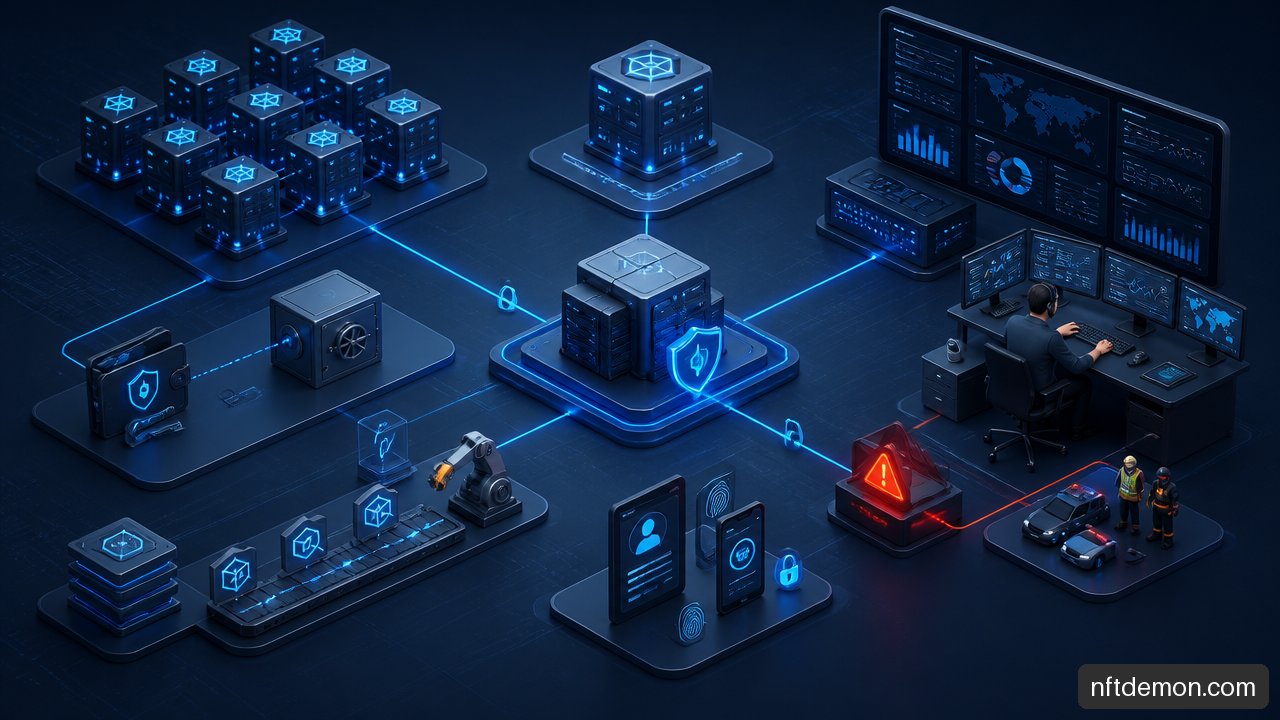
A production monitoring design should feed node, cloud, identity, wallet, contract, and application telemetry into a SIEM or equivalent centralized monitoring platform. The Hacken enterprise guide on real time on chain monitoring recommends continuous monitoring and anomaly detection for enterprise operations.
Alert categories should include:
• Node synchronization lag, missed validator duties, peer loss, disk exhaustion, abnormal CPU or memory use, and unexpected process restarts
• RPC spikes, failed authentication attempts, calls to privileged methods, configuration drift, and newly exposed endpoints
• Signing requests outside approved windows, unexpected destination addresses, threshold changes, unusual gas spending, and balance limit breaches
• Smart contract ownership transfers, upgrades, emergency pause events, role grants, and unusually large or repeated token movements
• Identity events such as new privileged accounts, failed MFA, disabled logging, or access from unapproved locations
The key is correlation. A signing event may look normal in isolation. A signing event that follows a new administrator account, an allowlist change, and a DLP alert is a different situation. Alert design should focus on these sequences, with clear severity thresholds and named responders.
Retain evidence that supports investigation and audit: approval records, privileged session logs, signer events, node configuration changes, deployment artifacts, transaction hashes, alerts, and incident decisions. The ledger records the transaction, but it usually does not record who authorized it inside your organization or why.
Test Recovery In The Order Operations Need It
A backup that cannot restore operational authority is not a recovery control. Blockchain disaster recovery should test at least five dependencies: node infrastructure, chain state or resynchronization method, keys, administrator access, and runbooks.
A realistic recovery exercise follows a sequence:
-
Declare the incident and assign incident command, technical recovery, custody authority, communications, and compliance roles.
-
Restore secure administrative access using break glass procedures that still require independent approval.
-
Rebuild or restore nodes from trusted images, validate software versions and configurations, then confirm chain synchronization and peer behavior.
-
Recover wallet or signing capability through the approved ceremony, while confirming that recovered credentials have not been exposed or superseded.
-
Reconnect application services only after transaction verification, monitoring, and approval workflows are functioning.
-
Reconcile balances, pending transactions, contract state, and operational logs before returning to normal processing.
The same operational risk assessment recommends documented restoration steps and partner contact points for disruptions. That detail matters when cloud providers, node providers, custodians, compliance vendors, and internal teams all participate in recovery.
Do not test only a clean node rebuild. Test the uncomfortable scenarios: a corrupted configuration backup, unavailable primary signer, expired certificate, lost access to a third party RPC provider, or a contract upgrade halted halfway through deployment. The test result should identify recovery time, recovery point, unresolved dependencies, and policy changes required before the next exercise.
Cryptography change readiness should also be included in long term planning. There is no universal timetable for post quantum migration across blockchain protocols, and current networks vary widely in upgrade capacity. Still, I would maintain an inventory of signature algorithms, wallet dependencies, contract assumptions, and vendor roadmaps. For example, a long lived treasury address with substantial assets may need a migration plan well before a protocol wide cryptographic transition becomes urgent.
Frequently Asked Questions
What Is The Minimum Security Baseline Before Production?
At minimum, establish named ownership, MFA, RBAC, protected key custody, hardened nodes, approved change management, centralized logs, alerting, backup and recovery testing, and an incident response process. The baseline must cover both blockchain components and the cloud, identity, API, and deployment systems around them.
Which Controls Are Specific To Blockchain Nodes?
Node specific controls include synchronization monitoring, peer configuration control, RPC exposure restrictions, validator key protection, consensus participation monitoring, chain state verification, and software compatibility testing. Standard host patching, vulnerability management, network segmentation, and endpoint protection still apply.
How Should Private Keys Be Stored And Rotated?
Store production signing keys in an HSM, secure hardware wallet, or another architecture designed to prevent exportable key material. Rotate by creating new keys, migrating funds or permissions under dual control, updating dependent systems, and retiring prior authority. Test the migration path before moving material balances.
Is Multisig Enough For Production Treasury Control?
No. Multisig protects against a single signer compromise, but it does not replace secure signer devices, transaction limits, address allowlists, independent approvals, monitoring, or incident response. It is one layer in a custody control system.
How Often Should Privileged Access Be Reviewed?
Review privileged access at least every six months and all production access annually, consistent with BSSC guidance. Review it sooner after role changes, departures, incidents, or material architecture changes. Access that is no longer justified should be removed promptly rather than waiting for the next scheduled review.
When Should A Team Run Its Own Full Node?
Run an internal full node when chain state drives a critical financial, compliance, settlement, entitlement, or risk decision. Third party APIs can remain useful for redundancy and convenience, but they should not be the only source of truth when a wrong response can cause customer loss or regulatory exposure.
What Should A Blockchain Disaster Recovery Test Include?
Test restoration of node infrastructure, chain synchronization, administrative access, signing authority, monitoring, application connectivity, and reconciliation procedures. Include people and approvals, not only technology. A technically restored node is insufficient if nobody can securely authorize the transactions needed to resume service.
Sources And References
• Rohas Nagpal — Blockchain Security Controls Primechain-BSC: https://www.rohasnagpal.com/docs/blockchain-security/blockchain_security_controls.pdf
• Blockchain Operational Risk Assessment — Do You Really Need a Blockchain?: https://uploads-ssl.webflow.com/5fd11235b3950c2c1a3b6df4/62b53d560764fa44279445ff_Blockchain_Operational_Risk_Assessment.pdf
• BSSC — General Security and Privacy Guidelines v2: https://specs.blockchainssc.org/gsp/
• Deloitte — Security Controls for Blockchain Applications: https://www.deloitte.com/ch/en/services/consulting-risk/perspectives/security-controls-for-blockchain-applications.html
• ijikm.org: http://www.ijikm.org/Volume16/IJIKMv16p307-330Al-Ketbi7113.pdf
NFT Demon Holdings helps enterprises scope, evaluate, and build blockchain programs — start with a free evaluation call.
Talk through your use case
Free evaluation call — objective, constraints, and fit, before any proposal.