Multi chain tokenization strategy, enterprise architecture guide
By Jeremy Ryan, Founder & CEO · October 2026
Deploying digital assets across a single blockchain network creates severe ecosystem constraints, fragmenting liquidity and restricting institutional utility. As modern financial infrastructure moves toward decentralized ledgers, building a cohesive multi chain tokenization strategy has become a critical operational requirement for asset managers, fintech institutions, and token issuers. When we evaluate enterprise token deployments, the primary challenge is not merely expanding reach across networks; it is maintaining strict accounting integrity, unified regulatory compliance, and bulletproof security across disparate consensus environments. This guide breaks down the structural mechanics, risk frameworks, and deployment workflows required to execute a resilient multi-chain token architecture.
• Key Takeaways
• Architectural
Paradigms: Native Canonical Tokens vs. Multi-Contract
Representations
• Developing
a Robust Cross-Chain Interoperability Framework
• Cross-Chain
Compliance and Identity State Management
• Chain
Selection and Operational Lifecycle Governance
• Strategic
Roadmap for Enterprise Multi-Chain Tokenization
• Frequently Asked
Questions
• Sources / References
Key Takeaways
• Canonical Supply Preservation: Maintaining a
single authoritative global token balance across multiple networks
requires explicit reconciliation protocols and controlled mint/burn
authorizations.
• Interoperability Security Alignment: Evaluating
cross-chain messaging requires isolating messaging verification
mechanisms from underlying token contract permissions to mitigate bridge
compromise risks.
• Unified Compliance Engines: Regulatory controls,
sanction rules, and identity verification must run through centralized
or synchronized logic rather than isolated per-chain policies.
• Structured Chain Selection: Network deployment
decisions must follow quantitative entry criteria including settlement
finality, gas economics, custody integration, and validator
security.
• Lifecycle Risk Management: Every multi-chain token
program requires explicit chain-exit procedures, token pool migration
mechanisms, and emergency pause functions.
Architectural Paradigms: Native Canonical Tokens vs. Multi-Contract Representations
When designing a multi chain tokenization strategy, the fundamental architectural decision centers on how the asset’s global supply is represented and controlled across multiple execution environments. Token issuers must choose between establishing a single canonical token with cross-chain messaging capabilities or managing distinct, locally native smart contract deployments anchored by bridge infrastructure.
Burn-and-Mint vs. Lock-and-Mint Mechanics
Cross-chain token transfers fundamentally rely on two primary supply management mechanisms: burn-and-mint and lock-and-mint (or escrow-and-mint). Choosing the correct pattern dictates both the security profile and the accounting ledger structure of your asset.
- Burn-and-Mint Model: Tokens on the source chain are permanently destroyed (burned), triggering a cryptographic message to the destination chain where an identical quantity is newly created (minted). As LayerZero’s cross-chain standards analysis demonstrates, cross-chain token standards define supply movement and authorization, including burn-and-mint and escrow-and-mint patterns. This model eliminates centralized asset backing risk on the source network, as no massive collateral pool accumulates over time.
- Lock-and-Mint (Escrow) Model: Tokens on the source network are deposited and locked inside a security contract (an escrow pool). A corresponding quantity of synthetic or wrapped tokens is then minted on the destination chain. While necessary for assets with fixed, non-mintable source contracts, this approach concentrates systemic risk in the escrow smart contract.
| Accounting Feature | Burn-and-Mint Pattern | Lock-and-Mint (Escrow) Pattern |
|---|---|---|
| Global Supply Impact | Dynamic local balances; invariant aggregate total. | Fixed source supply; expanding collateral pool. |
| Hedge Against Exploits | Exploit on chain B cannot drain collateral on chain A. | Exploit on destination contract risks draining source escrow. |
| Smart Contract Capability | Requires direct mint and burn authorizations. | Compatible with immutable, legacy ERC-20 tokens. |
| Reconciliation Overhead | Low event verification complexity; direct ledger balance. | High custodial audit overhead for locked reserve accounts. |
Token Pool Architecture and Lifecycle Management
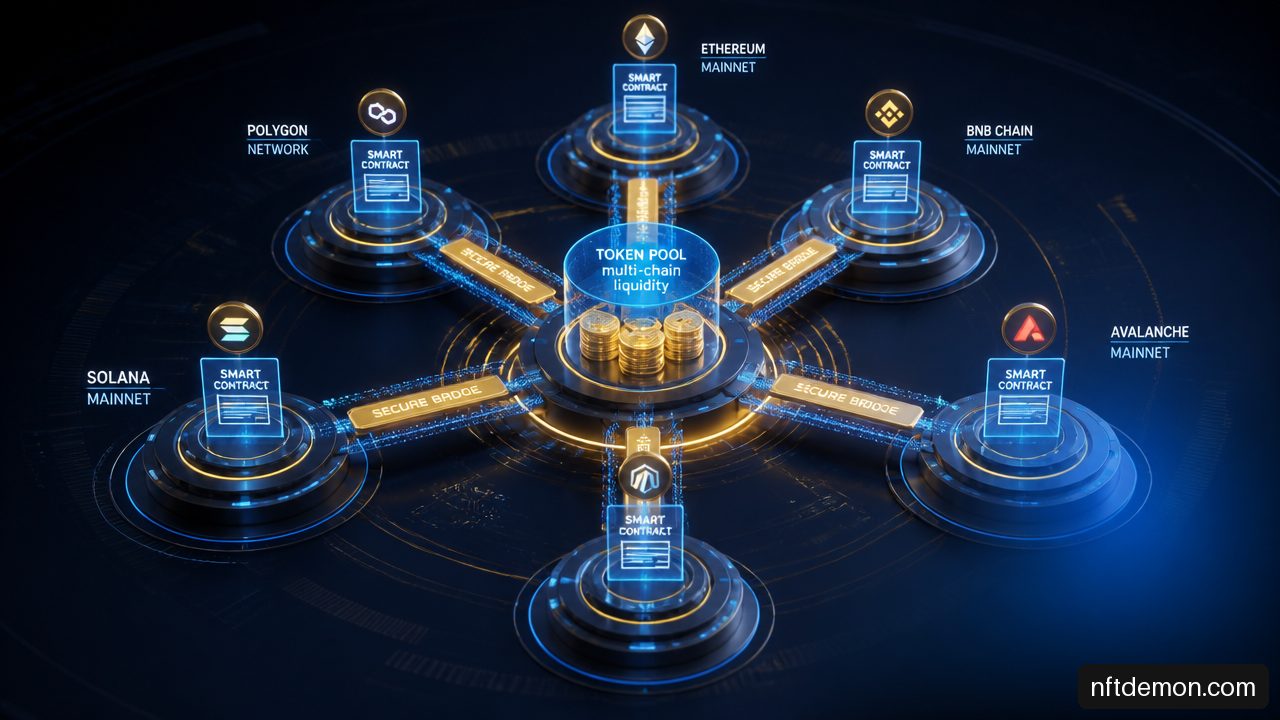
To standardize token behavior across diverse runtime environments, modern frameworks utilize specialized abstraction layers known as token pools. As documented in Chainlink’s architecture documentation, each token uses a token pool on each blockchain, with standard and custom deployment approaches. These token pools act as smart contract gateways that validate inbound cross-chain instructions before modifying token supply or balance state.
Under this design, according to Chainlink’s cross-chain token overview, token pools lock or burn on the source chain and release or mint on the destination chain. For enterprise deployments, evaluating custom token pools versus standardized implementations involves balancing flexibility against security risk:
• Standard Token Pools: Pre-audited smart contract
pools provided by interoperability networks offer rapid deployment and
lower audit overhead. However, they may constrain custom business logic
or regulatory freeze capabilities.
• Custom Token Pools: Custom-coded contract pools allow
issuers to embed institutional rulebooks, such as dynamic fee handling,
transfer restrictions, or real-time compliance hooks directly into the
bridging cycle. The trade-off is an increased attack surface and
requirement for independent security audits.
When evaluating deployment architecture, asset issuers must balance private infrastructure requirements with broader market reach. Choosing between public and permissioned blockchains plays a decisive role in determining whether token pools should operate in open ecosystems or restricted network environments.
Developing a Robust Cross-Chain Interoperability Framework
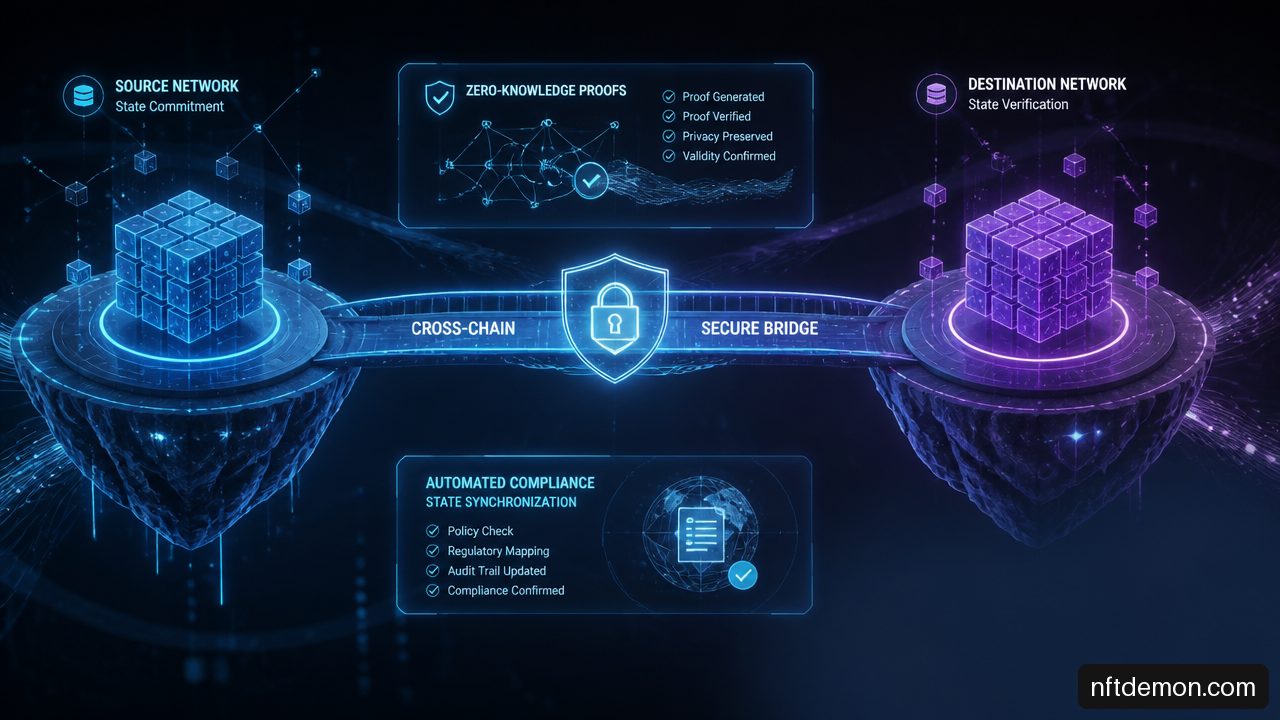
Cross-chain tokenization is only as secure as the underlying messaging fabric that links smart contracts across networks. A robust multi chain tokenization strategy isolates messaging layer risks from token contract permissions, ensuring that a vulnerability in a relayer or oracle network cannot unilaterally compromise the core asset ledger.
Bridge Security and Trust Assumptions
Interoperability architectures rely on varied cryptographic trust models to verify cross-chain state. As noted in Tokenization Policy’s enterprise guidance, enterprise multichain designs should evaluate chain security, finality, economics, institutional support, regulatory acceptability, and bridge security.
We categorize cross-chain validation models into four distinct operational structures:
- Proof-Based Native Verification (Light Clients): Verifies block headers and cryptographic proofs directly on the destination chain. Offers high security, but incurs high gas overhead for state verification.
- Committee-Based Multisig Verification: Relies on a decentralized set of validators to sign state updates. Requires lower execution cost, but introduces security reliance on validator subset collusion thresholds.
- Oracle and Relayer Dual-Attestation: Splitting state verification between independent data providers (oracles) and message deliverers (relayers). Ensures execution only occurs when both parties agree on source chain state changes.
- Zero-Knowledge (ZK) Relayers: Generates succinct cryptographic proofs off-chain that are settled on-chain. Provides strong trustlessness with low destination verification costs.
Failure Handling and Partial Execution Recovery
A common failure mode in multi-chain environments is partial execution—where tokens are burned or locked on the source network, but the destination transaction fails due to gas spikes, unhandled logic reverts, or destination node outages. To prevent asset loss, issuers must implement explicit recovery workflows.
[Source Chain]
│
├── 1. Execute Token Burn / Lock
├── 2. Emit Cross-Chain Message
│
[Messaging Protocol]
│
├── 3. Validate Proof / Consensus
│ │
│ ├─► [Destination Failure Options]:
│ │ • Destination Gas Exhaustion
│ │ • Account Freeze / Compliance Revert
│ │ • Network Outage
│ │
▼ ▼
[Recovery Execution]
│
├── A. Automatic Retry Engine (Gas Top-Up)
└── B. Reversion Claim Proof (Source Refund Mint)
To maintain ledger integrity during transaction failures, the system architecture must support two core fallback mechanisms:
• Manual Execution & Gas Top-Up: Allows the
token holder or an automated relayer service to re-submit the
destination transaction with updated gas parameters without
re-initiating the source transaction.
• Source-Chain Reversion Mechanisms: If a destination
chain message permanently fails or times out, a cryptographically signed
proof of non-execution must allow the source token pool to unlock or
re-mint the original tokens back to the user’s account.
Understanding these failure boundaries requires examining enterprise consortium models where validation rules differ across institutional participants. Reviewing Trade-offs in enterprise consortium blockchain architecture offers insight into managing consensus edge cases across cross-organizational networks.
Cross-Chain Compliance and Identity State Management
Regulated asset tokenization—including real-world assets (RWAs), debt instruments, and equity tokens—requires enforcing compliance rules continuously. In a multi-chain environment, compliance logic cannot remain isolated inside individual network deployments; it must act as a globally synchronized state engine.
Distributed Compliance Synchronization
When an institutional token issuer needs to pause transfers, apply a sanctions freeze, or update Know-Your-Customer (KYC) whitelist eligibility, that administrative action must take effect simultaneously across all supported networks. Operating independent, per-chain whitelist registries introduces settlement lag and regulatory arbitrage risks.
- Hub-and-Spoke Identity Architecture: Maintain the authoritative identity and policy database on a primary sovereign chain (the hub). When investor credentials change, the hub emits authenticated state-update messages to lightweight compliance modules installed on each spoke chain.
- Off-Chain Identity Verification with On-Chain Attestation: Utilize cryptographic zero-knowledge attestations or signed off-chain identity proofs. Holders attach an issuer-signed compliance token to their transfer transaction, which local smart contract interfaces verify on execution without requiring full local whitelist databases.
- Global Pause and Emergency Controls: Ensure token smart contracts on every chain contain unified access controls capable of halting local pool minting and transfers upon receiving an emergency broadcast from the primary governance wallet.
Preserving Token Metadata and Identity Invariants
A subtle risk in multi-chain asset issuance is metadata drift and token identification mismatch. Misaligned token symbols, varying decimal precision, or uncoordinated contract address updates degrade wallet integration, decentralized exchange pricing feeds, and institutional custody tracking.
To enforce metadata consistency, enterprise issuers must establish cross-chain identity invariants:
• Global Asset Identifiers: Embed standardized asset
identifier codes (such as ISO 24165 Digital Token Identifiers) into the
token’s smart contract metadata across all networks.
• Invariant Decimals: Standardize decimal precision
across all chains (typically 6 or 18 decimals). Allowing differing
decimals across EVM and non-EVM deployments introduces calculation
errors in cross-chain accounting.
• Canonical Registry Synchronization: Maintain an
authoritative public configuration registry specifying approved contract
addresses, token pool versions, and messaging endpoints per chain
ID.
Chain Selection and Operational Lifecycle Governance
Expanding a token ecosystem onto new blockchain networks increases brand visibility and user accessibility, but introduces operational overhead, security exposure, and liquidity fragmentation. Strategic expansion requires clear quantitative criteria for onboarding and offboarding networks.
Quantitative Chain-Entry and Chain-Exit Criteria
Before deploying smart contracts to a target network, enterprise asset teams must evaluate the destination network against a structured scoring rubric. Deploying blindly to emerging chains creates maintenance liabilities if node infrastructure degrades or liquidity evaporates.
                [Chain Selection Threshold Matrix]
                               │
     ┌─────────────────────────┴─────────────────────────┐
     ▼                                                   ▼
[Security & Finality Checks] [Commercial & Regulatory
Checks]
• Min. 128-bit Security • Qualified Custodian Support
• Deterministic Finality < 60s • Regulatory Jurisdictional
Acceptance
• > 50 Independent Validator Nodes • Sustainable Transaction
Economics
│ │
└─────────────────────────┬─────────────────────────┘
│
▼
[Go / No-Go Deployment Approval]
We utilize a four-pillar framework to determine network eligibility:
- Settlement Finality and Reorganization Risk: The network must offer deterministic finality within an acceptable operational window (e.g., under 60 seconds). Networks prone to deep chain reorganizations threaten cross-chain messaging safety.
- Institutional Custody Support: Major qualified custodians and institutional wallet frameworks must support the network’s token standards natively.
- Economic Sustainability: Gas fees and operational maintenance costs must remain economically viable relative to projected transactional volume.
- Validator Concentration and Security: Evaluation of network decentralization metrics, node hosting concentration, and historical network uptime.
Equally vital is defining explicit Chain-Exit Procedures. If a supported network experiences security degradation, loss of validator decentralization, or regulatory prohibition, the issuer must execute a structured retirement plan:
• Step 1: Freeze local token pool minting while
leaving burn/release functions open to allow users to exit the
chain.
• Step 2: Publish an official deprecation grace period
notice for token holders.
• Step 3: Re-route messaging protocols to automatically
redirect inbound transfers back to the source network or a primary
reserve chain.
• Step 4: Decommission local contracts and liquidate
remaining reserve pools after the grace period expires.
Managing Liquidity Fragmentation and Total Cost of Ownership
Distributing token supply across six different networks often splits overall market liquidity into six small pools. This fragmentation causes higher slippage for market participants and reduces capital efficiency.
To evaluate the ongoing expense of multi-chain expansion, issuers should model the aggregate Total Cost of Ownership (TCO) per additional network:
| Cost Category | Initial Setup Overhead | Recurring Operational Expense |
|---|---|---|
| Smart Contract Audits | High (Independent pool audits per chain type) | Medium (Re-auditing upgrades/patches) |
| Infrastructure & Indexing | Medium (Setting up archive nodes/indexers) | High (Monthly RPC & API data fees) |
| Compliance Monitoring | Low (Initial contract configuration) | High (Continuous multi-chain transaction monitoring) |
| Security & Monitoring | Medium (Setting up cross-chain alerting) | High (Real-time pool reconciliation services) |
Maintaining rigorous security standards across all deployed chain environments is non-negotiable. Reviewing Security and scalability in enterprise blockchain architecture provides systemic guidance on maintaining operational integrity while scaling digital asset platforms.
Strategic Roadmap for Enterprise Multi-Chain Tokenization
Executing a successful multi-chain token launch demands a phased deployment model that limits risk while validating operational procedures in real-world conditions.
Phased Deployment and Controlled Testing
A structured rollout isolates potential integration flaws before exposing large capital balances to cross-chain transfers:
- Phase 1: Testnet Stress Testing: Deploy token pools to testnets for all target environments. Simulate edge cases including destination chain congestion, gas exhaustion, invalid payload delivery, and oracle delay.
- Phase 2: Soft Launch with Capped Transfer Limits: Deploy production contracts to mainnet environments, but enforce hard daily transfer caps on token pools. This limits exposure while verifying live relayer performance.
- Phase 3: Automated Reconciliation Activation: Enable continuous, automated monitoring engines that cross-verify token supply totals across all deployed smart contracts every hour.
- Phase 4: Full Liquidity Integration & Uncapped Operations: Remove transfer limits and allow full institutional routing once monitoring engines verify zero accounting discrepancies over an extended observation period.
Emergency Controls, Pause Mechanisms, and Pool Migration
Governance frameworks must prepare for emergency scenarios, such as zero-day exploits in messaging protocols or compromised token pool admin keys. Enterprise token contracts should integrate modular access control architectures (such as OpenZeppelin AccessManager or role-based multi-signature mechanisms).
Key emergency features include:
• Circuit Breakers: Smart contract rate-limiters
that automatically pause bridging activity if transfers exceed pre-set
volume thresholds within a short time window.
• Upgradable Pool Interfaces: Utilizing proxy
architectures or modular adapter patterns that allow issuers to swap out
an underlying messaging protocol without re-issuing the core token
contract.
• Emergency Supply Reclamation: Administrative
capabilities to isolate compromised bridge contracts, freeze affected
sub-pools, and re-mint legitimate token balances to verified account
holders on a secure chain.
Frequently Asked Questions
What does a multi chain tokenization strategy mean?
It is an enterprise design framework that enables a single asset or token to exist, transfer, and interact natively across multiple distinct blockchain networks while preserving a unified total supply, consistent metadata, and identical compliance enforcement.
Should one token use the same supply across every blockchain?
Yes. Allowing uncoordinated, duplicate token supplies on different chains inflates the aggregate supply and destroys pricing consistency. A valid multi-chain strategy utilizes lock-and-mint or burn-and-mint logic to ensure tokens destroyed on one network equal those minted on another, keeping global circulating supply invariant.
What is the difference between burn-and-mint and lock-and-mint?
In a burn-and-mint model, tokens are destroyed on the source chain when bridging and newly minted on the destination chain. In a lock-and-mint model, original tokens are locked in a source escrow smart contract, and a wrapped representation is minted on the destination chain. Burn-and-mint avoids escrow accumulation risk but requires direct minting permissions.
How can total supply remain consistent across multiple chains?
Total supply balance is preserved using automated token pool contracts combined with cryptographic messaging protocols. Every cross-chain transfer generates an authenticated event log on the source network that must be verified before destination tokens are unlocked or minted. Continuous off-chain automated reconciliation monitors ledger totals across all networks to detect discrepancies instantly.
Which interoperability model is safest for a regulated token?
For regulated institutions, frameworks combining zero-knowledge proofs or dual-attestation mechanisms (independent oracle and relayer verification) offer superior security. These models prevent a single bridge operator or compromised validator set from unauthorized minting.
How can compliance restrictions stay synchronized across networks?
Compliance state is managed using a hub-and-spoke model or off-chain attestation engine. When identity records or regulatory freeze lists change, an authoritative state update is broadcast across all supported destination chain compliance modules simultaneously, locking or unlocking account transfer capabilities across all networks.
What happens if the destination chain is unavailable during a transfer?
If the destination network experiences an outage or transaction failure, well-designed cross-chain messaging frameworks place the message into a retry queue. If execution fails permanently or times out, the user can submit a cryptographic proof of non-execution to the source chain to unlock or re-mint their original tokens.
Sources / References
• Chainlink — Cross-Chain Token Standard: Architecture (SVM):
https://docs.chain.link/ccip/concepts/cross-chain-token/svm/architecture
• Chainlink — Cross-Chain Token Standard: Overview:
https://docs.chain.link/ccip/concepts/cross-chain-token/overview
• LayerZero — Cross-Chain Token Standards:
https://layerzero.network/blog/cross-chain-token-standards
• Tokenization Policy — Advanced Tokenization Implementation: Enterprise
Architecture:
https://tokenizationpolicy.com/guides/advanced-tokenization-implementation/
NFT Demon Holdings helps enterprises scope, evaluate, and build blockchain programs — start with a free evaluation call.
Talk through your use case
Free evaluation call — objective, constraints, and fit, before any proposal.