Liquidity aggregation for tokenized assets, a practical guide
By Jeremy Ryan, Founder & CEO · October 2026

Liquidity aggregation for tokenized assets is not simply a matter of connecting blockchains or displaying more quotes on one screen. For institutional markets, it is an execution, eligibility, custody, cash, and settlement problem. A buyer may see an attractive price, but that price has little value if the buyer cannot legally receive the token, fund the trade with compatible cash, or complete delivery versus payment.
I use liquidity aggregation here to mean the coordinated discovery, routing, execution, and settlement of tokenized-asset liquidity across venues, chains, custodians, and settlement systems. That distinction matters because tokenized securities, funds, treasuries, private-credit instruments, and other real-world assets operate under constraints that ordinary crypto spot markets often do not.
Article Map
- What Liquidity Aggregation Actually Solves
- Designing A Compliant Aggregation Stack
- Measuring Execution And Recovering From Failure
- Key Takeaways
- Frequently Asked Questions
The Core Decision
The central decision is not whether to aggregate liquidity. It is which liquidity is genuinely executable for a specific investor, trade size, settlement asset, and jurisdiction. A broad distribution network may expand reach. A smart-order router may improve price selection. A regulated venue may provide compliant matching. None of these functions automatically replaces the others.
What Liquidity Aggregation Actually Solves
Aggregation Is An Execution And Settlement Function
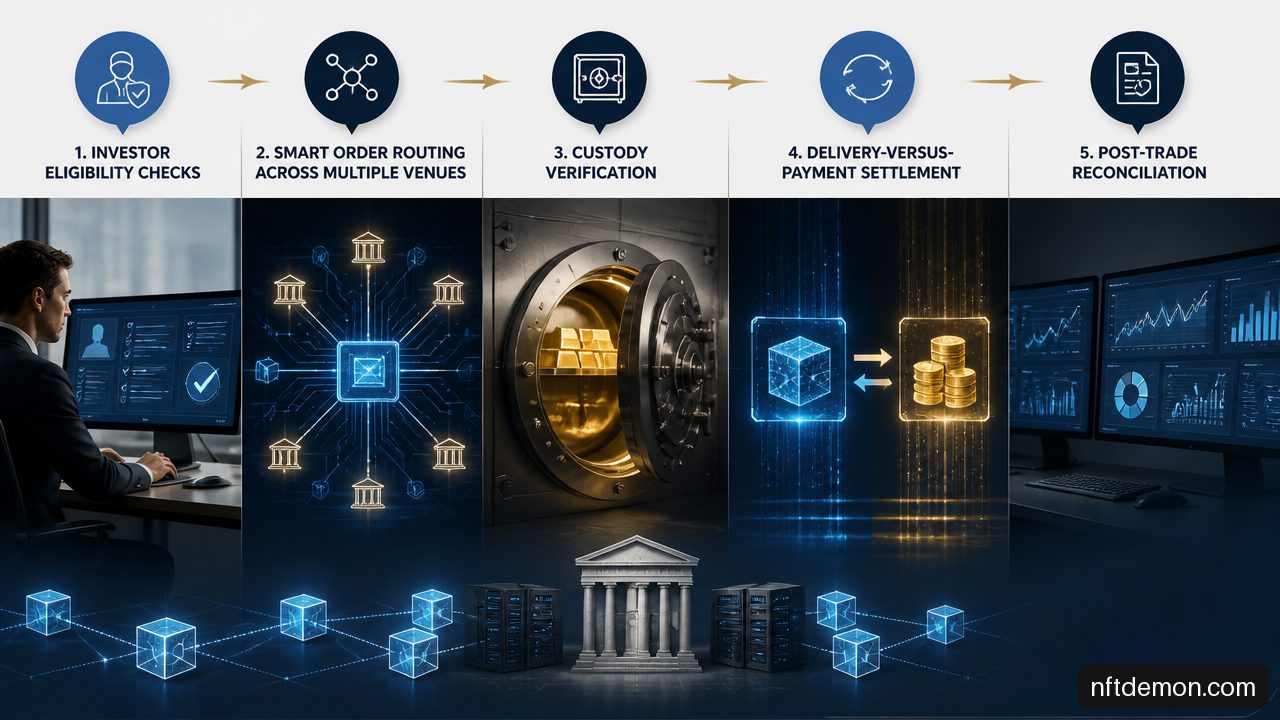
At the simplest level, a liquidity aggregator combines bids, offers, liquidity pools, market-maker streams, or order books from more than one source. In tokenized markets, however, aggregation has at least five connected jobs:
• Discover available quotes and depth across venues, chains, and dealers.
• Determine whether the asset is economically and legally interchangeable across those sources.
• Check investor eligibility, wallet permissions, sanctions controls, transfer restrictions, and venue access.
• Route the order according to price, size, expected fill probability, fees, and settlement conditions.
• Coordinate settlement, custody movements, ownership-record updates, and post-trade reconciliation.
A useful way to think about it is this: a bridge moves an asset representation; an aggregator decides where and whether a trade should happen. Those are materially different functions.
For example, an asset manager seeking $10 million of tokenized Treasury exposure may find offers on two networks and an institutional venue. One quote may be cheaper but settle in a stablecoin the buyer cannot use. Another may require a custodian relationship the buyer does not have. A third may be available only to a restricted investor class. The apparent best price is not necessarily the best executable outcome.
SIFMA’s 2026 digital-assets conference debrief notes that tokenization can fragment liquidity unless interoperability connects asset, cash, custody, and settlement systems. That is the institutional reality: market access without coordinated operations can create more endpoints without creating a more usable market.
Displayed Liquidity Is Not Always Executable Liquidity
Decision-makers should distinguish four layers of liquidity:
| Liquidity Layer | What It Represents | Common Failure Point |
|---|---|---|
| Displayed liquidity | Orders, quotes, or pool balances visible to the market | Quote may be stale or nonbinding |
| Eligible liquidity | Liquidity available to a particular investor or wallet | Transfer restrictions or investor classification |
| Fundable liquidity | Liquidity that can be paid for using approved cash or credit arrangements | Incompatible stablecoin, tokenized deposit, or fiat rail |
| Settled liquidity | Trades that complete with asset delivery, payment, and record updates | Custody, transfer-agent, or reconciliation breaks |
This framework prevents a familiar mistake: treating aggregated quotes as fungible volume. Two tokens may reference the same fund or security but differ in custody structure, redemption mechanics, legal rights, eligible holders, transfer-agent workflow, or settlement currency. They may be economically similar while remaining operationally nonfungible.
A consolidated price feed can improve visibility. It does not prove that every displayed unit can be bought, transferred, financed, and settled by the same participant.
The distinction is particularly important for permissioned token standards such as ERC-3643, where token transfers can require identity verification and rule checks. An investor may be approved for the underlying product but still need a registered wallet, a participating custodian, or venue-specific access before a trade can settle.
Why Technical Availability Does Not Equal Market Depth
Tokenization can improve transferability and automation, but it does not manufacture recurring demand. The question for issuers is not merely, “Can this token trade continuously?” It is, “Who will provide bids at meaningful size when an investor needs an exit?”
The study Tokenize Everything, But Can You Sell It? reports that many real-world-asset tokens exhibit low trading volumes, long holding periods, and limited investor participation. That finding should temper assumptions that always-available infrastructure automatically produces active secondary trading.
Market depth comes from overlapping buyer and seller interest, reliable price formation, market-maker participation, and confidence that settlement will work. A token with thousands of holders can still have a thin order book if holders are long-term allocators, redemption is easier than secondary sale, or no firm stands ready to quote both sides.
Designing A Compliant Aggregation Stack
Choose The Aggregation Model Before Choosing Technology
Different market structures solve different problems. Treating them as interchangeable often creates expensive design errors.
| Model | Best Fit | Strength | When To Avoid Or Supplement It |
|---|---|---|---|
| Smart-order routing | Multiple accessible venues with comparable assets | Selects routes based on price, depth, fees, and rules | Avoid as a standalone solution when custody and cash rails are disconnected |
| Centralized routing and netting | Institutional flows across several liquidity sources | Can reduce operational complexity and settlement movements | Requires robust governance, reconciliation, and counterparty controls |
| Permissioned distribution network | Issuers seeking broader compliant reach | Extends connectivity to approved platforms and investors | Does not itself guarantee continuous secondary-market depth |
| Regulated ATS, MTF, or DLT venue | Tokenized securities requiring formal market structure | Supports controlled matching, surveillance, and rule-based access | May need external connectivity to avoid isolated order books |
| AMM or liquidity pool | Standardized, highly transferable assets with suitable risk controls | Offers continuous algorithmic liquidity | Usually needs careful design for restricted securities and large institutional blocks |
For regulated instruments, off-chain matching with on-chain settlement is often a practical pattern. Orders can be matched within a controlled venue environment, while smart contracts enforce wallet restrictions during settlement. This separates rapid market operations from the final transfer of tokenized ownership.
Chainlink’s exchange and trading-venue overview describes interoperable infrastructure that can connect on-chain and off-chain venues while coordinating trading and settlement workflows. The important insight is broader than token movement: trading instructions, market data, lifecycle events, allocations, confirmations, and settlement messages may all need to cross system boundaries.
Build The Eligibility And Custody Layer Into Routing
A compliant router should perform pre-trade checks before it treats a quote as executable. At minimum, it should evaluate:
• Investor classification and jurisdiction.
• Wallet allowlisting and identity status.
• Transfer restrictions embedded in the token or enforced by the transfer agent.
• Venue membership, broker-dealer, or intermediary requirements.
• Custody account availability and asset location.
• Settlement-cash compatibility and foreign-exchange requirements.
• Sanctions, AML, and transaction-monitoring controls.
This is where architecture choices become business choices. The design should account for resilience, privacy, throughput, key management, and permissioning from the beginning. A review of enterprise blockchain architecture security and scalability is useful when evaluating whether the underlying environment can support controlled transfers and institutional operating requirements without creating a bottleneck.
Consider an order that is matched at 10:00 a.m. but fails at settlement because the buyer’s wallet is no longer eligible. The right response is not to treat that as a blockchain error. It is a market-control failure. The system should define whether the trade is automatically canceled, held for remediation, reassigned to a substituted wallet, or escalated for manual review. Each option has implications for market integrity, legal finality, and customer communications.
Treat Tokenized Cash As Part Of Market Structure
Asset liquidity and cash liquidity are inseparable under delivery versus payment, or DvP. A tokenized bond may be available on several venues, yet trades can remain fragmented if each venue settles with a different stablecoin, tokenized deposit, commercial-bank money arrangement, or conventional cash process.
The aggregation layer should therefore understand both legs of a trade. It needs to know whether the buyer has acceptable payment assets, whether those assets can move to the seller’s settlement environment, and whether the payment leg can be synchronized with token delivery.
A practical implementation sequence is:
Normalize asset identifiers, legal terms, token contract details, and settlement currencies.
Build a permissions engine that evaluates investor, wallet, venue, and jurisdiction constraints before routing.
Connect order books, request-for-quote systems, dealer streams, and approved liquidity pools.
Add routing logic that scores expected execution quality rather than headline price alone.
Link the matching layer to custody, cash, transfer-agent, and reconciliation workflows.
Run exception handling before scaling volume or adding chains.
Platform decisions should follow this sequence, not lead it. The relevant question is not which chain has the loudest ecosystem, but whether it supports the asset’s legal controls, expected transaction pattern, privacy needs, and operational integrations. That decision framework is explored in blockchain platform selection for financial institutions.
Measuring Execution And Recovering From Failure
Measure What Investors Can Actually Trade
There is no reliable industry-wide benchmark for aggregated tokenized-asset spreads, fill rates, rejection rates, or settlement failures. Metrics should be reported by asset, investor class, venue, trade-size band, and measurement period. A blended headline metric can hide the exact friction an institution needs to fix.
| Metric | What It Shows | Practical Interpretation |
|---|---|---|
| Quoted spread | Difference between visible bid and offer | Useful only if quotes are current and available to the investor |
| Effective spread | Actual execution cost relative to a reference price | Captures price improvement or deterioration after routing |
| Fill ratio | Percentage of requested size actually executed | Reveals whether displayed depth is usable at institutional size |
| Price impact | How much execution moves the market | Identifies capacity limits in thin books or pools |
| Rejection rate | Orders rejected for eligibility, funding, or venue reasons | Exposes failures in pre-trade controls or data quality |
| Settlement-failure rate | Matched trades that do not settle as intended | Measures operational friction beyond execution |
| Time to finality | Time from execution to irrevocable settlement and record update | Shows whether tokenization is reducing or relocating delay |
A router that consistently finds the best displayed price but creates a high rejection rate is not providing best execution. Nor is a venue that settles quickly on-chain but requires hours of manual reconciliation to align custody books, transfer-agent records, and accounting systems.
Design For Exceptions, Not Only Happy Paths
The post-trade lifecycle deserves as much attention as the trading screen. A robust operating model should identify the authoritative record for ownership, define finality conditions, and establish who resolves a mismatch between blockchain state and institutional records.
Three scenarios illustrate the difference:
• Wallet eligibility changes after matching. The settlement contract rejects delivery. The venue needs a documented cancel-or-remediate workflow, not an improvised operations call.
• Payment arrives but asset delivery pauses. DvP logic should prevent one-sided finality where possible. If a hold is necessary, collateral and escalation rules should be explicit.
• A token transfer succeeds on-chain but the transfer agent has not updated the official register. The trade may require reconciliation before the investor can exercise rights, transfer again, or use the position as collateral.
Post-trade controls also affect market-maker willingness to commit capital. A liquidity provider is more likely to quote firm prices when inventory movement, settlement timing, and failed-trade procedures are predictable. This is why compliance infrastructure is not merely a defensive cost. It can affect whether professional liquidity appears at all. For institutions evaluating screening and monitoring workflows, AI-powered AML compliance tools for decentralized exchanges provide useful context on how automated controls can support scalable market access.
Governance Determines Whether Connectivity Becomes Trust
Aggregation introduces governance questions that cannot be solved by APIs alone:
• Who sets asset-normalization rules when multiple token representations exist?
• Who is accountable when two venues publish conflicting reference prices?
• Which party bears the cost of a settlement fail caused by a custody or eligibility break?
• How are routing conflicts handled when the best economic price has a lower probability of settlement?
• What audit trail proves why a particular venue, liquidity provider, or settlement path was selected?
Decision-makers should require a documented execution policy that balances price, certainty, speed, regulatory constraints, and operational cost. Fair warning: optimizing for the lowest displayed offer can be a false economy when the route has a higher probability of rejection or delayed settlement.
Key Takeaways
What A Decision Maker Should Remember
• Liquidity aggregation for tokenized assets is a full trade-lifecycle capability, not a bridge, dashboard, or chain-connection feature.
• Displayed liquidity is not the same as executable liquidity. Eligibility, custody, settlement cash, and transfer rules determine whether a quote can become a completed trade.
• Market depth must be measured, not assumed. Low turnover and long holding periods can persist even where tokens are technically available around the clock.
• Hybrid market models are often practical for regulated assets. Off-chain matching can coexist with on-chain settlement and programmable transfer controls.
• Tokenized cash matters as much as the tokenized asset. Fragmented payment rails can prevent otherwise compatible counterparties from settling.
• Best execution should include settlement certainty. Price, fill ratio, price impact, rejection rate, and post-trade performance belong in the same evaluation.
A Sensible Starting Position
Start with one asset class, a defined investor population, and a limited set of connected venues. Establish the ownership record, settlement asset, eligibility model, and failure-handling process before pursuing broad cross-chain distribution. Scale only after the organization can demonstrate execution quality and reconciliation discipline under ordinary and exception conditions.
Frequently Asked Questions
What Is Liquidity Aggregation For Tokenized Assets?
It is the process of combining and routing executable liquidity from multiple tokenized-asset venues, market makers, order books, pools, custodians, and settlement systems. The goal is to improve trade execution while preserving legal transfer controls, custody requirements, and settlement certainty.
Does Liquidity Aggregation Require Moving Tokens Across Chains?
No. An aggregator can route an order to the venue or chain where the asset already exists. Cross-chain movement may be useful when assets are designed to be portable, but it adds bridge, custody, legal, and reconciliation considerations. For regulated securities, maintaining the asset within its approved venue and custody framework may be preferable.
How Is Tokenized-Asset Liquidity Different From Ordinary Crypto Liquidity?
Tokenized assets may have investor eligibility rules, transfer restrictions, transfer-agent requirements, regulated venue obligations, and settlement dependencies that do not apply to unrestricted crypto assets. A crypto quote can often be assessed mainly by price and available size. A tokenized-security quote must also be assessed for legal and operational executability.
Should Tokenized Securities Use An Order Book, An AMM, Or Both?
That depends on the asset and investor base. Order books and request-for-quote systems are generally better suited to larger, negotiated, or restricted institutional trades. AMMs can provide continuous liquidity for standardized assets but may be difficult to adapt to complex transfer restrictions and institutional block sizes. A hybrid model may be appropriate where each mechanism serves a distinct segment.
How Should An Institution Measure Aggregated Liquidity Quality?
Measure quoted and effective spreads, fill ratio, price impact, rejection rate, settlement-failure rate, and time to finality. Segment results by venue, investor type, asset, trade-size band, and settlement currency. This reveals whether poor outcomes originate in price discovery, eligibility, funding, custody, or post-trade operations.
What Happens If A Buyer Becomes Ineligible After A Trade Is Matched?
The outcome should be defined in advance. Depending on legal and technical controls, the trade may be canceled, paused for a substituted eligible wallet, rerouted, or escalated for manual review. The key requirement is a documented procedure that preserves auditability and avoids one-sided settlement.
Can A Token Have Many Holders And Still Be Illiquid?
Yes. Holder count does not guarantee active two-sided trading. Liquidity depends on recurring demand, available supply, market makers, reliable pricing, accessible settlement, and confidence that participants can exit positions at a fair price. A widely distributed token can still have sparse tradable depth.
Sources/References
SIFMA Insights + SIFMA Digital Assets Conference 2026 Debrief — https://www.sifma.org/wp-content/uploads/2026/09/SIFMA-Digital-Assets-Conference-2026-Debrief.pdf
arXiv + Tokenize Everything, But Can You Sell It? RWA Liquidity — https://arxiv.org/pdf/2508.11651
Chainlink + Exchanges & trading venues — https://chain.link/use-cases/exchanges-trading-venues
NFT Demon Holdings helps enterprises scope, evaluate, and build blockchain programs — start with a free evaluation call.
Talk through your use case
Free evaluation call — objective, constraints, and fit, before any proposal.