How to plan an NFT project from concept to marketplace launch
By Jeremy Ryan, Founder & CEO · September 2026
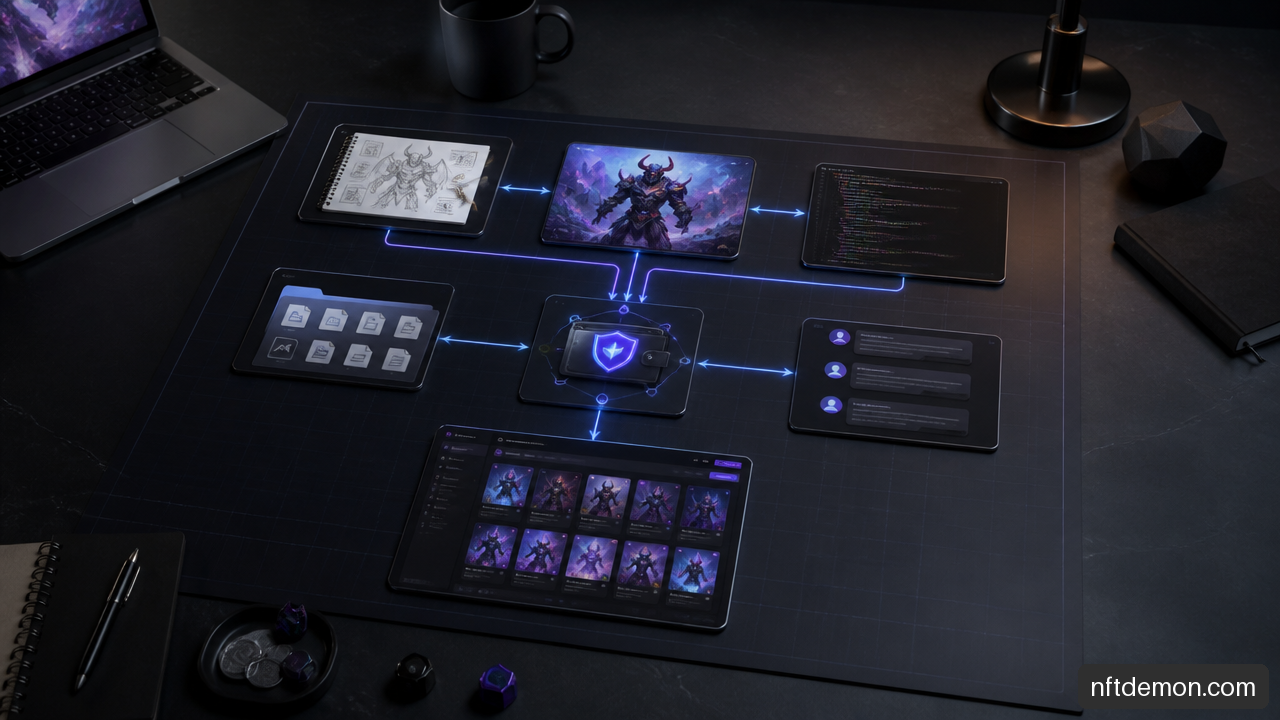
Planning an NFT project is not primarily an artwork exercise or a smart contract exercise. It is a product, trust, and operating model exercise. If you are learning how to plan an NFT project from concept through marketplace launch, start by defining what buyers receive, why the collection should exist, how it will function after minting, and who will handle the technical and commercial obligations.
A polished collection can still fail if metadata breaks, the marketplace does not index the contract, buyers cannot get support, or the roadmap promises more than the team can deliver. I recommend treating the launch as a controlled release of a digital product, not a one day marketing event.
Define The Commercial Concept And Risk Boundaries
An NFT collection needs a specific buyer and a credible reason to own it. Artwork can be central to that reason, but it is rarely sufficient for a decision maker who must approve budget, legal exposure, technical work, and long term support.
Start With A Buyer Outcome, Not A Trait List
Define the project in one sentence before commissioning art or choosing a chain. The sentence should explain the audience, the ownership experience, and the enduring value proposition.
For example, a hospitality brand might create a limited NFT collection that serves as a digital membership credential for priority event access. A game studio may use NFTs as collectible assets with clearly defined in game functionality. A visual artist may issue a small edition where the work itself is the primary value.
These are different products. They need different contracts, marketing claims, customer support, and compliance reviews.
Use a concept brief that answers the following questions:
-
Who is the buyer? Define whether the buyer is a collector, customer, fan, member, business partner, or player.
-
What does ownership provide? State whether the NFT is art, access, a credential, a license, a redeemable item, or a combination.
-
What is deliberately excluded? Clarify what ownership does not provide, especially governance, profit participation, resale guarantees, or equity like rights.
-
Why use an NFT? The token should solve a real ownership, authenticity, portability, access, or provenance problem. If a database login produces the same outcome with less friction, reconsider the design.
-
What must be delivered after mint? Convert broad roadmap language into discrete commitments with owners, deadlines, and budget.
A useful test is whether the project can be explained without mentioning floor price. If the answer is no, the concept may be depending on speculation rather than buyer value.
Separate A Collection Launch From A Marketplace Launch
These terms are often used as if they mean the same thing. They do not.
| Launch Type | Core Objective | Main Operational Work | Typical Failure Point |
|---|---|---|---|
| NFT collection mint | Issue a defined set of NFTs | Contract deployment, mint flow, metadata, buyer communications | Failed mint transactions or broken reveal process |
| Third party marketplace listing | Make the collection discoverable and tradable | Indexing, contract verification, collection profile, listing checks | Collection is not visible or displays incorrect metadata |
| Branded marketplace launch | Operate a trading venue or curated storefront | User onboarding, moderation, payments, security, policies, support | Insufficient trust controls or marketplace operations |
A collection can mint through a project website and later appear on a third party marketplace. A branded marketplace is far more complex because it introduces listing rules, search, custody choices, fraud reporting, moderation, buyer and seller support, and potentially more regulatory questions.
For a first release, I would generally favor a minimum viable collection release over a feature heavy marketplace build. The logic is simple: prove that the audience wants the ownership experience before funding an entire transaction platform. One marketplace playbook similarly argues that a minimum viable marketplace launch can reduce execution risk while validating demand.
Set Legal, Intellectual Property, And Financial Guardrails Early
Legal review is not an afterthought for US NFT projects. It should happen while the concept is still editable.
The US Securities and Exchange Commission has indicated that NFT and NFT marketplace designs can raise securities analysis questions depending on their facts and structure, as discussed in its written input on NFT marketplace securities and broker status. A collectible promoted for aesthetic enjoyment presents a different fact pattern from a token marketed around expected resale gains, pooled development efforts, or revenue sharing.
This does not mean every NFT is a security. It means messaging, buyer expectations, royalty structures, marketplace functions, and the economic reality of the offering need qualified legal review.
Before public announcements, document these decisions:
• Ownership of every artwork, photograph, character, logo, music track, and generative source file.
• The license transferred to holders, including commercial use limits and prohibited uses.
• Utility terms, redemption rules, expiration dates, geographic restrictions, and cancellation rights where relevant.
• Marketing statements that could be read as promises of appreciation, yield, passive income, or guaranteed future value.
• Tax and accounting processes for primary mint proceeds, creator payouts, contractor payments, and any treasury assets.
• Privacy, consumer protection, sanctions, and payment obligations that may apply to a marketplace or a project serving broad public audiences.
Fair warning: an NFT roadmap is part product specification and part public promise. If a project says holders will receive access forever, the team should know what “forever” means operationally, financially, and legally before the first mint occurs.
Design The Collection, Contract, And Asset Architecture
Once the concept is defensible, translate it into a collection design that can be built and supported. This is where supply, tokenomics, metadata, storage, and smart contract decisions meet.
Choose Supply, Pricing, Utility, And Rarity As One System
Supply and mint price should reflect demand evidence, production capacity, and the real cost of delivering utility. They should not be chosen merely because another collection used the same numbers.
A limited 250 piece art edition might support a higher touch collector experience. A 10,000 item profile collection needs scalable support, stronger metadata operations, and a larger community plan. A membership pass may need a fixed supply tied to venue capacity or concierge availability.
Build a simple launch economics model before finalizing mint terms:
| Decision | Choose It When | Avoid It When |
|---|---|---|
| Fixed supply | Scarcity and capacity are known in advance | Utility requires flexible enrollment or changing inventory |
| Open edition | Broad participation matters more than scarcity | The project depends on a strict member cap |
| Tiered rarity | Traits affect utility, collecting goals, or creative narrative | Rarity exists only to imply financial upside |
| Allowlist mint | Demand needs controlled access and bot resistance | The project lacks clear eligibility rules or support capacity |
| Public mint | The audience is broad and the user journey is simple | High demand could create gas spikes, failed transactions, or dissatisfaction |
Tokenomics for an NFT project should cover more than price. It should explain supply, access rules, treasury allocation, fees, reserve inventory, team allocations, resale expectations, and utility costs. If there is no fungible token, say so clearly rather than borrowing tokenomics language that does not fit the product.
Royalties deserve a conservative approach. A royalty setting in a contract or marketplace profile does not guarantee that every marketplace will enforce or honor it in the same way. Budget the project so promised utility can survive without assuming a particular level of secondary sale revenue.
Build The Smart Contract Around Trust Controls
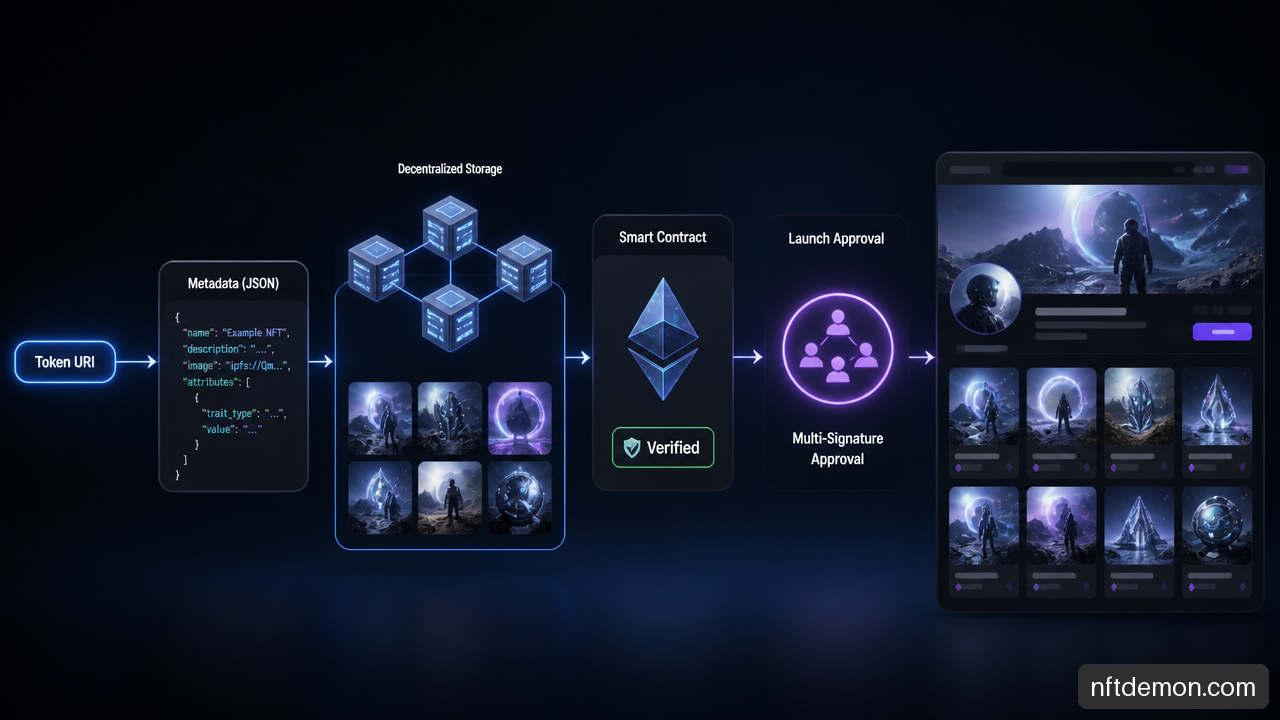
The smart contract governs minting, ownership, transfer logic, and often the token URI that points to metadata. Select a standard that the target chain and marketplace support. For many collections, common NFT standards and a straightforward fixed supply contract are safer than custom logic that adds little user value.
Decide explicitly whether the contract is immutable or upgradeable.
An immutable contract reduces the ability to change logic after deployment, which can increase predictability for holders. An upgradeable contract can correct defects or add approved features, but it creates an ongoing governance and key management obligation. If administrators can alter supply, metadata, transfer behavior, or mint price, disclose that power plainly.
Use these control layers before deployment:
-
Separate wallets by purpose. Do not use one wallet for contract administration, treasury funds, marketplace operations, and personal activity.
-
Use a multisig for material assets and privileges. A multisig requires multiple approvals, reducing the risk that one compromised key can move funds or change critical settings.
-
Create an admin key inventory. Record each key, role, access holder, recovery method, and revocation procedure.
-
Define an incident response path. Decide who can pause minting, who approves public communication, and how buyers receive updates if a defect occurs.
-
Match review depth to risk. A simple fixed supply art mint may need thorough testing and independent code review. A contract with upgradeability, revenue splits, staking, randomization, or cross chain behavior usually justifies a more formal security assessment.
Do not confuse an audit with a guarantee. A review reduces known risk; it does not make a complicated product safe by default.
Make Metadata Durable Before You Mint
Metadata is the structured record that tells wallets and marketplaces what an NFT is called, which image or media file it displays, and what traits it has. A token can exist on chain while appearing blank or incorrect if its token URI, metadata JSON, or linked asset fails.
For each token, validate at least:
• Token name and collection name.
• Description and holder rights summary.
• Image, animation, or media URI.
• Trait names, values, display types, and rarity logic.
• External link and support contact where appropriate.
• Token ID sequencing and URI behavior.
Storage choice is a durability decision. IPFS can provide content addressed storage, but teams still need a persistence plan, commonly called pinning, so the content remains available. Arweave is often selected when permanence is the primary objective, though the cost and workflow differ. The key question is not simply “IPFS or Arweave?” It is who is responsible for keeping the assets available after the initial launch team changes or a vendor relationship ends.
Create a metadata recovery file containing original media, final JSON, contract addresses, token IDs, storage identifiers, and deployment records. Keep it under controlled organizational custody. If a reveal is planned, test the metadata switch thoroughly and disclose whether the team can later alter it.
Prepare The Mint, Marketplace, And Operating Launch
Mint day should be the final stage of a rehearsed system. Your objective is not simply to sell out. It is to let legitimate buyers mint successfully, obtain accurate assets, find the collection on the selected marketplace, and receive timely help if something goes wrong.
Select Chain And Marketplace Based On The Buyer Journey
Choose a blockchain based on the buyer, not only on the team’s preference. Consider wallet availability, transaction costs, marketplace support, environmental positioning if relevant to the brand, security maturity, and the expected buyer’s ability to acquire the required currency.
Marketplace selection is equally practical. Confirm the marketplace supports the chosen chain, token standard, collection type, creator settings, and metadata format. Review the user experience from the perspective of a first time holder: can they connect a wallet, see the collection, understand the listing, and contact support?
A practical collection launch sequence described in the CryptOrbix NFT collection launch playbook includes concept development, metadata preparation, test minting, marketplace visibility, and post launch monitoring. That sequence matters because deployment alone does not make a collection usable.
Test The Whole Buyer Flow On A Testnet
A testnet is a blockchain environment where the team can simulate the mint flow without using production assets. Test not only the contract but also the entire customer journey.
Run at least one controlled rehearsal with people who did not build the interface. Give them a test wallet and ask them to complete the process without live assistance. Their confusion will reveal more than an internal walkthrough.
Test these conditions:
• An eligible allowlist wallet and an ineligible wallet.
• Mint quantity limits and supply limits.
• Incorrect network selection.
• Insufficient wallet balance for price and gas fees.
• Failed or rejected transactions.
• Mobile wallet and desktop wallet flows.
• Metadata display and post reveal behavior.
• Transaction confirmation emails or on screen messaging, if used.
The Mimic NFTs launch checklist also emphasizes test mints, launch calendars, and support planning. This is a sensible operating standard: a buyer who sees a failed transaction needs a direct explanation of what happened, what funds moved, and what to do next.
Set Marketplace Acceptance Criteria And A Go Or No Go Gate
Marketplace indexing is the process that makes a deployed collection visible and searchable. It can lag or fail when contract details, metadata, chain selection, or marketplace requirements do not align.
Before launch, write acceptance criteria rather than assuming the collection will appear automatically:
-
The contract address is confirmed on the intended mainnet.
-
Contract source or relevant deployment information is verified where the chain explorer supports verification.
-
The public collection page displays the correct name, creator identity, image, description, and external links.
-
Sample tokens display the expected media, traits, and token IDs.
-
Transfer and listing behavior work as designed.
-
Royalty preferences are configured where supported, with no promise that every venue will enforce them.
-
Support staff can reproduce the buyer journey and access escalation contacts.
Do not open the mint merely because the art is ready. Use a go or no go meeting with product, technical, legal, community, and support owners. Delay if there is an unresolved contract permission, broken metadata, unclear buyer disclosure, missing treasury control, or no staffed response channel.
Run Communications As An Operating Function
Community engagement should reduce uncertainty, not manufacture urgency. Publish the mint date, time zone, price, supply, supported wallets, chain, official URLs, allowlist rules, and fraud warnings in one authoritative location. Repeating those details consistently is more useful than posting vague countdowns.
A well structured launch calendar usually includes teasers, educational posts, eligibility notices, wallet setup guidance, a final pre mint reminder, live status updates, and post mint support. The 2026 NFT collection planning guidance from CryptOrbix similarly covers collection planning, chain selection, metadata storage, testnet work, and treasury security.
During the mint, monitor transaction errors, scam impersonation, support volume, remaining supply, contract events, and marketplace display. After the mint, publish a short factual update: what minted, what happens next, when metadata reveals if applicable, and where holders can receive support.
Key Takeaways
The strongest NFT launches are designed as accountable products. The collection, contract, marketplace presence, legal disclosures, treasury controls, and support process must work together.
• Define the buyer outcome and utility before commissioning a large asset set or writing custom smart contract logic.
• Treat a collection mint, third party marketplace listing, and branded marketplace as separate scopes with different operating and compliance demands.
• Set supply, pricing, rarity, and tokenomics based on delivery capacity and buyer value, not resale speculation.
• Protect treasury funds and admin privileges with role separation, a multisig, documented authority, and an incident response plan.
• Validate metadata, token URIs, storage persistence, and reveal behavior before mainnet deployment.
• Make marketplace indexing and contract verification explicit launch acceptance criteria.
• Use a go or no go gate based on technical readiness, disclosure quality, and support capacity rather than marketing momentum.
Frequently Asked Questions
What Should Come First: Artwork, Utility, Or Community?
Start with the buyer outcome and utility, then shape the artwork and community plan around that promise. Art may be the utility for a fine art release, while access or membership may be central for a brand program. Community work should begin early, but it needs a clear proposition to communicate.
How Do I Choose The Right Blockchain For An NFT Project?
Choose the chain that best fits your buyer journey, target marketplace support, wallet availability, transaction cost tolerance, and contract requirements. Avoid selecting a chain solely because it is technically fashionable if your intended buyers cannot easily use its wallets or marketplaces.
How Many NFTs Should Be In A Collection?
There is no universal number. Tie supply to demand evidence and delivery capacity. A 100 item premium membership may be reasonable if the program can serve 100 holders. A 10,000 item release should have a credible reason for that scale beyond creating artificial scarcity tiers.
Should NFT Assets Be Stored On IPFS Or Arweave?
Choose IPFS when content addressed distribution and a managed pinning strategy fit the project. Consider Arweave when long term permanence is the central requirement. In either case, retain original assets and metadata under organizational control, because storage architecture does not remove the need for operational stewardship.
When Does An NFT Project Need A Smart Contract Audit?
The need rises with complexity and financial exposure. A simple, well tested fixed supply contract may require an independent review rather than a broad audit engagement. Contracts with upgradeability, randomization, revenue splits, staking, custody functions, or substantial treasury value deserve a more rigorous security assessment.
How Do I Get An NFT Collection Indexed On A Marketplace?
Deploy the contract to the correct mainnet, verify the contract details where supported, confirm metadata URIs resolve correctly, and follow the marketplace’s collection claim or submission process. Test sample tokens and collection search results immediately. If indexing is delayed, provide holders the verified contract address and clear status updates.
What Legal Issues Should Be Reviewed Before A US NFT Launch?
Review intellectual property rights, holder licenses, consumer disclosures, marketing claims, tax and accounting processes, privacy obligations, sanctions considerations, and the facts that could affect securities analysis. Marketplace operators may face additional questions because their platform design and transaction functions are different from a simple collectible mint.
Sources / References
• U.S. Securities and Exchange Commission — Securities Exchange and Broker Status of NFT Marketplaces
• CryptOrbix — How to Launch an NFT Collection: Practical 7-Step Playbook
• CryptOrbix — How to launch an NFT collection — 2026 playbook
• Mimic NFTs — NFT Launch Checklist: From Idea to Mint
NFT Demon Holdings helps enterprises scope, evaluate, and build blockchain programs — start with a free evaluation call.
Talk through your use case
Free evaluation call — objective, constraints, and fit, before any proposal.