How to integrate blockchain with existing enterprise systems
By Jeremy Ryan, Founder & CEO · September 2026
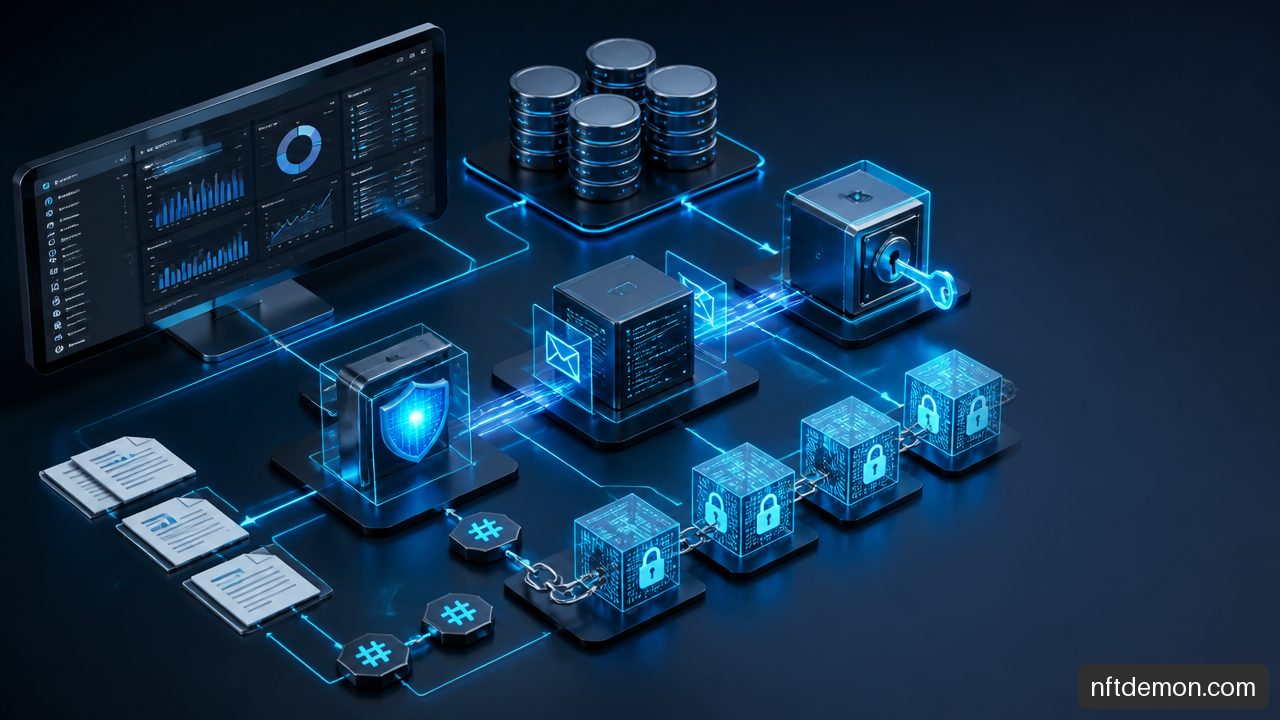
How to integrate blockchain with existing enterprise systems and databases is primarily an integration and control-design problem, not a replacement project. In most enterprise deployments, the ERP, CRM, data warehouse, and operational database remain the systems that process daily work. Blockchain adds a shared verification layer for the records, approvals, handoffs, or proofs that multiple parties need to trust.
We recommend treating blockchain as a carefully bounded capability beside existing infrastructure. The goal is not to place every invoice, customer record, or database row on a distributed ledger. The goal is to make selected business events independently verifiable without disrupting established workflows, reporting, security controls, or service-level expectations.
Choose The Right Integration Architecture
The best architecture depends on three constraints: who must share data, how quickly each party needs confirmation, and what data may legally or commercially leave the enterprise database. A blockchain integration should begin with a business event that has a clear dispute, audit, provenance, or multiparty coordination problem.
For example, a purchase order approval inside an ERP is often not a candidate for public blockchain storage. A goods-receipt confirmation that suppliers, logistics providers, finance teams, and auditors must validate may be a better candidate. The chain records the shared fact. The ERP continues to manage inventory, payables, workflow screens, and reporting.
Research on blockchain and database systems describes an active effort to combine blockchain capabilities with database security, efficiency, and privacy requirements, as summarized in this survey of blockchain and database integration research. That combination is exactly why hybrid designs are usually more practical than wholesale data migration.
Select An API, Event Driven, Or Ledger First Pattern
There is no universal best pattern. We would use the following decision framework before approving an implementation.
| Integration Pattern | Best Fit | Avoid Or Limit It When | Typical Mechanism |
|---|---|---|---|
| API led | A business application needs an immediate request and response | A transaction can wait for asynchronous confirmation or arrives at very high volume | ERP or CRM calls an API gateway, which submits or queries blockchain transactions |
| Event driven | Multiple systems react to the same business event | Teams cannot operate a message broker, schema registry, or dead letter process | CDC, webhooks, or application events flow through middleware to blockchain services |
| Ledger first | Shared ledger state is the authoritative starting point for a cross organization workflow | Existing ERP processes must remain the legal or operational source of truth | Participants submit to a smart contract before local systems update |
API led integration works well when a user action must return a decision quickly. A procurement portal could call an integration API to verify whether a supplier certificate hash exists on a permissioned ledger before allowing a receiving transaction. The API can return a reference, validation status, and correlation ID without exposing chain complexity to the ERP interface.
The risk is coupling. If the blockchain node, signing service, or network is slow, the ERP transaction may stall. We recommend timeouts, circuit breakers, and a clear fallback state such as pending external validation rather than holding a database lock while waiting for blockchain finality.
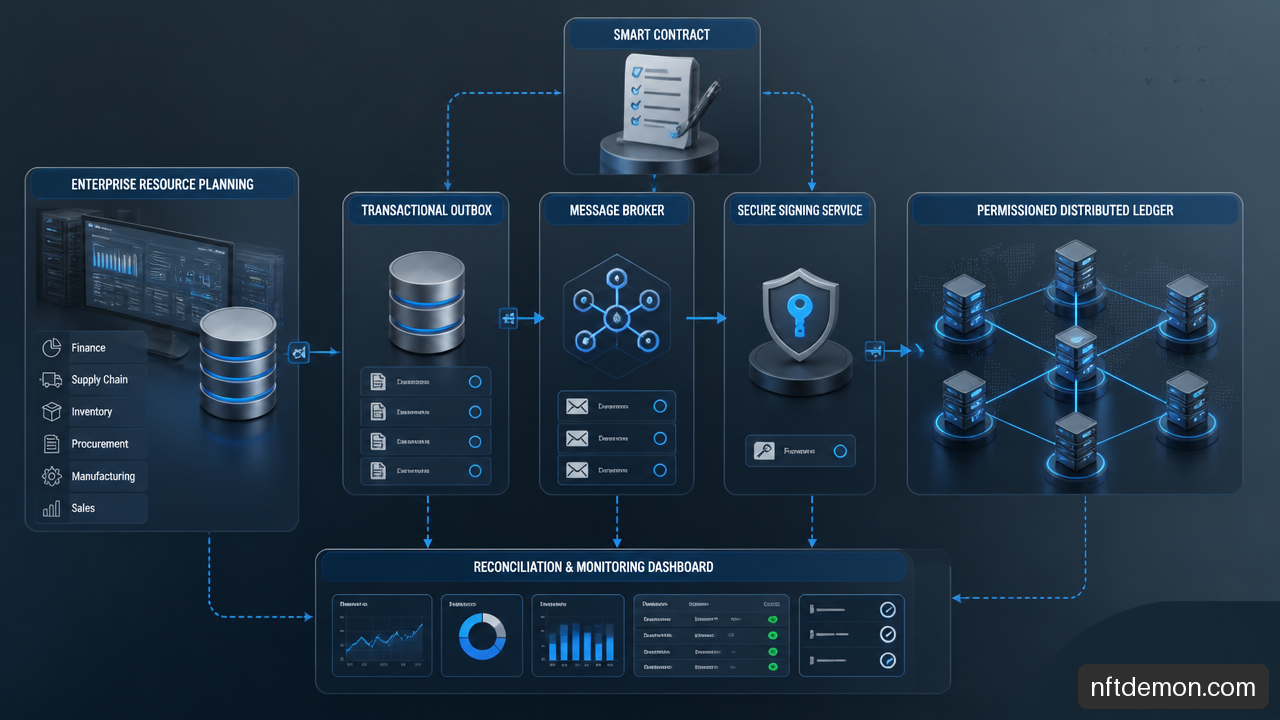
Event driven integration is usually the stronger choice for high volume or multi-system processes. Change data capture can detect a committed database event, publish it to a broker, and allow a middleware service to transform that event into a blockchain transaction. The source application completes its local transaction first, while the blockchain proof follows through a controlled asynchronous path.
This lowers direct dependency but introduces eventual consistency. A finance user may see an invoice marked posted locally, blockchain confirmation pending for a short period. That is acceptable only if the process defines what can happen during the pending state.
Ledger first integration fits a consortium process where the shared record itself is the governing transaction. Consider a trade-finance workflow in which approved banks, a buyer, a seller, and a carrier must agree on a document state before funds are released. The smart contract can validate required signatures before each organization writes the confirmed outcome to its own systems.
A University of Birmingham paper on ERP and accounting information systems notes that decentralized networks can be suitable for integrating existing ERP environments with a shared blockchain ledger, particularly in system-integration contexts such as e-procurement. Read the ERP and shared-ledger integration research for that specific finding. Suitability does not mean automatic value. It depends on whether independent parties actually need a common state.
Decide Whether The Network Should Be Permissioned
For most enterprise workflows, a permissioned blockchain is the starting point. Participants are known, access can be role based, and governance can specify who runs nodes, approves upgrades, reads private data, and resolves operational incidents.
A public blockchain can make sense when a public proof is part of the business requirement. A brand may want customers to independently verify a product authenticity record, for instance. Even then, the public record should generally be a hash, timestamp, token reference, or selectively disclosed proof rather than a customer record or full transaction document.
Identity design should map to enterprise identity controls. Employees should authenticate through the organization’s identity provider where practical, while service accounts use narrowly scoped permissions. A blockchain participant identity is not a substitute for application authorization. The ERP must still decide whether a buyer can approve a purchase order; the smart contract should only enforce the shared rule it is designed to govern.
Build The Transaction Flow And Data Model
The most dependable integration sequence is explicit about state transitions. Teams should define exactly when an enterprise event becomes eligible for blockchain submission, when the chain is considered final enough for write-back, and how exceptions are recovered.
Use A Minimum Viable Synchronization Sequence
A workable flow for a purchase-order receipt, quality certificate, or regulated handoff generally follows these steps:
-
Create and commit the source event. The ERP, CRM, warehouse platform, or database writes its own transaction first and assigns a stable business identifier.
-
Publish an integration event. An outbox table, CDC stream, webhook, or message broker emits a versioned event containing the business ID, event type, timestamp, permitted metadata, and a correlation ID.
-
Canonicalize the payload. Middleware converts source fields into a stable schema. Field order, date format, currency precision, and null handling matter because semantically identical records can produce different hashes if serialized differently.
-
Store sensitive detail off chain. The enterprise database or document repository retains the full record. The integration service calculates a cryptographic hash over the canonical payload and selects only the minimal on-chain attributes needed for verification.
-
Submit the blockchain transaction. A controlled signing service signs the request, and the smart contract checks authorization, state rules, and duplicate protections before recording the event.
-
Wait for the chosen finality threshold. A permissioned network may provide deterministic finality under its configured consensus model. A public network may require a policy-defined confirmation threshold. The middleware records the transaction ID, block or ledger position where available, and confirmation status.
-
Write back a reference, not a duplicate record. The source system receives the blockchain transaction ID, hash, ledger status, and confirmation timestamp. It should not recreate all ledger data in a second uncontrolled table.
-
Reconcile and notify. A reconciliation job compares expected and confirmed events. Stakeholders receive exceptions, not routine success messages, unless the process requires a formal notification.
A pre-implementation ERP guide describes a synchronized workflow in which blockchain validation can precede ERP database updates and stakeholder notifications. The blockchain validated ERP update model is useful because it highlights a crucial design question: should the ERP update happen before validation, after validation, or in two stages?
For routine internal transactions, local-first with asynchronous proof is often more resilient. For a multiparty release of goods or funds, blockchain-first or a controlled two-stage status may be safer. The business consequence of a delay should decide the sequence.
Apply Practical On Chain And Off Chain Rules
A simple rule helps: place information on-chain only when multiple authorized parties need to verify the same fact independently and the information can remain accessible for the ledger’s retention period.
| Data Category | Recommended Location | Reason |
|---|---|---|
| Customer names, addresses, health data, payroll details | Off chain | Privacy, retention, correction, and access-control requirements |
| Full invoices, contracts, images, sensor files, and documents | Off chain with on-chain hash | Large content creates cost, performance, and confidentiality problems |
| Business identifiers and transaction references | Usually off chain, selectively on-chain | Use only where counterparties need a shared reference |
| Approval proofs, document hashes, timestamps, and status transitions | On chain | These are compact, verifiable, and useful for audit trails |
| Smart contract rules and allowed state changes | On chain | Participants can validate the same business logic |
Hash anchoring does not make confidential data safe by itself. If a source value has low entropy, such as a small list of product codes or predictable invoice numbers, an attacker may guess values and compare hashes. Add a protected salt or use a more appropriate privacy design when the record is sensitive.
An enterprise should also preserve correction rights. Blockchain is append-only, so a mistaken record is not deleted by editing history. Instead, a compensating transaction references the incorrect event and records the corrected state. The off-chain database can show the current operational view, while the ledger preserves the sequence of corrections.
Design Smart Contracts As Narrow Business Controls
Smart contracts should enforce clear shared rules, not replicate every ERP configuration table. Good candidates include requiring signatures from designated roles, preventing a shipment from being marked received twice, enforcing a permitted order of status transitions, or verifying that a document hash is associated with an approved supplier.
Keep complex pricing, tax calculation, employee permissions, and internal approval logic in the ERP unless multiple organizations must independently verify them. Every additional rule on-chain raises testing, change-control, and upgrade complexity.
Architectural research compares sidechain, event-sourcing, and validation-layer approaches for blockchain-integrated databases. This comparison of blockchain integrated database models reinforces a practical point: the ledger can serve as an event history or validation layer without becoming the sole data store.
Operate The Integration Securely And Reliably
The hard work begins after the first successful transaction. Production systems need durable handling for duplicates, temporary outages, changed schemas, revoked access, and reconciliation discrepancies.
Prevent Double Writes And Stale State
The classic failure occurs when the database commit succeeds but the blockchain call fails, or the blockchain transaction succeeds but the middleware crashes before recording the transaction ID. Retrying blindly can create duplicate submissions.
Use these controls together:
• Transactional outbox: Write the source event and an outbound integration message in the same database transaction. A separate process publishes only committed outbox records.
• Idempotency key: Derive a stable key from the business ID, event type, and version. The middleware and smart contract should reject or safely return a previous result for repeated keys.
• State machine: Define statuses such as pending, submitted, confirmed, failed, and reversed. Never rely on an ambiguous Boolean field such as blockchain_done.
• Inbox or deduplication store: Consumers record processed message IDs so a broker redelivery does not produce another database update.
• Reconciliation queue: Events that remain pending beyond a policy threshold are compared against both the ledger and source database before automated retry or manual review.
A public-chain design needs a separate finality policy. A transaction that appears accepted can still require additional confirmation before the enterprise treats it as final. A permissioned ledger may reduce that uncertainty, but network outages and application failures still require the same idempotency discipline.
TechScience describes an ERP integrity architecture in which blockchain is synchronized with a database to validate transactions as they occur. The database synchronized transaction-validation architecture supports the value of validation-oriented synchronization, but production implementations still need explicit retry, deduplication, and exception procedures.
Isolate Keys And Signing Authority
Do not place blockchain private keys in ERP configuration files, source code, browser applications, or general-purpose middleware environment variables. A compromised integration credential could authorize fraudulent ledger transactions, and immutable records make cleanup difficult.
Use a key management system, hardware security module, or custody-grade signing service where the private key remains isolated. The integration service should submit a signing request with a narrow policy: allowed contract, allowed function, allowed network, spending or transaction limit where applicable, and required approver for high-risk actions.
Separate duties matter. Application operators should not automatically have authority to modify smart contract rules. Developers should not automatically control production signing. Security teams need revocation, rotation, audit logging, and incident playbooks that cover both enterprise identities and blockchain participant credentials.
Test The Failure Paths, Not Only The Happy Path
A pilot is not production-ready because a smart contract executed once. We recommend testing the full path from source-system commit through middleware, signing, node submission, confirmation, write-back, reporting, and exception handling.
At minimum, test these cases:
-
Duplicate event delivery after a successful ledger submission.
-
Middleware outage after source database commit.
-
Blockchain-node timeout followed by delayed transaction acceptance.
-
Invalid smart-contract state transition.
-
Schema change from the ERP or source database.
-
Key revocation during an in-flight workflow.
-
Reconciliation of a corrected or reversed business event.
-
Load conditions that exceed the broker, API gateway, signing service, or blockchain network capacity.
Performance bottlenecks are often outside the chain itself. Payload transformation, synchronous API calls, serial signing, database locks, and excessive notification traffic can all add latency. Measure end-to-end time by stage. If a receipt event takes ten seconds, decision makers need to know whether the delay is consensus, a broker backlog, an HSM queue, or a slow ERP write-back.
Key Takeaways
The strongest enterprise blockchain integration is usually invisible to most users: existing business applications continue to work, while selected shared facts become independently verifiable.
• Keep the ERP, CRM, and database as operational systems of record unless a cross-organization process has a compelling reason to make the ledger authoritative.
• Choose API-led integration for immediate validations, event-driven middleware for scalable asynchronous processing, and ledger-first flows only when shared ledger state governs the business process.
• Store sensitive, high-volume, and editable records off-chain. Anchor hashes, timestamps, approvals, and shared state transitions on-chain.
• Use an outbox, idempotency keys, state machines, and reconciliation jobs to prevent duplicate writes and inconsistent records.
• Isolate signing keys in a controlled service. A blockchain transaction is an authorization event, not just another API request.
• Define finality, exception ownership, accounting treatment, and reporting requirements before the first production transaction.
Frequently Asked Questions
What Is The Best Way To Integrate Blockchain With An Existing ERP Or Database?
For most enterprises, use a hybrid model: retain operational records in the existing database and integrate selected events through an API gateway or event-driven middleware. Start with one workflow where independent verification reduces a measurable dispute, audit, or coordination problem.
Should Blockchain Sit In Front Of The Database Or Beside It?
Usually beside it. Placing blockchain in front of every database write can impose unnecessary latency and complicate normal operations. Use a ledger-first design only when participants must agree on blockchain state before the business transaction can proceed.
Which Data Should Stay In The Database And Which Should Go On-Chain?
Keep personal data, large documents, operational detail, and frequently updated records in the database. Put durable proofs on-chain: hashes, timestamps, approvals, ownership or custody transitions, and limited shared status changes.
How Do You Connect Blockchain To SAP, Oracle, Or Microsoft Dynamics?
Use the platform’s supported APIs, integration framework, outbound events, or change data capture capabilities to publish a business event. Middleware maps that event to a canonical blockchain payload, submits it through a signing service, then writes the transaction reference and confirmation status back to the enterprise application.
Is API Integration Better Than Event Driven Middleware?
API integration is better when the calling application needs an immediate answer, such as a real-time eligibility check. Event-driven middleware is better when many systems consume the event, transactions are high volume, or temporary blockchain delays should not block users. Many mature designs use both.
How Do You Keep Blockchain And Database Records Synchronized?
Treat synchronization as a controlled state machine, not a one-time API call. Use a transactional outbox, stable correlation IDs, idempotency keys, ledger transaction references, retries with backoff, and scheduled reconciliation. Every pending event needs an owner and a resolution path.
What Is The Safest Way To Sign Blockchain Transactions From Enterprise Systems?
Route signing through a key management system, hardware security module, or dedicated signing service. Restrict each credential to approved contracts and operations, log every signing request, require stronger approval for sensitive actions, and support rapid revocation.
When Should An Enterprise Use A Permissioned Blockchain Instead Of A Public Chain?
Use a permissioned network when participants are known and the workflow requires controlled access, private data handling, governance, and predictable operating rules. Use a public chain when public verification or broad ecosystem interoperability is a core requirement, while still keeping confidential enterprise data off-chain.
Sources And References
• PubMed — A Survey on the Integration of Blockchains and Databases: https://pubmed.ncbi.nlm.nih.gov/37197366/
• University of Birmingham — Blockchain, Enterprise Resource Planning (ERP) and Accounting Information Systems (AIS): Research on e-Procurement and System Integration: https://pure-oai.bham.ac.uk/ws/portalfiles/portal/162092809/applsci_11_06792_v2.pdf
• TechScience — Blockchain Based Enhanced ERP Transaction Integrity Architecture ...: https://www.techscience.com/cmc/v70n1/44407/html
• The American Journals — Blockchain-Integrated Databases: A Framework for Immutable and ...: https://www.theamericanjournals.com/index.php/tajet/article/view/6428
• Semantic Scholar PDF — Toward Blockchain-Integrated Enterprise Resource Planning: A Pre-Implementation Guide: https://pdfs.semanticscholar.org/e9e9/6b2035729cca021c16b0430ee896f90f9f54.pdf
NFT Demon Holdings helps enterprises scope, evaluate, and build blockchain programs — start with a free evaluation call.
Talk through your use case
Free evaluation call — objective, constraints, and fit, before any proposal.