How to create an enterprise blockchain operating model
By Jeremy Ryan, Founder & CEO · September 2026
How to create an operating model for an enterprise blockchain initiative is ultimately a question of who has authority, who bears responsibility, and how the network keeps functioning when conditions change. Technology selection matters, but a distributed ledger shared by multiple organizations will fail if decision rights, legal obligations, operating controls, and funding rules remain implicit.

A sound operating model turns a blockchain program from a pilot owned by an innovation team into a managed business capability. It defines how participants join, run validators, submit transactions, deploy smart contracts, respond to incidents, approve upgrades, and leave the network. I recommend designing these rules before production architecture is finalized, because the rules should shape the system rather than be retrofitted around it.
The practical test is simple: if a participant asks who can stop a harmful transaction flow, approve a protocol change, or pay for a security upgrade, the operating model should provide a written, enforceable answer.
Key Takeaways
• Start with a measurable multi party business outcome, not an assumed need for blockchain. The operating model should serve the commercial process the network is meant to improve.
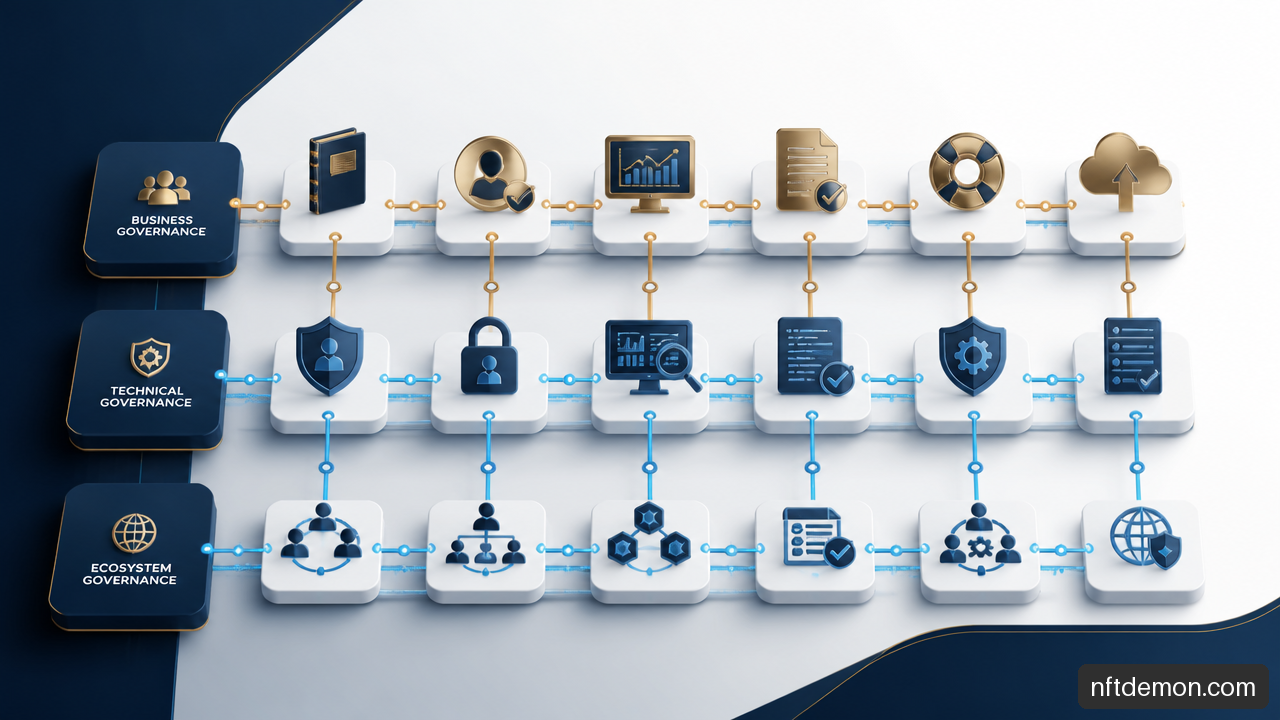
• Separate business governance, technical governance, and ecosystem governance. One committee should not make every decision merely because it can.
• Put high risk actions into a decision rights matrix: validator admission, smart contract deployment, emergency pause, protocol upgrades, and dispute resolution.
• Treat the consortium charter, security controls, funding model, and participant exit rights as production requirements, not legal cleanup work.
• Integrate blockchain operations with existing IAM, SIEM, GRC, incident response, and enterprise change management processes.
• Do not promote a pilot until every participant can demonstrate operational readiness, including support coverage, key management, rollback procedures, and accountable ownership.
Build The Operating Model From Business Outcomes
An enterprise blockchain operating model is the set of people, processes, technology controls, commercial rules, and governance mechanisms that allow a blockchain network to operate over time. It is broader than a technical architecture diagram. Architecture describes what the network is; the operating model defines how organizations make it work together.
Define The Shared Business Problem First
I would begin with a single cross organizational workflow where a shared record changes an important decision, obligation, or settlement process. Good candidates usually involve several firms reconciling data, proving an event occurred, or coordinating controlled handoffs. A vague objective such as “explore Web3” cannot support durable governance.
Write the outcome in operational terms:
| Decision Area | Example Of A Testable Definition |
|---|---|
| Business outcome | Reduce disputed shipment custody events by creating a shared, timestamped chain of responsibility. |
| Network boundary | Manufacturers, carriers, insurers, and authorized auditors may participate. |
| Authoritative event | A custody transfer is valid only after required parties submit verified evidence. |
| Value at risk | The network may affect payment release, compliance reporting, warranty claims, or contractual liability. |
| Success measure | Lower dispute resolution time, higher data completeness, or fewer manual reconciliations. |
This step prevents a common error: building an immutable record for data that no participant has agreed to treat as authoritative. If a carrier considers its own warehouse system authoritative while an insurer relies on the ledger, the ledger becomes another reconciliation surface rather than a shared source of truth.
Choose The Governance Shape That Fits The Power Structure
The governance model should reflect commercial reality. The relevant question is not whether the design appears maximally decentralized. It is whether authority matches liability, operational capability, and incentives.
A study by Goldsby and Hanisch identifies four generic blockchain governance modes: chief, clan, custodian, and consortium governance modes. For many permissioned enterprise networks, a consortium or federated model is sensible when several firms need meaningful control. A custodian model may fit better where one regulated operator must retain strong accountability.
| Model | Choose It When | Avoid It When |
|---|---|---|
| Central operator | One organization has contractual accountability and can sustainably fund operations. | Participants need equal authority over rules that materially affect them. |
| Consortium | Several organizations share risk, value, and long term operational responsibility. | Members are unwilling to commit resources or accept common operating rules. |
| Federated governance | A small group of approved organizations can jointly govern the network efficiently. | The network needs broad, open participation with minimal gatekeeping. |
| Hybrid model | A central service operator is needed, but key policy decisions require member approval. | Responsibilities cannot be cleanly separated between operator and members. |
Fair warning: shared governance is not automatically fair governance. A network with nominally equal members but one firm controlling engineering, hosting, and the customer relationship may have hidden concentration risk. The operating model should acknowledge that fact and create checks around it.
Design Three Connected Governance Layers
I recommend treating governance as three linked layers with explicit handoffs. MIT Sloan Management Review frames enterprise blockchain governance as stewardship across protocol, application, and ecosystem layers. That distinction is useful because a code approval is not the same as a commercial policy decision.
-
Business governance owns the use case, policy intent, participant value, and performance outcomes. It decides whether a new workflow, data field, or participant class supports the network’s mission.
-
Technical governance owns infrastructure standards, validator operations, security architecture, smart contract assurance, release management, and resilience. It decides whether a proposed change is safe and operable.
-
Ecosystem governance owns membership terms, legal obligations, commercial incentives, dispute pathways, funding, and partner engagement. It decides whether the network can function across organizational boundaries.
For example, adding a new regulator as a read only participant may begin as an ecosystem question about confidentiality and legal authority. Business governance confirms the reporting need. Technical governance then provisions identity, least privilege access, audit logging, and data visibility rules. The handoff matters: no team should assume its approval covers another team’s risk.
Assign Governance, Roles, And Decision Rights
Governance becomes operational only when named individuals or functions have clear mandates. A committee chart alone is insufficient; participants need to know who makes a decision, who can block it, and what happens if the designated party does not respond.
Establish A Practical Role Taxonomy
Roles may be held by different organizations or combined in a small network, but their responsibilities should remain distinct.
• Network sponsor: Owns the strategic mandate, budget approval, and executive escalation path.
• Product owner: Prioritizes business capabilities, translates policy needs into requirements, and accepts delivered functionality.
• Network operator: Runs shared services, coordinates node operations, tracks availability, and manages routine service requests.
• Participant delegate: Represents each member organization in governance votes and communicates obligations internally.
• Security lead: Owns key management standards, threat monitoring, incident coordination, and assurance requirements.
• Legal and compliance counsel: Interprets contractual, privacy, regulatory, retention, and liability obligations.
• Smart contract release authority: Confirms required testing, approvals, deployment evidence, and rollback readiness before production changes.
Where the same organization serves as operator and release authority, introduce an independent approval control for material changes. Otherwise, the operator may effectively certify its own work without adequate challenge.
Use A Decision Rights Matrix For High Risk Actions
A decision rights matrix is more valuable than generic statements about collaboration. It makes authority visible before pressure arrives during an incident or contentious upgrade.
| Decision | Recommends | Approves | Executes | Must Be Consulted |
|---|---|---|---|---|
| Admit a validator | Network operator | Governance council | Network operator | Security lead, affected members |
| Deploy a smart contract | Product owner and technical lead | Release authority | Network operator | Security, legal, participant delegates |
| Trigger an emergency pause | Security lead | Preauthorized incident authority | Network operator | Governance council, legal counsel |
| Upgrade protocol software | Technical governance group | Council vote at defined quorum | Network operator and validators | All participants |
| Resolve a member dispute | Participant delegates | Dispute panel or arbitral process | Designated administrator | Legal counsel |
The matrix should specify thresholds rather than relying on phrases such as “majority approval.” A routine configuration change might require technical approval and notification. A protocol upgrade affecting consensus, validator eligibility, or data visibility may require a supermajority and a formal notice period. There is no universal quorum standard supported by strong evidence across enterprise consortia, so I would set thresholds based on the harm a decision could cause and revisit them after initial operating cycles.
Separate On Chain Rules From Off Chain Authority
On chain governance uses code or protocol logic to enforce decisions. Off chain governance uses contracts, committees, policies, and formal approvals. Both matter. The University of São Paulo’s research distinguishes blockchain governance arrangements that operate on chain and off chain; in practice, enterprise networks depend heavily on the boundary between them.
Consider an emergency pause. The smart contract may technically allow a designated address to pause transfers. That is the on chain mechanism. The off chain policy must still state who can authorize the pause, what evidence is required, how members are notified, the maximum duration, and how normal operation resumes. Without the second layer, a technically valid pause can still produce a legal and commercial dispute.
The University of Arkansas Blockchain Center of Excellence lists governance facets including mission, participation and validation rights, data policies, override rights, ownership and liability, software update control, governance residence, and funding. Those are not side documents; they are the operating model’s core design inputs, as summarized in its enterprise blockchain governance framework.
Connect Legal, Technical, And Control Environments
A blockchain network does not replace enterprise controls. It introduces a new shared system that must fit within them. The goal is not to make every existing approval process slower. It is to preserve accountability where the blockchain changes how records, access, and transactions are managed.
Write A Consortium Charter That Can Survive Disagreement
The consortium charter should operate as both a legal agreement and a service operating manual. It should define at least the following:
-
Membership rules: Eligibility, due diligence, onboarding evidence, suspension grounds, and voting status.
-
Data rights: What is written on chain, what remains off chain, who may view each data class, and how retention obligations are met.
-
Liability allocation: Responsibility for inaccurate submissions, compromised credentials, node outages, intellectual property claims, and third party losses.
-
Exit rights: Required notice, data export rights, validator retirement steps, outstanding cost obligations, and treatment of historical records.
-
Dispute resolution: Escalation from operational review to governance council, then mediation, arbitration, or an agreed legal forum.
An exit clause deserves particular care. Immutability does not eliminate obligations when a participant departs. A member may lose future access while historical evidence remains necessary for audit, contractual proof, or record retention. The charter should state this plainly instead of promising deletion that the ledger design cannot technically deliver.
Map Blockchain Procedures To Enterprise Controls
Blockchain Council’s guidance advises organizations to define objectives and governance, codify policies, design risk controls, map compliance requirements, and integrate operations with ERP, IAM, SIEM, and GRC tools. That is the practical implication of its enterprise governance and compliance guidance: blockchain control should become part of the existing control environment, not a separate exception process.
| Enterprise Control | Blockchain Operating Procedure | Evidence To Retain |
|---|---|---|
| IAM | Verify organizational and individual identity before issuing credentials; remove access promptly after role changes. | Approval record, identity proof, access logs. |
| SIEM | Forward validator, API, key use, and smart contract event logs for correlation and alerting. | Alert history, triage notes, incident timeline. |
| GRC | Map network risks to control owners and test controls on a defined schedule. | Risk register, control test results, remediation status. |
| Change management | Classify releases, require testing and approvals, and maintain rollback plans. | Change ticket, test evidence, approvals, deployment hash. |
| ERP or workflow systems | Reconcile on chain events with operational and financial records. | Reconciliation reports, exception handling records. |
Fund The Network Like Shared Infrastructure
A funding model must cover more than initial development. It should allocate recurring costs for hosting, security monitoring, support, audits, legal administration, training, upgrades, and incident response.
Possible approaches include equal membership fees, transaction based charges, validator cost reimbursement, or weighted contributions based on volume and benefit received. Each has tradeoffs. Equal fees simplify administration but can discourage smaller members. Transaction fees align usage and cost but may create arguments about how usage is measured. A hybrid often works: a base membership contribution funds governance and minimum operations, while variable charges fund high volume services.
Do not let a founding sponsor subsidize the network indefinitely without written terms. That can be appropriate during launch, but it may also turn a purported consortium into a centrally controlled service once the sponsor determines it can no longer carry costs.
Prepare The Network For Production And Continuous Operation
A pilot proves that a workflow can execute. Production proves that several organizations can operate, govern, and recover the workflow under normal and abnormal conditions. Those are different tests.
Set An Operating Cadence Before Launch
Cadence should match risk and transaction criticality. A low volume document provenance network may need monthly operating reviews. A network linked to payments, regulated reporting, or safety critical supply events may need weekly operational review and continuous monitoring.
A workable starting cadence can include:
• Weekly operational review for incidents, service requests, node health, and access changes.
• Monthly technical governance review for releases, vulnerability status, capacity, and control exceptions.
• Quarterly business and ecosystem council meeting for performance, membership, funding, and policy changes.
• An emergency escalation path with named contacts, authority limits, and target acknowledgement times agreed by all members.
These are design choices, not universal benchmarks. For instance, a four member trade documentation consortium may agree that a suspected credential compromise must be acknowledged within one hour, while a noncritical asset registry may set a longer window. The right commitment depends on what delay exposes participants to financially, legally, or operationally.
Use A Multi Firm Launch Readiness Gate
Before production, require evidence from each participant rather than accepting a central project team’s assurance. The network is ready only when the least prepared critical member can meet its obligations.
| Readiness Area | Production Evidence |
|---|---|
| Governance | Signed charter, named delegates, voting rules, escalation contacts, and recorded decision rights. |
| Technology | Validator capacity, monitoring, backups where applicable, tested interfaces, and version inventory. |
| Smart contracts | Security review, business acceptance, deployment authorization, emergency controls, and rollback procedure. |
| Security | Key custody process, privileged access review, incident runbook, and SIEM integration. |
| Legal and compliance | Data classification, retention approach, audit access, liability terms, and applicable approvals. |
| Operations | Support model, issue intake, training, service commitments, and reconciliation procedures. |
Enterprise governance guidance consistently centers on who can join, write, approve upgrades, and resolve disputes. Blockchain Council’s architecture overview explicitly frames these as the questions that enterprise blockchain governance must answer. A launch gate turns those questions into testable evidence.
Measure Governance Health, Not Just Transaction Volume
Transaction counts can increase while the operating model deteriorates. I would monitor a small set of indicators that expose friction and concentration:
• Time from complete onboarding request to approved participant access.
• Percentage of governance votes receiving quorum and active member participation.
• Smart contract release lead time, including security and business approval stages.
• Mean time to acknowledge and resolve incidents involving nodes, credentials, or contract behavior.
• Share of validators operated by the largest member or hosting provider.
• Number and age of unresolved reconciliation exceptions.
• Budget variance and the proportion of costs carried by each member.
Watch for decentralization theater: many listed members, but only one organization can deploy code, interpret data rules, or maintain production infrastructure. The recovery path is not cosmetic decentralization. Rebalance decision rights, add independent operational capability, and revise the charter so the written model matches the actual one.
Frequently Asked Questions
What Is An Operating Model For An Enterprise Blockchain Initiative?
It is the practical system of governance, roles, legal terms, operating procedures, technology controls, funding, and performance measures that keeps a blockchain network functioning across one or more organizations. It answers operational questions that architecture alone cannot answer.
How Do Decision Rights Work In A Permissioned Blockchain Network?
Decision rights assign who recommends, approves, executes, and must be consulted for specific actions. The highest priority decisions are usually membership approval, validator operation, transaction permissions, smart contract deployment, emergency intervention, protocol upgrades, and disputes.
Who Should Be Allowed To Run Validators?
Choose validator operators based on operational capability, security maturity, availability commitments, legal accountability, and the need to avoid excessive concentration. Do not grant validator rights only because an organization is commercially influential. A participant that cannot protect keys, patch systems, and meet support obligations creates shared network risk.
How Should Smart Contracts Be Approved And Upgraded?
Use a release process that combines business acceptance, technical testing, security review, legal or compliance review where needed, formal authorization, deployment evidence, and a rollback or containment plan. Material changes should receive stronger approval thresholds than routine configuration updates.
What Belongs In A Blockchain Consortium Charter?
Include the mission, membership criteria, rights and duties, data rules, validation rules, funding, intellectual property, liability allocation, confidentiality, audit rights, exit procedures, dispute resolution, and amendment process. It should also define the relationship between off chain governance decisions and on chain enforcement.
How Do We Connect Blockchain Controls To Existing Enterprise Systems?
Integrate identities with IAM, security telemetry with SIEM, risks and evidence with GRC, releases with change management, and operational events with ERP or workflow systems where reconciliation is required. The aim is one accountable control environment, not parallel governance paperwork.
What Are Common Enterprise Blockchain Governance Failures?
Typical failures include unclear upgrade authority, validator concentration, ambiguous liability for bad data, unfunded operations, weak participant onboarding, emergency powers without limits, and a pilot that moves to production before members can support it. Each failure is avoidable when responsibilities are written, tested, and tied to enforceable controls.
Sources
• blockchain-council.org — https://www.blockchain-council.org/blockchain/enterprise-blockchain-governance-policies-risk-management-compliance/
• journals.sagepub.com — https://journals.sagepub.com/doi/10.1177/00081256221080747
• blockchain-council.org — https://www.blockchain-council.org/blockchain/enterprise-blockchain-architecture-nodes-consensus-governance-security/
• walton.uark.edu — https://walton.uark.edu/departments/information-systems/files/bccoewhitepaper022019open.pdf
• sloanreview.mit.edu — https://sloanreview.mit.edu/article/unleashing-the-power-of-blockchain-in-the-enterprise/
NFT Demon Holdings helps enterprises scope, evaluate, and build blockchain programs — start with a free evaluation call.
Talk through your use case
Free evaluation call — objective, constraints, and fit, before any proposal.