How to choose between public and permissioned blockchains
By Jeremy Ryan, Founder & CEO · September 2026

How to choose between public and permissioned blockchains for enterprise use comes down to one question: what kind of trust problem are you actually solving? If the participants are known, commercial data is sensitive, and a small group must control operating rules, a permissioned design is often the stronger fit. If the objective is neutral settlement, public verification, ecosystem reach, or durable proof that no single company controls, a public blockchain may be worth its added operational constraints.
I recommend treating this as an architecture and governance decision, not a platform selection exercise. The wrong choice can create a system that is technically functional but commercially unusable: a public network that exposes too much metadata, or a consortium network that becomes an expensive shared database with unclear accountability.
Start With The Enterprise Decision Matrix
The practical difference between public and permissioned blockchains is not simply whether users can join. It is who can read, write, validate, govern, and exit the system. Those five rights define the operating model more accurately than the labels alone.
A public blockchain typically permits broad participation and relies on an open consensus mechanism. It can offer neutrality because no consortium needs to approve every participant. A permissioned blockchain restricts one or more roles to approved organizations. Its consensus mechanism commonly relies on a defined validator set rather than anonymous participants competing to produce blocks.
The selection process should begin with the business event being recorded. Is it an internal approval? A multi party trade instruction? A consumer owned asset? A regulatory filing? The answer changes the architecture.
| Enterprise Requirement | Usually Stronger Fit | Why It Matters | When To Reconsider |
|---|---|---|---|
| Confidential pricing, contracts, or customer records | Permissioned | Visibility can be limited by organization, role, or transaction | Use public proof anchoring if an outside party must independently verify timing or integrity |
| Neutral settlement among unrelated parties | Public | Shared infrastructure can reduce dependence on one operator | Use permissioned rails if all parties require contractual control and restricted access |
| Open customer participation or token liquidity | Public | Users can interact without joining a closed consortium | Use a hybrid model if customer identity verification is mandatory |
| Controlled supplier or partner workflow | Permissioned | Known members can be admitted, monitored, and revoked | Use public attestations where downstream buyers need open verification |
| Regulator or auditor observation | Permissioned or Hybrid | Access can be granted without exposing all records to every participant | Use a public chain only when full disclosure is appropriate and legally permissible |
| Long term public provenance | Public | A public record can be independently checked by parties outside the enterprise | Keep sensitive commercial details off chain and publish only proofs or identifiers |
Choose Public When Neutrality Is A Product Requirement
A public blockchain is most compelling when an enterprise needs a system that counterparties can verify without trusting the enterprise itself. That distinction is easy to miss. If a company controls the rules, operates the validators, and can remove participants, then a permissioned network may improve coordination but does not deliver the same neutrality.
Consider a product authenticity program. A luxury brand could keep manufacturing records in its internal systems and publish a public token or signed proof that buyers can verify after resale. The public chain is useful not because every manufacturing detail belongs in public view, but because a future buyer, marketplace, insurer, or customs authority can validate provenance without requesting access to the brand’s private network.
Public networks can also make sense for collateral movement, tokenized instruments, customer facing digital assets, or shared settlement where ecosystem connectivity is central to the value proposition. In those cases, interoperability with wallets, marketplaces, liquidity venues, and external developers may outweigh the loss of direct infrastructure control.
Fair warning: public visibility includes more than the data field your application displays. Transaction timing, wallet relationships, smart contract interactions, and balances may expose meaningful metadata. Encryption does not automatically solve that problem if the surrounding activity reveals who transacted and when.
Choose Permissioned When Coordination Needs Boundaries
Permissioned blockchains are usually better suited to workflows among banks, manufacturers, logistics providers, insurers, government agencies, or enterprise business units that already know one another and need controlled collaboration.
A University of Lisbon study on enterprise blockchain interoperability notes that permissioned networks are commonly operated by known consortium nodes when internal transactions and data are confidential. This is the core use case: several parties need a shared record, but none should see every data element or gain unilateral control.
For example, a pharmaceutical supply network may need manufacturers, distributors, wholesalers, and regulators to verify product movement. A permissioned ledger can separate transaction visibility from validation rights. A distributor can confirm custody. A regulator can inspect relevant records. A competing supplier does not automatically see commercial terms.
The value is not “faster blockchain” in the abstract. The value is a controlled trust boundary with shared state, enforceable workflow rules, and clearer participant accountability.
Design Governance, Privacy, And Compliance First
A permissioned blockchain does not eliminate risk. It changes the risk profile from anonymous participation toward governance concentration, insider conduct, operational failure, and disputes among named organizations.
Before approving a network, I recommend documenting its ownership model in terms that legal, security, and business leaders can test. Ask who holds each decision right, how that right is exercised, and what happens if the responsible party fails.
Separate Admission, Validation, And Governance Rights
These functions are often grouped together, but they should be designed separately:
-
Member admission determines who may join the business network and what identity evidence is required.
-
Transaction authorization determines which participants can submit, endorse, view, or amend a workflow state.
-
Validator admission determines who can produce or confirm blocks and whether a single operator can change that set.
-
Protocol governance determines who can approve smart contract changes, security patches, and version upgrades.
-
Member revocation determines how access is removed after a breach, insolvency, sanctions event, merger, or contractual dispute.
This separation matters because a network can have strong identity controls but weak governance. Imagine a four member trade consortium where one large member operates most validators, hosts the shared infrastructure, and controls onboarding. The network may be technically permissioned, yet smaller members may reasonably view it as a supplier controlled platform rather than neutral shared infrastructure.
A consortium should define voting thresholds, quorum rules, emergency authority, independent audits, and a dispute process before production. It should also establish what happens when a member refuses an upgrade that fixes a critical vulnerability. Without these rules, “decentralization” becomes a slogan while operational control remains ambiguous.
Treat Data Visibility As A Compliance Design Problem
Enterprises should classify data before choosing the network. Personal information, account data, trade secrets, health related records, payment instructions, and audit logs each carry different obligations and business consequences.
| Data Class | Public Chain Exposure Risk | Permissioned Control Option | Practical Design Response |
|---|---|---|---|
| Personal data | High if identifiers or linkable metadata are recorded | Restrict readers and apply role based access | Store personal data off chain; record a reference or cryptographic proof instead |
| Commercial terms | High because competitors may infer pricing or volumes | Limit visibility to transaction parties | Keep contract documents outside the shared ledger and place only verified state changes on chain |
| Financial records | Moderate to high depending on disclosure rules and wallet traceability | Provide controlled access to compliance teams | Use segregation of duties, key controls, retention rules, and auditable permissions |
| Audit evidence | Often appropriate only in summarized form | Give observers defined read access | Preserve source records separately and use the ledger as integrity evidence |
Permissioned systems can support selective disclosure. ZugDLT describes designs in which transaction visibility can be restricted to counterparties and designated regulators while validators remain controlled and known. That can be valuable, but it is not a compliance shortcut. The enterprise still needs a lawful data model, retention approach, access reviews, incident response plan, and evidence that permissions operate as intended.
Avoid Putting Sensitive Records On Chain By Default
Immutability is useful for proving that a record existed and has not been silently altered. It can be problematic when a record must be corrected, deleted, restricted, or superseded. A safer pattern is often to keep the sensitive source record in a governed system of record and store a hash, timestamp, status, or signed attestation on the ledger.
That design does not make the off chain system optional. It makes responsibilities clearer: the enterprise manages protected records, while the blockchain provides shared integrity and workflow evidence.
Build Identity And Key Management Into The Approval Gate
Identity and access management is not an add on. Permissioning depends on reliable participant identities, certificate lifecycle management, hardware protected keys where appropriate, delegated administration, and rapid revocation.
Salesforce Trailhead explains that permissioned networks require invited users, helping prevent anonymous participation. That benefit only exists if invitation and revocation processes are governed well. A dormant administrator account, compromised signing key, or poorly controlled certificate authority can undermine an otherwise sound permissioned model.
Public chain applications face a different challenge: users may self custody keys, transact through third party wallets, and expect little central intervention. Enterprises need to decide whether they can support recovery, screening, custody, and customer service without pretending they control assets held by external wallet owners.
Compare Operating Costs, Performance, And Interoperability
Transaction throughput and transaction fees matter, but they are only part of the operating model. Public networks may charge variable fees for blockspace and expose enterprises to market driven transaction costs. Permissioned networks can make transaction economics more predictable, but they shift spending toward node operations, security, integrations, consortium administration, and support.
Model Total Cost Rather Than Gas Fees Alone
Use a five part cost model before selecting a chain:
• Transaction cost: gas fees, transaction relays, settlement fees, or member charges.
• Infrastructure cost: validator nodes, cloud hosting, storage, monitoring, backups, and disaster recovery.
• Security cost: key management, identity systems, penetration testing, incident response, and smart contract assurance.
• Governance cost: legal agreements, member onboarding, voting procedures, audits, and dispute administration.
• Integration cost: ERP, CRM, custody, payments, data platforms, reporting, and existing identity systems.
A public deployment may have higher per transaction variability but lower need to establish a new consortium. A permissioned network may have low marginal transaction fees but expensive governance overhead. For a small number of high value settlement events, public fees may be commercially acceptable. For millions of confidential supply chain events, managed permissioned infrastructure may be easier to budget.
Benchmark Finality Against The Actual Business Deadline
Do not ask whether a chain is “fast.” Ask whether it reaches sufficient finality before the business process must act.
A warehouse handoff may tolerate minutes if goods cannot physically move until a scan is complete. A securities settlement workflow may require stronger certainty and carefully designed exception handling. A consumer checkout flow may need fast confirmation but can sometimes accept a separate risk policy before final settlement.
Benchmark the entire transaction path: identity lookup, signature collection, smart contract execution, consensus, downstream integration, exception handling, and audit reporting. The blockchain may confirm quickly while a legacy ERP connector creates the actual delay.
Use Hybrid Designs For Selective Public Proof
A hybrid architecture is appropriate when an enterprise needs both restricted operations and public verification. It should be a deliberate division of responsibilities, not a vague promise to “use both.”
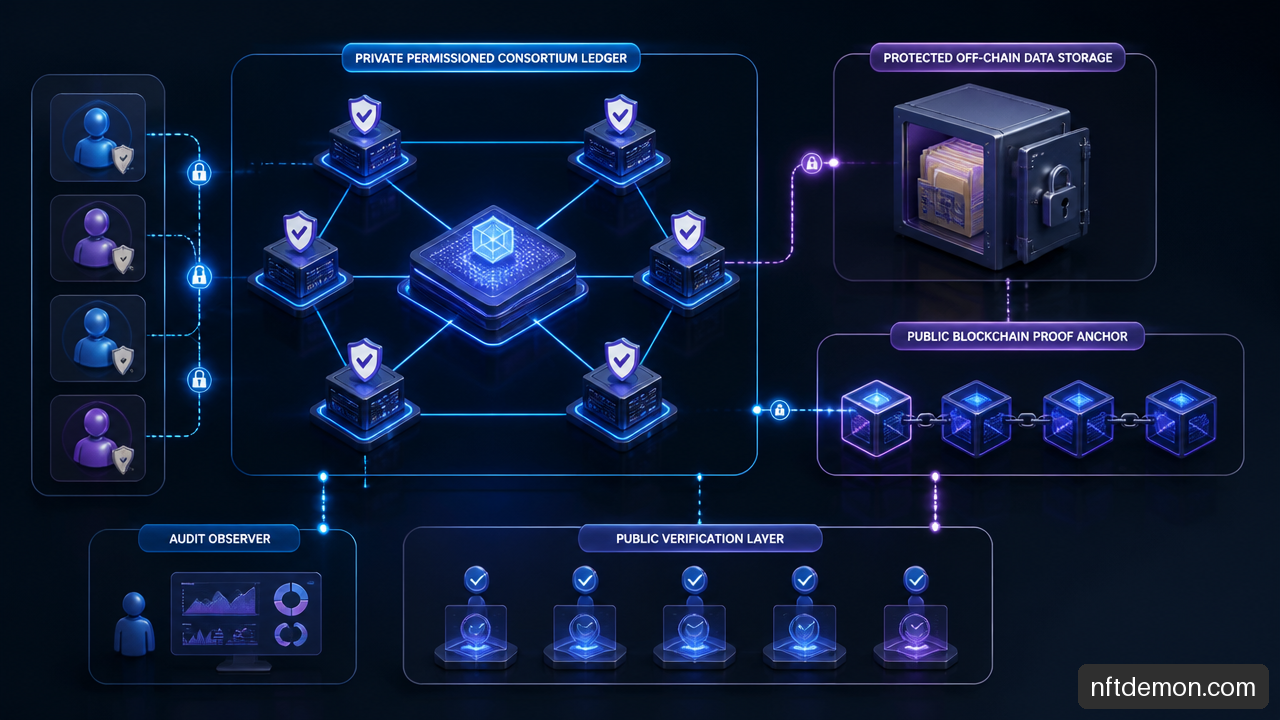
A practical pattern has three layers:
-
A permissioned ledger records confidential transactions among approved members.
-
An off chain repository stores protected documents, personal data, and large files under enterprise controls.
-
A public blockchain receives a periodic hash, aggregate proof, tokenized settlement event, or notarized checkpoint.
For example, a consortium can process private invoices and financing approvals internally, then publish a daily root hash publicly. External auditors can later verify that a disclosed invoice record was included in the committed batch without seeing every participant’s transaction.
This pattern introduces its own obligations. Teams must specify who creates the proof, how source data is reconciled, how often anchors are published, and what happens if an anchor is delayed or incorrect. The public record proves consistency with the committed data; it does not prove that the original data was accurate when entered.
Guard Against Lock In And Governance Deadlock
Permissioned deployments can create dependence on a platform vendor, cloud operator, certificate authority, or dominant consortium member. Public deployments can create dependency on smart contract standards, wallet ecosystems, and protocol governance beyond the enterprise’s control.
There is no universal winner. The recovery strategy matters more. Require exportable transaction history, documented APIs, reproducible smart contract builds, independent node operation rights, key escrow policies where legally appropriate, and contractual data portability. For a consortium, include a wind down process: how data is preserved, who pays for archival nodes, and whether members can continue validating records if the operating company exits.
FAQ: Public And Permissioned Blockchains For Enterprise Use
What Is The Real Difference Between Public And Permissioned Blockchains?
A public blockchain generally allows open participation and public verification under its protocol rules. A permissioned blockchain limits certain roles, such as submitting transactions, reading records, or validating blocks, to approved participants. The more important distinction is operational: public networks distribute control broadly, while permissioned networks allocate control through an explicit governance model.
Which Model Is Better For Confidential Business Data?
Permissioned systems are usually more suitable when transaction participants, regulators, and auditors require different access levels. Still, sensitive data should rarely be placed directly on any immutable ledger. Use off chain protected storage and record proofs, references, or state changes on chain when confidentiality, deletion, or correction requirements apply.
When Does A Public Blockchain Make More Sense For An Enterprise?
Choose public infrastructure when independent verification by customers, partners, investors, marketplaces, or future counterparties is central to the product. It is especially relevant when neutral settlement, open asset ownership, public provenance, or interoperability with the broader digital asset ecosystem creates business value that a closed network cannot reproduce.
Is A Permissioned Blockchain Always Better For Business Use?
No. A permissioned network can become a costly, centralized operating model if one participant controls validators, onboarding, upgrades, and data access. It is best when a genuine multi party workflow exists and participants need shared state with controlled disclosure. If one company owns every process and every dataset, a conventional database may be more appropriate.
What Should We Weigh First: Privacy, Cost, Or Governance?
Start with governance and data classification. Governance determines who can change the rules and operate the network; data classification determines what cannot safely be exposed. Cost and performance should follow because they can be benchmarked against a defined architecture. Starting with fee comparisons often produces a premature decision.
Can A Permissioned Blockchain Still Be Transparent To Auditors Or Regulators?
Yes. Permissioned networks can grant limited observer access or provide specific transaction disclosures without opening all data to every member. The design should define what an observer can view, whether records can be exported, how access is logged, and how long evidence remains available after a participant leaves the network.
How Do We Avoid Vendor Lock In Or Consortium Deadlock?
Require portability and governance protections before launch. Contract for data export, independent node operation, documentation, upgrade voting, member exit rights, security responsibilities, and a network wind down procedure. Test these processes in a staging environment. A recovery plan that has never been exercised is not a reliable operational control.
Sources
• Salesforce Trailhead — Blockchain Network Types Comparison: https://trailhead.salesforce.com/content/learn/modules/blockchain-basics/blockchain-network-types
• ZugDLT — Permissioned vs Public Blockchain: The Enterprise DLT ...: https://zugdlt.com/infrastructure/permissioned-vs-public/
• University of Lisbon dissertation — Gateway-Based Enterprise Blockchain Interoperability: https://fenix.tecnico.ulisboa.pt/downloadFile/1126295043839728/90704-andre-augusto-dissertacao.pdf
• Investopedia — Public, Private, and Permissioned Blockchains Compared: https://www.investopedia.com/news/public-private-permissioned-blockchains-compared/
NFT Demon Holdings helps enterprises scope, evaluate, and build blockchain programs — start with a free evaluation call.
Talk through your use case
Free evaluation call — objective, constraints, and fit, before any proposal.