How to Build an Enterprise Blockchain Business Case
By Jeremy Ryan, Founder & CEO · September 2026
How to build a business case for blockchain adoption in an enterprise starts with a disciplined question: does a shared ledger solve a costly business problem better than a conventional database, workflow platform, or API integration? If the answer is unclear, the organization should not fund blockchain because the technology is fashionable. It should fund a narrowly defined business outcome.

A credible case links a multi party process to measurable improvements in reconciliation, settlement, provenance, auditability, or programmable execution. It also makes the inconvenient costs visible early: ERP integration, data governance, participant onboarding, privacy controls, and operational ownership. The objective is not to prove that blockchain is useful. It is to prove that this network can produce more value than its alternatives.
Test Whether Blockchain Is The Right Architecture
Start With The Broken Business Process
The strongest enterprise blockchain cases begin with a process that crosses organizational boundaries and produces conflicting records. Consider a manufacturer, logistics provider, distributor, and insurer that each maintain separate shipment records. When goods are delayed or damaged, employees may spend days matching timestamps, documents, custody events, invoices, and insurance terms. The issue is not simply poor data storage. It is the cost of proving which record is authoritative.
I recommend writing the problem statement in operational terms:
• Which decision or transaction is delayed? • Which organizations maintain separate versions of the same record? • How many manual touches, exceptions, disputes, and audit requests occur each month? • What happens when records disagree? • What financial, regulatory, or customer impact follows from the delay?
This avoids the common mistake of describing a technology project instead of a business problem. MIT Sloan Management Review emphasizes that enterprise blockchain efforts should begin with use case selection and cost benefit analysis rather than the technology itself. Its guidance on advancing blockchain through a focused business case supports this order of operations.
Apply A Hard Stop Or Go Decision Gate
A blockchain network is usually justified when independent parties need a shared, tamper evident record but do not want one participant to control the system unilaterally. That distinction matters. A distributed ledger adds coordination and governance overhead. It should earn that overhead.
| Decision Question | Favor A Conventional System When | Favor A Blockchain Network When |
|---|---|---|
| Who controls the records? | One trusted enterprise can act as the authoritative operator. | Several independent organizations need equal or negotiated authority. |
| What is the core problem? | Internal workflow automation or analytics is the main need. | Reconciliation, provenance, settlement, or cross party auditability drives cost. |
| Can APIs solve it? | Parties can exchange trusted data through existing contracts and interfaces. | APIs still leave disputes over timing, status, ownership, or record integrity. |
| Is shared governance realistic? | Partners will not commit to common rules or onboarding. | Participants can agree on standards, voting rights, and operating responsibilities. |
| Is immutability appropriate? | Records need routine deletion or unrestricted editing. | An append only event history is valuable, with sensitive data kept off chain. |
The stop rule should be explicit: if a trusted central operator and conventional database can meet the required service level at lower total cost, reject blockchain. This is not a failure. It is good capital discipline.
CIO Dive frames adoption similarly: the business problem, blockchain capabilities, and deployment resources must fit together. Its reporting also identifies asset tracking and provenance as common early enterprise use cases. See CIO Dive’s analysis of enterprise blockchain use case fit for that alignment principle.
Choose The Value Mechanism, Not Just The Use Case
A use case label such as “supply chain” is too broad for a funding request. Name the mechanism that creates value. There are four recurring mechanisms:
- Shared ledgering reduces record comparison across parties by giving authorized participants a common transaction history.
- Smart contract automation applies agreed rules when validated events occur, such as releasing payment after delivery and inspection conditions are met.
- Tokenization may create value where fractional ownership, transfer restrictions, settlement, or asset lifecycle controls require a digital representation of rights.
- Provenance and auditability improve traceability for assets, certificates, regulated documentation, or chain of custody records.
A real enterprise case study from Brunel University on R3 Corda describes how shared records, automated document management, and smart contracts can improve reconciliation and settlement processes while helping manage counterparty risk. The study’s R3 Corda enterprise blockchain findings are useful because they connect the technology to operational mechanisms rather than abstract claims.
Build The Financial Case And Compare Alternatives
Model Value In Separate, Defensible Buckets
Do not present a single, vague “efficiency benefit.” Executives need to see where the economics originate, who owns the baseline, and what must change to capture the value. Separate benefits into cost avoided, cash flow improvement, risk reduction, and new revenue.
| Value Bucket | Baseline Measure | Potential Blockchain Effect | Evidence Needed |
|---|---|---|---|
| Reconciliation labor | Hours, loaded labor cost, exception volume | Fewer record matching tasks and duplicate investigations | Process logs, time studies, finance data |
| Dispute resolution | Claims, chargebacks, legal or operations cost | Faster evidence review and clearer responsibility | Dispute history and resolution time |
| Audit and compliance | Audit preparation hours, document retrieval time | More traceable records and faster verification | Audit findings and compliance workflow data |
| Settlement and working capital | Days to settle, capital tied up, financing cost | Shorter settlement cycles where rules and data are shared | Treasury data and contractual terms |
| Fraud and loss exposure | Loss events, investigation cost, write offs | Better provenance and control points, subject to process design | Incident records and control testing |
| Revenue or fee compression | New products, retained margin, transaction fees | New asset models or lower coordination costs | Customer demand and commercial assumptions |
The financial model should calculate annual benefits conservatively. For example, if a trade documentation process consumes 20,000 reconciliation hours annually, the model should not assume all labor disappears. It should estimate the percentage of tasks eliminated, the portion that is redeployed versus removed, and the added cost of validating data at the source. Automation shifts work; it does not always erase it.
a16z crypto argues that enterprise blockchain adoption occurs when a concrete use case creates material economic or operational upside, including cost savings, efficiency gains, or fee compression. That focus on measurable upside should anchor the economic rationale for enterprise blockchain adoption.
Calculate ROI And Total Cost Of Ownership
A simple ROI equation is useful, but it is not enough on its own:
ROI = (Cumulative Benefits − Cumulative Total Cost Of Ownership) ÷ Cumulative Total Cost Of Ownership
Use a multi year view, usually aligned to the organization’s normal technology investment horizon. Include the payback period, downside scenario, and break even adoption threshold. A consortium network can have strong unit economics at scale and poor economics with only two participating organizations.
Total cost of ownership should include more than platform licensing or node hosting:
• Discovery, process mapping, architecture, security review, and legal analysis • Smart contract development, testing, code review, and change management • ERP, CRM, identity, data warehouse, and document system integration • Data model remediation, master data work, and event quality controls • Network infrastructure, monitoring, incident response, backups, and support • Participant onboarding, training, governance administration, and compliance reporting • Cybersecurity controls, key management, privacy design, and independent assurance
Fair warning: integration is often the largest undercounted cost. If an ERP system remains the system of record for inventory or invoicing, the blockchain layer must reliably receive, validate, and return events. That may require middleware, revised identifiers, new approval steps, and exception handling. A polished demonstration that bypasses those realities is not a production business case.
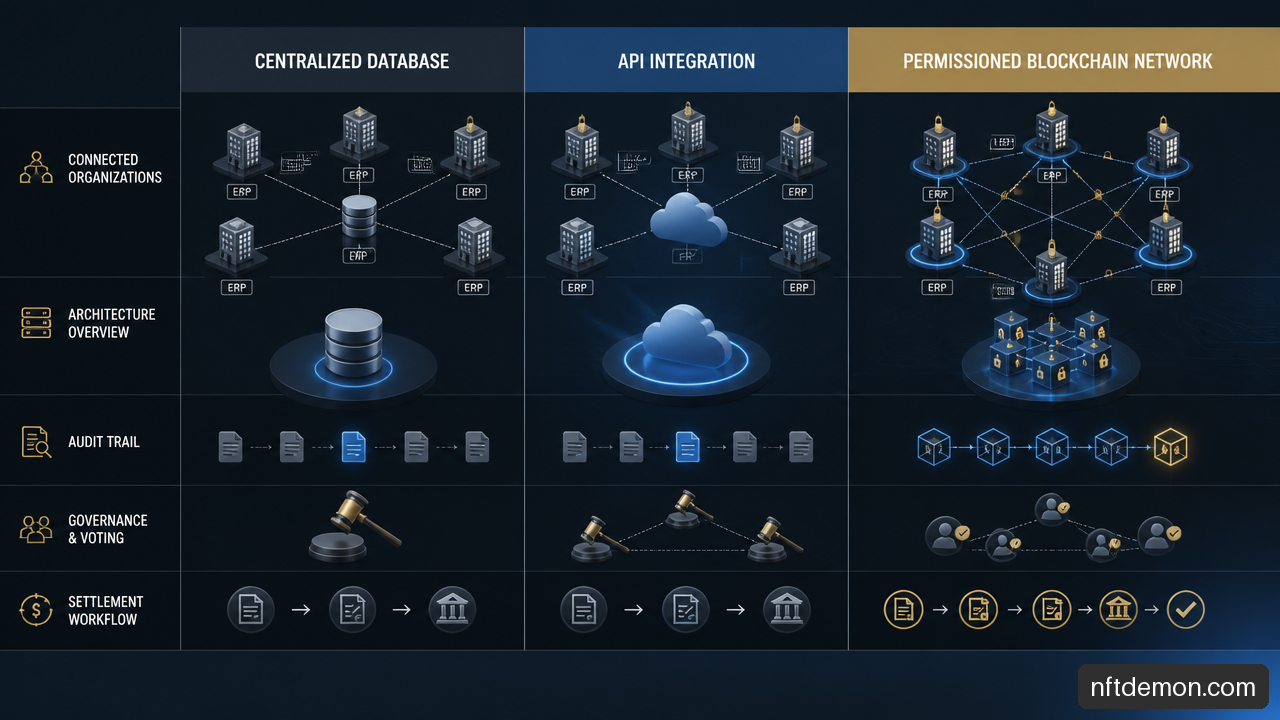
Compare The Full Alternatives
The alternatives should be funded and evaluated with equal seriousness. Otherwise, blockchain wins by definition rather than merit.
| Option | Best When | Primary Advantage | Main Limitation |
|---|---|---|---|
| Centralized database | A single trusted party can govern records | Lower complexity and faster implementation | Participants may resist one party controlling the source of truth |
| API and workflow integration | Partners already trust bilateral exchanges | Familiar architecture and flexible interfaces | Reconciliation and differing records can persist |
| Permissioned blockchain | Known participants need shared governance and controlled access | Shared audit trail with identity and policy controls | Requires consortium rules and participant commitment |
| Public blockchain with enterprise controls | Open settlement, public verification, or interoperable assets matter | Broad accessibility and composability | Privacy, fee volatility, and compliance design may be harder |
A permissioned network changes the business case because access, validation, and data visibility can be limited to approved entities. It does not remove governance work. It makes governance more central.
Design Governance, Compliance, And Integration Early
Treat Governance As A Product Requirement
A consortium is not merely a technical network. It is an operating agreement expressed partly in software and partly in legal, commercial, and policy terms. Before a pilot is funded, define the minimum viable governance model.
| Governance Area | Decision To Make | Failure If Unresolved |
|---|---|---|
| Membership | Who may join, sponsor, or be removed? | Unqualified participants or stalled onboarding |
| Voting | Which changes require majority, supermajority, or unanimous approval? | Gridlock or one party dominance |
| Data rights | Who can view, submit, correct, and export each data type? | Privacy breach or unusable visibility |
| Operating costs | How are hosting, support, and enhancement costs allocated? | Free rider disputes and unfunded operations |
| Liability | Who is responsible for bad data, outages, and smart contract errors? | Commercial disputes after an incident |
| Exit rules | What happens to data, nodes, keys, and obligations when a member leaves? | Operational disruption and legal uncertainty |
The crucial nuance is that blockchain can preserve a validated event, but it cannot guarantee that an input was true. If a warehouse scans the wrong serial number, the system may create a durable record of the wrong event. Controls at the point of data capture remain essential.
Convert Compliance Into A Measurable Benefit
Compliance should not appear only in the risk section. In regulated workflows, auditability can be a value driver when it reduces evidence collection, improves traceability, or strengthens recordkeeping controls. The business case should map each required record to its source, retention rule, access policy, and audit evidence.
For example, a regulated product distribution network may store document hashes and lifecycle events on the ledger while retaining personally identifiable information and sensitive documents in controlled off chain repositories. The ledger proves sequence and integrity; the document system manages access, retention, and deletion obligations. This design is often more practical than placing full documents or personal data directly on chain.
I recommend involving legal, privacy, records management, compliance, and security leaders during discovery rather than after the architecture is selected. There is no universal regulatory template for every jurisdiction and sector. A financial institution, healthcare organization, and public agency may face materially different obligations even when their technical patterns look similar.
Build Security And Data Risks Into The Case
The risk register should assign owners, indicators, mitigation actions, and residual risk. Technical risks become business risks when they interrupt settlement, expose data, or prevent a network from operating.
• Immutability risk: Incorrect or sensitive data may be difficult to amend. Mitigate by keeping personal data off chain and recording corrections as new, traceable events. • Key management risk: Lost, compromised, or poorly governed cryptographic keys can prevent access or authorize improper actions. Mitigate with enterprise custody controls, recovery procedures, separation of duties, and monitoring. • Smart contract risk: Coding defects can automate incorrect business logic. Mitigate through formal requirements, testing, independent review, controlled upgrades, and emergency procedures. • Consortium dependency risk: Value falls if critical partners delay participation. Mitigate with signed commitments, minimum adoption thresholds, and a fallback operating model. • Interoperability risk: The new ledger may become another isolated system. Mitigate with canonical data models, documented APIs, and integration ownership.
Fund The Initiative In Stages And Measure Proof
Use Stage Gates Instead Of A Single Large Commitment
A stage gated plan limits exposure while producing evidence that decision makers can use. Each stage should have a budget, specific deliverables, and a clear stop, continue, or revise decision.
- Discovery: Map the process, baseline costs, participants, data flows, alternatives, regulatory constraints, and adoption incentives. Output: an investment thesis and architecture options.
- Pilot: Test a narrow workflow using representative data and a limited number of participants. Output: KPI results, security findings, integration effort, and governance lessons.
- Limited Production: Connect production adjacent systems, run real transactions under controlled volume, and establish support operations. Output: validated unit economics and operational readiness.
- Scale: Onboard more participants, automate additional rules, and expand geographic or product coverage only after minimum adoption and service targets are met.
The “why now” argument belongs here. Timing is credible when partners are ready, the data standards exist, a regulatory or market change creates urgency, or network participation can reach a viable threshold. It is weak when the only urgency is a technology trend.
Select Pilot KPIs That Can Change A Funding Decision
A pilot should not be judged by whether a ledger was deployed. It should show whether the new process performs better under realistic conditions.
| KPI | What It Tests | Example Funding Question |
|---|---|---|
| Settlement time | Speed from validated event to completed transfer | Did the process remove a material delay? |
| Exception rate | Frequency of mismatches or failed workflows | Did shared records reduce errors or reveal data quality problems? |
| Manual touches | Human interventions per transaction | Is automation reducing repetitive operations work? |
| Reconciliation time | Hours required to align records across parties | Are savings sufficient to support the network cost? |
| Audit cycle time | Time to locate and verify required evidence | Is auditability producing measurable compliance value? |
| Participant adoption | Active users and transaction share | Is the network approaching viable scale? |
| Cost per transaction | Operating cost divided by validated transactions | Does scale improve, preserve, or damage unit economics? |
Set baselines before the pilot begins. If current settlement averages five business days, document how that was measured, which transaction types are included, and how exceptions are treated. A pilot that reports a two hour settlement time for only clean, hand selected transactions does not establish production value.
Present The Executive Narrative Clearly
The board or investment committee should be able to understand the proposal in a few minutes. The narrative needs five answers:
• What costly multi party problem exists today? • Why do conventional alternatives fall short or cost more over time? • Which measurable benefits justify the investment? • What must be true about partner participation, governance, and integration? • What evidence will trigger the next funding decision or stop the program?
The most persuasive case is not an argument that blockchain is inevitable. It is a controlled investment proposition with assumptions that can be tested.
Key Takeaways
• Build the case around a specific cross organization process, not a general desire to adopt blockchain. • Reject blockchain when a trusted centralized system can achieve the same outcome at lower total cost. • Quantify reconciliation, disputes, audit labor, settlement, risk exposure, and revenue separately. • Treat ERP and CRM integration, data remediation, security, and participant onboarding as first order costs. • Define consortium membership, data rights, voting, liability, and exit rules before production funding. • Use a staged discovery, pilot, limited production, and scale model with measurable decision gates. • Judge pilots using operational KPIs such as settlement time, exception rate, manual touches, audit cycle time, adoption, and cost per transaction.
FAQ
What Business Problem Should Blockchain Solve In An Enterprise?
Blockchain should solve a problem involving multiple parties that maintain separate records, incur reconciliation costs, dispute transaction status, require traceable provenance, or need programmable settlement rules. Avoid using it for a purely internal workflow where one enterprise can operate a conventional database efficiently.
When Is Blockchain Better Than A Database Or API Integration?
It is better when independent participants need a shared source of truth and no single party should control the record without oversight. APIs remain a stronger choice when participants already trust a central authority, bilateral data exchange is sufficient, and record disputes are limited.
How Do You Calculate ROI For Enterprise Blockchain?
Calculate cumulative benefits minus cumulative total cost of ownership, then divide by total cost of ownership. Use conservative assumptions and include avoided reconciliation labor, reduced dispute costs, shorter settlement cycles, audit efficiency, risk reduction, and any defensible new revenue. Show downside and adoption threshold scenarios, not only the base case.
What Costs Are Commonly Missed In A Blockchain Business Case?
The most frequently undercounted costs are ERP and CRM integration, data cleanup, identity design, key management, smart contract assurance, legal work, participant onboarding, governance administration, support operations, and process change. A network is an operating model, not just deployed software.
How Do Permissioned Blockchains Change The Business Case?
Permissioned networks can support controlled participation, selective data access, and defined validation rights. They may suit regulated or known participant environments, but they also require formal governance. The organization must budget for membership administration, policy enforcement, network operations, and participant agreements.
What KPIs Prove A Blockchain Pilot Is Working?
Use pre defined operational measures: settlement time, reconciliation hours, exception rate, manual touches, audit evidence retrieval time, participant adoption, transaction completion rate, and cost per transaction. The pilot succeeds only if it improves these measures enough to justify production costs and partner commitments.
What Are The Biggest Risks In Enterprise Blockchain Adoption?
The largest risks are poor use case fit, weak participant incentives, unclear governance, inaccurate source data, privacy mistakes, compromised keys, smart contract defects, difficult integration, and a network that never reaches sufficient scale. Each risk should have an owner and a mitigation plan before production approval.
How Long Does It Take To See Value From Enterprise Blockchain?
There is no reliable universal timeline because integration complexity and partner readiness vary substantially. A narrow pilot can show process evidence relatively quickly, while production value may depend on onboarding enough participants to create network effects. For example, a provenance network with one manufacturer and one distributor may validate data flows, but it may not reduce broad industry reconciliation until additional suppliers, carriers, and buyers participate.
Sources And References
• MIT Sloan Management Review — 7 ways to advance blockchain in the enterprise • Brunel University — Unlocking enterprise blockchain adoption: A R3 Corda case study • CIO Dive — Enterprise blockchain adoption hinges on use case fit • a16z crypto — Enterprise blockchain adoption happens when someone ...
NFT Demon Holdings helps enterprises scope, evaluate, and build blockchain programs — start with a free evaluation call.
Talk through your use case
Free evaluation call — objective, constraints, and fit, before any proposal.