How should an enterprise expose internal data to an AI application
By Jeremy Ryan, Founder & CEO · November 2026
How should an enterprise expose internal data to an AI application? I recommend treating it as an identity, authorization, and data-governance problem first—and only then as an AI integration problem. The safest pattern is usually a governed mediation layer that retrieves only the data a requesting user may access, sends the minimum necessary context to the model, and tightly controls any action the AI can perform.
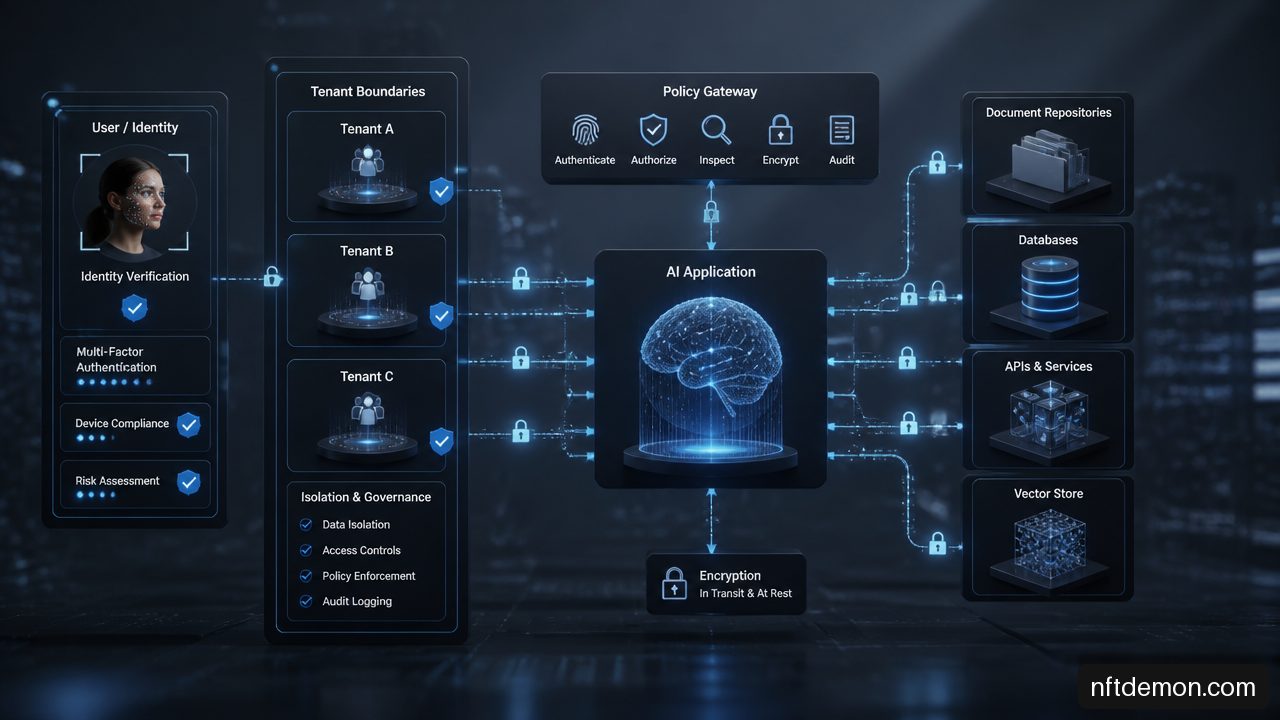
An enterprise assistant should not become a privileged shortcut around existing systems. If an employee cannot see a customer record, salary field, legal hold, or security incident in the source system, the AI application should not reveal it through retrieval, summaries, tool calls, cached results, or logs. That principle sounds straightforward. Implementing it requires deliberate data architecture.
• Build A Governed Data Exposure Model
• Choose The Right Data Access Pattern
• Enforce Identity, Permissions, And Safe Actions
Key Takeaways
The Practical Decision Rule
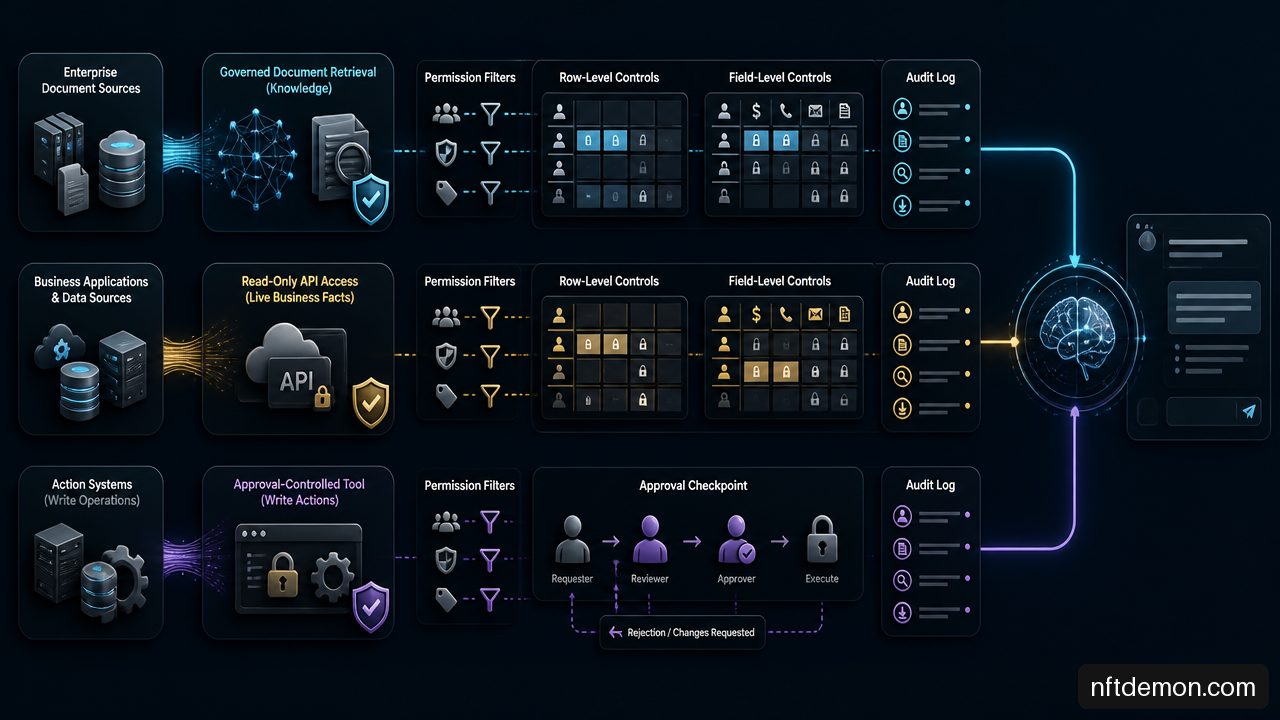
I would expose internal data through separate, governed paths for unstructured knowledge, structured facts, and business actions. Use retrieval-augmented generation, or RAG, for approved documents and knowledge content. Use read-only APIs for current operational facts. Use narrowly designed tools for business actions, with stronger approval and audit controls than read operations.
The architecture should preserve the employee’s effective permissions at the moment of retrieval or tool execution. It should also apply tenant, row, and field filtering before content reaches the model. A vector database, model provider, observability platform, and prompt log are all data surfaces—not neutral plumbing.
The AI application should inherit existing enterprise boundaries, not redraw them.
Build A Governed Data Exposure Model
Start With An Exposure Inventory
Before selecting a model, create an exposure inventory. This is the operating map for every AI capability, not a compliance document left untouched after launch. It should state what the AI can access, for whom, for what purpose, and through which control point.
For each capability, document:
• The business use case and accountable owner
• The requesting user, agent identity, and authentication method
• Source systems, data classifications, tenants, and retention rules
• Permitted records, fields, document types, and geographic restrictions
• Whether data may be indexed, cached, embedded, logged, or sent externally
• Available read operations, write operations, approval requirements, and rollback options
• The gateway, API, MCP server, vector store, model provider, and monitoring systems involved
This scope should include dependencies that are easy to overlook. ITConductor’s enterprise AI security guidance supports mapping identities, permissions, data sources, APIs, secrets, and operational dependencies rather than viewing the model as the entire system.
For example, a procurement copilot may retrieve policy documents from SharePoint, query purchase-order status through an ERP API, and prepare an approval request. Those are three different exposure paths with different risks. The policy document may be suitable for a controlled index. Purchase-order status may require real-time access. Approval submission is a write action and should not inherit the same frictionless treatment as a document search.
Classify Data Before It Becomes AI Context
Data classification must happen before ingestion, embedding generation, prompt construction, or external API calls. Otherwise, the organization may discover sensitive data only after it has already been copied into an index, conversation history, tracing system, or provider-side retention environment.
A useful policy divides data into handling categories such as public, internal, confidential, restricted, regulated, and prohibited. The exact labels vary, but the decision must be explicit: may this class be retrieved? May it be embedded? May it leave a private environment? May it appear in logs?
Some information should be excluded entirely from broad AI retrieval. Examples often include authentication secrets, private keys, raw payment data, unredacted health information, privileged legal communications, active investigation materials, and credentials. Other material may be usable only after masking or tokenization. A customer-support assistant, for instance, may need account status and product entitlements but not a full bank account number or internal fraud notes.
Sensitive derivatives deserve the same discipline. Embeddings can reveal semantic information about the material used to create them. Prompt transcripts and tool outputs can become a second, poorly governed copy of the source data. NetApp’s private RAG architecture discussion describes keeping data under organizational control while preserving access permissions, a useful pattern where regulatory, contractual, or governance requirements limit public-cloud exposure.
Treat Governance As A Runtime Control
Data governance cannot stop at initial ingestion. Permissions change. Employees move teams, customers leave, legal holds appear, and records are corrected. A knowledge index built six months ago may still return content that no longer matches the user’s current entitlements.
I recommend a control loop with three stages:
Ingest deliberately. Capture source identifiers, owner, tenant, classification, document version, permissions, and retention metadata alongside every indexed chunk.
Evaluate at request time. Filter candidates using the authenticated user’s current roles, attributes, tenant, and purpose before the model sees them.
Revoke and reconcile. Propagate deletions, permission changes, and classification updates to indexes, caches, conversation stores, and logs on a defined schedule.
This is especially relevant for organizations also connecting distributed ledgers, supply-chain records, or token systems. The same discipline used in integrating blockchain with existing enterprise systems applies here: establish authoritative systems of record, controlled interfaces, and clear responsibility for synchronization failures.
Choose The Right Data Access Pattern
Use RAG For Governed Knowledge, Not Every Question
RAG is well suited to policies, product documentation, technical runbooks, approved research, contracts with appropriate controls, and other unstructured knowledge. It allows an AI application to retrieve relevant passages at query time instead of retraining a model on internal content.
But RAG is not automatically the right choice merely because the data exists in documents. It can be a poor fit for rapidly changing balances, live inventory, current account status, or other facts where a stale answer creates operational harm. The relevant question is not “Do we prefer RAG or APIs?” It is: How current must this answer be when someone acts on it?
There is no universal freshness threshold. A human-resources handbook can tolerate a scheduled index refresh if change controls are strong. A sanctions-screening result, a patient-care status, or an available-credit figure may require a live governed query. Fair warning: an index refresh interval that seems acceptable in a demo can become unacceptable when its answer triggers a financial or regulatory decision.
Route Knowledge, Facts, And Actions Differently
A durable enterprise design commonly combines three paths:
| Need | Recommended Exposure Path | Why It Fits | Primary Control |
|---|---|---|---|
| Policies, manuals, approved knowledge | RAG over a permission-aware index | Semantic retrieval works well for unstructured content | Retrieval-time document and chunk filtering |
| Current records, calculations, status | Read-only API or governed query service | Source remains authoritative and current | Row-level and field-level authorization |
| Create, update, approve, or send | Narrow AI tool behind an API gateway | Limits action scope and preserves workflow rules | Confirmation, approval, idempotency, audit trail |
This structure avoids a common failure mode: putting every enterprise system behind one broad tool and expecting model instructions to provide safety. They do not. Tool descriptions can guide behavior, but enforcement belongs in the API, gateway, policy engine, and source system.
An MCP server can standardize how an AI application discovers resources and invokes tools. It should not be mistaken for a complete governance layer. Zuplo’s guidance on AI-powered applications supports using an MCP or gateway layer to expose controlled API tools and enforce authorization on each invocation.
Keep Direct Database Access Exceptional
I would avoid giving a general-purpose AI agent direct credentials to a production database. Even a read-only connection can expose every table, bypass business rules, enable costly queries, or create a path for data inference across records. A shared database account also makes it difficult to attribute an action to a user.
Where structured access is required, build a domain-specific query
service or API. For example, expose
get_customer_order_status(order_id) rather than a generic
SQL interface. Return only approved fields. Bind tenant and user context
server-side. Apply row-level security so a permitted employee sees only
authorized records, and field-level security so access to a customer
record does not automatically reveal salary, health, credentials, or
confidential notes.
The tool should be semantically narrower than the underlying API. A
broad update_customer endpoint might permit changes to an
address, a credit limit, a tax profile, and a risk status. An AI
workflow that only needs to correct a shipping address should receive a
purpose-built propose_shipping_address_change capability
instead.
This separation also matters for blockchain-connected data. Teams considering AI for blockchain network performance should keep telemetry analysis, operational recommendations, and on-chain transaction execution as distinct capabilities. A model may analyze congestion safely; broadcasting a transaction requires materially stronger safeguards.
Enforce Identity, Permissions, And Safe Actions
Carry The Requesting User’s Authority End To End
The critical design question is simple: whose permissions does the AI use? The answer should usually be the requesting user’s effective permissions, constrained further by the approved task—not the broad rights of a shared integration account or the administrator who created the connection.
User-delegated OAuth is often a practical mechanism. The application receives scoped authorization to act for a specific user, then passes that identity and scope through the gateway to the source system. Snowflake’s enterprise MCP gateway guidance states that agent tool execution should remain within the permission scope of the user represented by the agent.
RBAC is valuable when responsibilities map cleanly to roles. ABAC becomes necessary when access also depends on tenant, location, project, data sensitivity, time, device posture, purpose, or case assignment. A regional account manager may have the same role as peers but should only see accounts in an assigned territory. That is an attribute decision, not merely a role decision.
Filter Before Context Reaches The Model
Authorization should happen before retrieved content enters the model context. Post-generation redaction is not enough; by then, sensitive information may have influenced the answer, been retained in memory, or appeared in logs.
OWASP’s RAG Security Cheat Sheet recommends authorization checks at query time and tenant isolation in vector stores. In practice, every retrieval request should include trusted metadata for tenant, user identity, roles, attributes, purpose, and applicable restrictions. The retrieval service filters candidates before similarity ranking results are returned.
Do not rely solely on source-level permission checks. A user might be allowed to retrieve a customer record but not the record’s internal-risk field. The filtering layer needs to enforce:
• Tenant isolation to prevent cross-customer or cross-business-unit retrieval
• Row-level security to limit which records can appear
• Field-level security to remove unauthorized attributes before context construction
• Document and chunk controls to prevent an authorized document from leaking a restricted embedded section
• Purpose restrictions when policy permits access for service delivery but not for training, marketing, or broad analysis
Separate Reads From Writes
Read tools can still cause harm, but write tools can change legal, financial, customer, security, or operational state. They require a different control model.
For low-risk writes, require explicit user confirmation and make operations idempotent so retries do not create duplicate tickets, payments, or messages. For higher-risk writes, add approval workflows, transaction limits, segregation of duties, rollback paths, and immutable audit records. The agent should explain the proposed action in human-readable terms before execution.
Consider a finance assistant asked to “resolve overdue invoices.” A safe design may retrieve invoice status, draft collection emails, and prepare payment-plan options. It should not waive fees, alter credit limits, or initiate refunds without a defined approval step. The distinction is not bureaucracy. It is containment when the request is ambiguous, malicious, or simply wrong.
For environments where blockchain systems are part of the workflow, enterprise blockchain architecture security and scalability should be evaluated alongside AI agent controls. Key custody, transaction policy, signer separation, and auditability cannot be delegated to a conversational interface.
Test Denials, Not Just Happy Paths
A system that answers authorized questions correctly is not yet proven secure. Test the denial paths deliberately. Include cross-tenant tests, revoked-user tests, restricted-field tests, malformed tool requests, prompt-injection content, and indirect inference attempts.
A useful negative authorization test asks whether a user can reconstruct denied information through multiple allowed queries. For example, if salary is hidden but a tool provides headcount, payroll totals, and a narrowly filtered department report, a user may infer an individual’s compensation. There is no universal automated solution for every inference risk. The right response is to test realistic combinations, reduce unnecessary precision, and escalate sensitive analytical requests for review.
Keep prompt, retrieval, response, and tool logs under the same classification policy as source data. Log enough to investigate who requested what, which policy decision applied, what sources were retrieved, and whether a tool changed state. Avoid indiscriminately storing raw sensitive payloads where structured event metadata will answer the operational question.
Frequently Asked Questions
What Is The Safest Way To Expose Internal Enterprise Data To An AI Application?
The safest general approach is a governed mediation layer that enforces the requesting user’s permissions at retrieval and tool-execution time. Use permission-aware RAG for approved knowledge, read-only APIs for current facts, and narrowly scoped tools for actions. Do not treat the model as the security boundary.
Should An Enterprise Use RAG, APIs, MCP, Or A Combination?
Use a combination when the application needs more than documents. RAG suits unstructured knowledge. APIs suit current structured facts. MCP can provide a standardized interface for resources and tools, while an API gateway and policy layer enforce authentication, authorization, rate limiting, and auditing. The protocol does not replace governance.
When Should Internal Data Be Indexed Instead Of Queried In Real Time?
Index data when semantic discovery matters and modest delay is acceptable, such as policy manuals or technical documentation. Query in real time when a stale answer could alter a decision or workflow, such as inventory availability, account status, or approval authority. Define freshness requirements by business consequence rather than platform preference.
How Can An AI Application Inherit An Employee’s Permissions?
Use enterprise single sign-on plus user-delegated OAuth or another trusted delegation mechanism. Pass verified user and tenant context to each retrieval and tool service. The source service should independently evaluate authorization; it should not trust a model-generated claim about who the user is.
Is It Safe To Let An AI Application Query A Production Database Directly?
Usually, no. Direct access creates broad exposure, weakens business-rule enforcement, and complicates attribution. Prefer a read-only API or query service that returns narrowly approved data, applies row-level and field-level controls, limits query cost, and records each request.
How Should An Enterprise Prevent Unauthorized Write Actions?
Separate read and write tools. Make write capabilities specific to a business purpose, require confirmation for low-risk changes, and require policy or human approval for material actions. Add idempotency keys, rate limits, rollback procedures, and audits that associate each action with a user, agent, and authorization decision.
What Should Be Logged For AI Retrieval And Tool Calls?
Log the authenticated user, agent identity, tenant, policy decision, source identifiers, tool name, requested operation, outcome, timestamp, and correlation ID. Apply data minimization to payload logging. Sensitive prompts, retrieved passages, responses, and external-call data should follow the same handling policy as the underlying source information.
Sources And References
• OWASP — RAG Security Cheat Sheet: https://cheatsheetseries.owasp.org/cheatsheets/RAG_Security_Cheat_Sheet.html
• NetApp — Private RAG: Unlocking Generative AI for Enterprise: https://www.netapp.com/blog/private-rag-unlocking-generative-ai-for-enterprise/
• Snowflake — Enterprise MCP Gateway Guide: Governing AI Agents: https://www.snowflake.com/en/blog/engineering/enterprise-mcp-gateway-ai-agent-governance/
• Zuplo — AI-Powered Applications on Akamai: https://zuplo.com/docs/dedicated/akamai/ai-powered-applications
• ITConductor — Securing AI Applications in Enterprise Environments: https://www.itconductor.com/blog/securing-ai-applications-in-enterprise-environments
NFT Demon Holdings helps enterprises scope, evaluate, and build blockchain programs — start with a free evaluation call.
Talk through your use case
Free evaluation call — objective, constraints, and fit, before any proposal.