AI for blockchain network performance, a practical control model
By Jeremy Ryan, Founder & CEO · October 2026
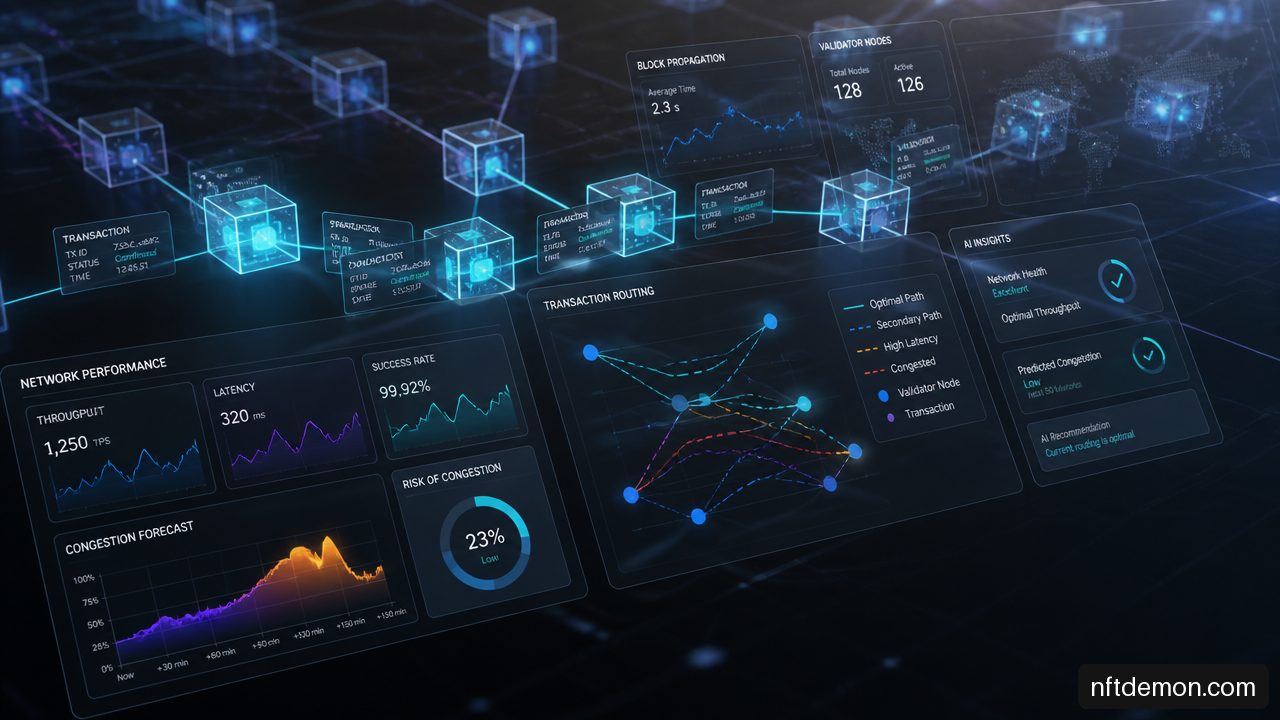
AI for blockchain network performance is most useful when it is treated as a disciplined operations layer, not a magic acceleration switch. I recommend using machine learning to forecast demand, detect abnormal conditions, and guide bounded operational decisions before allowing it to alter any consensus-sensitive behavior. The objective is measurable: improve throughput, reduce transaction latency, manage fee pressure, and preserve reliability without weakening decentralization or safety.
• Where AI Improves Blockchain Performance
• Building A Safe AI Control System
Where AI Improves Blockchain Performance
Start With The Performance Constraint, Not The Model
The best application of AI for blockchain network performance begins with a precise bottleneck. A network may have enough theoretical transaction capacity but still produce poor user outcomes because transactions queue unpredictably, validators fall out of sync, Layer 2 sequencers become overloaded, or fee estimation reacts too late. “Use AI” is not a performance requirement. “Keep p95 confirmation latency below a defined threshold during demand spikes” is one.
For decision makers, the relevant distinction is between prediction and control. Prediction estimates what is likely to happen next: transaction arrival rate, mempool growth, failed transaction probability, validator availability, expected gas pressure, or a rise in block propagation delay. Control changes something in response: routing traffic, reserving infrastructure capacity, changing execution priority, or proposing a parameter adjustment.
Prediction is comparatively low risk. A forecasting model can warn that a transaction queue is likely to grow in the next five minutes, allowing an operations team to prepare capacity or update user guidance. Control is riskier because a poor action can compound congestion rather than relieve it.
A useful decision structure is shown below.
| Network Problem | AI Input Signals | Potential Action | When I Would Avoid Automation |
|---|---|---|---|
| Mempool growth | Pending transactions, fee distribution, arrival rate | Recommend fee bands or Layer 2 routing | When telemetry is incomplete or manipulated |
| Sequencer saturation | Queue depth, CPU use, batch duration, proof delays | Rebalance capacity or defer nonurgent workloads | When routing creates cross-domain settlement risk |
| Validator reliability | Uptime, missed proposals, peer connectivity, latency | Flag risk and adjust nonconsensus scheduling | When the action changes validator rights or stake influence |
| Fee volatility | Gas use, block fullness, transaction mix | Forecast cost windows and route eligible work | When users require immediate finality on the base layer |
| Suspicious traffic | Transaction graph features, error rates, contract calls | Escalate, rate limit, or isolate endpoints | When a false positive could censor valid activity |
This framework prevents a common mistake: optimizing a convenient metric while degrading the system that users actually rely on. Increasing block size may raise raw throughput, for example, while also increasing propagation delay, hardware demands, and pressure toward validator centralization. A model should not be rewarded solely for transactions per second if it produces worse finality, higher failure rates, or lower participation.
The optimization target should be explicitly multi-objective. I would define it as a weighted score that includes throughput, median and tail latency, cost, node resource consumption, failed transaction rate, availability, and decentralization-related constraints. The weights are a governance decision, not a machine-learning decision.
A controller that maximizes one metric without hard safety limits is not an optimizer. It is an unbounded experiment running against production infrastructure.
Forecasting Congestion Before Users Feel It
Congestion forecasting is one of the strongest early use cases because it changes planning rather than consensus. Models can combine recent transaction arrivals, mempool composition, gas-price movement, block fullness, execution time, node health, and time-based activity patterns. The model then estimates whether a queue, fee spike, or confirmation delay is likely to occur before it becomes visible at the user interface.
A practical example is a network serving token transfers, NFT minting, and smart contract calls. A simple moving average may notice that traffic is climbing. A stronger model can distinguish between a brief burst of low-compute transfers and sustained high-gas contract execution. That distinction matters because the second condition can consume execution resources long after the initial submission spike ends.
Forecasting should still compete against simpler baselines. Before approving a complex neural model, compare it with threshold alerts, moving averages, queueing models, and rule-based autoscaling. If the AI model does not predict materially earlier or more accurately after accounting for compute and maintenance costs, the simpler method is the better operational choice.
Evidence from experimental work is promising but needs careful interpretation. An IAES blockchain scalability evaluation reported a 58.6% transaction-latency reduction, 28.9% lower gas fees, and 41.5% less congestion, while reporting stable performance under a 200% transaction-volume increase in its test conditions. Those figures are useful signals, not universal expectations. Results will vary with chain architecture, traffic composition, hardware, routing options, and the baseline used.
Routing Workloads Across Execution Paths
AI can also assist with workload placement. This may mean recommending whether a transaction should execute on Layer 1, a Layer 2 network, a sidechain, a private execution environment, or at a later time. The controller evaluates settlement requirements, estimated confirmation time, fee tolerance, bridge exposure, transaction urgency, and available capacity.
Not every transaction is eligible. Treasury movement, liquidation-sensitive activity, and operations that depend on a particular smart contract state may need a specific execution path. By contrast, batched loyalty points, nonurgent attestations, and some gaming actions may tolerate deferred or lower-cost execution.
The routing decision must be policy constrained. AI may rank options, but business rules should determine whether the action is permitted. The staged approach described in the Blockchain Council guidance on staged AI deployment recommends measuring baseline metrics and starting with predictive analytics before enabling bounded closed-loop control. That sequence is sound: first prove that the system can see conditions accurately, then permit a narrow action with reversal rules.
Security telemetry belongs in the same routing conversation. An abnormal transaction cluster can be both a fraud signal and a performance signal if it is consuming execution capacity or probing RPC infrastructure. Teams developing this capability should connect performance operations with training custom ML models for Web3 threat detection rather than treating availability and abuse detection as separate systems.
Building A Safe AI Control System
Separate Advisory Mode From Closed-Loop Control
I recommend four operating levels, each with more authority and more required assurance.
Observe: The model collects telemetry, produces forecasts, and does not influence operations.
Advise: The model recommends actions, while an operator or policy engine approves them.
Execute Within Bounds: The model can take predefined low-risk actions, such as scaling a read service or routing eligible noncritical traffic.
Propose Governed Changes: The model creates evidence-backed proposals for protocol or consensus changes, which remain subject to formal governance and human approval.
The critical boundary is clear: no AI system should independently change validator membership, stake-weighted influence, finality assumptions, slashing behavior, or other consensus-critical rules merely because a reward function suggests a performance gain. These controls affect trust, not just speed.
Reinforcement learning is often proposed for tuning block size, block intervals, validator scheduling, or resource allocation because it can learn from repeated feedback. It may be suitable in a simulator or a tightly controlled permissioned environment. On an open network, however, it introduces a difficult question: who verifies that the reward function has not favored a short-term gain over long-term resilience?
A study of AI-assisted consensus describes using machine learning and reinforcement learning with signals including transaction rate, node availability, latency, and energy use to adjust validator selection and block-generation parameters. The concept is technically plausible, but production applicability depends on the chain’s governance model and fault tolerance. I would keep consensus-sensitive recommendations in advisory mode unless the protocol has explicit, auditable approval paths.
For automated smart contract operations, predefined limits matter just as much. Teams should consider implementing time-locked circuit breakers on AI agent smart contracts so a harmful recommendation cannot instantly become an irreversible onchain action.
Measure Net Gains, Including AI Overhead
A performance controller consumes resources. It needs data collection, storage, feature computation, model inference, alerts, policy evaluation, and sometimes coordination across nodes or services. If those costs are excluded, a reported improvement can be misleading.
Measure performance as a net result:
| Measurement Area | What To Record | Why It Matters |
|---|---|---|
| User performance | Submission-to-confirmation latency, p95 latency, failure rate | Median results can hide painful tail delays |
| Network performance | Throughput, queue depth, propagation delay, block utilization | Shows whether the bottleneck actually moved |
| Economic impact | Fee distribution, retry cost, routing cost, infrastructure spend | Lower fees can be offset by higher operational cost |
| AI overhead | Inference time, CPU or GPU use, bandwidth, storage, energy | Determines whether the optimizer creates a new bottleneck |
| Safety outcomes | Rollbacks, policy violations, false positives, incident rate | Proves whether automation remains bounded |
A useful benchmark runs identical workloads through at least three alternatives: static configuration, a simple rule-based controller, and the AI-assisted approach. Use the same hardware, traffic mix, transaction sizes, network topology, test duration, and fault scenarios. Repeat the test enough times to report variability rather than one headline result.
The comparison should also cover distribution shift. A model trained on routine business-hours traffic may fail during an airdrop, market crash, exploit attempt, or a sudden shift in validator behavior. Consider a controller that predicts moderate growth and directs traffic toward a Layer 2 path. If a bridge outage occurs simultaneously, the recommendation may become harmful. A rollback guardrail should detect rising failures or latency and immediately return routing to the approved fallback policy.

Permissioned And Permissionless Networks Need Different Assumptions
Permissioned blockchains can be easier places to deploy AI control because membership, hardware profiles, identity, and governance are more predictable. This makes it practical to model throughput and reliability from known scaling configurations. A 2025 study of permissioned blockchain performance prediction reported errors of approximately 1.9% when modeling reliability and throughput under its evaluated configurations. That is meaningful for planning, but it should not be generalized automatically to permissionless networks with open participation and heterogeneous nodes.
The same caution applies to optimization experiments. A Hyperledger Fabric study evaluated block size, timeout, arrival rate, and timeout probability using Node2Vec, PCA, and TensorFlow-based modeling in its Hyperledger Fabric evaluation. That design may be informative for enterprise networks, yet open validator networks face additional uncertainty around adversarial behavior, varying infrastructure, governance delays, and network-wide incentive effects.
For enterprise decision makers, the architecture choice comes first. A permissioned consortium may allow direct configuration changes, controlled telemetry sharing, and common service-level objectives. A permissionless integration usually requires more conservative measures: application-side routing, RPC resilience, transaction simulation, fee prediction, and monitoring that does not assume control over the protocol. The right approach depends on where authority actually sits. For a broader design framework, review enterprise blockchain architecture security and scalability.
Test For Drift, Adversarial Inputs, And Recovery
Models degrade when reality changes. Transaction types evolve, contracts upgrade, validators change infrastructure, and attackers learn which signals trigger protective actions. A controller that was accurate last quarter may become confidently wrong this quarter.
A production design should include the following safeguards:
• Feature-quality checks that identify missing, delayed, or implausible telemetry.
• Confidence thresholds that send uncertain predictions to advisory review rather than automated execution.
• Canary deployment, where a new policy affects a limited workload before broad release.
• Hard limits on parameter ranges, rate of change, and actions per time window.
• Rollback rules tied to p95 latency, failure rate, propagation delay, and service availability.
• Post-incident review that compares model inputs, recommendations, executed actions, and actual outcomes.
The recovery plan must be operationally simple. Disable the controller, return to a known static or rule-based policy, preserve logs, and verify the network’s health before retraining or re-enabling automation. If recovery itself requires a complicated AI diagnosis, the system has been overdesigned.
Experimental approaches continue to advance. A reported generative diffusion comparison for blockchain networks found faster convergence and improved throughput and latency relative to its traditional AI baseline. It is a useful research direction, especially for high-dimensional optimization, but it does not remove the need for workload-specific benchmarking, policy controls, and independent safety checks.
Key Takeaways
Decision Rules For Leaders
• Use AI first for forecasting, anomaly detection, capacity planning, and advisory routing. These applications can improve decisions without modifying consensus.
• Require a baseline that includes static configuration and simple automation. An AI model must beat alternatives on net outcomes, not only on a favorable metric.
• Optimize multiple objectives at once. Throughput, latency, cost, reliability, energy use, and decentralization can conflict.
• Keep validator selection, consensus parameters, and governance-sensitive actions behind explicit approval processes and rollback guardrails.
• Treat permissioned and permissionless environments differently. Controlled enterprise networks can support deeper automation; open networks generally require stricter boundaries.
• Include AI inference, telemetry, and coordination overhead in every business case. Faster decisions are not useful if the control plane becomes a bottleneck.
Frequently Asked Questions
What Does AI For Blockchain Network Performance Mean?
It means applying machine learning, forecasting, anomaly detection, optimization, or policy automation to improve measurable network outcomes such as transaction throughput, latency, reliability, fee efficiency, and infrastructure use. It does not mean allowing a model to govern consensus without constraints.
Can AI Increase Throughput Without Changing Consensus?
Sometimes. AI can improve effective throughput by predicting congestion, routing eligible work to alternative execution paths, scheduling infrastructure capacity, reducing failed submissions, and identifying inefficient transaction patterns. The protocol’s maximum capacity may remain unchanged, but more useful work may clear reliably.
How Can AI Predict Congestion Before Transaction Latency Rises?
It analyzes early signals such as transaction arrival rate, queue growth, block fullness, execution time, fee movement, and node health. A forecast is valuable only if it arrives early enough to support a permitted action, such as capacity scaling, user notification, or routing changes.
Is Reinforcement Learning Suitable For Block Size Or Block Interval Tuning?
It can be suitable for simulation, research, or controlled permissioned systems with clear objectives and stable governance. I would avoid direct autonomous tuning on open networks when it can affect propagation, validator accessibility, finality behavior, or decentralization.
Can AI Reduce Fees And Latency At The Same Time?
It can under certain workloads, particularly when better routing or congestion prediction prevents unnecessary competition for limited block space. The goals can conflict, though. A strategy that lowers fees by delaying transactions may increase latency, so service classes and user urgency must be part of the policy.
How Much Overhead Does An AI Optimizer Add?
There is no universal figure. Costs include telemetry collection, data storage, feature processing, model inference, alerting, policy checks, and operational maintenance. Measure these costs directly alongside the gains. A lightweight threshold controller may be preferable when the AI model’s advantage is marginal.
What Happens When Training Data Becomes Outdated?
Model drift can cause inaccurate forecasts or harmful recommendations. The appropriate response is confidence monitoring, retraining with validated recent data, canary testing, and a rapid fallback to a known safe policy. Historical accuracy is not a guarantee during sudden market or traffic changes.
Sources And References
arXiv + “Generative AI-enabled Blockchain Networks” — https://ar5iv.labs.arxiv.org/html/2401.15625
arXiv + “Machine Learning-Based Prediction Models for Permissioned Blockchain Performance” — https://arxiv.org/pdf/2503.15769
IUB Journals + “Optimizing Blockchain Scalability: Enhancing …” — https://journals.iub.edu.pk/index.php/JCIS/article/download/3779/2188/15150
IAES International Journal of Artificial Intelligence + blockchain scalability study — https://ijai.iaescore.com/index.php/IJAI/article/download/29356/14959
Blockchain Council + “Blockchain Scalability AI: Efficiency and Performance” — https://www.blockchain-council.org/blockchain/blockchain-scalability-ai-impact-on-efficiency-performance/
NFT Demon Holdings helps enterprises scope, evaluate, and build blockchain programs — start with a free evaluation call.
Talk through your use case
Free evaluation call — objective, constraints, and fit, before any proposal.