How Innovation Teams Prioritize Blockchain Projects with Measurable Outcomes
By Jeremy Ryan, Founder & CEO · September 2026

How innovation teams prioritize blockchain projects with measurable business outcomes comes down to a disciplined question: does a shared, tamper resistant record improve a business metric enough to justify its cost, complexity, and governance burden? I recommend treating blockchain as one option in a portfolio, not as the starting point.
For decision makers, the strongest projects are usually not broad “blockchain transformation” programs. They are narrow multi party workflows where reconciliation, provenance, settlement, auditability, or dispute handling creates recurring friction. The opportunity is measurable only when the team defines a baseline, names an accountable owner, and agrees in advance on what result would justify scale.
Start With The Business Constraint
Define The Workflow Before Selecting The Technology
A blockchain project should begin with a process failure, not a technology preference. I would require the sponsoring business unit to describe the workflow in operational terms:
• Which parties maintain separate versions of the same record?
• Where do employees rekey, reconcile, approve, or investigate data?
• What delay, error, dispute, fraud exposure, or audit effort does that create?
• What happens if the process remains unchanged for another two years?
This framing prevents an innovation team from measuring activity instead of value. A prototype may demonstrate that a decentralized application works, yet still fail to prove that the organization should operate it.
The World Economic Forum’s framework for building blockchain value makes the same foundational point: use case assessment should begin with business pain, then evaluate blockchain’s role in productivity, transparency, and process reinvention.
Consider a supplier compliance process. A manufacturer may collect certificates, batch records, and inspection reports from dozens of suppliers. If every participant already submits validated data into one trusted platform, a conventional workflow system may be sufficient. If suppliers, logistics providers, insurers, and distributors each maintain records that routinely conflict, then a shared ledger could be worth evaluating. The distinction is not philosophical. It changes the economic case.
Identify The Workflow Classes With Better Fit
Blockchain has stronger potential when a process requires multiple organizations to coordinate around a shared state but lacks a universally trusted operator. That does not mean every multi party workflow needs decentralization. It means the team should test whether shared recordkeeping addresses the actual source of friction.
| Workflow Class | Potential Business Outcome | When Blockchain May Fit | When To Avoid It |
|---|---|---|---|
| Shared reconciliation | Lower manual effort and fewer exceptions | Parties maintain inconsistent records and need synchronized status | One company controls all records and participants accept its database |
| Provenance and traceability | Faster investigations, lower recall scope, stronger audit evidence | Asset history passes across independent organizations | Input data cannot be trusted or validated at the source |
| Settlement and asset transfer | Shorter settlement time and reduced capital tied up in process | Several parties must confirm rights, obligations, or delivery | Existing rails already settle quickly at low cost |
| Compliance evidence | Less audit preparation and clearer record lineage | Multiple parties contribute regulated documentation | Privacy rules prohibit the proposed data model |
| Digital product or process redesign | New service revenue or product capability | Shared ownership, rights, or credentials are central | The business case depends mainly on token speculation |
The most useful prioritization insight is simple: a blockchain cannot make unreliable input data reliable merely by recording it permanently. If a supplier falsely labels a shipment before the record is written, immutability preserves the false claim. The project must therefore include controls for data capture, validation, and accountability.
Separate Operational Value From Innovation Theater
I would place proposed initiatives into two portfolio categories.
| Portfolio Category | Primary Purpose | Funding Standard | Expected Evidence |
|---|---|---|---|
| Exploratory innovation | Build organizational learning or test an emerging capability | Limited, time boxed budget | Technical feasibility, stakeholder learning, documented constraints |
| Operational value initiative | Improve an existing business process | Business owner commitment and measurable threshold | Baseline KPI movement, adoption evidence, credible ROI case |
Both categories can be legitimate. The problem begins when exploratory work is presented as operational ROI. A brand credential experiment, for example, may generate useful learning about digital identity and customer engagement, but it should not be funded as a cost reduction program unless the team can show the mechanism for lowering costs or raising revenue.
A successful pilot is not one that launches. It is one that produces enough evidence to support a scale, redesign, or stop decision.
Key Takeaways
• Prioritize the business constraint before choosing blockchain architecture.
• Favor workflows with persistent reconciliation, provenance, settlement, or audit friction across organizations.
• Keep exploratory projects separate from initiatives expected to deliver operating results within roughly 6 to 18 months.
• Measure baseline performance before development, not after the pilot has changed the process.
• Stop projects when counterparties, data quality, governance, or economics fail the preapproved threshold.
Score Blockchain Against Alternatives
Use A Two Part Prioritization Rubric
Many teams score blockchain ideas by strategic alignment, expected ROI, and technical feasibility. That is necessary but incomplete. The missing comparison is whether blockchain outperforms a centralized database, workflow platform, integration layer, or improved audit process.
I recommend a two part rubric. The first score asks whether the business problem deserves investment. The second asks whether blockchain is the best mechanism for solving it.
| Criterion | Question To Ask | Suggested Weight | Strong Signal |
|---|---|---|---|
| Business impact | What cost, risk, revenue, cycle time, or capital metric can improve? | 25% | A named KPI has a defensible baseline |
| Strategic alignment | Does the project advance a stated business priority? | 15% | Executive sponsor can explain why it matters now |
| Multi party friction | Do independent parties spend material effort matching records or resolving disputes? | 15% | Reconciliation burden is frequent and measurable |
| Blockchain advantage | Does shared state materially outperform a central platform? | 15% | No participant is accepted as sole system owner |
| Adoption feasibility | Will required users and counterparties participate? | 10% | Written commitment exists for the pilot |
| Governance readiness | Are decision rights, funding, and dispute rules workable? | 10% | Operating model is agreed before build |
| Compliance and security fit | Can privacy, records, access, and retention requirements be met? | 10% | Legal and security review identifies a viable design |
Score each item from 1 to 5. A weighted score can rank candidates, but it should not override gating conditions. A project with excellent projected ROI should still stop if the required counterparties refuse to participate or if the proposed data model cannot satisfy applicable obligations.
Compare The Counterfactual Honestly
The crucial comparison is not blockchain versus doing nothing. It is blockchain versus the least expensive credible alternative.
For example, imagine a financial operations group spends substantial time reconciling invoices among buyers, suppliers, and financing partners. The blockchain proposal may promise a shared ledger. The alternative may be a conventional shared workflow portal with role based access and a central operator. The team should compare both options against the same criteria:
• Implementation and integration cost
• Change management effort
• Expected reduction in exception handling
• Security and privacy requirements
• Data ownership and control implications
• Scalability under real transaction volumes
• Cost of dispute resolution
Blockchain earns its place when the decentralized or shared governance model produces a material advantage. If a central platform can meet the need more cheaply, with clearer accountability and equivalent trust, it should win.
Set Decision Thresholds Before Ranking
A scorecard becomes less useful when every project is labeled “high priority.” Define thresholds before workshop discussions begin.
| Decision | Example Threshold | Practical Meaning |
|---|---|---|
| Fund discovery | Weighted score of 3.5 or higher with no major gate failure | Validate workflow, stakeholders, and baseline data |
| Fund pilot | Clear blockchain advantage plus committed participants | Build a limited production like test |
| Scale | Pilot reaches predefined KPI and adoption thresholds | Commit operating funding and integration resources |
| Stop or redesign | Counterparty, compliance, governance, or KPI threshold fails | Document learning and redirect resources |
There is no universal ROI percentage that proves value. Evidence for standardized blockchain ROI benchmarks remains limited and varies widely by use case. A supply chain traceability project may be justified by risk reduction and audit readiness, while a settlement initiative may focus on cycle time and working capital. The right threshold depends on the baseline economics and strategic risk of the workflow.
Convert Blockchain Features Into KPIs
Measure The Mechanism, Not The Marketing Claim
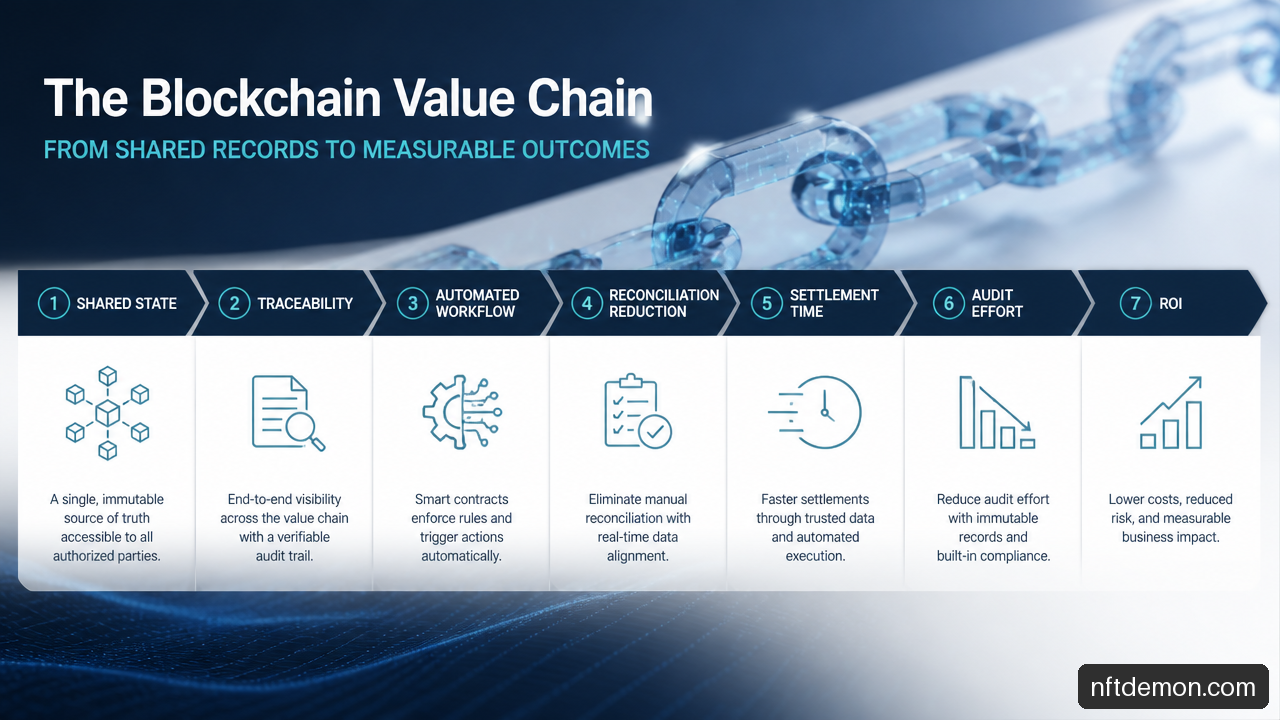
Terms such as transparency, immutability, and traceability are not business outcomes. They are technical or process characteristics. The measurement model must show how the characteristic changes work.
| Blockchain Characteristic | Operational Change | Measurable KPI | Business Outcome |
|---|---|---|---|
| Shared record of status | Fewer duplicate records and manual comparisons | Reconciliation hours, exception rate | Lower operating cost |
| Traceability | Faster location of asset history or documentation | Investigation time, recall scope | Lower loss exposure and faster response |
| Tamper resistant history | Better evidence for reviews and controls | Audit preparation hours, documentation exceptions | Improved auditability and reduced compliance effort |
| Automated workflow rules | Fewer manual handoffs and delayed approvals | Cycle time, approval backlog | Faster processing and potentially improved cash flow |
| Shared settlement state | Earlier confirmation across parties | Settlement time, capital held during processing | Working capital efficiency |
This mapping protects the business case from vague claims. “Improve transparency” is not a KPI. “Reduce the average time to resolve a shipment documentation dispute from 10 days to 4 days” is measurable.
Build A Baseline That Can Survive Executive Scrutiny
Before development, capture at least three forms of baseline evidence:
-
Volume: Number of transactions, records, disputes, audits, or exceptions per month.
-
Unit cost: Labor time, external fees, investigation expense, or capital cost per event.
-
Process performance: Cycle time, error rate, settlement time, adoption rate, and service level performance.
For a reconciliation use case, the formula may be straightforward:
Annual value = (baseline reconciliation hours minus pilot reconciliation hours) × fully loaded hourly cost × annual workflow volume
The formula should also include new operating costs. These may include infrastructure, integration, identity management, data validation, partner support, security monitoring, and governance administration. A pilot that lowers internal reconciliation work but adds a larger network operating burden has not created positive ROI.
Use Leading And Lagging KPIs Together
Lagging indicators, such as cost reduction, matter most for funding scale. Yet they can take months to appear. Leading indicators show whether the mechanism is working early enough to intervene.
| KPI Type | Examples | Why It Matters |
|---|---|---|
| Leading adoption metrics | Active participant rate, percentage of eligible records submitted, user completion rate | Reveals whether the network has enough participation to create value |
| Leading data quality metrics | Missing fields, validation failures, duplicate records | Identifies whether immutability could preserve poor quality inputs |
| Process metrics | Settlement time, exception rate, dispute time, audit preparation hours | Shows the operational mechanism changing |
| Financial metrics | Cost per transaction, labor savings, cash conversion impact, loss avoidance | Supports the ROI decision |
| Risk metrics | Unauthorized access events, unresolved disputes, compliance exceptions | Ensures gains do not create unacceptable exposure |
A traceability pilot illustrates the tradeoff. Suppose a company can retrieve a product history in minutes rather than days during the pilot. That is encouraging, but it may not justify scaling if only 30% of suppliers submit reliable records. The project needs both a process KPI, such as retrieval time, and an adoption KPI, such as verified supplier submission rate.
Use Governance And Pilots As Gates
Treat Governance As A Precondition, Not A Workstream
Technical feasibility is often easier than multi party governance. A network can function in a demo while participants still disagree about who pays, who can write data, who corrects errors, and who resolves disputes.
The SAGE analysis of blockchain governance identifies participation, information sharing, funding, decision authority, and dispute resolution as explicit governance decisions. These are not administrative details. They determine whether a network can operate when incentives diverge.
A viable operating model should answer the following before scale:
• Who is allowed to join, validate, read, and write records?
• Who funds implementation, operations, upgrades, and incident response?
• Who owns data standards and decides when they change?
• What happens when a participant submits disputed information?
• Which organization has authority to pause, remediate, or retire the network?
The comprehensive blockchain governance framework published by ScienceDirect similarly frames governance as an integrated matter of decentralization, incentives, accountability, ecosystem roles, and legal and ethical obligations. That makes compliance a selection criterion before launch, not a repair task after a pilot succeeds technically.
Apply U.S. Compliance And Records Gates Early
For U.S. enterprises, a proposed architecture should be reviewed for privacy, retention, access controls, records obligations, sector specific rules, and contractual responsibility. The required analysis varies by industry, but the design questions are consistent.
A permissioned blockchain may allow controlled participation, but permissioning alone does not solve privacy. Teams should determine whether personal data, confidential commercial data, or regulated records must remain off chain, with the ledger retaining only references, hashes, permissions, or attestations. They should also assess how correction requests, retention requirements, legal holds, and audit access will be handled.
Fair warning: a project can pass a technical proof of concept and still fail this gate. Consider a healthcare adjacent credentialing workflow. The ledger may improve verification between organizations, but placing identifiable patient related information on chain could create unnecessary compliance risk. A safer model may store sensitive records in existing systems and record only verifiable proofs and permissions.
Run A Stage Gated Pilot With Kill Criteria
A pilot should test the smallest shared workflow capable of proving or disproving the value hypothesis. Do not begin with a full network redesign. Start with one transaction type, a limited geography, a manageable set of participants, or a specific exception category.
| Pilot Stage | What The Team Tests | Required Exit Evidence |
|---|---|---|
| Discovery | Process baseline, participant incentives, data availability | Signed problem statement and viable governance concept |
| Design | Architecture, privacy model, controls, KPI instrumentation | Security, legal, and operating reviews identify no blocking issue |
| Pilot | Real user behavior in a limited workflow | KPI movement, participant adoption, and stable operating process |
| Scale Decision | Economic and governance sustainability | Approved business case, funding model, and accountable operator |
Define success and failure conditions before building. For example, a reconciliation pilot might require a meaningful reduction in exception handling time, participation by a minimum share of counterparties, no material security or compliance finding, and an operating cost below the savings generated. The precise targets will differ, but the principle should not: no post hoc adjustment of the goal after results arrive.
The LUISS study of blockchain outcomes and governance categorizes outcomes across use cases, organizational extensions, users, benefits, risks and challenges, and public value. That broader view matters for public sector and consortium projects, where private ROI may be only one part of the approval case.
Frequently Asked Questions
How Do Innovation Teams Decide Whether A Blockchain Project Is Worth Funding?
They should fund discovery when there is a measurable business problem, a plausible multi party workflow fit, and no immediate governance or compliance blocker. They should fund a pilot only after comparing blockchain with centralized alternatives and securing participant commitment. Scale requires measured KPI improvement and a durable operating model.
What Business Problems Are Best Suited To Blockchain?
The strongest candidates involve shared records across organizations, recurring reconciliation, provenance requirements, settlement delays, or audit evidence gaps. Blockchain is less suitable when one trusted organization can efficiently operate a central database or when participants have little reason to contribute accurate data.
How Do You Compare Blockchain With A Normal Database Or Workflow System?
Compare both approaches against the same baseline: implementation cost, operating cost, adoption burden, data control, resilience, compliance fit, cycle time improvement, and dispute handling. Choose blockchain only if its shared governance and record model create a material advantage over a conventional system.
What KPIs Should Judge A Blockchain Pilot?
Use KPIs that measure the workflow change: reconciliation hours, settlement time, dispute duration, audit preparation effort, exception rate, verified record completeness, adoption rate, and cost per transaction. Pair financial metrics with adoption and data quality measures so apparent savings are not masking a weak network.
When Should A Blockchain Pilot Be Killed?
Stop or redesign the pilot when counterparties will not participate, input data remains unreliable, a legal or security constraint lacks a viable design response, governance decisions remain unresolved, or the measured benefit cannot exceed ongoing operating costs. Ending a pilot with documented evidence is sound portfolio management, not failure.
How Do You Prove Blockchain Value To Executives?
Present a baseline, the KPI mechanism, pilot results, the counterfactual alternative, and the full cost of operating the solution. Executives need to see not only that the technology worked, but also why the result cannot be achieved more economically through process redesign or conventional software.
Which Use Cases Produce Measurable Results Fastest?
Narrow shared workflows often produce evidence sooner than broad transformation programs. Reconciliation, document provenance, and limited settlement confirmation processes can be easier to baseline and test. The actual timeline depends on integration complexity, participant readiness, and data quality rather than blockchain alone.
Sources And References
• World Economic Forum — Building Value with Blockchain Technology
• ScienceDirect — Defining blockchain governance principles: A comprehensive framework
• SAGE Journals — The Boon and Bane of Blockchain: Getting the Governance Right
• LUISS University repository — A Study of Outcomes, Tensions, and Governance of Blockchain ...
NFT Demon Holdings helps enterprises scope, evaluate, and build blockchain programs — start with a free evaluation call.
Talk through your use case
Free evaluation call — objective, constraints, and fit, before any proposal.