How enterprises evaluate blockchain latency, throughput, and finality
By Jeremy Ryan, Founder & CEO · September 2026
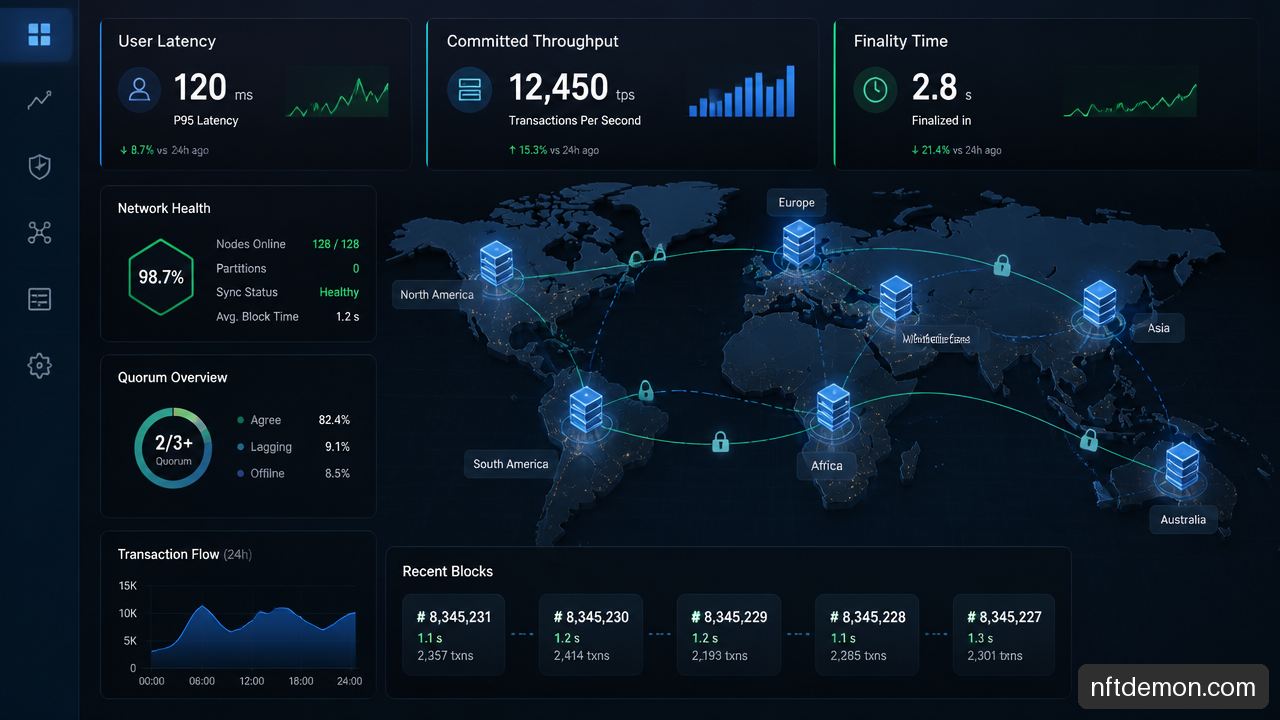
When evaluating how enterprises evaluate blockchain latency throughput and finality requirements, I recommend starting with business completion, not vendor transactions per second claims. A ledger that accepts 10,000 requests per second is not necessarily useful if only a fraction commit, tail latency becomes unpredictable during peak demand, or a transaction remains reversible when the business process requires settlement.
For decision makers, the central question is straightforward: When can a user, system, auditor, or counterparty safely act on a ledger record? The answer depends on three related but separate measures: responsiveness for the user, time to commit across the network, and time until the transaction is sufficiently final for the risk involved.
Define The Business Completion Point
Separate User Latency, Commit Latency, And Finality Latency
Enterprises often put all timing measures under the label latency. That shortcut causes poor requirements and misleading proofs of concept. I would define three clocks before selecting a platform.
| Measure | Start And End Point | What It Tells The Business | Typical Decision Use |
|---|---|---|---|
| User perceived latency | User action to visible acknowledgement | Whether the workflow feels responsive | Interface and operational design |
| Commit latency | Submission to ledger commitment | When the network records the valid state change | Backend orchestration |
| Finality latency | Submission to irreversible or policy accepted settlement | When dependent parties may safely complete the business action | Settlement, custody, audit, and risk controls |
A user interface may acknowledge a request in 200 milliseconds while the transaction is still queued, endorsed, ordered, or awaiting a quorum. That is useful for experience design, but it is not settlement. Conversely, a transaction can be committed quickly while an organization’s own policy requires an additional reconciliation step before releasing an asset.
The Hyperledger Blockchain Performance Metrics White Paper defines transaction latency, throughput, and finality as separate performance measures, including formulas for evaluating them. That separation should appear in the enterprise requirements document, service level objectives, dashboard, and vendor test script.
A fast acknowledgement is not proof of finality. Treat each as a separate operational promise.
Consider a supply chain receiving workflow. Scanning a pallet can produce an immediate local confirmation. The ledger may commit the event seconds later. Yet title transfer or automated payment should wait until the agreed finality point. If the process merely improves visibility, a short commit delay may be acceptable. If it triggers transfer of high value inventory, the finality requirement becomes stricter.
Tie Finality To Reversibility Risk
Deterministic finality means the protocol provides a point after which a committed transaction cannot be reversed under its stated fault assumptions. Probabilistic finality means confidence grows with additional blocks or confirmations, rather than reaching an immediate absolute protocol guarantee.
That distinction matters, but it should not be the entire decision rule. I would first ask what happens if the transaction is later reversed, disputed, duplicated, or unavailable to one participant. The higher the cost of reversal, the more the workflow should demand a clear finality policy.
| Workflow | Reversibility Risk | Practical Finality Requirement | Design Implication |
|---|---|---|---|
| Product provenance update | Usually moderate | Committed record plus exception handling may be sufficient | Optimize for traceability and availability |
| Loyalty point issuance | Moderate and recoverable | Policy based confirmation may be acceptable | Maintain adjustment controls |
| Wholesale payment instruction | High | Defined settlement state and auditable finality evidence | Use explicit release conditions |
| Tokenized asset delivery | High | Strong finality before ownership or collateral release | Coordinate ledger, custody, and legal controls |
A payment workflow illustrates the difference. Authorization may be visible quickly, but the receiving party may not deliver goods until settlement is final enough for its loss tolerance. A public blockchain with probabilistic confirmation can be viable when the business can wait and price the residual risk. It may be unsuitable when a regulated process requires a clearly defined irrevocable state at a specific deadline.
Write Requirements As Measurable Service Objectives
Avoid requirements such as “near real time,” “enterprise grade,” or “high TPS.” They cannot be tested. A usable requirement names the transaction, load condition, measurement point, and percentile.
For example:
-
“At 500 committed asset transfer transactions per second, the 95th percentile commit latency shall remain below three seconds across the defined regional topology.”
-
“No downstream release occurs until the network reaches the approved finality state and the transaction receipt is retained for audit.”
-
“During the peak hourly batch, valid committed throughput must remain above the planned rate with less than one percent application level rejection unrelated to business rules.”
-
“Read operations for participant status must meet a separate 95th percentile target and may not be reported as transaction throughput.”
The 95th percentile means 95 out of every 100 measured operations finish at or below the stated threshold. The 99th percentile exposes the slowest one out of 100. Average latency can look healthy while a small but operationally damaging share of transactions waits far longer. For a call center, a few delayed status updates may be tolerable. For automated collateral management, those outliers can cause failed handoffs or manual intervention.
Measure Performance Without Inflating Results
Count Finalized Goodput, Not Submitted Requests
Throughput is often reported as TPS, but the denominator and numerator matter. Submitted requests measure how rapidly a client can send messages. They do not prove that the ledger processed them successfully. Goodput is the useful rate: valid transactions that actually commit or finalize.
The Hyperledger metrics PDF specifies committed transaction throughput and network wide latency, emphasizing measurement at committed nodes rather than raw submission. This is the number procurement teams should compare.
Use a simple calculation:
Committed throughput = valid committed transactions ÷ measured interval in seconds
The measurement interval should begin after warmup, exclude no unexplained failures, and identify whether retries are counted once or multiple times. If 50,000 requests are submitted in one minute but 42,000 become valid committed records, the observed goodput is 700 TPS, not 833 TPS. The missing 8,000 requests require an explanation: rejection, expiration, duplicate detection, queue overflow, smart contract failure, or a client side issue.
A CEUR workshop paper on blockchain performance testing similarly defines throughput as finalized transactions over time and latency as finalization time minus submission time. Those definitions prevent a common comparison error: putting one platform’s intake rate beside another platform’s finalized rate.
Benchmark The Workload You Will Actually Run
A uniform transfer benchmark is useful for basic capacity testing. It is not a production forecast. Real deployments mix reads, writes, queries, event subscriptions, identity checks, smart contract execution, duplicate requests, and bursts around operational cutoffs.
I recommend testing at least the following workload conditions:
• Steady state writes: A stable rate that represents ordinary business activity.
• Burst writes: A compressed arrival pattern, such as end of day reconciliation or campaign redemption.
• Read heavy periods: Concurrent lookups, dashboards, and API queries against the same infrastructure.
• Contention cases: Multiple transactions attempting to change the same account, asset, or smart contract state.
• Mixed contract complexity: Simple state updates alongside the validation, signature checks, and policy logic used in production.
Contention is especially revealing. A ledger can demonstrate impressive performance when every transaction changes unrelated keys. Performance can decline sharply when many transactions target one inventory record, account balance, or asset registry entry because ordering and state validation serialize portions of the workload. That is not a platform defect by itself; it is a design constraint that should be surfaced early.
Publish The Test Conditions With Every Result
A TPS number without conditions has little procurement value. Every benchmark report should identify the following variables.
| Test Variable | Why It Changes Results | What To Record |
|---|---|---|
| Membership size | More participants can increase communication and verification work | Total nodes, voting nodes, client nodes |
| Geography | Interregional network delay adds to consensus and propagation time | Regions, cloud zones, observed round trip times |
| Quorum rule | Higher agreement thresholds can change commitment timing | Fault model and required votes |
| Hardware profile | CPU, storage, memory, and network limits affect execution | Instance type, storage class, bandwidth |
| Transaction shape | Payload size and smart contract work affect capacity | Bytes, signatures, reads, writes, contract path |
| Client behavior | Batch size, retry logic, and concurrency can distort results | Connection count, retries, submission rate |
The review of blockchain evaluation approaches in PMC discusses network wide latency, finality time, and the importance of carefully chosen measurement thresholds across systems. This matters because one team may call a transaction confirmed when a local node sees it, while another waits for all correct nodes or a defined network threshold. Those are different outcomes and should never be compared as if they were identical.
Match Consensus And Architecture To Risk
Evaluate The Consensus Mechanism Through Its Operating Assumptions
Consensus is not merely a performance setting. It defines who may participate, what failures the network can tolerate, how quickly agreement occurs, and what finality means.
| Consensus Family | Common Enterprise Fit | Performance Characteristic | Main Evaluation Question |
|---|---|---|---|
| Crash fault tolerant ordering, such as Raft | Controlled organizations with trusted operators | Often lower coordination overhead | Is malicious behavior outside the threat model? |
| Byzantine fault tolerant protocols, such as PBFT or IBFT variants | Consortiums where some members may act incorrectly or be compromised | More message coordination, often stronger finality semantics | Does the fault tolerance justify the added latency and operational complexity? |
| Public chain consensus | Open participation and broad external settlement | Finality and cost may vary with network conditions | Can the workflow tolerate confirmation delay, transaction fees, and probabilistic settlement? |
A permissioned network can reduce latency because membership, hardware, network routes, and governance are controlled. That does not make it automatically superior. It changes the trust model. If an enterprise needs independent public verification or a native public asset, a controlled consortium may not meet the business objective regardless of its benchmark score.
The University of Bologna study of permissioned blockchains for financial applications identifies throughput and latency as key scalability metrics and measures latency after consensus and propagation. The implication is practical: a local node response is insufficient where several institutions must rely on the same transaction state.
Compare Public, Consortium, And Permissioned Designs Fairly
Do not ask only, “Which blockchain is faster?” Ask which architecture meets the required trust boundary at acceptable cost and operational burden.
A public chain may be appropriate when external settlement, broad composability, or public verification is integral to the product. A consortium network may be appropriate when multiple independent institutions need shared control but have known identities. A private permissioned ledger may fit internal workflows where access control, data minimization, and predictable operations outweigh open participation.
Fair warning: comparing their raw TPS figures alone can create a false winner. The systems may use different node counts, geographic scope, contract logic, confidentiality approaches, transaction fees, and finality thresholds. Compare each option against the same business completion point instead.
Include Cost Per Finalized Transaction
Cost per finalized transaction is not a universal blockchain standard, but it is a useful enterprise planning metric. It combines infrastructure, node operations, monitoring, key management, support, and, where relevant, network fees. A high TPS system that requires extensive infrastructure or produces expensive tail latency may be less attractive than a slower system with predictable operating costs.
Use cost as a scenario model rather than a single benchmark number. A network handling 10 transactions per second continuously has a different cost profile from one handling 10,000 transactions per second for ten minutes each day. Include normal, peak, and degraded conditions. Otherwise, the cheapest pilot can become the most expensive production design.
Test Degraded Operations Before Production
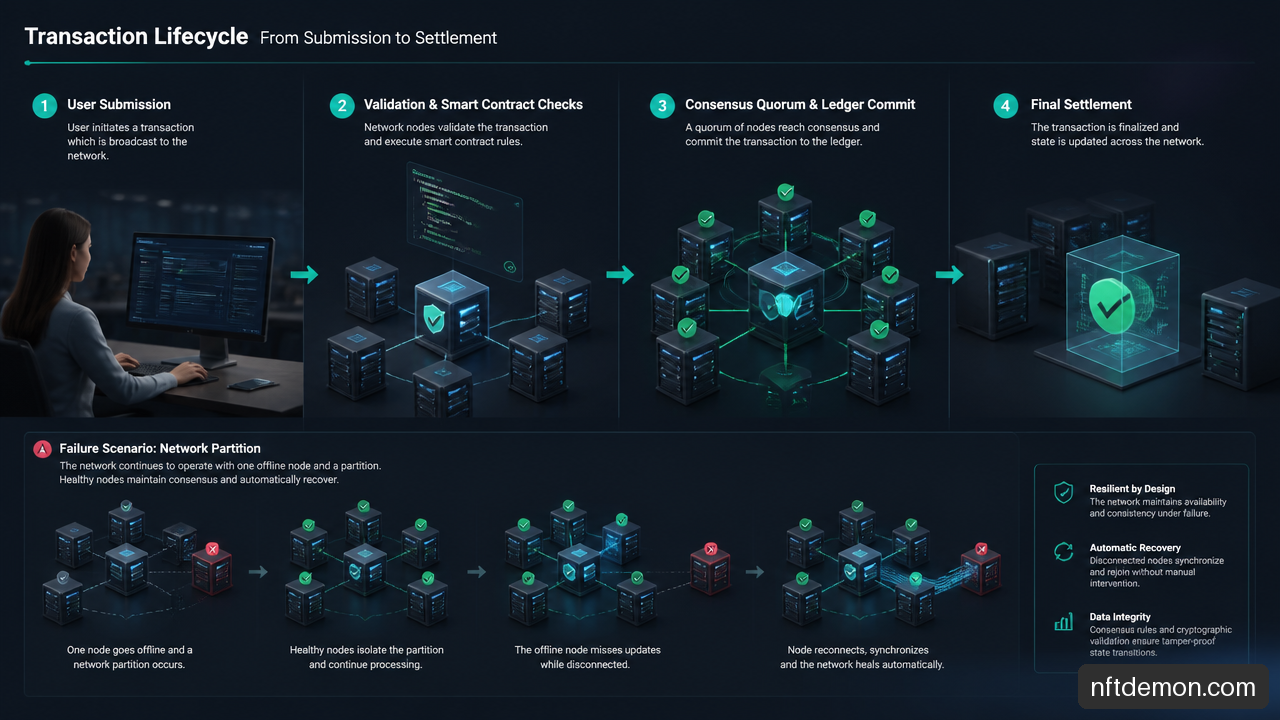
Node Loss And Network Partitions Change The Answer
Steady state tests show capacity. Failure tests show whether the finality claim remains meaningful when the network is stressed.
A node can fail, a certificate can expire, a cloud region can become unreachable, or interregional latency can rise. In a Byzantine fault tolerant design, losing enough voting participants may stop progress rather than risk conflicting commitments. That safety property can be correct, but the business still needs a recovery procedure.
Test these scenarios deliberately:
-
Remove a nonvoting node and measure the effect on reads, event delivery, and catchup time.
-
Remove or isolate a voting node and measure whether the quorum still commits transactions within the required percentile.
-
Simulate regional network delay and packet loss between participants.
-
Create a partition, observe whether either side can commit, then test reconciliation after connectivity returns.
-
Restart nodes with a realistic backlog and verify ledger state, event order, and duplicate handling.
The most useful output is not simply “pass” or “fail.” It is a table of degraded service states: what continues, what stops, what becomes delayed, who is notified, and which business actions must pause.
Design Recovery And Escalation Into The Workflow
Finality does not remove the need for operational recovery. A transaction can be final on the ledger while a downstream ERP system, custody service, or customer notification service fails. The enterprise must distinguish ledger settlement from end to end process completion.
For each critical transaction, define an idempotency key, a retry policy, an event replay method, and a manual exception route. An idempotency key ensures a recovered client does not accidentally create a second transfer after losing the original response. Event replay allows downstream systems to rebuild their view after an outage. These controls frequently matter more to business continuity than shaving a few milliseconds from a benchmark.
Key Takeaways
• Measure three clocks: user perceived latency, commit latency, and finality latency answer different operational questions.
• Use committed goodput: submitted TPS is demand; valid committed or finalized TPS is proven capacity.
• Set percentile targets: require 95th and, for critical workflows, 99th percentile performance rather than relying on an average.
• Make finality risk based: the required settlement state should reflect the cost of reversal, dispute, or premature release.
• Disclose benchmark conditions: membership, geography, quorum, hardware, contract complexity, and client behavior all affect results.
• Test failures before launch: node loss and network partitions reveal whether the system can preserve safety and how operations recover.
Frequently Asked Questions
What Throughput Do Enterprises Actually Need From A Blockchain System?
The required throughput is the peak rate of valid committed transactions, not the total number of API calls. Start with transaction volume by business process, then model peak windows, retries, growth, and smart contract complexity. A trade finance workflow may need modest TPS but strong finality and auditability. A consumer rewards program may need much higher burst capacity but can often tolerate more recoverable exceptions.
How Should We Measure Blockchain Latency In A Pilot?
Measure from the client submission timestamp to the agreed outcome: local acknowledgement, commit, or finality. Capture every transaction identifier, clock source, status, and failure reason. Report median, 95th percentile, 99th percentile, maximum, and timeout rate. Also measure reads separately; read performance should not inflate transaction performance.
What Is The Difference Between Confirmation Latency And Finality?
Confirmation latency is the time until a transaction appears accepted at a defined threshold. Finality is the point at which reversal is no longer possible under the protocol’s rules, or the point the enterprise policy treats as settled. A confirmation may be useful for progress tracking while still being insufficient for asset delivery or irrevocable accounting entries.
When Is Deterministic Finality Necessary?
Deterministic finality is often preferable when a workflow releases money, custody rights, collateral, regulated assets, or irreversible operational authority. It may be unnecessary for low risk activity logs or provisional workflow signals that can be corrected. The deciding factor is the consequence of acting on a record that later changes, not a preference for a particular protocol label.
Why Does Throughput Drop As More Nodes Join A Blockchain Network?
Additional nodes can add message propagation, signature verification, quorum coordination, state replication, and slower network paths. The size of the impact depends on the consensus mechanism and topology. A benchmark that uses four colocated nodes should not be assumed to predict the result for twelve institutions distributed across several regions.
What Latency Is Acceptable For Payments, Supply Chain, Or Asset Transfers?
There is no universal threshold. Payment authorization can often be presented before settlement, while delivery or fund release requires the organization’s approved finality point. Supply chain scans may prioritize operational responsiveness and eventual reconciliation. Asset transfer generally needs a more explicit settlement condition. Define the acceptable delay at the exact moment another party takes an irreversible action.
How Should Enterprises Compare Public And Permissioned Blockchains?
Compare them using the same workload, transaction definition, finality threshold, node geography, security model, and operating cost assumptions. Permissioned networks can offer controlled membership and predictable performance. Public networks can provide open verification and external settlement. The correct choice depends on which properties the business cannot compromise.
What Failure Cases Should Be Tested Before Production Rollout?
At minimum, test node loss, quorum loss, regional delay, network partition, certificate or key issues, backlog recovery, duplicate submission, and downstream system outage. Verify not only whether the ledger remains safe, but also whether the business knows when to pause releases, reconcile records, and resume operations.
Sources And References
• Linux Foundation Decentralized Trust — Hyperledger Blockchain Performance Metrics White Paper: https://www.lfdecentralizedtrust.org/learn/publications/blockchain-performance-metrics
• Linux Foundation Decentralized Trust — Hyperledger Blockchain Performance Metrics PDF: https://www.lfdecentralizedtrust.org/hubfs/Hyperledger/Printables/HL_Whitepaper_Metrics_PDF_V1.01.pdf?hsLang=en
• PMC — Blockchain Evaluation Approaches: State-of-the-Art: https://pmc.ncbi.nlm.nih.gov/articles/PMC7349160/
• University of Bologna — Performance evaluation of permissioned blockchains for financial applications: The ConsenSys Quorum case study: https://cris.unibo.it/bitstream/11585/830383/4/1-s2.0-S209672092100021X-main.pdf
• CEUR Workshop Proceedings — Performance and Scalability Testing for Blockchain …: https://ceur-ws.org/Vol-3791/paper22.pdf
NFT Demon Holdings helps enterprises scope, evaluate, and build blockchain programs — start with a free evaluation call.
Talk through your use case
Free evaluation call — objective, constraints, and fit, before any proposal.