How enterprises compare blockchain platforms for production
By Jeremy Ryan, Founder & CEO · September 2026

Choosing a blockchain for production is not a contest to find the fastest chain or the most recognizable ecosystem. How enterprises compare blockchain platforms for a production application starts with a harder question: does a shared ledger solve a real coordination, trust, audit, or settlement problem that conventional architecture cannot solve more simply?
A production decision should be defensible to security, finance, compliance, operations, and product teams. That requires evaluating the platform as an operating system for a multi party workflow, not merely as a smart contract environment.
Decide Whether Blockchain Is Justified
Blockchain earns its operational complexity when multiple organizations need a shared source of truth but cannot, or should not, grant one participant unilateral control. Typical examples include consortium settlement, controlled asset tokenization, cross company supply chain attestations, and regulated workflows where each participant needs an independently verifiable record.
If one enterprise owns the process, controls all users, and can operate a reliable database with standard audit logs, a blockchain may be unnecessary. A replicated database, event store, or workflow system is usually cheaper to secure, easier to query, and easier to change.
Identify The Shared State Problem
I recommend that decision makers document the workflow before selecting platforms. Map who submits an event, who validates it, who can view it, who can reverse a business decision, and which systems remain authoritative. This is where unsuitable blockchain projects often become apparent.
A useful test is whether the application needs all four conditions below:
• Multiple organizations write or verify records.
• Participants need a common history without relying entirely on one operator.
• Disputes, reconciliation delays, or duplicated records create measurable business cost.
• The workflow can tolerate append only records and explicit governance rules.
Consider a manufacturer, carrier, insurer, and retailer tracking temperature sensitive products. If every participant already accepts the manufacturer’s ERP system as the authority, a permissioned portal may be enough. If each party needs to attest to custody, temperature exceptions, and claims events while limiting what competitors can see, a distributed ledger becomes more credible.
A blockchain is not justified because data is valuable. It is justified when independent parties must coordinate valuable data under rules they can all verify.
Choose The Right Network Model
A permissioned blockchain is not automatically better than a public blockchain. It is better when participant admission, confidential data handling, contractual governance, and controlled validator operation matter more than open participation.
Hyperledger Fabric is often evaluated where membership controls and organizational identity are central. Its documentation describes a permissioned model in which network membership and identity are foundational considerations for access control, making Fabric’s permissioned identity architecture relevant to enterprise comparisons.
R3 Corda is commonly considered for known counterparty workflows that require transaction information to be shared selectively rather than broadcast to every network member. The platform’s design makes Corda’s privacy oriented approach for known participants relevant to regulated workflow analysis.
Enterprise Ethereum deployments can make sense when compatibility with Ethereum tools, token standards, public network liquidity, or EVM developer skills outweigh the need for a closed ledger. In that model, the enterprise must still decide what data is public, what remains off chain, and whether permissioning occurs at the network, contract, wallet, or application layer.
Define Nonnegotiable Constraints First
Before a shortlist exists, write the constraints that can eliminate a platform. Do not hide them inside a generic feature score.
| Constraint | Production Question | Likely Implication |
|---|---|---|
| Confidentiality | Must competitors be prevented from seeing transaction details? | Favor selective disclosure, private transaction, or off chain data patterns. |
| Finality | When can a payment, release, or entitlement be treated as final? | Favor deterministic finality where settlement timing is strict. |
| Participant control | Who may validate, read, write, or revoke access? | Favor strong identity and permissioning controls. |
| Public composability | Must assets interact with public wallets, markets, or protocols? | Favor EVM compatible or public chain connected designs. |
| Regulatory duties | What records, retention rules, approvals, and supervisory controls apply? | Require controls beyond ledger immutability. |
| Integration | Which ERP, identity, payments, and case management systems must connect? | Score adapters, APIs, eventing, and operational ownership. |
NIST advises enterprises to assess identity, access control, scalability, and operational management rather than focusing only on ledger capabilities. That broader evaluation is reflected in NIST guidance on security strategies for distributed application systems. The practical point is simple: a technically sound consensus mechanism does not compensate for weak identity lifecycle management or an unmonitored production environment.
Build A Risk Weighted Platform Scorecard
A feature checklist gives every criterion equal importance. Production risk does not work that way. A one point difference in transaction throughput rarely matters if a platform cannot meet a mandatory privacy obligation or if consortium members cannot agree on upgrades.
I recommend scoring only two or three shortlisted platforms after defining weighted business risks. Use a five point rating for each criterion, multiply it by the weight, then require every candidate to pass nonnegotiable gates. A platform with the best total score should still be rejected if it fails a legal, security, or integration requirement.
Weight Criteria By Consequence
For a regulated multi party application, privacy, governance, auditability, and identity controls may account for more than half of the decision. For tokenized consumer rewards that must interact with public wallets, ecosystem compatibility and user experience may deserve more weight.
| Evaluation Area | Suggested Weight Range | What To Verify |
|---|---|---|
| Security, identity, and privacy | 20% to 30% | Authentication, authorization, key custody, data segmentation, audit logs, incident controls. |
| Governance and legal operating model | 15% to 25% | Membership rights, validator rules, upgrades, disputes, exit terms, jurisdictional duties. |
| Integration and developer productivity | 15% to 25% | SDK maturity, smart contract languages, APIs, test tooling, ERP and identity connectors. |
| Performance and resilience | 15% to 20% | Latency, throughput, finality, partition behavior, node failure recovery. |
| Cost and operational sustainability | 10% to 20% | Infrastructure, licensing, implementation, monitoring, support, audits, staffing. |
The weighting should reflect loss exposure. For example, if an application records clinical supply provenance, a privacy breach and inaccurate audit trail may carry far greater risk than a two second increase in confirmation latency. Conversely, a consumer application serving thousands of wallet interactions may prioritize predictable fees and ecosystem reach.
Compare Security And Privacy As Controls
“Private blockchain” is not a security control by itself. A proper review asks where data exists, who can decrypt it, and how access changes when an employee leaves, a partner is suspended, or a key is compromised.
| Requirement | Control To Evaluate | Failure Mode If Missing |
|---|---|---|
| Participant authentication | Enterprise identity federation, certificate management, wallet controls | Unauthorized entities join or impersonate legitimate users. |
| Action authorization | Role based and attribute based permissions | Valid users perform actions outside their business authority. |
| Data minimization | Off chain sensitive data, hashes, references, encrypted stores | Personal, commercial, or regulated data becomes overexposed. |
| Segmented visibility | Private channels, selective sharing, private transaction design | Every consortium member sees information it does not need. |
| Key recovery | Documented custody, rotation, recovery, and revocation procedures | Lost keys interrupt business operations or create irreversible access loss. |
| Audit evidence | Tamper evident event logs linked to business identities | Teams cannot explain who approved or changed a business state. |
Sensitive data should generally remain off chain unless there is a compelling reason to store it on the ledger. A hash can prove that a document existed in a certain form; it does not require every validator to retain the document itself. This architecture also makes retention and correction workflows more manageable.
For regulated deployments, immutability does not eliminate compliance obligations. Organizations still need recordkeeping, auditability, supervision, and appropriate controls, consistent with the SEC’s guidance environment for records and supervisory obligations. A ledger can strengthen evidence, but it cannot decide retention schedules, classify records, or approve exceptions.
Treat Governance As A Production Requirement
A consortium can fail without a technical outage. One member may refuse an upgrade, a validator may be compromised, or a participant may need to be removed during a dispute. If those events have no documented process, the network has an operational governance gap.
Before approving a platform, I would require written answers to these questions:
-
Who admits new organizations and issues identities?
-
What voting threshold approves protocol, smart contract, and policy upgrades?
-
Who operates validator nodes, and what service expectations apply?
-
How are compromised keys, unavailable nodes, or malicious participants suspended?
-
Who owns the source code, transaction data, interfaces, and disaster recovery artifacts if the consortium dissolves?
-
What dispute path applies when ledger state conflicts with an external legal or commercial fact?
Governance should be tested as a workflow, not filed as a legal appendix. Run an upgrade simulation. Remove a member in a staging environment. Restore an operator node from backup. Those exercises expose dependencies that a platform demonstration usually does not show.
Test Production Readiness Before Commitment
A production pilot should not be a polished proof of concept that runs ideal transactions on clean infrastructure. It should test the actual workload, the actual integration boundaries, and at least one uncomfortable failure scenario.
Raw transactions per second figures are often misleading because they vary with transaction size, endorsement policies, network geography, consensus configuration, database behavior, and participant count. A benchmark only matters if its conditions resemble the proposed application.
Build A Representative Pilot
The pilot should include the highest risk transaction path, not merely a simple asset transfer. For a trade finance workflow, that may mean submitting documents, enforcing role approvals, limiting visibility by counterparty, integrating sanctions screening, generating audit evidence, and handling an exception after a participant becomes unavailable.
Measure the following under realistic concurrency:
• End to end user latency, including identity checks, middleware, and external system calls.
• Ledger confirmation time and business finality time.
• Sustained transaction throughput during normal and peak periods.
• Error rates, retry behavior, duplicate submission handling, and queue backlogs.
• Node resource consumption, storage growth, backup duration, and recovery time.
• Behavior during validator loss, network partition, credential revocation, and dependent system outage.
The relevant question is not “Can the chain process 1,000 transactions per second?” It is “Can the business complete its 95th percentile workflow within the agreed service level while one member node is offline and an ERP connector is retrying?” Those are radically different tests.
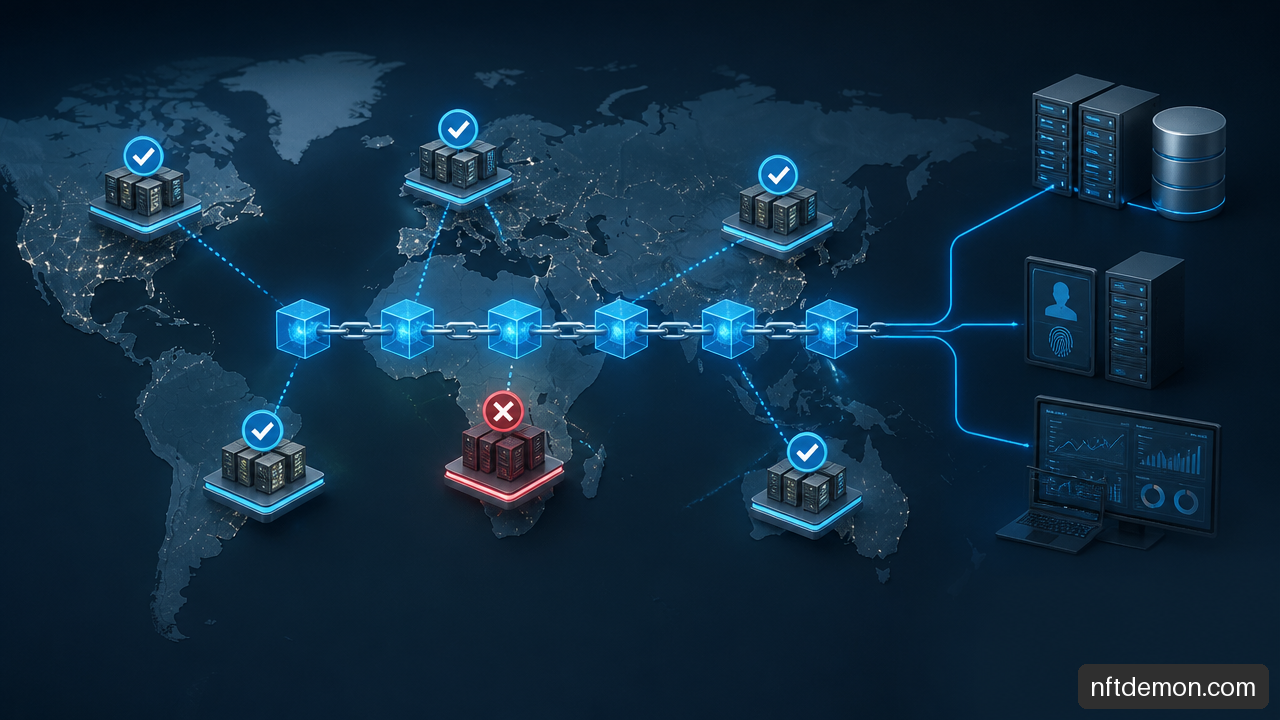
NIST’s enterprise evaluation criteria are often summarized in industry comparisons as including identity, access control, consensus, scalability, and operations. For a concise industry framing of that same point, see this enterprise blockchain platform comparison discussion. The right interpretation is not that one platform wins every benchmark; it is that the benchmark must match the operating model.
Examine Operations, Not Only Architecture
Every production platform needs an owner for node patching, certificate renewal, monitoring, alerting, backups, incident response, and capacity planning. Managed infrastructure can reduce administrative burden, but it may also add dependency on a vendor’s control plane, support terms, and regional availability.
Ask whether development, test, staging, and production environments can be kept meaningfully consistent. If the organization tests with three nodes but production requires twelve organizations across multiple regions, configuration drift can invalidate early performance results.
A minimum operations review should establish:
• Named owners for application code, smart contracts, nodes, keys, identity services, and integration middleware.
• Monitoring for consensus health, transaction failures, node lag, certificate expiry, storage capacity, and suspicious access activity.
• Recovery objectives for ledger data, off chain documents, integration queues, and cryptographic keys.
• Change control for smart contract upgrades, schema changes, API versions, and participant onboarding.
• A rehearsed incident playbook that distinguishes application bugs, node failures, identity compromise, and consortium disputes.
Model Total Cost And Exit Risk
Transaction fees are only one cost component, and often not the largest one. The bigger expense may be integration work, security review, 24 hour operations, or the legal and technical coordination required to change a consortium rule.
| Cost Category | What Enterprises Commonly Miss |
|---|---|
| Platform and infrastructure | Node hosting, environments, storage expansion, observability, network connectivity, managed service premiums. |
| Build and integration | ERP adapters, identity federation, data transformation, mobile or web applications, reporting pipelines. |
| Security and compliance | Smart contract review, penetration testing, key management, evidence collection, policy design, audit support. |
| Operations | On call coverage, patching, certificate rotation, backup testing, incident exercises, participant support. |
| Governance and migration | Legal agreements, voting processes, interoperability work, data export, replacement platform planning. |
A platform may look inexpensive during a prototype because one team runs a small network. The cost profile changes when multiple companies require separate environments, formal release approvals, security operations, and shared support obligations.
Exit planning should begin before contract signature. Preserve application level data exports, document smart contract interfaces, avoid proprietary integration layers where possible, and specify what happens to keys, nodes, and records if a managed provider exits the relationship. Complete portability is rarely realistic, but undocumented dependence is avoidable.
Key Takeaways
• Start with the business coordination problem. If one organization can safely own the workflow, a conventional system may be the better architecture.
• Use nonnegotiable gates for privacy, compliance, identity, finality, and integration before applying a weighted scorecard.
• Compare platforms by production controls, not vendor claims. Membership, access segmentation, key recovery, upgrade rights, and observability deserve explicit scores.
• Treat governance as system design. A consortium needs rules for admission, upgrades, outages, revocation, disputes, and dissolution.
• Test realistic transactions under peak load and failure conditions. Nominal throughput is not a production service level.
• Model total cost through operations and migration, not just transaction fees or initial implementation estimates.
Frequently Asked Questions
How Do Enterprises Decide Whether Blockchain Is Actually Needed?
Enterprises should use blockchain when independent organizations need shared, verifiable state and no single party can reasonably serve as the accepted system of record. If a centralized owner, standard access controls, and an audit log solve the problem, a database is likely the lower risk option.
Is A Permissioned Blockchain Always Better For Businesses?
No. Permissioned platforms fit controlled membership, confidential workflows, and contractual governance. Public or Ethereum compatible networks may fit tokenization, public wallet access, open settlement, and ecosystem interoperability. The right choice depends on who must participate and what information can be disclosed.
Which Criteria Matter Most In A Production Comparison?
Prioritize criteria by business consequence: privacy, identity, governance, integration, resilience, finality, developer productivity, and total cost. Throughput matters, but it should not outweigh a mandatory security or regulatory requirement.
How Should Privacy And Access Control Be Evaluated?
Review identity issuance, user authentication, authorization rules, encrypted data handling, selective visibility, key rotation, revocation, logging, and off chain storage architecture. Ask for a demonstration in which a participant loses authorization and can no longer access protected information.
How Should Teams Compare Throughput, Latency, And Finality?
Use the same workload across finalists. Measure end to end workflow time, not only ledger confirmation. Include transaction complexity, peak concurrency, network geography, failed dependency calls, and node disruption. Finality should align with the moment the business can safely release funds, goods, or rights.
What Causes Blockchain Costs To Escalate In Production?
Integration with ERP and identity systems, node operations, security reviews, compliance evidence, cross organization support, and governance administration frequently exceed early infrastructure estimates. A credible budget includes recurring operational labor and a migration or exit contingency.
How Can Teams Avoid Vendor Lock In?
Use documented APIs and data schemas, retain deployment and key management artifacts, clarify code ownership, test exports, and avoid making a proprietary managed service the only way to operate the network. Contractual exit terms should match the technical plan.
Sources And References
• NIST SP 800-204A, Security Strategies for Microservices-based Application Systems: https://csrc.nist.gov/pubs/sp/800/204/a/final
• Hyperledger Fabric Documentation, Hyperledger Fabric: https://hyperledger-fabric.readthedocs.io/
• R3 Corda Documentation, Corda Documentation: https://docs.r3.com/en/platform/corda/
• U.S. Securities and Exchange Commission, Regulation S-P and records/audit-related guidance pages: https://www.sec.gov/
• optimism.io: https://optimism.io/blog/best-enterprise-blockchain-platforms-in-2026
NFT Demon Holdings helps enterprises scope, evaluate, and build blockchain programs — start with a free evaluation call.
Talk through your use case
Free evaluation call — objective, constraints, and fit, before any proposal.