How APIs and event streams connect blockchain applications to legacy software
By Jeremy Ryan, Founder & CEO · September 2026
How APIs and event streams connect blockchain applications to legacy software is ultimately a question of controlled translation. Older enterprise platforms need stable interfaces, familiar records, predictable recovery, and clear accountability. Blockchain networks produce transactions, logs, confirmations, and changing finality states. A practical integration layer converts one operating model into the other without forcing an ERP, CRM, or mainframe to become blockchain aware.
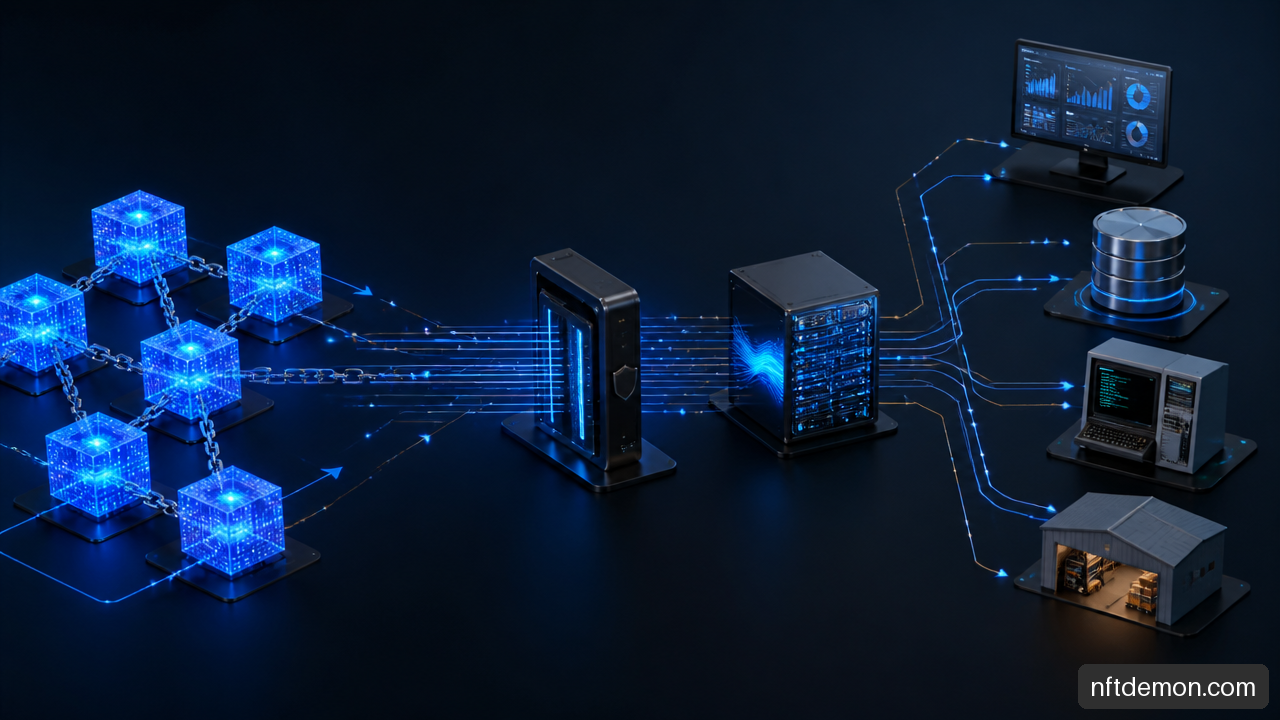
How The Connection Actually Works
The short answer is simple: APIs handle requests and responses, while event streams distribute state changes that have already occurred. The integration service between them is where enterprise control lives. It validates data, maps blockchain fields into business records, applies finality rules, and records enough evidence to explain what happened later.
A legacy application rarely needs raw blocks or smart contract logs. An accounts receivable platform needs a payment status. A supply chain system needs proof that a custody event was recorded. A CRM may need a token gated entitlement to become active. The bridge should translate chain specific data into those recognizable domain events.
The Three Layers Of The Bridge
A durable architecture separates responsibilities rather than wiring an enterprise application directly to a blockchain node.
| Layer | Primary Job | Typical Output |
|---|---|---|
| Blockchain access layer | Reads transactions, indexed records, contract events, and confirmation status | Raw event, transaction hash, block reference |
| Integration layer | Validates, enriches, deduplicates, and maps data | Business event such as PaymentSettled |
| Legacy adapter layer | Calls or publishes to ERP, CRM, ESB, SOAP service, file process, or mainframe interface | Journal entry, order update, case record, batch file |
This separation matters because chains evolve independently from enterprise systems. A contract upgrade can change an event field. A node provider can impose a query limit. The ERP may still run a nightly batch cycle. When these concerns are isolated, changes are contained in adapters and mappings rather than scattered across critical business software.
The chain should provide verifiable facts. The integration layer should decide how those facts become enterprise actions.
APIs Provide Controlled Reads And Writes
An API gateway gives older systems one stable interface for blockchain related capabilities. A finance application might request GET /payments/{invoiceId} and receive a normalized answer: pending, observed, settled, disputed, or failed. It does not need to know whether settlement came from a public network, permissioned ledger, indexer, or smart contract.
For write workflows, an API accepts an approved business command, such as POST /asset-transfers. The bridge validates authorization, creates the transaction request, tracks its lifecycle, and returns a correlation ID. It should not promise that a submitted transaction is final. Submission, inclusion, confirmation, and final settlement are different states.
A synchronous API is useful when a user or application needs an immediate response. It is less suitable for making downstream systems wait while a chain reaches a business defined confirmation threshold. In that case, the API should acknowledge the request and let an event communicate the final result later.
Event Streams Turn Chain Activity Into Business Facts
Smart contracts can emit logs as transactions execute. Those logs are the normal raw material for downstream automation. As Avalanche’s integration guidance explains, smart contract events can flow into existing systems through message queues or event streaming platforms.
Consider a wholesale payment workflow. A contract emits a PaymentCompleted event containing a reference, token amount, and payer address. The bridge enriches the event by looking up the invoice mapping, verifies that the event has met the confirmation policy, and emits a business event such as InvoicePaymentSettled. The ERP then posts the cash receipt using its own standard interface.
The difference is not cosmetic. The raw log says, “a contract emitted bytes at a location in chain history.” The business event says, “invoice 80319 met the organization’s settlement rule and may be posted.” Keeping those meanings separate prevents blockchain internals from leaking into accounting logic.
Choosing APIs, Event Streams, And Middleware
Decision makers should avoid treating REST, WebSockets, queues, and streaming platforms as interchangeable tools. They solve different timing and reliability problems. The right choice depends on whether the enterprise system is asking a question, sending a command, or reacting to a fact.
Use A Decision Rule, Not A Tool Preference
| Need | Best Starting Pattern | Choose It When | Avoid It When |
|---|---|---|---|
| Current balance, asset status, transaction lookup | REST or GraphQL API | A consumer needs a point in time answer | Thousands of consumers need every change |
| User initiated blockchain action | Command API plus asynchronous status event | Approval and validation must occur before submission | The caller expects irreversible completion in one request |
| Continuous operational updates | Event stream into a queue or broker | Multiple systems react independently | The target can only accept nightly files |
| Legacy batch processing | Stream landing zone plus scheduled export | The mainframe or ERP runs on defined cycles | A process requires immediate intervention |
| Low latency screen updates | WebSocket or SSE through an indexed stream layer | A client needs live notifications | Delivery must survive long consumer outages without durable replay |
A useful rule is this: use APIs for questions and commands; use events for facts and propagation. Many architectures need both.
Streaming delivery may come from an indexer rather than directly from the chain. The toncenter streaming API documentation illustrates this model: streaming layers can support WebSocket and Server Sent Events delivery while operating above an indexing pipeline. That arrangement gives enterprise consumers filters, normalized records, and replay options that raw node subscriptions may not provide.
Indexer First, Gateway First, Or Broker First
An indexer first design is strongest for rich search and reporting. It collects chain data, interprets contract events, and exposes queryable views. This is usually a better fit than asking a legacy system to scan blocks or reconstruct token balances itself.
A gateway first design is strongest when a few legacy applications need controlled reads or approved write commands. It centralizes authentication, rate limits, audit logs, and business validation. It can be sufficient for low volume workflows, but it should not become a bottleneck for every status change in the enterprise.
A broker first design is strongest when one on chain event must reach many independently deployed systems. For example, a verified product transfer may need to update warehouse software, a customer portal, a compliance archive, and analytics. A message broker decouples those consumers so one outage does not block the others.
Mainframes And ERP Systems Need Adapters, Not Reinvention
A COBOL based application can consume blockchain derived information, but usually not directly. An adapter may publish a fixed width file, write to a staging table, call a SOAP endpoint, place a message on an existing enterprise service bus, or invoke a transaction through a mainframe integration gateway.
The adapter should own legacy format rules. It converts a canonical business event into the fields, codes, and retry behavior expected by the target. That keeps the event stream clean. It also lets a modernization program replace the target interface later without changing the blockchain listener.
For newer Aptos implementations, it is worth noting that Aptos recommends newer application reads through its Indexer GraphQL API or fullnode REST event endpoints, while legacy event streams are deprecated. The broader lesson applies beyond one network: do not build critical enterprise workflows around interfaces marked for retirement.
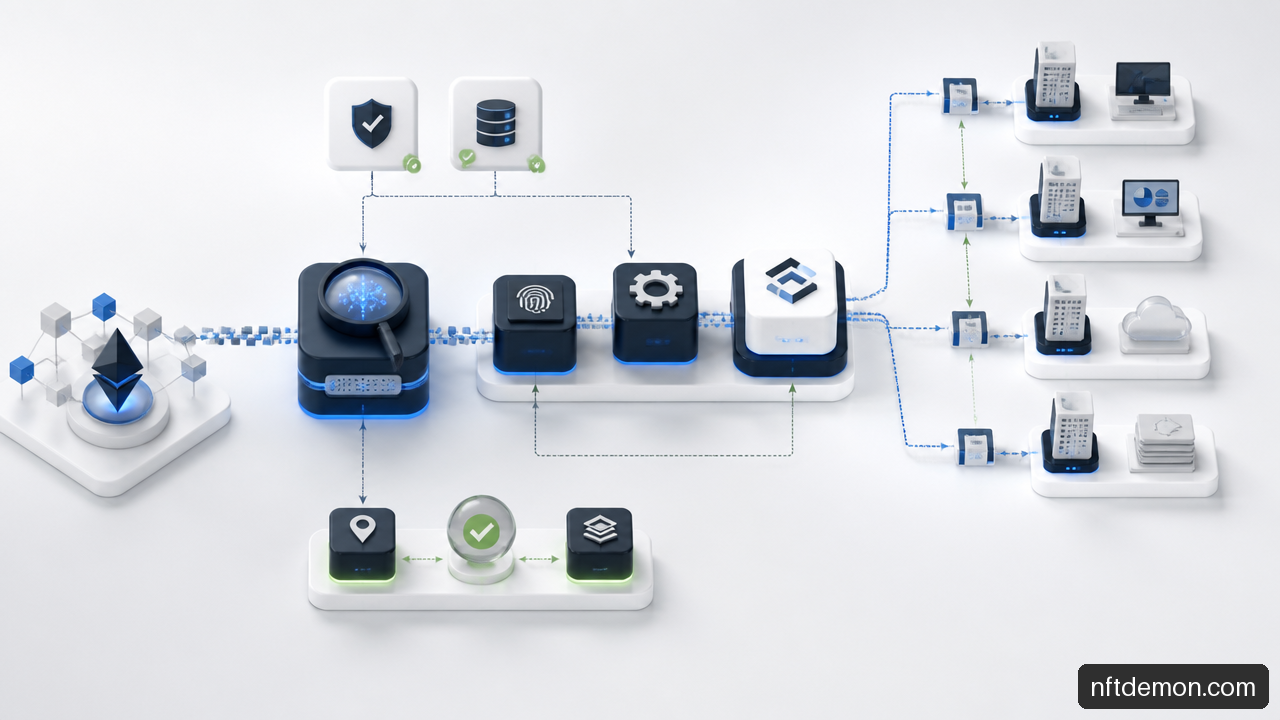
Designing A Reliable Blockchain Bridge
The difficult part is not receiving an event. The difficult part is ensuring that repeated, delayed, reordered, or revised chain information does not create repeated business consequences.
Define One Canonical Business Contract
Start with a canonical domain model that is independent of the chain and independent of the legacy target. A payment event might include:
• eventId, a stable unique identifier for deduplication
• businessReference, such as an invoice or purchase order number
• eventType, such as PaymentObserved or PaymentSettled
• occurredAt, processedAt, and chain reference fields
• finalityStatus and confirmationPolicyVersion
• transactionHash, contract address, and log position for traceability
• normalized amounts, currencies, parties, and validation status
The synchronous API and asynchronous stream should use this same model. The API can return the current status of the business object, while the event stream publishes state transitions. Publishing REST endpoints through OpenAPI and event channels through AsyncAPI makes the boundary reviewable by both integration teams and business owners.
7Block Labs’ integration guidance specifically recommends domain events, OpenAPI and AsyncAPI contracts, checkpoints, and a transactional outbox pattern. The outbox is especially useful when an internal database update and an outbound message must remain aligned: the application commits its business state and outbox record together, then a separate publisher sends the event.
Treat Delivery As At Least Once
At least once delivery means the same event may arrive more than once. This is expected behavior, not evidence that a platform is broken. Kaleido’s Event Streams documentation states that Ethereum events are delivered to REST HTTPS endpoints with at least once semantics.
The consumer must therefore be idempotent. In practice, store a processed event key before applying the business effect, or execute the effect and key insert in one local transaction where the target supports it. A robust key often combines chain identifier, transaction hash, log index, and contract address. If the same event returns, the consumer recognizes it and safely returns success.
Do not rely on timestamp alone. Two events can share a timestamp, and one logical operation can be retried after a timeout. Also distinguish a duplicate event from a legitimate correction. If an invoice is paid twice by design, the events should carry distinct chain references and distinct business identifiers.
Finality And Reorganizations Change The Meaning Of “Done”
A chain event first seen by the bridge may not yet be final. On some networks, a chain reorganization can replace a previously observed portion of history. A downstream ERP that posted an irreversible journal entry immediately may then have a problem: the original on chain event is no longer part of the canonical chain.
Use explicit state transitions instead of pretending every event is final at first sight.
-
Record the event as
Observedwhen detected. -
Wait until the selected finality or confirmation threshold is met.
-
Publish
Settledonly when the threshold is met. -
If the observed history changes before settlement, publish a compensating
ReversedBeforeFinalityevent and prevent the business posting. -
If the target has already acted, initiate a controlled exception process rather than attempting to erase evidence.
The threshold is a business risk decision. A customer facing screen might display “payment detected” quickly, while an asset release or accounting post waits longer. There is no universal threshold because acceptable exposure varies by asset value, chain characteristics, contractual terms, and operational tolerance.
Operating The Integration Under Failure And Change
A bridge should be designed as an operational product, not a one time connector. Its quality is visible during provider outages, consumer lag, schema changes, and audits.
Checkpoints, Replays, And Recovery
A checkpoint is the last safely processed position in a stream. For blockchain ingestion, it commonly includes block number, transaction position, log index, and an indication of whether the record reached the required finality state. Persist it only after the event has been durably handled.
When a consumer fails, recovery should not begin with “resume from now.” It should resume from the last checkpoint, request a bounded historical range, deduplicate every recovered event, and compare expected versus received ranges. Provider limits can require smaller block windows, so backfills should be paginated and monitored.
A practical recovery procedure is:
-
Pause business side effects while preserving inbound events.
-
Identify the last confirmed checkpoint and the affected block interval.
-
Replay the interval through the same validation and idempotency path used for live traffic.
-
Reconcile event counts, transaction references, and business records.
-
Advance the checkpoint only after the reconciliation passes.
Fair warning: a replay facility without idempotency can be more dangerous than an outage. It can duplicate payment postings, inventory movements, or entitlements at scale.
Observability Must Track Business And Chain State
Infrastructure metrics alone are insufficient. CPU utilization does not reveal whether an invoice event was delayed beyond a service commitment. Track both technical and business facing measures:
• event lag from block observation to consumer completion
• confirmation depth at the time a settlement action occurred
• duplicate rate and deduplication decisions
• failed delivery rate by destination adapter
• replay depth, checkpoint age, and backfill completion time
• schema validation failures and unmapped business references
• reconciliation differences between indexed chain facts and legacy records
A correlation ID should connect the API command, wallet or transaction request, chain transaction hash, raw event, normalized domain event, and ERP response. That trace provides an audit path without placing regulated customer data on chain.
Security And Governance Boundaries
Keep sensitive personal, contractual, and operational data off chain whenever possible. Store references, hashes, or minimal proofs on chain only when the use case requires them. The bridge should enforce least privilege: read only services should not possess transaction signing authority, and a system that submits transactions should use constrained credentials, approval controls, and separate audit logs.
Data retention also needs a deliberate policy. Blockchain history may be durable, while event payloads and legacy records may be subject to retention, access, or deletion requirements. The integration layer can minimize this tension by publishing business identifiers and proof references rather than full customer records.
Frequently Asked Questions
How Do APIs Connect Blockchain Applications To Existing Enterprise Software?
APIs expose a stable, enterprise friendly interface for blockchain reads and approved write commands. They hide node providers, contract addresses, transaction formatting, and confirmation logic behind business operations such as checking settlement status or requesting an asset transfer.
What Is The Difference Between An API Bridge And An Event Stream Bridge?
An API bridge is request driven: a system asks for information or submits a command. An event stream bridge is fact driven: it distributes a state change to interested systems. Most serious implementations use both, with APIs for control and events for synchronization.
When Should A Blockchain Integration Use REST Instead Of Kafka Or WebSockets?
Use REST when a consumer needs a current answer, such as the status of one transaction. Use a durable broker when multiple systems must process every event independently and recover after outages. Use WebSockets for live user notifications, but do not treat a transient client connection as the only audit grade delivery channel.
How Do You Keep Legacy Systems From Processing Duplicate Blockchain Events?
Give each normalized event a deterministic idempotency key and store it with the resulting business action. When the same key appears again, return a safe success response without reposting the transaction. The exact storage mechanism depends on the target, but the deduplication decision must be durable.
How Do You Handle Blockchain Reorganizations In Downstream Systems?
Separate observed events from final events. Delay irreversible enterprise actions until the selected finality threshold is met. If a reorganization occurs before that point, mark the event as reversed or invalidated. If an action already occurred, use a compensating business process with a complete audit record.
What Is The Best Way To Sync On Chain Events With An ERP?
Normalize contract logs into business events, place them on a durable stream or queue, and use an ERP adapter that understands the target’s APIs, batch process, or service bus. Avoid sending raw blockchain logs directly to the ERP. The adapter should map event types to recognized business operations and maintain its own delivery status.
Can A Mainframe Consume Blockchain Events Directly?
It can, but direct consumption is usually not the best design. A dedicated adapter can convert normalized events into a message, fixed width file, database staging record, or transaction request that fits existing mainframe integration controls. This reduces changes to core COBOL applications and preserves a cleaner upgrade path.
Key Takeaways
• APIs provide stable read and command interfaces, while event streams distribute blockchain facts to multiple downstream systems.
• A canonical domain model keeps smart contract details out of ERP, CRM, and mainframe business logic.
• At least once delivery requires durable idempotency, not optimistic retry behavior.
• Finality is a business policy. Observed, confirmed, and settled should be distinct states.
• Checkpoints, bounded replays, reconciliation, and adapter specific monitoring turn an integration into an operable system.
• Keep sensitive enterprise data off chain and retain correlation evidence across every boundary.
Sources And References
• Avalanche — Integration with Existing Systems: APIs and Middleware: https://www.avax.network/resource-hub/resources/integration-with-existing-systems-apis-and-middleware/
• Kaleido — Event Streams: https://www.kaleido.io/blockchain-platform/event-streams
• Aptos — Events: https://aptos.dev/network/blockchain/events
• 7Block Labs — Blockchain API Integration with Legacy Systems: https://www.7blocklabs.com/blog/blockchain-api-integration-with-legacy-systems-a-step-by-step-guide
• toncenter / ton-indexer DeepWiki — Streaming API: https://deepwiki.com/toncenter/ton-indexer/4.4-streaming-api
NFT Demon Holdings helps enterprises scope, evaluate, and build blockchain programs — start with a free evaluation call.
Talk through your use case
Free evaluation call — objective, constraints, and fit, before any proposal.