Enterprise NFT strategy with measurable outcomes for consumer brands
By Jeremy Ryan, Founder & CEO · September 2026
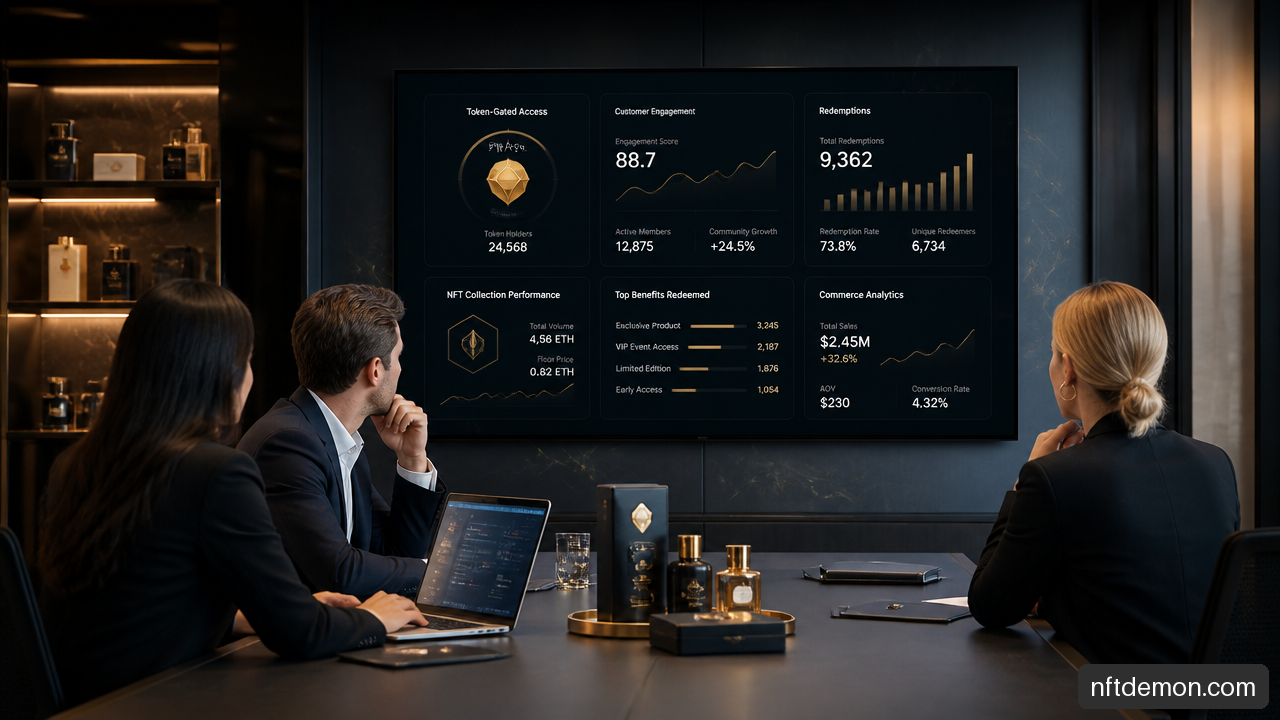
How consumer brands can develop an enterprise NFT strategy with measurable outcomes starts with a simple discipline: treat the NFT as a customer relationship mechanism, not a speculative product. The token is only useful if it creates a repeatable behavior that the brand can observe, measure, and improve.
For decision makers, the question is not whether NFTs can generate attention. They can. The harder question is whether digital ownership can improve retention, increase redemption, create better customer data, support commerce, or deepen membership over time. That requires a strategy connected to CRM, e-commerce, legal review, customer support, and measurable operating goals.
Define The Business Case Before Choosing Technology
An enterprise NFT strategy should begin with a business problem that already matters to the organization. If the project cannot be tied to an existing commercial or customer objective, the NFT may become a costly promotional artifact with little long-term value.
Harvard Business Review advises that NFT initiatives should align with broader corporate strategy and community building rather than operate as isolated technology experiments. That principle matters because a token cannot repair weak customer value, fragmented loyalty operations, or poor fulfillment. It can only make an existing value exchange more visible, portable, and programmable.
Separate Collectibles From Utility-Based Programs
A collectible drop and an enterprise NFT program may use similar technology, but they are not the same operating model. A collectible is generally appropriate when scarcity, creative expression, fandom, or cultural relevance is the primary objective. A utility-first program is appropriate when the brand wants a token to trigger an ongoing customer action.
| Model | Primary Objective | Best-Fit Brand Situation | Core Success Measure | Main Risk |
|---|---|---|---|---|
| Collectible NFT | Awareness, cultural relevance, creative participation | Fashion, entertainment, sports, luxury, artist partnerships | Qualified reach, earned media, first-party opt-ins | Attention disappears after the drop |
| Membership NFT | Retention and advocacy | Brands with recurring purchases, events, or premium communities | Holder retention, repeat purchase, benefit redemption | Perks are too weak to justify holding |
| Loyalty NFT | Repeat spend and referral | Retail, hospitality, food, travel, consumer subscriptions | Incremental purchase frequency, referral conversion, CLV | Existing loyalty program becomes more complex |
| Authentication NFT | Trust, provenance, post-purchase service | Luxury goods, collectibles, resale-sensitive products | Registration rate, resale participation, service engagement | Customer friction exceeds perceived value |
| Co-creation NFT | Product insight and community participation | Brands with active enthusiasts and limited-edition product lines | Participation rate, idea conversion, pre-order demand | Governance becomes performative |
I recommend choosing a collectible model only when the brand can accept a short campaign horizon. Choose a utility model when there is a credible reason for customers to return after minting. A token that grants priority access to product launches, event entry, repairs, community voting, or loyalty benefits can create recurring signals. Those signals are what make the program measurable.
Define One North-Star Business Outcome
A useful strategy starts with one outcome and a small set of supporting measures. Too many dashboards create a familiar problem: a team can report strong wallet activity without knowing whether the program improved the business.
Use this sequence:
- Define the commercial question. For example: “Can token-gated early access increase repeat purchase among high-value customers?”
- Identify the customer behavior that should change. This might be event attendance, referral activity, product registration, repeat purchase, or offer redemption.
- Choose the smallest practical KPI set that can answer the question.
- Set a decision rule before launch. Decide what result justifies expansion, revision, or shutdown.
A premium cosmetics brand, for instance, may issue a free digital membership token to customers who register a product after purchase. The business goal is not mint volume. It is higher replenishment purchase rates among registered customers compared with similar customers who did not receive the token.
Confirm Consumer And Brand Fit
Not every brand needs an NFT strategy. A practical fit test should assess whether the customer has a reason to value durable digital membership or ownership.
| Fit Question | Strong Signal | Weak Signal |
|---|---|---|
| Does the brand have repeat interaction opportunities? | Events, recurring purchases, seasonal drops, subscriptions | One-time purchases with little post-sale contact |
| Can the brand offer a meaningful benefit? | Access, priority, service, discounts, participation | Vague promises of future value |
| Does the audience tolerate digital onboarding? | App users, loyalty members, online purchasers | Low digital adoption or high support sensitivity |
| Can the business measure behavior after issuance? | CRM, commerce, event, and support data are connected | Wallet activity is isolated from customer records |
| Is there a governance owner? | Named product, legal, data, and customer-experience leaders | Innovation team operates alone |
Research from the University of Liverpool indicates that NFTs can improve brand awareness and create cross-selling opportunities for consumer brands. Still, that outcome depends on brand context and execution. Awareness lift is plausible, but it should not be treated as proof of commerce lift.
Key Takeaways
• Start with a customer or commercial problem, not a blockchain selection.
• Treat collectible drops and utility-first membership programs as different products with different success criteria.
• Make the token trigger an action that can be observed, such as redemption, registration, referral, purchase, or event attendance.
• Use one north-star outcome and a limited KPI set before launch.
• Avoid a launch when the brand cannot provide durable utility, connect wallet activity to customer data, or support holders after minting.
Design Utility That Produces Observable Customer Behavior
The strongest enterprise NFT programs convert ownership into repeated action. Harvard Business School’s NFT Staircase describes the progression through ownership, utility, identity, community, and evolution. For consumer brands, this is more than a conceptual model: each layer can be connected to a different type of measurable behavior.
Map Utility To Business Outcomes
| Utility Type | What The Customer Receives | Observable Behavior | Business Outcome To Test |
|---|---|---|---|
| Token-gated offers | Discount, bundle, replenishment incentive | Offer views and redemptions | Conversion rate and repeat purchase lift |
| Priority access | Early entry to products, tickets, reservations | Access claims and purchases | Sell-through, waitlist conversion, retention |
| Membership status | Recognition, profile badge, tier eligibility | Profile completion and renewal | Engagement and member retention |
| Product authentication | Digital proof linked to a physical item | Registration, ownership transfer, service use | Post-purchase engagement and resale trust |
| Community voting | Input on designs, flavors, events, or collaborations | Votes and follow-up purchases | Participation and demand validation |
| Referral rewards | Benefits for verified introductions | Referral links, referrals, referred sales | Lower acquisition cost and customer quality |
A brand should avoid promising that an NFT will appreciate in value or implying that purchasers should expect a financial return. Instead, define the customer benefit in plain language: what holders receive, how long it lasts, what exclusions apply, how redemption works, and what happens if a program changes.
This is also where customer trust is won or lost. A benefit that expires without warning, a redemption path that requires complex wallet steps, or a token with unclear terms can create more support burden than loyalty value.
Make The Customer Journey Friction-Aware
The NFT should fit the customer journey rather than force customers into unfamiliar behavior. If the audience does not already use wallets, requiring a browser extension, cryptocurrency purchase, and marketplace account will likely reduce participation. A custodial or embedded wallet can lower friction, although it introduces additional privacy, security, and vendor-management responsibilities.
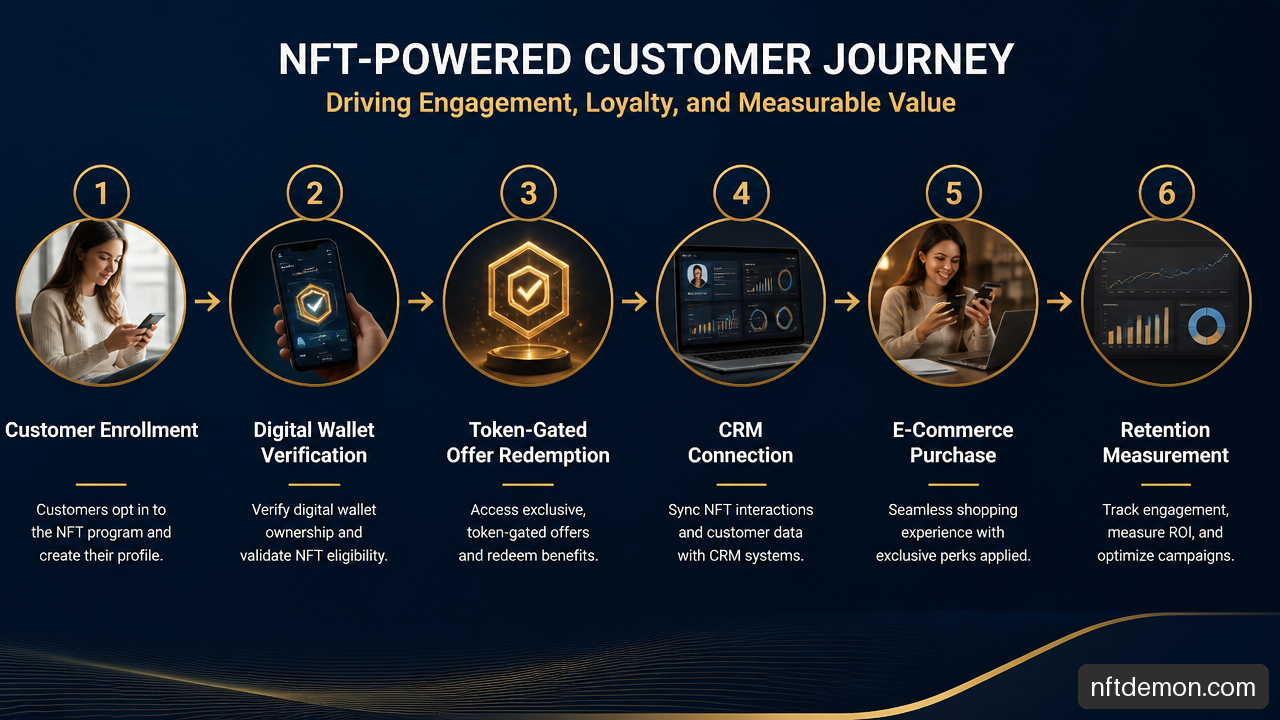
A sensible customer journey has four observable moments:
- Enrollment: The customer claims or receives the NFT through a familiar brand channel.
- Verification: The system confirms ownership without repeatedly asking the customer to complete complicated wallet actions.
- Utility: The holder accesses a real benefit, such as an offer, event, service, or membership function.
- Re-engagement: The brand sends a relevant prompt when new utility becomes available, while respecting consent preferences.
A token without an operating calendar is usually a one-time campaign. A token with scheduled benefits, eligibility rules, and customer support becomes a product.
Design Post-Mint Obligations Before Launch
The common failure mode is not a low mint count. It is an inactive holder base after the initial excitement ends. Brands should define at least two or three post-mint utility moments before issuing tokens.
For example, an apparel brand could offer early access to one seasonal capsule, a repair or customization benefit, and a holder vote on a future colorway. The NFT then serves as a membership record. Each moment produces data: who claimed access, who used the benefit, who voted, and who purchased.
Harvard Business School notes that NFTs can serve as both brand content and mechanisms for marketplace-style engagement. The implication is important: the content may attract customers, but the participation mechanics are what create an enterprise-grade relationship.
Build Measurement Into The Data Architecture
A measurable NFT program needs more than blockchain analytics. Wallet data can show that a token was minted, transferred, or held. It cannot independently show whether a customer became more valuable to the brand.
The essential capability is wallet-to-CRM linking: a consent-based connection between a customer identity and a wallet identifier. Without it, marketing, loyalty, commerce, and blockchain teams will each see partial activity but cannot evaluate the same customer journey.
Create A Practical Data Flow
| Data Layer | Records Captured | Business Use |
|---|---|---|
| Wallet and smart contract | Mint, transfer, ownership status, eligibility | Confirms token status and utility rights |
| Identity and consent layer | Customer ID, wallet link, communication permissions | Connects blockchain events to approved customer records |
| CRM and loyalty platform | Segment, tier, engagement history, preferences | Builds holder and non-holder cohorts |
| Commerce platform | Orders, product category, order value, returns | Measures purchase behavior and CLV signals |
| Experience systems | Event attendance, content access, support tickets, redemptions | Measures whether utility is actually used |
The data model should use a stable customer identifier as the joining point. Wallet addresses may change, customers may own several wallets, and some customers will decline identity linking. That does not invalidate the program, but it limits what can be measured at the individual level.
A brand should make this trade-off explicit. Anonymous participation may support reach and privacy, while linked participation supports better ROI measurement. A hybrid model can offer basic benefits without identity linkage and enhanced loyalty value to customers who voluntarily connect their wallet and consent to data use.
Use A KPI Hierarchy, Not A Vanity Dashboard
Mint counts, social mentions, and secondary-market activity may be useful context. They are not sufficient evidence of business value. Organize metrics into a hierarchy that distinguishes activity from outcomes.
| KPI Level | Question Answered | Example Metrics |
|---|---|---|
| Operational health | Did the program function? | Claim completion, failed transactions, support resolution time |
| Leading engagement | Did holders use the experience? | Activation rate, redemption rate, event attendance, repeat visits |
| Behavioral change | Did customers act differently? | Purchase frequency, referral rate, product registration, churn reduction |
| Business outcomes | Did the program create economic value? | Incremental revenue, margin contribution, CLV change, acquisition efficiency |
Redemption rate deserves special attention. A high claim count can be misleading if few holders ever use the promised benefit. Calculate redemption rate as the number of eligible holders who redeem a benefit divided by the number of eligible holders offered that benefit. Then compare redemption across segments, channels, and benefit types.
If 10,000 members hold a token but only 200 use a recurring benefit, the brand has learned something useful: either the utility is weak, the communication is ineffective, or the redemption flow is too difficult. The remedy is not automatically more marketing. It may be a simpler benefit, better timing, or fewer steps at checkout.
Run A Controlled Pilot Before Scaling
A pilot should be designed to answer one decision, not prove that blockchain is broadly useful. I recommend limiting the first release to a defined audience, a narrow utility set, and a specific measurement period. This protects the brand from making large commitments before the value exchange is understood.
Establish Cohorts And A Control Group
The cleanest way to estimate impact is through incrementality testing. Compare NFT participants with a similar group that did not receive the NFT experience. The groups should be matched on meaningful factors such as past spending, loyalty tenure, geography, channel preference, and engagement level.
Consider a hospitality brand testing token-gated priority reservations. It could invite 5,000 loyalty members with comparable historical behavior, randomly offering the token to half of them. Over a defined period, the brand compares reservation frequency, spend per visit, cancellation behavior, and satisfaction signals between groups.
This design will not eliminate every confounding factor. Customers who actively claim a token may already be more engaged. Randomized invitations or carefully matched cohorts reduce that bias. If random assignment is impossible, the results should be framed as directional rather than causal.
Set Pilot Gates And Recovery Plans
Before launch, define what happens under each result scenario.
| Pilot Result | Interpretation | Next Action |
|---|---|---|
| High activation and high redemption | Utility appears relevant and usable | Expand eligible audience and test economics |
| High activation and low redemption | Initial interest exceeds ongoing value | Simplify utility or improve redemption timing |
| Low activation and high satisfaction among users | Value may be strong but onboarding is weak | Reduce wallet friction and revise messaging |
| High engagement but no commerce lift | Affinity may be improving without revenue impact | Continue only if brand objective supports it; test a commerce-linked benefit |
| High support burden or trust complaints | Program design is creating friction or confusion | Pause expansion and repair terms, flows, and support content |
Treat Legal And Governance As Product Requirements
US consumer brands should involve legal, privacy, tax, security, finance, customer support, and marketing leaders before launch. The goal is not to turn the initiative into a committee exercise. It is to ensure that product claims, data practices, commercial terms, and operating responsibilities match the actual experience.
Important governance questions include:
• What does the token provide, and what does it explicitly not provide?
• Are benefits transferable, revocable, time-limited, or subject to inventory constraints?
• What customer data is collected when a wallet is linked, and how is consent recorded?
• Who pays network fees, handles account recovery, and responds to support requests?
• Are secondary-market royalties necessary, enforceable in the chosen environment, and consistent with customer expectations?
Secondary-market royalties should not be treated as a dependable revenue forecast. Marketplace support and enforcement can vary, and royalties can create reputational friction if holders believe a brand is extracting value without delivering continuing utility. If resale is enabled, publish clear rules and make post-sale obligations explicit.
Frequently Asked Questions
How Can Consumer Brands Tell Whether An NFT Strategy Is Worth Pursuing?
It is worth pursuing when the brand has a recurring customer relationship, a benefit that is meaningful enough to influence behavior, and a way to measure that behavior through CRM, commerce, loyalty, or experience data. Avoid it when the only objective is publicity or when the program cannot support customers after the initial drop.
What Business Problem Should An NFT Program Solve?
It should solve a defined problem such as weak loyalty engagement, poor product registration, limited access management, low referral activity, or limited post-purchase contact. The program should not begin with “we need an NFT.” Begin with the behavior the brand needs to change.
Which KPIs Matter Most For NFT Loyalty Programs?
Prioritize activation rate, redemption rate, holder retention, repeat purchase, referral conversion, support burden, and incremental CLV. Mint volume may be useful as an operational measure, but it does not demonstrate that the token changed customer economics.
How Do Brands Connect Wallet Activity To Sales And Retention?
Use voluntary wallet-to-CRM linking with clear consent. Connect the customer identifier to commerce, loyalty, event, and support records. Then create holder and non-holder cohorts to compare redemption, purchase behavior, engagement, and retention over the same period.
Should A Brand Use NFTs For Loyalty, Access, Authentication, Or Collectibles?
Choose the use case that fits the customer relationship. Loyalty fits repeat-purchase brands. Access fits event, hospitality, and limited-release models. Authentication fits high-value physical products and resale-sensitive categories. Collectibles fit cultural campaigns where attention and creative participation are legitimate goals. Do not force all four into one launch.
How Can Brands Avoid Looking Speculative Or Gimmicky?
State the utility clearly, avoid investment language, publish benefit durations and redemption terms, and make the customer experience useful even if the token is never resold. A free or earned token can sometimes be more credible than a paid drop when the objective is loyalty rather than direct monetization.
How Should A Brand Measure Success After The Initial Drop?
Measure whether holders return, redeem, purchase, refer, attend, register products, or participate in the next utility moment. A successful first week does not prove a successful program. The real test begins when novelty fades and the token must still earn a place in the customer relationship.
How Long Should An Enterprise NFT Pilot Run?
The answer depends on purchase cadence. A quick-service restaurant may learn from a six-to-eight-week offer cycle. A luxury or travel brand may need several months to observe repeat behavior. The measurement window should be long enough to capture the intended action, not just the initial claim.
Sources/References
• Harvard Business School: Building Brand Engagement: Lessons from NFTs and Collectibles
• University of Liverpool Repository: How Can Non-Fungible Tokens Bring Value to Brands
• Harvard Business Review: How Brands Are Incorporating NFTs Into Their Corporate Strategy
NFT Demon Holdings helps enterprises scope, evaluate, and build blockchain programs — start with a free evaluation call.
Talk through your use case
Free evaluation call — objective, constraints, and fit, before any proposal.