Enterprise Blockchain Assessment for Supply Chain and Digital Identity
By Jeremy Ryan, Founder & CEO · September 2026
Enterprise blockchain use case assessment for supply chain and digital identity should begin with a blunt question: is a distributed ledger solving a trust and coordination problem, or merely adding complexity to data that one organization already controls? I recommend treating blockchain as a shared evidence layer, not as a replacement for ERP, product lifecycle management, warehouse systems, or identity directories.

Decide Whether Blockchain Is Justified
A blockchain use case is strongest when several independent parties need to record, verify, or audit events, yet no single party is broadly accepted as the permanent owner of the shared record. In supply chains, this may include a manufacturer, contract assembler, freight provider, customs broker, distributor, retailer, certification body, and regulator. Each has data, incentives, and liability exposure that do not fully align.
A conventional shared database is usually the better choice when one enterprise can govern access, correct records, and resolve disputes. A database can be cheaper, faster, and easier to change. Blockchain becomes more defensible when the business problem includes cross organization write access, disputed provenance, fragmented audit trails, or a recurring need to prove what was known at a particular point in time.
Apply A Practical Go Or No Go Test
I would require a use case to satisfy at least four of the following conditions before treating blockchain as a serious architecture option:
| Decision Criterion | Why It Matters | If The Answer Is No |
|---|---|---|
| Multiple independent parties must write records | Shared custody of the event history reduces dependence on one operator | Use a governed database or integration hub |
| Parties have a meaningful trust gap | A tamper evident record has value only when participants need independently verifiable evidence | Strengthen contractual controls and audit logs first |
| Auditability is tied to financial, safety, compliance, or brand risk | The cost of disputed records can justify added governance and integration work | Avoid ledger complexity for low consequence events |
| Events can be defined consistently | A ledger preserves bad semantics as reliably as good semantics | Standardize event definitions before implementation |
| Sensitive data can remain off ledger | Most enterprise data requires access controls, retention rules, or jurisdictional handling | Do not place confidential records directly on chain |
| Participants can sustain onboarding and credential management | The network is only as useful as its active participants | Start with a smaller federation or centralized service |
The critical distinction is between shared visibility and shared truth. A dashboard can provide visibility. A distributed record can help establish which party attested to a shipment, certificate, inspection, or handoff, and when. It cannot establish that a scanned serial number was physically attached to the right item. That remains a process, sensor, inspection, and governance issue.
Compare The Main Enterprise Patterns
Supply chain and identity initiatives often combine several patterns, but each has different success criteria.
| Pattern | Core Record | Best Fit | Main Limitation |
|---|---|---|---|
| Traceability | Production, custody, and transformation events | Regulated goods, high value components, recall readiness | Depends on accurate physical to digital capture |
| Provenance and anti counterfeit | Product passport, serial identity, certificate references | Luxury goods, pharmaceuticals, electronics, collectibles | A token alone does not prevent physical substitution |
| Partner credentialing | Verified legal entity and role claims | Supplier onboarding, carrier authorization, certification checks | Revocation and issuer governance can become bottlenecks |
| Shared compliance evidence | Inspection, test, audit, or sustainability attestations | Multi tier sourcing and controlled supply chains | Data confidentiality may limit network participation |
| Transaction coordination | Status changes, releases, approvals, smart contract triggers | Narrow, repeatable workflows with clear obligations | Legal and operational exceptions often exceed smart contract logic |
Assessment principle: If the business cannot name the disputed event, the required evidence, and the accountable party, it is not ready to choose a ledger.
Separate Product, Participant, And Transaction Identity
Digital identity is not one thing. Enterprise programs frequently fail because they merge the identity of an organization, the identity of a product, and the identity of an event into one identifier model. Those layers should be deliberately separated.
Use Three Identity Layers
| Identity Layer | What It Identifies | Example | Control Question |
|---|---|---|---|
| Product identity | A physical or digital item, batch, lot, or asset | A serialized medical device or component batch | Can the identifier remain linked to the item through custody changes? |
| Participant identity | A legal entity, facility, person, or system | A contract manufacturer, carrier, inspector, or warehouse | Who verified that this entity is real and authorized? |
| Transaction identity | A specific business event | A shipment acceptance, inspection result, or title transfer | Which party signed the event, and what evidence supports it? |
A product passport may point to origin, authenticity, certifications, and lifecycle records. A participant identity establishes who is allowed to issue or consume those records. A transaction identity creates the evidence trail connecting the two. Mixing them creates confusing permissions. For example, a carrier should be able to attest that it received a pallet, but it should not automatically gain authority to alter the manufacturer’s product specification.
The World Economic Forum’s work on legal entity verification and provenance in supply chain networks frames digital identity as a way to support trusted remote interactions and connect product origin claims to verified entities. That relationship is more useful than treating a wallet address as proof of organizational legitimacy.
Distinguish DIDs, Credentials, And Ledger Records
A decentralized identifier, or DID, is an identifier associated with a subject and controlled through cryptographic keys. A verifiable credential is a digitally signed statement made by an issuer about that subject. A blockchain record may anchor a hash, registry entry, status change, or transaction history. They can work together, but they are not interchangeable.
Consider supplier onboarding. A supplier may hold an identifier. A government registry, certification authority, or network operator may issue credentials confirming legal status, facility certification, insurance, or authorization to ship controlled goods. The supply chain network then verifies those credentials when the supplier submits an event. The ledger need not contain every underlying document. It may contain proof references, credential status, or event hashes.
The emerging scope of IEEE P3210’s blockchain based digital identity framework includes identity definition, creation, authentication, identity notes, and data or asset circulation protocols. For decision makers, the implication is straightforward: identity architecture requires lifecycle design, not merely wallet creation.
Keep Confidential Data Off Ledger
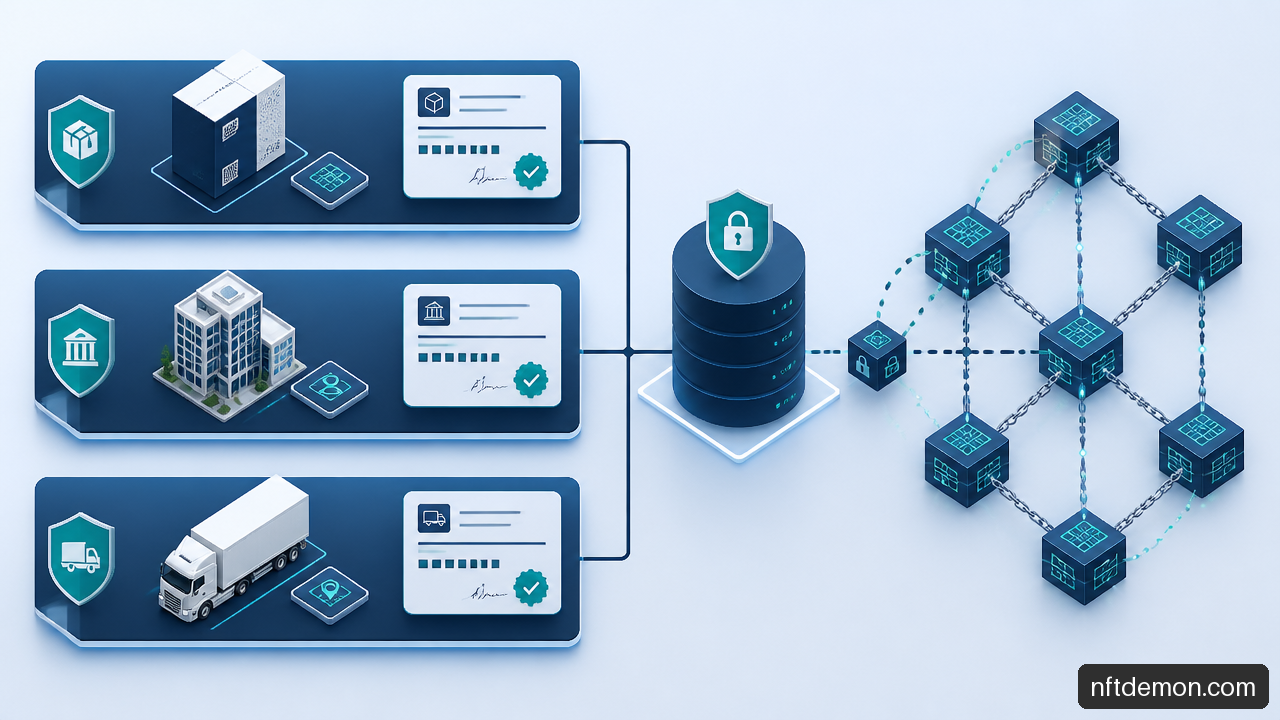
Supply chain events can reveal prices, volumes, routes, suppliers, production timing, and regulated data. Immutability is a poor fit for raw data that must be corrected, deleted, or selectively disclosed. The practical pattern is to keep sensitive records in enterprise repositories or controlled data spaces and store minimal references, hashes, timestamps, permissions, or proofs on the ledger.
ISO 8000 117:2023 identifier requirements for supply chain ledgers address this directly: identifiers used in distributed ledgers for supply chain transaction exchange must identify a single off ledger data set and include data capable of verifying that the referenced set has not changed since creation. This is not a minor implementation detail. It determines whether an auditor can validate evidence without exposing the record itself.
Score The Use Case Before Funding A Pilot
A pilot should test the assumptions most likely to break production adoption, not simply demonstrate that a transaction can be written to a ledger. I recommend scoring the use case before selecting a platform, consortium model, or smart contract framework.
Use A Weighted Innovation Team Matrix
Score each category from 1 to 5, where 1 means poor fit and 5 means strong fit. Multiply the score by the weight. The total is not a substitute for judgment, but it makes hidden assumptions visible.
| Category | Weight | What A Score Of 5 Looks Like | Warning Sign |
|---|---|---|---|
| Multi party trust need | 20% | Independent organizations must verify each other’s events | One company already governs all records |
| Traceability value | 15% | A disputed chain of custody creates material recall, fraud, or liability exposure | Event history is rarely reviewed |
| Identity readiness | 15% | Participants can support verified legal entity and role credentials | Partners cannot maintain keys or onboarding records |
| Data standards maturity | 15% | Product, location, event, and document semantics are already defined | Teams disagree on basic identifiers |
| Privacy feasibility | 10% | Sensitive records can remain off ledger with controlled disclosure | The proposed design requires public exposure of confidential data |
| Governance feasibility | 15% | Rules exist for admission, revocation, disputes, fees, and change control | No party will accept accountability for network operations |
| Integration and operating fit | 10% | ERP, warehouse, identity, and partner systems can produce reliable events | Manual rekeying would become the permanent workflow |
A weighted total of 80 or above may justify a focused pilot. A score between 60 and 79 usually indicates that blockchain could fit, but the organization should resolve governance, data, or onboarding gaps first. Below 60, the use case is often better served by conventional integration, a shared database, or targeted identity modernization.
Test The Negative Case
The most useful assessment output is sometimes a decision not to deploy blockchain. For instance, a brand may want product authenticity records but controls the manufacturing, warehousing, retail channels, and customer service function. If no external party needs write access and the main challenge is counterfeit detection at the physical edge, secure serialization, inspection controls, and a centralized verification service may deliver more value.
By contrast, a multi manufacturer aerospace parts network may require independent custody attestations, certificate verification, maintenance history, and long term audit evidence across organizations. In that scenario, shared event integrity and participant identity carry more weight. Still, the physical tagging method and certificate issuer controls remain decisive.
Design For Governance, Privacy, And Production
Technical feasibility is rarely the hard part. The difficult work is deciding who can join, who can issue credentials, what happens when a credential is revoked, how disputes are resolved, and who pays for operations.
Establish A Participant Governance Model
A workable model assigns responsibilities before the first production transaction.
| Governance Function | Required Decision | Practical Failure If Missing |
|---|---|---|
| Membership | Who validates legal entities and admits participants? | Unverified or duplicate organizations enter the network |
| Credential issuance | Which authorities can issue roles and certifications? | Any participant can claim regulated authority |
| Revocation | How quickly are expired, compromised, or withdrawn credentials invalidated? | Offboarded partners retain functional access |
| Data access | Which fields, documents, and proofs are visible to each role? | Competitive or personal data is overshared |
| Dispute resolution | Who decides when physical evidence conflicts with the ledger? | Teams treat the ledger as infallible and delay remediation |
| Change control | Who approves schema, identifier, and smart contract updates? | One participant breaks interoperability for all others |
NIST’s manufacturing supply chain traceability project description is useful because it models role based identities for activities such as Make, Assemble, Transport, Receive, and Employ, while recognizing that production ecosystems may use independent identity providers. It also describes its MVP as illustrative rather than prescriptive and does not implement specific supply chain data standards. That scope boundary matters: a working MVP does not automatically prove that a production network has solved semantics, onboarding, or governance.
Treat Interoperability As An Identifier Problem
Interoperability is often described as a question of connecting chains. The more immediate issue is whether systems mean the same thing when they exchange identifiers. A product ID must resolve consistently. A participant ID must distinguish a parent company from a facility or business unit. A document reference must identify the precise version that was attested.
ISO/TR 6039:2023 on blockchain identifier interoperability treats identifier design as a distinct distributed ledger interoperability problem. I would therefore define identifier ownership, resolution, versioning, and collision handling before evaluating bridge technology or cross network messaging.
Move From Assessment To Scale In Stages
-
Define the business dispute. Identify the event that currently causes cost, delay, fraud exposure, or compliance risk.
-
Map participants and evidence. List each legal entity, role, data source, credential issuer, and required proof.
-
Model identifiers and data boundaries. Specify product, participant, and transaction identifiers, plus which data remains off ledger.
-
Write governance rules. Cover admission, role issuance, revocation, incident response, commercial terms, and change management.
-
Pilot the hardest workflow. Test partner onboarding, credential verification, exception handling, and document retrieval, not just a happy path transfer.
-
Measure operational outcomes. Track evidence retrieval time, reconciliation effort, onboarding completion, exception resolution, and the percentage of events backed by usable source data.
-
Scale only after control tests pass. Expansion should follow successful security, privacy, interoperability, and operating model reviews.
Key Takeaways
Use Blockchain Only Where Shared Trust Is The Constraint
• Choose blockchain when independent parties need durable, verifiable shared evidence and cannot rely on one database operator alone.
• Separate product identity, participant identity, and transaction identity before selecting platforms or designing smart contracts.
• Treat DIDs as identifiers, verifiable credentials as signed claims, and ledger records as evidence anchors or event histories.
• Keep commercially sensitive and regulated source data off ledger whenever possible, using identifiers and integrity proofs to connect it to shared records.
• Score governance, identity readiness, data standards, privacy, and integration maturity before authorizing a pilot.
• A pilot that lacks formal data semantics, revocation processes, or independent identity provider planning should be regarded as exploratory, not production ready.
Frequently Asked Questions
What Supply Chain Problems Are Actually Good Fits For Blockchain?
The best fits involve multi party traceability, provenance, anti counterfeit evidence, certification verification, and shared compliance records where parties need independently auditable events. Avoid blockchain when a single company controls all data and the issue is simply internal system integration.
When Should A Company Choose Blockchain Instead Of A Shared Database?
Choose blockchain when independent organizations must write and verify a shared record, have limited trust in a central operator, and face meaningful audit or dispute costs. Choose a shared database when one entity can credibly govern corrections, access, uptime, and participant relationships.
How Does Blockchain Help With Digital Identity In Supply Chains?
It can provide a shared mechanism for resolving participant identifiers, validating signed credentials, recording authorization status, and linking signed event attestations to organizations or roles. It does not replace legal entity verification, key management, or supplier due diligence.
What Is The Difference Between A DID, A Verifiable Credential, And A Blockchain Identity?
A DID identifies a subject through cryptographic control. A verifiable credential is a signed claim about that subject, such as a certification or role authorization. A blockchain identity is an imprecise phrase that may refer to an on ledger identifier, wallet address, credential registry entry, or combination of these elements. Enterprise designs should use precise terms.
How Should Suppliers Be Assessed For Adoption Readiness?
Assess technical connectivity, legal entity verification, credential lifecycle capability, process ownership, data quality, and willingness to follow shared governance rules. A small supplier may participate through a managed portal, while a large manufacturer may require API integration and use its own identity provider. The network should support both without reducing assurance standards.
What Privacy Problems Appear When Identity And Traceability Are Combined?
The combined record can expose supplier relationships, shipment timing, facilities, volumes, certifications, and potentially personal data. Mitigate this by minimizing on ledger content, using role based permissions, retaining sensitive documents off ledger, and defining disclosure rules before participants upload data.
How Do You Handle Credential Revocation And Participant Offboarding?
Define a credential status service or registry, revocation authority, effective time, notification method, and audit trail. Offboarding should disable future authorizations without deleting historical evidence. If a carrier loses authorization today, prior signed delivery events may remain valid evidence, but new transport attestations should fail verification.
What Are The Common Failure Modes In Blockchain Traceability Pilots?
Common failures include unclear data ownership, inconsistent product identifiers, weak physical to digital links, manual event capture, no credential revocation plan, unrealistic participant onboarding assumptions, and pilots that demonstrate only ideal workflows. Recovery usually requires narrowing the process, fixing data semantics, and testing exceptions before adding more partners.
Sources
-
ISO - ISO 8000-117:2023 https://www.iso.org/standard/81208.html
-
NIST NCCoE - Manufacturing Supply Chain Traceability with Blockchain Related Technologies https://www.nccoe.nist.gov/sites/default/files/2023-08/mfg-sct-blkchn-project-description-final.pdf
-
IEEE Blockchain and Distributed Ledger Standards Committee - Home https://sagroups.ieee.org/bdlsc/
-
ISO - ISO/TR 6039:2023 https://standards.iteh.ai/catalog/standards/iso/60f2dc6f-e901-44b4-aa08-20c1c915d535/iso-tr-6039-2023
-
World Economic Forum - Inclusive Deployment of Blockchain for Supply Chains Part 2 https://www3.weforum.org/docs/WEF_Trustworthy_Verification_of_Digital_Identities_2019.pdf
NFT Demon Holdings helps enterprises scope, evaluate, and build blockchain programs — start with a free evaluation call.
Talk through your use case
Free evaluation call — objective, constraints, and fit, before any proposal.