Contents
- Key takeaways
- Define the production problem before evaluating firms
- Test technical and security readiness
- Select for delivery governance and long-term operations
- Frequently asked questions
Key takeaways
- Choose against a defined production outcome, not a vague innovation objective. The firm should understand the business workflow, users, data, systems of record, control requirements, and measurable ROI target.
- Demand evidence of production delivery. Useful evidence includes architecture diagrams, deployment scope, operational metrics, audit artifacts, integration patterns, and client references that can discuss delivery reality.
- Make identity and key custody explicit. A consultant that cannot clearly explain who approves transactions, owns keys, performs recovery, and monitors privileged access is not ready for production.
- Evaluate security through evidence, not assurances. Ask for secure development lifecycle practices, smart contract review methods, vulnerability handling, logging design, and incident response responsibilities.
- Treat integration as a core workstream. Blockchain rarely replaces ERP, CRM, identity, payments, warehouse, document, or reporting systems. It must coexist with them.
- Contract for post launch support, governance, source code access, and exit rights before development begins. Production deployment is the start of operating responsibility, not the end of consulting work.
A production blockchain deployment is not defined by whether a ledger is live. It is defined by whether the enterprise can operate, secure, audit, change, and recover the business process around that ledger.
Define the production problem before evaluating firms
Start with the business process, not the chain
I recommend beginning with the business process that needs shared trust, traceability, controlled coordination, programmable settlement, or verifiable records. This avoids selecting a consulting firm because it promotes a particular protocol, token model, or platform preference.
A useful enterprise brief identifies the following before procurement begins:
- The process failure or commercial opportunity being addressed.
- The participating organizations, users, and decision rights.
- The systems that remain authoritative for customer, financial, product, or operational data.
- The data that may be written on chain, referenced by hash, or retained off chain.
- The expected transaction volume, response time, availability, and recovery needs.
- The legal, security, privacy, and audit constraints that cannot be negotiated away.
Consider a manufacturer seeking provenance across suppliers. The blockchain is not the product. The product is a defensible chain of custody process that must connect supplier systems, quality records, shipment events, and enterprise reporting. A consulting firm that focuses only on ledger nodes and smart contracts may miss the harder work: data quality, onboarding partners, exception handling, and ownership of disputed records.
Choose the network model from requirements
The decision between a permissioned blockchain and a public blockchain should follow operating requirements. It should not follow market fashion.
| Requirement | Better consulting capability to seek | Why it matters |
|---|---|---|
| Known participants and restricted access | Permissioned network design and consortium governance | Membership, roles, confidentiality, and change rights require formal controls |
| Public verification or open asset transfer | Public chain architecture and token compliance awareness | Transaction finality, wallet interaction, gas economics, and public visibility affect the design |
| Sensitive enterprise data | Off chain storage and on chain data minimization | Immutability can conflict with privacy, retention, and correction obligations |
| Multi party commercial process | Governance design and dispute management | Technology cannot decide membership changes, fee rules, or business disputes on its own |
NIST’s blockchain overview identifies identity, governance, consensus, and cryptography as core blockchain considerations. During selection, ask vendors to explain each area using your proposed workflow rather than a generic slide deck. A firm’s treatment of these choices is often more revealing than its list of supported protocols. See NIST IR 8202’s blockchain technology overview for the underlying considerations.
Set a production evidence standard
Case studies are useful only when they answer operational questions. “Built a blockchain solution” is marketing language, not procurement evidence.
Ask each finalist to provide evidence that is proportionate to the proposed deployment:
- The business process and deployment environment, with confidential details redacted where necessary.
- A description of the production architecture, including integrations, node operations, identity, and data boundaries.
- Measurable service outcomes such as transaction throughput, latency targets, availability objectives, adoption levels, or reduction in reconciliation effort.
- Security review evidence, including the scope of any smart contract audit or penetration test.
- A clear statement of what the consulting firm owned versus what the client, cloud provider, auditor, or subcontractor owned.
- A reference conversation with a stakeholder who can discuss delivery management and post launch support.
There is no universal minimum number of references or fixed performance benchmark. A low volume asset registry and a high volume settlement workflow have radically different needs. What matters is relevance. If the proposed program depends on regulated data, multiple counterparties, or continuous availability, prior evidence should reflect those same conditions.
Test technical and security readiness
Examine architecture beyond smart contracts
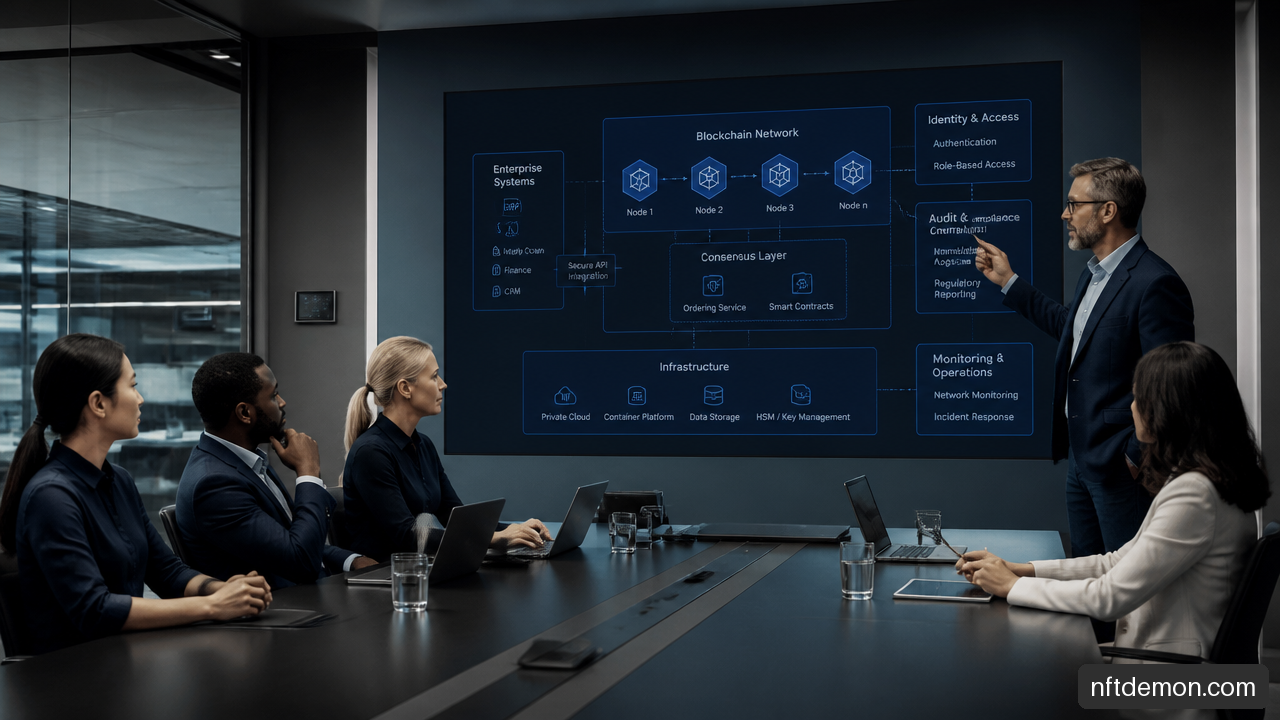
A blockchain consulting firm should be capable of assessing the whole enterprise architecture. Smart contracts are only one layer. Production systems also need integration services, APIs, identity controls, data storage, monitoring, administrative tooling, resilience planning, and user workflows.
Ask the firm to walk through a failure scenario. For example: an ERP system submits a shipment event, the blockchain transaction confirms, but the downstream warehouse system times out. What is the source of truth? How is the event reconciled? Who detects the failure? Can the process be replayed safely without creating duplicate records?
The answer should cover idempotency, event handling, reconciliation, audit logs, error queues, and operational ownership. If the discussion remains limited to transaction confirmation, the firm may be optimized for demonstrations rather than enterprise deployment.
Require identity, key management, and custody mapping
Key management deserves its own diligence session. In blockchain systems, control of a private key can confer the ability to approve transactions or administer assets. That creates a security, operational, and governance question at the same time.
A production ready vendor should document:
| Control area | Questions for the consulting firm |
|---|---|
| Identity | How will employees, partners, service accounts, and administrators authenticate? |
| Authorization | Which roles can initiate, approve, administer, pause, or upgrade transactions? |
| Key custody | Who generates, holds, rotates, backs up, and retires keys? |
| Recovery | What happens when a signer leaves, loses access, or is compromised? |
| Segregation | Can one individual deploy code, approve transactions, and alter access controls? |
| Auditability | Which actions are logged, retained, and reviewed? |
Identity should integrate with existing enterprise controls where possible. The CISA Zero Trust Maturity Model reinforces the relevance of identity centered access and continuous verification for enterprise systems. A consultant should be able to translate that principle into concrete integration choices, such as federated identity, privileged access controls, device policies, and service account governance.
Ask for secure delivery evidence, not security claims
A consultant may say that security is “built in.” That is not enough. Production procurement should require evidence of the practices used to reduce defects and respond to vulnerabilities.
The NIST Secure Software Development Framework makes secure development and vulnerability management relevant selection criteria because it spans requirements, design, implementation, verification, and remediation. In practice, ask to see how the firm handles threat modeling, peer review, dependency scanning, secrets management, test coverage, release approvals, and vulnerability disclosure.
For smart contracts, clarify whether the firm performs internal review, commissions an independent audit, or both. An independent audit is not a guarantee of safety. It is a scoped review at a point in time. Still, a vendor that cannot explain audit scope, remediation workflow, or upgrade controls leaves the enterprise without a credible pre launch assurance path.
Use the NIST SP 800 53 security and privacy control families as a practical interview framework. Access control, audit logging, incident response, and system integrity are especially useful control areas for testing whether a vendor can support a real operating environment.
Match compliance competence to the use case
Compliance should influence vendor selection early, particularly in financial services, healthcare, government, telecommunications, and consumer programs involving customer data or tokens.
For healthcare workflows, the HHS HIPAA Security Rule guidance establishes that electronic protected health information must be safeguarded through appropriate access and security controls. A healthcare consultant should therefore explain how protected data stays off chain where appropriate, how identities are managed, and how audit requirements are met.
Public chain or token related structures can also raise legal questions that depend on the facts of the program. A consulting firm should not substitute for legal counsel. It should, however, know when to bring compliance and legal stakeholders into architecture decisions. A token model designed before legal review may require expensive redesign later.

Select for delivery governance and long-term operations
Evaluate the actual delivery team
Enterprises should assess the people who will perform the work, not only senior leadership who participates in the sales process. Request a proposed staffing plan showing architecture, smart contract engineering, integration engineering, security, product, quality assurance, cloud operations, and project governance responsibilities.
Interview the named technical lead and delivery manager. Ask each to explain the same architecture decision. Consistent, specific answers are encouraging. Conflicting answers may indicate that the delivery approach is still conceptual.
A strong statement of work should define:
- Business outcomes and acceptance criteria.
- Architecture and security deliverables.
- Integration responsibilities and test environments.
- Smart contract audit and remediation requirements.
- Deployment gates, rollback criteria, and change approvals.
- Documentation, training, source code, and intellectual property rights.
- Support scope, escalation paths, and service level objectives.
Separate network governance from code governance
Multi party blockchain programs require two governance systems. Code governance controls how software changes are proposed, reviewed, tested, approved, and deployed. Network governance controls who can join, vote, validate, pay fees, access records, resolve disputes, and leave the network.
These are not interchangeable. A technically elegant smart contract cannot settle a commercial dispute about incorrect source data, membership termination, or liability for an integration outage.
For a consortium, ask the consulting firm to produce draft operating rules before production launch. They should address membership criteria, voting thresholds, administrator powers, upgrade procedures, data sharing boundaries, dispute escalation, and continuity if a participant exits. Avoid a vendor that treats governance as a document to write after the network is live. That sequence often turns business disagreements into technical emergencies.
Make support and observability contractual
Post launch support is where a pilot becomes a production service. The firm should specify what it monitors, who receives alerts, how incidents are classified, and how recovery occurs.
At minimum, request observability for nodes, APIs, integration queues, smart contract events, administrative actions, infrastructure health, and failed transactions. Service level objectives should be measurable. “High availability” is too vague. A useful objective identifies the service, measurement window, target, exclusions, alert threshold, and reporting method.
Ask for an incident response model that covers preparation, detection, analysis, containment, recovery, and lessons learned. The hard question is not whether the firm has an on call contact. It is whether that contact can coordinate with your security operations center, cloud team, application owners, legal team, and affected partners during a material event.
Protect portability and exit options
Vendor lock in can arise through proprietary code, undocumented infrastructure, exclusive control of deployment credentials, or a network design that cannot be handed over. It may be reasonable to accept some platform dependency when it produces clear operational value. It is less reasonable to accept consultant dependency by accident.
Include exit provisions for source code access, infrastructure as code, documentation, administrative credentials, data export, key handover, transition assistance, and ongoing third party audit materials. If a firm cannot describe how another qualified team could operate the system, the enterprise should consider that a risk signal.
Frequently asked questions
What makes a blockchain consultant qualified for enterprise production work?
Qualification is demonstrated by relevant production evidence, enterprise integration capability, security engineering, governance design, and post launch operating support. A firm should show how these disciplines work together for a use case similar to yours, not merely list them as services.
Should an enterprise hire a consulting firm or a general software vendor?
Choose a blockchain consulting firm when the work requires specialized decisions around network architecture, smart contracts, token mechanics, key custody, consortium governance, or chain specific security. Choose a general software vendor when blockchain is a small component of an otherwise conventional application and the vendor can demonstrate credible specialist support. For complex deployments, a blended model may be appropriate.
How do you verify production deployment experience?
Request a walkthrough of a deployed system, architecture documentation, measurable operating outcomes, security assurance artifacts, and references able to discuss delivery and support. Confidentiality may limit detail, but a credible firm should still explain its role, constraints, and results with enough specificity for diligence.
What security questions should enterprises ask before signing?
Ask about identity integration, privileged access, key generation and recovery, smart contract audit scope, secure development controls, dependency management, logging, alerting, incident response, and rollback procedures. Also ask who is accountable when a third party auditor, cloud provider, or subcontractor is involved.
How should compliance affect vendor selection?
Compliance should shape architecture and staffing from the start. For regulated data, financial activity, healthcare information, or cross border participation, select a firm that can work constructively with internal legal, privacy, risk, and security teams. Avoid vendors that frame compliance as a late stage documentation task.
What should a production support model include?
It should include monitoring, alerting, incident severity definitions, escalation paths, maintenance windows, patching responsibilities, release management, backup and recovery procedures, reporting, and clearly stated service level objectives. Support must cover integrations and operational tooling, not only blockchain nodes.
How do enterprises avoid vendor lock in after launch?
Require contractual rights to source code, documentation, infrastructure configurations, deployment credentials, data export methods, and transition support. Confirm that the architecture is understandable and operable by another qualified team. Portability should be tested as part of handover planning, not assumed.
What are red flags that a firm is only ready for pilots?
Warning signs include vague case studies, no named delivery team, no explanation of key custody, no independent security review path, weak integration answers, unclear support commitments, and claims that governance can be solved later. A pilot focused firm usually demonstrates features; a production focused firm demonstrates controls, operations, and accountability.
Sources
- NIST SP 800-218, Secure Software Development Framework (SSDF)
- NIST IR 8202, Blockchain Technology Overview
- NIST SP 800-53 Rev. 5, Security and Privacy Controls for Information Systems and Organizations
- HHS, HIPAA Security Rule
- CISA, Zero Trust Maturity Model
Related: Blockchain consulting services at NFT Demon Holdings, or start a conversation about your deployment requirements.