How to Design Enterprise Blockchain Architecture for Security and Scalability
By Jeremy Ryan, Founder & CEO · September 2026
Designing enterprise blockchain architecture for security and scalability starts with a blunt question: does this workflow actually need shared, tamper evident state across organizations or trust boundaries? If the answer is yes, the architecture must be built around identity, finality, privacy, key custody, throughput, and recovery from the first design session. Adding those controls after a pilot is live is expensive and often disruptive.

Choose The Architecture From The Workload
Enterprise blockchain architecture is the combination of network topology, consensus mechanisms, identity services, smart contracts, data storage, integration services, and governance controls that determine how participants create and verify shared records. NIST describes blockchain as a tamper resistant distributed ledger maintained through participant consensus; its Blockchain Technology Overview also distinguishes permissioned and permissionless participation models and highlights key enterprise security considerations.
I recommend starting with the workflow rather than the chain. Document who writes records, who reads them, which parties can dispute a transaction, how quickly the business needs finality, and what information must remain confidential. A supply chain provenance process, for example, may accept minutes of finality but require many independent organizations to verify product history. A treasury approval process may need immediate policy enforcement, restricted membership, and a durable evidence trail.
Select A Network Model Based On Trust Boundaries
The right network is not automatically private or public. It depends on who must independently verify the record and whether public settlement has business value.
| Workload Characteristic | Suitable Architecture Pattern | Why It Fits | When To Avoid It |
|---|---|---|---|
| Known counterparties, private commercial data, controlled governance | Permissioned consortium network | Identities, validator roles, and data access can be governed contractually | Avoid when neutral public verification is the core product value |
| One enterprise maintains most nodes and users | Private network or permissioned internal ledger | Lower operational complexity and tighter access control | Avoid if the design merely recreates a conventional database without a shared trust problem |
| Public asset settlement or independently verifiable consumer activity | Public chain with application controls | Broad verification and established liquidity may matter | Avoid for raw regulated business data or confidential workflows |
| Private workflow with public proof requirements | Hybrid architecture | Sensitive operations remain restricted while proofs or settlement can be anchored externally | Avoid if bridge and synchronization risks outweigh the value of public verification |
Permissioned networks are often appropriate when participants are known and governance is contractual. In a Hyperledger Fabric style deployment, membership services establish recognized identities, while channels and private data collections can limit transaction visibility to authorized members. The Hyperledger Fabric documentation on private data describes these mechanisms along with endorsement policies that determine which organizations must approve a transaction.
That distinction matters. A shared network with ten members does not need all ten members to see every invoice, health record, pricing term, or legal document. It may need all members to verify that an authorized event occurred. Design the difference deliberately.
Use A Workload Decision Matrix Before Selecting Consensus
Consensus is both a security mechanism and a performance decision. It defines who can propose blocks, who validates them, how faults are tolerated, and when a transaction is treated as final. For enterprise systems, the most useful measure is rarely theoretical transactions per second. It is whether the network can meet a defined workload at an agreed finality threshold during normal operation and degraded conditions.
| Decision Input | Low Complexity Pattern | Higher Assurance Or Scale Pattern | Design Implication |
|---|---|---|---|
| Write volume | Limited business events | Continuous high volume event streams | Batch, aggregate, or move frequent events off chain |
| Read volume | Participants query node state directly | Applications serve many read requests | Use indexed replicas, caches, and APIs outside the consensus path |
| Finality need | Eventual or delayed settlement is acceptable | Irreversible business action requires prompt finality | Favor deterministic finality and define timeout handling |
| Participant trust | Single operator or tightly managed group | Multiple firms with competing interests | Increase validator independence and require multi organization endorsement |
| Privacy requirement | Metadata can be visible to members | Records, identities, or commercial terms must be restricted | Use private collections, encryption, selective disclosure, or off chain records |
For a consortium, a Byzantine fault tolerant or crash fault tolerant permissioned consensus design may offer predictable finality and throughput because validator membership is controlled. The tradeoff is governance concentration: removing, adding, or recovering validators becomes a formal business and security process. For public settlement, proof based designs typically offer stronger open participation properties but can introduce variable fees, confirmation timing, and capacity constraints.
Architecture principle: Define the business meaning of finality before choosing a consensus mechanism. A transaction that is technically included but operationally reversible under policy is not final enough for settlement, release of goods, or regulated approval.
Build Security Across Control, Data, And Key Boundaries
A secure blockchain network is not secured by consensus alone. Smart contracts, administrator accounts, certificate authorities, node hosts, API gateways, cloud identities, relayers, and recovery procedures all create attack paths. The practical approach is to separate security controls into three boundaries: the control plane, the data plane, and key custody.
Protect The Control Plane With Zero Trust
The control plane includes validator administration, node configuration, contract deployment, certificate issuance, network membership, backup recovery, and monitoring access. These actions can alter the network itself. Treat them as privileged production changes, not ordinary application administration.
NIST's Zero Trust Architecture guidance supports explicit policy based separation among blockchain administration, signing, and infrastructure privileges rather than relying on a trusted network location.
I would separate these roles at minimum:
• Network operator: Maintains node availability but cannot independently deploy contracts or sign high value business transactions.
• Release approver: Reviews and authorizes a versioned smart contract or configuration package but does not manage validator infrastructure.
• Transaction signer: Uses narrowly scoped authority to approve business actions within policy limits.
• Identity administrator: Manages certificates, revocation, and onboarding without unrestricted access to ledger data.
• Incident responder: Receives time limited emergency access with full audit logging and independent approval.
Use separate cloud accounts or projects, separate credentials, and separate deployment environments for development, testing, staging, and production. A developer wallet should never have production deployment authority merely because it belongs to an approved engineer. Fair warning: a single shared administrator credential can defeat an otherwise sophisticated consensus model.
Treat Key Custody As A Core Architecture Layer
Private keys and validator credentials are often more valuable to an attacker than the blockchain data itself. If a key can approve a transfer, endorse a transaction, deploy a contract, or operate a validator, compromise can produce valid looking malicious activity.
Use hardware security modules for high value keys where possible, and consider multi party computation or multisignature approval when no individual should control a critical action. The pattern should reflect risk. A service account that signs frequent low value workflow events may use automated HSM backed signing with transaction limits. A contract upgrade, validator membership change, or high value settlement should require multiple independently controlled approvals.
Recovery is equally important. Maintain encrypted backup material, documented custody procedures, and a tested key rotation process. Do not assume a key can simply be replaced after compromise. In a permissioned network, rotation may affect certificates, endorsement policies, peer trust stores, and downstream applications simultaneously.
Keep Sensitive Business Data Off Chain By Default
On chain storage is best for state that must be independently verified: hashes, timestamps, signatures, identifiers, entitlement status, approval state, and proofs of document integrity. It is usually a poor location for raw customer records, contracts, personally identifiable information, medical information, or large media files.
Consider an invoice dispute workflow. The invoice document and detailed line items can remain in a controlled repository with enterprise retention controls. The ledger stores a cryptographic hash of the document, a version identifier, the approved parties, and the event history. Later, an auditor can hash the retained document again and verify whether it matches the committed proof. This reduces ledger bloat and limits exposure if a node is replicated to multiple organizations.
Encryption does not solve every privacy problem. Encrypted data stored permanently on a ledger can become readable if keys are later compromised or cryptography weakens. It can also leave sensitive metadata visible, such as which organizations transacted and when. Use private data collections, encrypted off chain records, and selective disclosure when the confidentiality model requires them.
Smart contracts need similarly disciplined controls. Test authorization logic, integer and rounding behavior, replay protection, state transitions, upgrade permissions, external calls, denial of service conditions, and emergency pause behavior. A contract audit is valuable, but it does not replace threat modeling the surrounding APIs, wallet flows, and administration process.
Scale Without Weakening Finality Or Auditability
Scalability failures usually appear outside the ledger first: overloaded API gateways, slow identity checks, database contention in off chain services, queue backlogs, or relayers that cannot submit transactions quickly enough. Still, blockchain design choices determine how much work every node must repeat. If every validator executes every transaction and stores every record, throughput will eventually hit a practical ceiling.
Remove Non Consensus Work From The Critical Path
The cleanest scaling strategy is to reserve the ledger for shared state transitions that require collective verification. Search, analytics, reporting, document storage, notifications, and most high volume reads should be handled by purpose built services that consume verified ledger events.
For example, a product traceability platform may record custody changes and compliance attestations on chain. The customer portal can query an indexed read model rather than asking validators to process thousands of identical history requests. The ledger remains the source of truth; the read model becomes the source of speed.
This architecture introduces a tradeoff: read replicas can be temporarily behind the chain. Applications should display status such as “pending confirmation” and should be able to reconcile indexed data against a block height, transaction ID, or event sequence.
Choose Layer 2, Sidechains, Or Sharding For Specific Constraints
Layer 2 systems move execution or transaction processing away from a base layer, then settle results back on chain. The Ethereum Foundation's Layer 2 explanation describes this approach as a way to improve scalability while later settling transactions on the base chain. Rollups can inherit security properties from their settlement layer, but operational performance and withdrawal behavior depend on the specific implementation.
| Scaling Method | Best Fit | Main Benefit | Principal Risk Or Tradeoff |
|---|---|---|---|
| Off chain records with on chain hashes | Confidential documents and large files | Lower storage load and reduced data exposure | Requires durable retention and proof verification workflows |
| Read replicas and indexed event stores | High query volume | Fast user and reporting experiences | Eventual consistency and reconciliation complexity |
| Rollups or Layer 2 | Public chain applications with high transaction volume | Batching can reduce base layer workload | Sequencer, bridge, settlement, and exit assumptions require review |
| Sidechains | Workloads needing isolated execution rules | Independent capacity and configurable fees | Security may not be equivalent to the connected main network |
| Sharding | Large distributed networks with separable state | Parallel transaction processing | Cross shard coordination can complicate application logic |
Choose sharding only if the application can partition data or transactions cleanly. A network where every workflow touches the same global inventory balance may gain little from sharding because cross shard coordination becomes the bottleneck. Choose a sidechain when isolation and independent operations matter, but do not describe it as equally secure to the main network unless its validator model and bridge controls demonstrate that property.
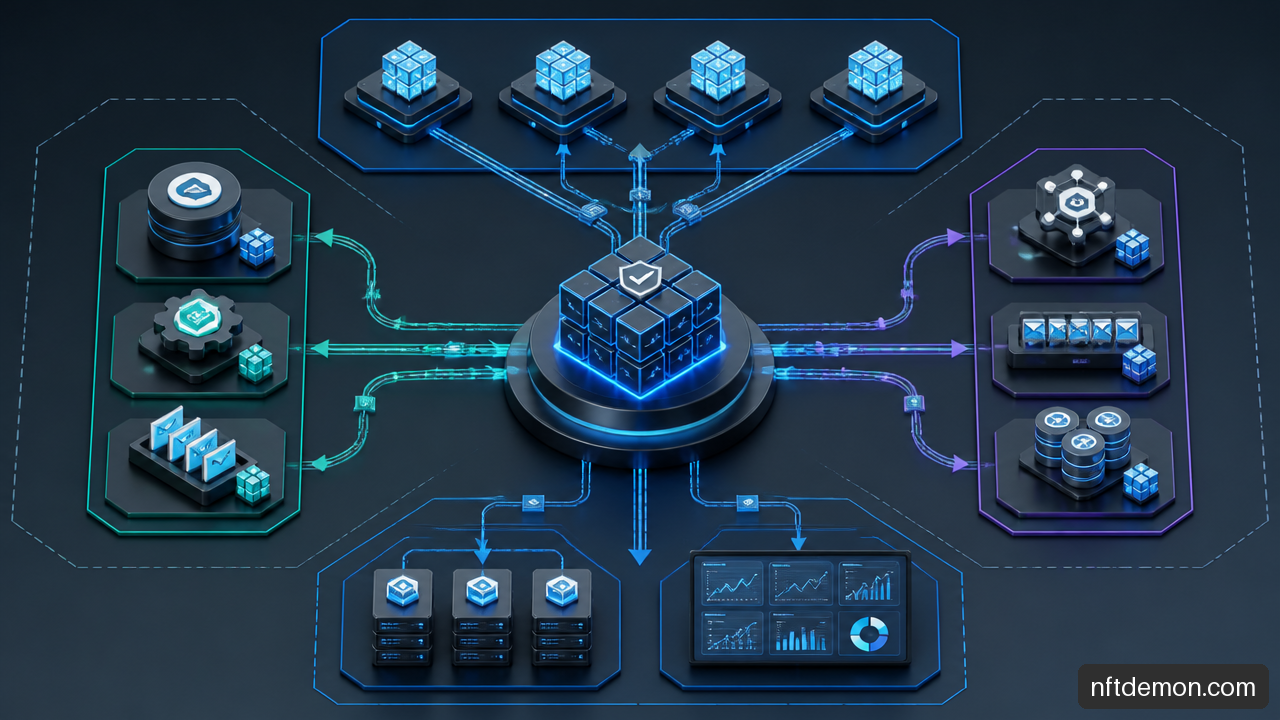
Design For Congestion And Stuck Finality
A scalable design includes what happens when it stops scaling. Define transaction expiry, retry behavior, queue limits, idempotency keys, and manual exception handling before production.
If finality stalls, applications should not blindly resubmit the same payment or approval. They should check whether the transaction was accepted, whether it remains pending, and whether a duplicate would create a second business obligation. Idempotency identifiers should tie the blockchain transaction to the ERP order, case number, or payment instruction.
For congestion, prioritize transaction classes. A routine telemetry event can wait. A safety recall, settlement cutoff, or regulatory hold may need a reserved capacity lane or a separate emergency workflow. This is not an argument for bypassing controls. It is an argument for defining which controls and service levels apply under stress.
Operate The Network As A Critical Enterprise System
Production readiness requires more than deployed nodes. It requires governance that can safely change the network, observability that can explain a failed transaction, and incident procedures that preserve evidence while restoring service.
Establish Governance Before The First Production Transaction
Governance should specify who can join the network, host validators, issue identities, approve upgrades, modify endorsement policies, rotate keys, and suspend a compromised participant. In a consortium, these decisions should not sit in informal chat threads or undocumented administrator habits.
Use versioned governance policies and a formal change path. For high impact changes, require review from security, operations, business ownership, and participating organizations. Contract upgrades deserve particular caution. A technically correct upgrade can still alter commercial rights, data visibility, or finality behavior.
Build End To End Observability
A blockchain transaction often passes through a user interface, wallet or signer, API gateway, identity provider, queue, relayer, node, smart contract, event processor, and enterprise system. Monitoring only the nodes leaves operational blind spots.
Capture correlated identifiers across each component:
• User or service identity, without exposing unnecessary personal data
• Request and idempotency identifier
• Wallet or signing policy identifier
• Transaction hash and block reference
• Smart contract version and endorsement result
• API, queue, relayer, and node latency
• ERP or external system reconciliation status
NIST's Security and Privacy Controls for Information Systems and Organizations supports the use of audit logging, access enforcement, configuration management, and incident response controls for critical enterprise operations.
Plan Failure Modes And Recovery Actions
The incident plan should differentiate between a failed node and a compromised validator. A failed node is an availability event. A compromised validator may be an integrity event that requires revocation, evidence preservation, membership changes, key rotation, and potentially a coordinated network decision.
For bridges, oracles, and API middleware, define a separate trust assessment. A ledger may be secure while an oracle supplies manipulated data or a bridge incorrectly represents an external asset. Limit bridge permissions, validate external data sources, monitor message delays, and establish a safe pause process for anomalous transfers.
Key Takeaways
• Build from the business workflow, trust boundary, privacy requirement, and finality target rather than from a preferred blockchain platform.
• Use permissioned identity, endorsement, and data visibility controls when known organizations need governed collaboration.
• Separate the control plane, transaction signing, infrastructure operations, and recovery authority under zero trust policies.
• Keep sensitive records and large documents off chain when hashes and proofs can preserve integrity with less exposure and lower storage cost.
• Scale by moving reads, files, analytics, and non consensus work outside the validator path before adding complex chain scaling mechanisms.
• Treat observability, congestion handling, validator compromise, and governance changes as architecture requirements, not operating afterthoughts.
Frequently Asked Questions
What Architecture Is Best For An Enterprise Blockchain?
A permissioned consortium is usually the strongest fit when several known organizations need shared records, controlled membership, and restricted data access. Choose a hybrid design only when public verification or settlement produces clear business value. A private chain controlled by one organization may be appropriate for internal integrity workflows, but the team should first verify that a conventional database cannot meet the same need more simply.
Which Consensus Mechanism Supports High Throughput?
For a known group of enterprise participants, permissioned consensus designs with deterministic finality can support predictable workflow processing. The right choice depends on the number of validators, fault assumptions, geographic distribution, and required finality. Do not select consensus solely on advertised transactions per second; test sustained performance using realistic transaction sizes, endorsement rules, and failure conditions.
How Should Enterprise Blockchain Keys Be Protected?
Keep production signing keys in HSMs or equivalent protected custody systems, limit signing authority by transaction type and value, and require multiple approvals for high impact actions. Separate validator keys from application wallet keys and deployment credentials. Test rotation and recovery procedures before an incident forces the issue.
Should Business Data Be Stored On Chain Or Off Chain?
Store proofs, hashes, permissions, timestamps, and state transitions on chain when participants need independent verification. Keep sensitive content, large files, and mutable business records in controlled off chain systems when retention, deletion, access control, or privacy requirements are stronger than the need for universal replication.
How Do Layer 2 Systems Improve Enterprise Blockchain Scalability?
Layer 2 systems can batch or execute transactions away from a base chain before settling results on it. They can be useful when public chain settlement is required but direct base layer execution is too slow or costly. Evaluate the specific design's sequencing, bridge, data availability, withdrawal, and operational support model before treating it as a simple performance upgrade.
What Must Be Monitored In A Production Blockchain Network?
Monitor node health, consensus progress, block production, validator connectivity, certificate expiry, signer activity, smart contract errors, relayer queues, API latency, bridge or oracle messages, and enterprise system reconciliation. Correlate events using transaction and request identifiers so operations teams can identify where a workflow failed rather than only seeing that it failed.
Sources
-
NIST — Blockchain Technology Overview: https://csrc.nist.gov/pubs/ir/8202/final
-
NIST — Zero Trust Architecture: https://csrc.nist.gov/pubs/sp/800/207/final
-
NIST — Security and Privacy Controls for Information Systems and Organizations: https://csrc.nist.gov/pubs/sp/800/53/r5/final
-
Hyperledger Fabric Documentation — Private Data: https://hyperledger-fabric.readthedocs.io/
-
Ethereum Foundation — Layer 2: https://ethereum.org/en/layer-2/
NFT Demon Holdings helps enterprises scope, evaluate, and build blockchain programs — start with a free evaluation call.
Talk through your use case
Free evaluation call — objective, constraints, and fit, before any proposal.