Enterprise Blockchain Architecture Patterns for Regulated Industries
By Jeremy Ryan, Founder & CEO · September 2026

Enterprise blockchain architecture patterns for regulated industries should be designed around control objectives before technology choices. The useful question is not whether a distributed ledger is innovative. It is whether several organizations need a shared, tamper evident workflow while retaining confidentiality, accountable governance, supervisory access, and reliable integration with systems of record.
A ledger rarely replaces core banking, health record, ERP, claims, or public records platforms. In most viable designs, it coordinates trust between organizations while established systems remain authoritative for detailed operational data. That distinction prevents a common failure: putting too much sensitive data, too much business logic, and too much regulatory responsibility into an immutable network.
Architecture Decisions Before Platform Selection
Key Takeaways
• Choose a blockchain only when multiple parties must maintain a shared state and none should unilaterally control changes.
• Treat the ledger as a coordination and evidence layer, not automatically as the primary system of record.
• Design privacy, retention, identity, and supervisory access before writing smart contracts.
• Prefer deterministic finality for workflows involving regulated settlement, ownership transfer, or irreversible approval states.
• Make governance operational: node admission, key recovery, access reviews, incident response, and dispute handling need named owners.
Start With The Control Objective, Not The Ledger
A conventional database is usually the better choice when one organization owns the process, participants already trust that operator, and audit requirements can be met through ordinary access logs and controls. Adding DLT in that situation often creates duplicated data, harder incident response, and governance overhead without removing a meaningful trust problem.
A blockchain architecture becomes defensible when several legally independent parties need to reconcile the same events, each has limited authority over the others, and the sequence of approvals or custody transfers matters. Consider pharmaceutical distribution: manufacturers, wholesalers, dispensers, logistics providers, and possibly regulators may need to verify product lineage. A shared ledger can establish a common chronology of identifiers, transfers, and exceptions without requiring every participant to surrender control of its internal systems.
The design choices are material. NIST’s blockchain technology overview explains that identity, permissions, and consensus decisions affect whether a blockchain design is suitable for a regulated deployment. That is why platform selection should follow architecture design, not substitute for it.
Define The System Of Record Boundary
The most durable pattern draws a precise boundary between the ledger and enterprise applications. The ledger should hold evidence that needs collective agreement: transaction identifiers, state transitions, approval proofs, document hashes, policy versions, and signatures. Systems of record should retain detailed customer files, protected health information, contracts, images, analytics, and documents that require editing, deletion, or complex reporting.
This hybrid boundary matters because an immutable ledger can preserve proof without becoming a permanent repository for sensitive content. If a patient consent document changes, for example, the document management system can retain the current version under healthcare controls. The ledger can record the consent event, the authorized party, the applicable purpose, a timestamp, and a cryptographic reference to the approved document version.
A ledger should establish what happened and who authorized it. A regulated system of record should retain the sensitive business content and lifecycle controls around that event.
Choose Finality Based On The Business Consequence
Finality is the point at which a network treats a transaction as complete and no longer subject to reversal through ordinary consensus activity. This is not a minor infrastructure detail. It determines when an institution can release funds, transfer ownership, close a compliance case, or report a settled obligation.
Permissioned networks commonly use consensus approaches intended to provide deterministic finality: once required validators approve a transaction, its state is final under the network rules. Public networks may rely on probabilistic finality, where confidence rises after additional blocks or confirmations. Either approach can work, but the workflow must match the model.
For tokenized securities settlement or an interbank obligation, deterministic finality is generally easier to align with cutoffs, accounting events, and exception handling. For a low consequence provenance timestamp, waiting for additional confirmations may be acceptable. Fair warning: deterministic finality does not eliminate legal disputes, operational reversals, or erroneous instructions. The architecture still needs a superseding transaction process and a clear definition of who can authorize corrective action.
Compliance Controls As An Architecture Layer
Map Requirements To Technical Controls
Compliance should not be treated as a report generated after deployment. It should shape transaction structure, identity rules, data placement, and operational evidence from the first design workshop. The table below translates common control objectives into design mechanisms.
| Control Objective | Architecture Mechanism | Practical Design Question |
|---|---|---|
| Confidentiality | Private channels, selective disclosure, encryption, off chain data stores | Which participants need each field, rather than merely the transaction? |
| Segregation Of Duties | Role based approvals, separate signing keys, workflow states | Can one person initiate, approve, and execute a material action? |
| Retention And Disposition | Off chain records repository, hash anchors, superseding entries | How will the organization meet retention expiration or legal hold rules? |
| Auditability | Signed events, immutable references, exportable audit logs | Can an examiner reconstruct a decision without viewing unrelated data? |
| Supervisory Access | Read only observer access, reporting APIs, controlled evidence exports | What evidence must be available during an examination or investigation? |
| Operational Resilience | Backup nodes, key recovery procedures, tested incident playbooks | What happens if a validator, identity provider, or signing service fails? |
For financial institutions, control discipline extends beyond the ledger itself. FFIEC guidance on architecture, infrastructure, and operations supports the expectation that regulated financial institutions manage governance, risk, and technology operations carefully. A distributed system does not transfer that responsibility to a consortium or software provider.
Privacy Means More Than Encrypting Payloads
Encryption protects content, but transaction metadata can still expose commercially sensitive relationships. Timestamps, transaction frequency, participant identifiers, asset types, and approval patterns may reveal that two firms are negotiating, treating a particular patient population, or responding to a supply disruption.
A need to know transaction sharing pattern limits visibility to the parties that must see a transaction. A selective disclosure pattern allows a participant to prove a fact, such as a valid license or completed sanction screening, without revealing the underlying record. A private data collection or encrypted sidecar pattern restricts sensitive fields while placing a shared proof of integrity on the main ledger.
In regulated capital markets, a transaction may be visible only to the buyer, seller, required intermediaries, and designated oversight functions. The network can still validate the state change while avoiding broad replication of sensitive trade details. The tradeoff is complexity: authorization policies, key distribution, and evidence retrieval must be carefully tested. Privacy is not achieved simply because the network is permissioned.
Design For Correction, Retention, And Examination
Immutability creates a useful evidentiary trail, but it does not override records management. U.S. National Archives records management requirements emphasize that regulated record systems must preserve retention and disposition obligations. An immutable event history alone cannot decide when a record must be retained, placed on legal hold, transferred, or disposed of.
The safer pattern is append only correction. Do not alter the original event. Instead, submit a signed superseding event that references the prior transaction, explains the correction category, and updates the effective state. Keep personal or sensitive information off chain where deletion, amendment, or retention controls may be required.
For healthcare, the constraint is sharper. HHS guidance on the HIPAA Security Rule establishes that systems handling protected health information must protect it through access control and auditability. A consent ledger can be useful, but writing PHI directly to replicated nodes is usually a poor default. Store the minimum proof needed to demonstrate an authorized disclosure, and preserve the underlying clinical information in systems built for PHI governance.
Core Patterns And When To Use Them
Private Workflow Ledger
A private workflow ledger is operated by one organization for controlled processes involving internal divisions, subsidiaries, or tightly governed external service providers. It can be appropriate for high value approvals, controlled asset movements, regulated document attestations, or internal reconciliation where tamper evident sequencing adds value.
Choose this pattern when a single institution must retain operational control but wants stronger evidence and shared workflow integrity across organizational boundaries. Avoid it when the process is entirely internal and existing workflow tools already provide sufficient auditability. The ledger’s cost must be justified by a real assurance gap.
Smart contracts in this pattern should automate narrow rules: required approver thresholds, date based eligibility, exception routing, and state transitions. They should not attempt to encode ambiguous legal judgment. If a policy requires human interpretation, have the smart contract route the case to a qualified reviewer and record the decision basis.
Consortium Settlement And Provenance Network
A consortium blockchain is governed by several organizations that jointly define membership, technical standards, cost allocation, liability, voting rights, and dispute processes. It fits multi party settlement, supply chain provenance, shared compliance attestations, and data exchange among counterparties.
This model is compelling when reconciliation delays and inconsistent records are costly. It is also politically difficult. A technically strong consortium can stall if members cannot agree on onboarding standards, validator costs, data ownership, or change control.
| Scenario | Recommended Pattern | Why It Fits | Primary Caution |
|---|---|---|---|
| Interbank obligation workflow | Consortium ledger with deterministic finality | Multiple institutions need a shared settlement state | Legal finality and exception governance must be explicit |
| Drug traceability | Consortium provenance ledger with off chain product data | Custody events and product identifiers cross many firms | Data standards and participant onboarding can become bottlenecks |
| Internal compliance approvals | Private workflow ledger | One accountable operator controls roles and policy | A conventional workflow system may be enough |
| Tokenized asset lifecycle | Consortium or hybrid control plane | Issuers, custodians, transfer agents, and investors need coordinated controls | Custody, transfer restrictions, and reporting remain external obligations |
Hybrid Control Plane With Off Chain Systems Of Record
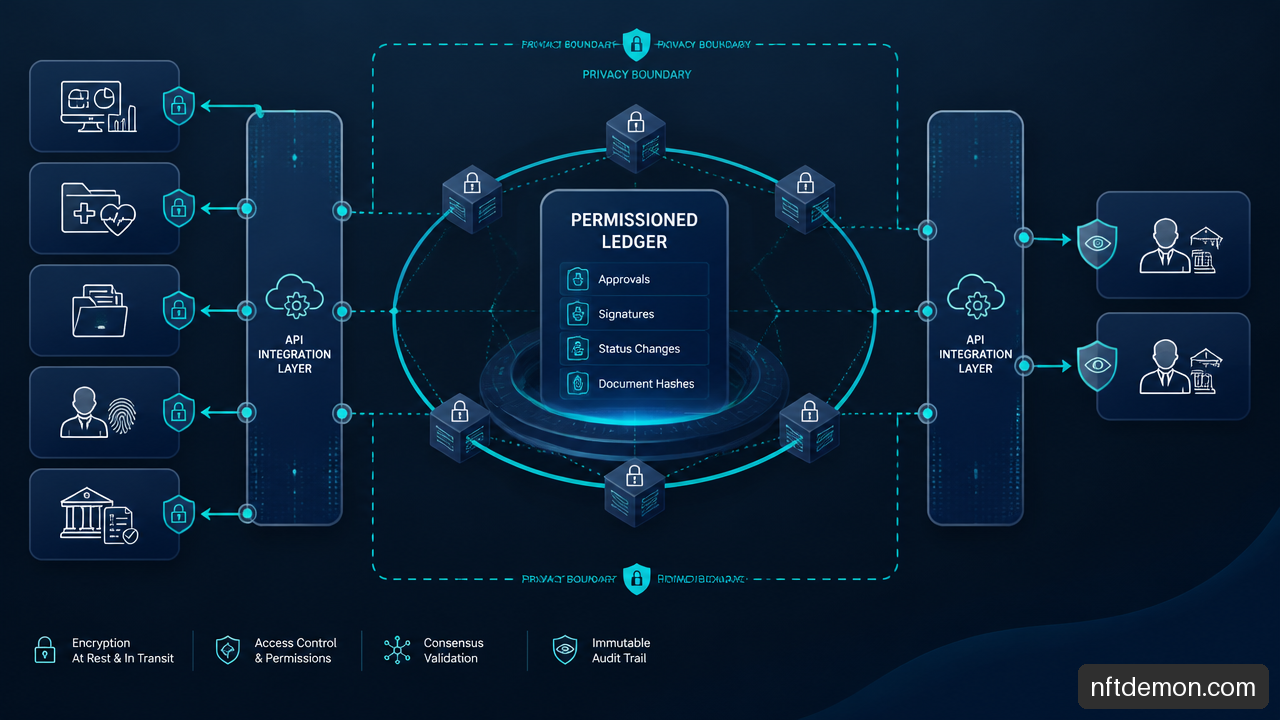
The hybrid control plane is often the most practical enterprise pattern. It places cross organization proofs, approvals, status changes, and policy checks on chain while retaining detailed business data in existing applications. APIs and middleware connect the ledger to ERP, IAM, case management, document, payment, and reporting systems.
Use it when privacy, data volume, correction needs, or integration requirements make a ledger only architecture unsafe or inefficient. In a trade finance workflow, the ledger might record that a document package was submitted, validated, approved, or rejected. The documents themselves remain in a controlled repository, with content hashes allowing each party to verify that the reviewed artifact has not changed.
The hard part is not hashing a document. It is handling failure between systems. If the ledger records approval but the ERP posting fails, the integration layer needs an idempotent retry mechanism, a reconciliation queue, and a visible exception state. Without these controls, the shared ledger can become another source of mismatch rather than the resolution mechanism.
Regulator Ready Observer Pattern
Some networks may need to provide supervisory visibility without giving a regulator transaction signing authority or unrestricted access to every participant’s data. An observer pattern can support this through read only nodes, filtered data views, evidence export APIs, or event subscriptions designed for examinations.
The appropriate model depends on legal authority, confidentiality constraints, and the regulator’s actual operational needs. There is no universal requirement that every regulator operate a node. In some cases, a well governed reporting interface with cryptographically verifiable evidence may be more workable than direct node operation.
The key principle is testability. If an examination requires reconstruction of an asset transfer, the design should show the applicable policy version, authorized identities, signatures, timestamps, related off chain records, and correction history without relying on informal spreadsheet exports.
Operating The Network As A Regulated Service
Membership, Identity, And Key Management
A permissioned blockchain is only as controlled as its membership process. Each organization needs a documented path for admission, identity proofing, certificate issuance, role assignment, periodic access review, suspension, and offboarding. An entity may operate a valid node while an individual user’s authority has expired; architecture must handle both levels.
Use enterprise IAM to authenticate people and applications, while network identity establishes which legal entity is acting on the ledger. Verifiable credentials can complement this model by allowing a participant to present signed proof of a qualification or authorization. They do not eliminate the need for revocation status, issuer governance, or audit logging.
Key management deserves executive attention because a compromised signing key can create valid looking transactions. At minimum, use protected key storage, separation between administrative and transaction signing keys, rotation procedures, revocation capability, recovery controls, and tested emergency access procedures. Multi signature approval can enforce segregation of duties for material actions, but it also creates a recovery problem if signers are unavailable.
Governance Is A Daily Operating Model
Network governance is more than a charter. It is the operating model for decisions that will occur under pressure: a participant outage, a disputed transaction, a smart contract defect, a compromised credential, a proposed schema change, or a regulator’s evidence request.
A workable governance model assigns responsibility across three layers:
-
Business governance defines participation criteria, liability allocation, dispute resolution, pricing, and policy ownership.
-
Technical governance controls protocol upgrades, smart contract releases, node standards, interoperability specifications, and resilience testing.
-
Control governance manages access reviews, audit evidence, incident reporting, record retention, and independent assurance.
Deadlock is a predictable failure mode. If every member has veto power over routine upgrades, security patches can be delayed. If a dominant member controls all decisions, smaller participants may view the consortium as a proprietary platform rather than neutral infrastructure. Tiered voting, emergency change authority, and clearly limited veto rights can reduce both problems.
Measure Whether The Design Is Reducing Risk
A regulated blockchain project should be measured against its original control and process objectives, not transaction volume alone. Useful indicators include reconciliation exceptions, approval cycle time, evidence retrieval time, unauthorized access attempts, failed integration events, participant onboarding duration, and the percentage of transactions completed without manual intervention.
For instance, a provenance network might process thousands of events and still fail its purpose if product recalls require manual reconstruction across five systems. Conversely, a smaller network that lets authorized teams trace a product event and its supporting evidence within minutes may provide meaningful operational value.
I recommend treating the first production release as a controlled service, not a finished product. Run tabletop exercises for key compromise, inaccurate source data, a validator outage, and a contested transaction. The objective is to find the gap between the ledger’s theoretical integrity and the organization’s actual ability to operate it.
Frequently Asked Questions
When Does A Regulated Business Need Blockchain Instead Of A Normal Database?
Use blockchain when multiple independent parties need a shared state, cannot rely on one party as the sole editor, and benefit from tamper evident evidence of approvals or transfers. Use a conventional database when one organization controls the workflow and can meet audit, availability, and reconciliation needs without a shared ledger.
What Is The Difference Between A Permissioned, Private, And Consortium Blockchain?
A permissioned blockchain limits participation to approved entities. A private blockchain is usually controlled by one organization. A consortium blockchain is permissioned but governed by several organizations. These categories overlap: a consortium network is normally permissioned, while a private network may also use permissioned access.
What Should Stay On Chain Versus Off Chain?
Keep shared proofs, signatures, state transitions, identifiers, and policy references on chain. Keep PHI, confidential documents, large files, mutable customer data, detailed analytics, and records with deletion or complex retention requirements off chain. Connect the two with hashes, signed references, and resilient APIs.
How Do Smart Contracts Support Compliance Workflows?
Smart contracts can enforce deterministic rules such as approval thresholds, role checks, time windows, transfer restrictions, and required evidence references. They should escalate ambiguous, discretionary, or legally complex decisions to human review. Code can enforce a policy rule; it cannot reliably interpret every exception to that policy.
How Do You Protect Confidential Data On A Shared Ledger?
Use layered controls: controlled membership, need to know transaction sharing, encryption, selective disclosure, private data stores, and metadata minimization. Review transaction patterns as well as payloads. Even encrypted data can reveal sensitive commercial relationships through timing and volume.
How Should Regulators Interact With A Blockchain Network?
Design supervisory access around the required evidence, not a generic promise of transparency. Options may include a read only observer function, filtered reporting interfaces, cryptographically verifiable exports, and controlled access to linked systems of record. The correct model depends on the governing authority and confidentiality obligations.
What Are The Most Common Failure Modes?
Frequent failures include unclear consortium governance, placing sensitive data directly on chain, weak key recovery processes, unreliable ERP integration, smart contracts that cannot handle exceptions, and no correction or retention model. Each is preventable only if addressed as architecture and operating design, not as a post launch compliance task.
Sources And References
• NIST — Blockchain Technology Overview: https://csrc.nist.gov/pubs/ir/8202/final
• NIST — Blockchain Technology Overview (alternative landing page): https://www.nist.gov/publications/blockchain-technology-overview
• U.S. NARA — Records Management: https://www.archives.gov/records-mgmt
• FFIEC — IT Handbook / Architecture, Infrastructure, and Operations: https://ithandbook.ffiec.gov/
• U.S. HHS — HIPAA Security Rule: https://www.hhs.gov/hipaa/for-professionals/security/index.html
NFT Demon Holdings helps enterprises scope, evaluate, and build blockchain programs — start with a free evaluation call.
Talk through your use case
Free evaluation call — objective, constraints, and fit, before any proposal.