Decentralized exchange for RWAs, a decision-maker's guide
By Jeremy Ryan, Founder & CEO · October 2026
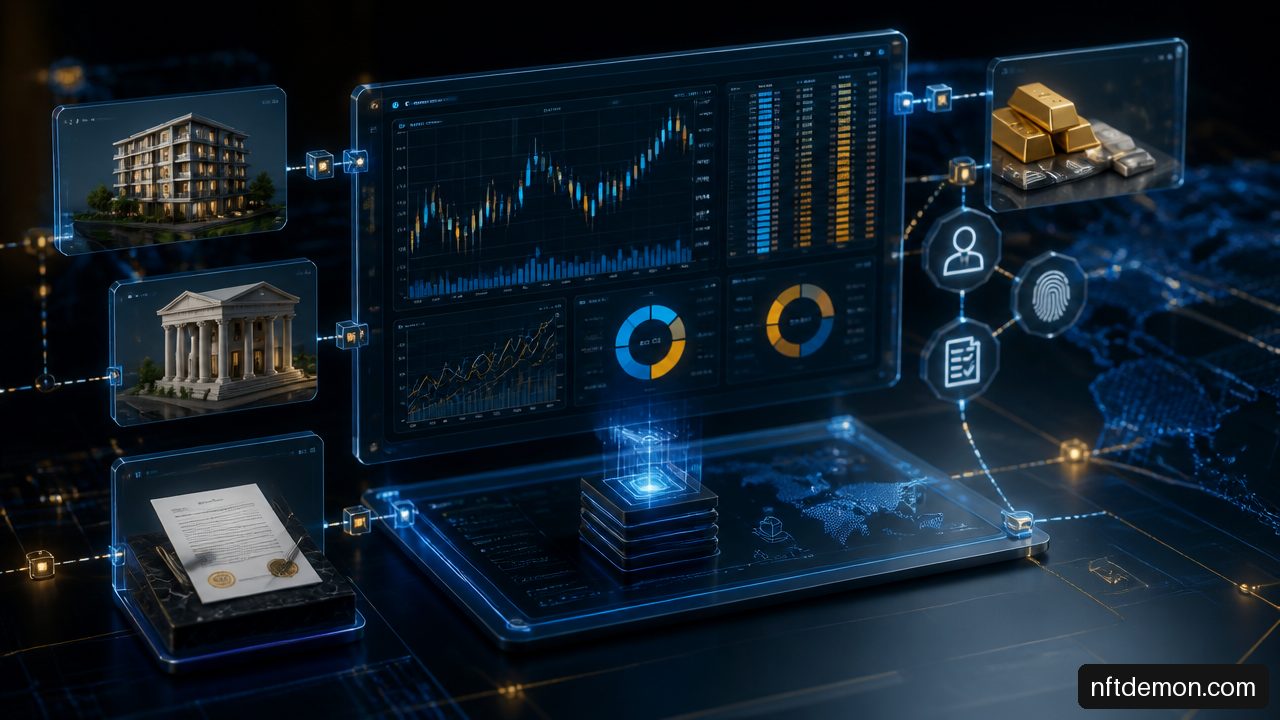
A decentralized exchange for RWAs is not simply a conventional crypto DEX with tokenized assets added to the menu. It is a trading and settlement system for blockchain tokens connected to offchain property, financial claims, income rights, or contractual obligations. That difference changes nearly every design decision: who can trade, which wallet can receive a token, how pricing works, what happens during a redemption, and whether a trade is legally and economically meaningful.
For decision makers, the central question is not whether tokenization can make an asset transferable. It can. The harder question is whether the exchange model preserves the asset’s legal rights, compliance rules, liquidity conditions, and operational controls after the token begins circulating.
A liquid token without enforceable redemption rights, verified backing, or compliant transfer logic may be technically tradable but economically weak.
- How A Decentralized Exchange for RWAs Works
- Choosing The Right Market Structure
- Compliance, Custody, And Transfer Controls
- Implementation And Due Diligence For Enterprises
- Key Takeaways
- FAQ: Decentralized Exchange for RWAs
How A Decentralized Exchange For RWAs Works
The Token Is A Rights Layer, Not The Asset Itself
An RWA token can represent very different legal and economic arrangements. It may evidence beneficial ownership in a fund, a claim on cash held by a custodian, participation in revenue, a debt instrument, or the right to redeem for an underlying asset. The blockchain record alone does not establish which of those rights exists.
This is why I would evaluate an RWA exchange in layers:
• Asset layer: What is the underlying asset, who owns it, and where is it held?
• Legal layer: What rights does the token holder receive, and under which governing documents and jurisdiction?
• Token layer: Does the smart contract accurately enforce the intended ownership, transfer, redemption, and administrative rules?
• Market layer: Can eligible buyers and sellers trade at credible prices with acceptable settlement risk?
• Operations layer: Who handles reconciliations, disclosures, corporate actions, disputes, freezes, and asset servicing?
Tokenization platforms frequently describe broad marketplace capabilities. For example, RWA Inc.’s documentation describes an integrated platform for tokenized real world assets and related marketplace functions. That stated scope is useful context, but it should not substitute for asset specific diligence into each listed instrument.
What Actually Happens During A Trade
On an unrestricted crypto DEX, a trade typically moves one token from Wallet A to Wallet B and another asset in the opposite direction. An RWA trade may add several checks before transfer is final.
- A buyer initiates a swap or accepts an order.
- The smart contract verifies that the buyer wallet is eligible to receive the token.
- The protocol may check jurisdiction, investor category, holding limits, lockups, sanctions screening status, or issuer approvals.
- The trade either settles onchain, fails, or waits for a permitted workflow such as offchain approval.
- The issuer, transfer agent, custodian, or administrator updates records where the legal structure requires it.
- The token holder may later redeem, hold, transfer, or receive distributions under the asset terms.
That is why a tokenized treasury product, private credit position, or real estate interest cannot be assessed like a meme token. Settlement is only complete when token movement, legal ownership records, and the underlying asset administration remain aligned.
What Makes An RWA DEX Different From A General Purpose DEX
General purpose DEXs generally optimize for permissionless composability. RWA markets often need selective participation. That tension is fundamental.
| Design Question | General Purpose DEX | Decentralized Exchange for RWAs |
|---|---|---|
| Participant access | Usually open to any wallet | May require identity verification and eligibility checks |
| Token transfers | Normally unrestricted | Often limited through whitelists or permissioned token rules |
| Settlement basis | Native crypto assets and smart contracts | Smart contracts plus legal, custody, and servicing processes |
| Price reference | Continuous crypto market activity | May rely on valuation reports, NAV, auctions, or limited trading |
| Administrative controls | Often minimized | May include freezes, redemptions, forced transfers, or corporate actions |
| Core risk | Smart contract and market volatility | Smart contract, legal enforceability, custody, valuation, and compliance risk |
RWA Inc. states in its published platform FAQ that tokenized assets may be traded through DEXs and that KYC is required at its participation tiers. This illustrates the central RWA reality: a venue can use decentralized settlement while still requiring identity controls.
Choosing The Right Market Structure
AMMs Are Useful, But Not Automatically Suitable
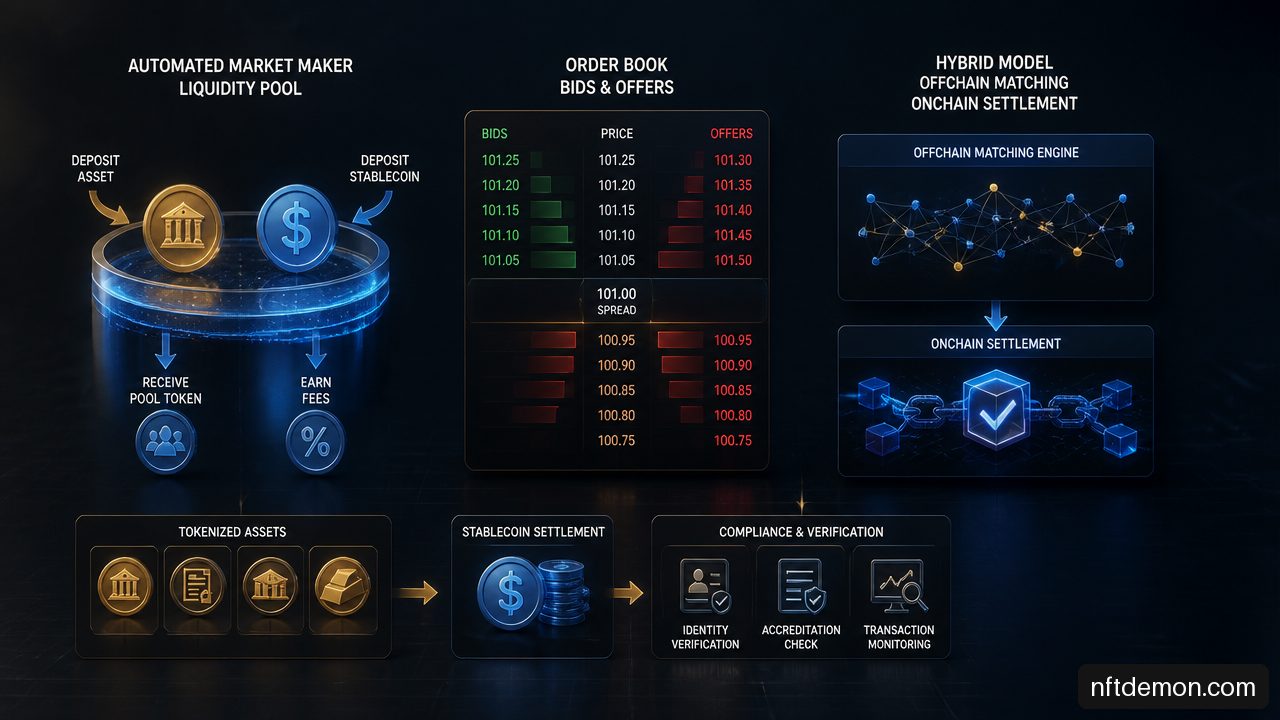
Automated market makers, or AMMs, use liquidity pools and a pricing formula rather than matching individual bids and offers. They work well when assets trade frequently, price feeds are credible, and liquidity providers accept inventory risk.
For many RWAs, those conditions are not guaranteed. A thinly traded token tied to private credit, commercial real estate, or a fixed price offering can create distorted outcomes in an AMM. A modest trade may move the quoted price sharply because the pool is shallow. That does not necessarily mean the underlying asset has changed in value. It may simply mean there are too few tokens and too little quote currency in the pool.
Consider a token representing a $10 million private debt vehicle. If a pool contains only $50,000 of stablecoins and a small percentage of tokens, a $10,000 trade can produce material slippage. The resulting onchain price might look like market discovery, yet it may reflect pool mechanics more than informed valuation.
I would consider an AMM when all of the following are true:
• The token has frequent, two sided demand.
• The asset has a transparent and regularly updated reference value.
• Liquidity providers understand redemption delays and valuation uncertainty.
• The pool has enough depth to support expected trade sizes.
• Transfer restrictions can be enforced for every pool participant.
Avoid using an AMM as the default answer for a restricted security, a new issuance with controlled pricing, or an asset with sparse natural demand.
Order Books Offer More Control Over Price Formation
An order book lets buyers state the price and size they are willing to pay while sellers state the price and quantity they will accept. This model can be better suited to institutional RWA markets because it provides visible price levels, controlled increments, and clearer execution logic.
The cost is complexity. Fully onchain order books can be expensive or slow depending on the network. They also expose order information publicly unless privacy features or permissioned infrastructure are used.
A practical middle ground is a hybrid design: orders are discovered or matched offchain, then settled onchain. A practitioner discussion in Ethereum’s community proposed fixed price increments, pair specific contracts, offchain matching, and onchain execution for RWA token trading. It is a community proposal rather than independent evidence of production performance, but it addresses a real problem: controlled fundraising and thin secondary markets may need explicit bids and offers rather than curve based AMM pricing.
Hybrid Markets May Better Match Institutional Behavior
A hybrid RWA exchange can combine several mechanisms:
• Periodic auctions for low turnover assets.
• Request for quote workflows for larger institutional trades.
• Continuous order books for actively traded instruments.
• AMM pools for smaller, standardized, liquid token classes.
• Net asset value based issuance and redemption windows.
This approach recognizes that “liquidity” is not one thing. A money market token might support same day redemption at a published value. A tokenized real estate fund may need monthly windows, administrator approval, and valuation updates. Treating both assets as if they belong in identical constant product pools is usually poor market design.
Measure Market Quality Beyond TVL
Total value locked can be informative, but it does not prove that a market is tradable. Capital can remain idle, be concentrated in one wallet, or be committed only at unusable prices.
| Metric | What It Reveals | Warning Sign |
|---|---|---|
| Bid ask spread | Cost of immediate execution | Wide spread despite high reported TVL |
| Depth at 1% | Trade capacity near the quoted price | Small trades cause major price changes |
| Slippage | Difference between expected and executed price | Inconsistent execution for normal order sizes |
| Turnover | Whether holders actually trade | Large supply with little recurring volume |
| Wallet concentration | Dependence on a few holders or market makers | One participant can disrupt the market |
| Redemption time | Practical connection to underlying value | Unclear or delayed redemption procedures |
| Failed transactions | Reliability of eligibility and settlement checks | Frequent failed swaps or reverted orders |
RWA.io describes a DEX for trading tokenized assets within its investment ecosystem, while its markets documentation describes an RWA exchange with trading tools, index funds, and liquidity pools. For any venue, however, decision makers should independently verify current market depth, execution quality, and completed redemptions rather than relying on feature descriptions or announced product scope.
Compliance, Custody, And Transfer Controls
Identity Must Connect To Wallet Eligibility
KYC is not a one time form that sits outside the exchange. In an RWA system, compliance needs an operational connection between a verified identity and one or more authorized wallets.
A typical eligibility model may include a verified identity record, a wallet allowlist, asset specific permissions, jurisdiction logic, investor classification, and an expiration or renewal process. The transfer function checks these conditions before allowing tokens to move.
That mechanism creates edge cases. A verified investor could lose access after changing residency. A wallet could be compromised. A token holder may move assets into a smart contract that cannot pass eligibility checks. A decentralized exchange must specify what happens in each case, not simply promise compliance.
For teams designing this layer, AI-powered AML compliance tools for decentralized exchanges provides a useful adjacent framework for considering transaction monitoring and risk controls without assuming that onchain activity alone establishes compliance.
Permissioned Tokens Change Composability
A permissioned token can reject transfers to ineligible wallets, enforce holding caps, prevent movement during a lockup, or allow an authorized administrator to freeze balances. These functions may be necessary for regulated assets. They also reduce the free composability commonly associated with DeFi.
This is not automatically a flaw. It is a tradeoff that must be disclosed. If a token can be paused or forcibly transferred, investors need to know who has that authority, under what conditions it can be used, whether actions are logged, and what appeal process exists.
“Decentralized” can describe different layers of a system. Smart contract settlement may be decentralized while identity issuance, oracle publication, custody, governance, and emergency controls remain centralized. I would treat decentralization as a system architecture question, not a marketing label.
Custody, Proof, And Redemption Determine Economic Credibility
The key diligence question is simple: what can the holder enforce if the token issuer fails? The answer depends on contracts, asset custody, bankruptcy treatment, administrator records, and jurisdiction.
A robust operating model should make the following clear:
• The legal entity that owns or controls the underlying asset.
• The custodian or account structure holding cash, securities, or property rights.
• The token holder’s claim relative to issuer creditors.
• The frequency and method of reserve, valuation, or asset reporting.
• The redemption procedure, fees, timing, and suspension conditions.
• The process for defaults, disputes, fraud allegations, corporate actions, and insolvency.
Without these answers, price discovery becomes fragile. Buyers cannot confidently price a token when the pathway from token to underlying value is uncertain.
Implementation And Due Diligence For Enterprises
Start With The Asset, Not The Chain
A common mistake is selecting a blockchain or DEX framework before defining the asset lifecycle. The better sequence begins with rights, rules, and operations.
- Define the legal claim represented by the token.
- Identify applicable securities, commodities, payments, consumer protection, tax, and privacy requirements.
- Specify investor eligibility and transfer restrictions.
- Design custody, proof, valuation, redemption, and servicing workflows.
- Select a market model aligned with expected liquidity and trade size.
- Select blockchain infrastructure based on privacy, finality, interoperability, cost, and operational control needs.
- Test exceptions, including failed eligibility checks, lost keys, freezes, disputed ownership, and redemption suspensions.
Blockchain platform selection for financial institutions and governments is relevant here because network selection should follow the operating model, regulatory obligations, and settlement requirements rather than a generic preference for public or private infrastructure.
Design For Exceptions Before Launch
A whitepaper may describe the happy path: asset issuance, trading, and redemption. Real operations are dominated by exceptions.
What happens if an oracle provides an incorrect valuation? What if a corporate action requires a token split? What if the issuer has lawful grounds to freeze a wallet? What if a bridge creates a duplicate representation of the same asset on another chain?
Crosschain trading deserves special caution. A wrapped token may be tradable elsewhere, but the issuer must determine whether it remains the canonical claim, whether the receiving chain enforces the same eligibility rules, and whether bridge failure can interrupt redemption. For regulated assets, moving tokens across chains without preserving identity and transfer controls can create an unsupported shadow market.
Integrate With Enterprise Records And Controls
A decentralized exchange does not replace accounting systems, customer records, risk tools, document management, or regulatory reporting. It must connect to them.
Integrating blockchain with existing enterprise systems is especially relevant when teams need to reconcile blockchain events with general ledgers, custodial records, CRM data, compliance workflows, and reporting obligations.
I would require a production readiness review across five control areas:
• Smart contract controls: Independent audits, role management, upgrade policy, pause logic, and key custody.
• Market controls: Market maker agreements, liquidity concentration limits, execution monitoring, and manipulation surveillance.
• Compliance controls: Wallet identity mapping, sanctions procedures, record retention, and escalation paths.
• Asset controls: Custody attestations, valuation policy, legal documentation, and redemption administration.
• Operational controls: Reconciliation frequency, incident response, customer support, business continuity, and governance reporting.
The recovery plan matters as much as launch readiness. If settlement breaks, the organization needs authority boundaries, communications procedures, evidence preservation, and a defined method to reconcile onchain balances with legal records.
Key Takeaways
• A decentralized exchange for RWAs should be evaluated as a combined legal, technical, custody, compliance, and market system.
• Token transfers may need wallet allowlists, jurisdiction rules, investor eligibility checks, lockups, and holding limits at the smart contract level.
• AMMs can support standardized and actively traded assets, but thin markets and fixed price offerings may require order books, auctions, or hybrid matching.
• Reported TVL and token availability do not establish real liquidity. Spread, depth, slippage, turnover, concentration, and redemption time are more decision useful measures.
• A token’s value depends on enforceable rights to the underlying asset, not merely the existence of an onchain balance.
• Chain interoperability adds risk unless canonical token identity, custody, ownership records, and compliance status remain consistent across networks.
FAQ: Decentralized Exchange For RWAs
What Is A Decentralized Exchange For RWAs?
It is a blockchain based venue for trading tokens tied to real world assets or rights. Unlike a standard crypto DEX, it may need identity checks, transfer restrictions, asset servicing, legal documentation, and redemption processes in addition to smart contract settlement.
Which Real World Assets Can Trade On An RWA DEX?
Potential categories include tokenized funds, government debt instruments, private credit, real estate interests, commodities, invoices, carbon related instruments, and revenue sharing arrangements. Whether an asset should trade on a DEX depends on its legal structure, transferability, valuation method, and investor eligibility rules.
Do Users Need KYC To Trade Tokenized RWAs?
Often, yes. Requirements vary by asset and jurisdiction. If an instrument is available only to certain investor categories or regions, the DEX needs a way to ensure that receiving wallets remain eligible throughout the token’s lifecycle.
How Do Transfer Restrictions Work Inside An RWA Smart Contract?
The token contract checks whether the sender and receiver meet programmed conditions before it completes a transfer. Conditions may include wallet whitelisting, investor status, jurisdiction, holding caps, lockup dates, or issuer approval. If the conditions fail, the transaction can revert even when the buyer has sufficient funds.
Is An AMM Or An Order Book Better For Trading RWAs?
Neither is universally better. AMMs can work for liquid, standardized assets with reliable reference values. Order books, periodic auctions, and hybrid models are often better when trade volume is sparse, price increments require control, or large participants need visible depth. The right answer follows the asset’s expected trading behavior.
How Are RWA Token Prices Determined When Trading Volume Is Low?
A low volume market may rely on the latest executed trade, bids and offers, administrator published NAV, valuation reports, or redemption value. These can differ materially. A token can trade below NAV when sellers need immediate liquidity, or above NAV when supply is limited. Buyers should distinguish a pool quote from a verified underlying valuation.
What Happens If The Underlying Asset Is Frozen, Redeemed, Or Legally Disputed?
The answer should be defined in the governing documents and smart contract authority model. The issuer or administrator may suspend redemptions, pause transfers, update balances after a corporate action, or follow a legal process. Before trading, investors should understand who can act, what evidence is required, and how decisions are communicated.
Can RWA Tokens Move Between Different Blockchains?
They can, but bridging creates risks. The issuer must define which token is canonical, how the bridged version is backed, whether wallet eligibility travels with it, and what occurs if the bridge fails. Crosschain movement is not just a technical feature when the token represents regulated or redeemable rights.
Sources And References
- RWA Inc. — Documentation: https://docs.rwa.inc/
- RWA Inc. — FAQs: https://docs.rwa.inc/investor-platform-and-staking/faq
- RWA.io — Investments: https://docs.rwa.io/documentation/ecosystem/investments
- RWA.io — Markets: https://docs.rwa.io/documentation/ecosystem/markets
- Reddit r/ethereum — Building a Simple On-Chain Orderbook DEX for RWA Tokens: https://www.reddit.com/r/ethereum/comments/1ievs5l/building_a_simple_onchain_orderbook_dex_for_rwa/
NFT Demon Holdings helps enterprises scope, evaluate, and build blockchain programs — start with a free evaluation call.
Talk through your use case
Free evaluation call — objective, constraints, and fit, before any proposal.