Cross chain token migration without mint and burn risks
By Jeremy Ryan, Founder & CEO · October 2026
Cross-chain token migration strategies without mint-and-burn vulnerability risks begin with a hard truth: no bridge design is inherently safe because it uses burning, locking, minting, or releasing. Security comes from whether the system can prove every state change, enforce one-time execution, and preserve the economic relationship between source assets and destination assets.

For decision makers, the goal is not simply to move liquidity to another chain. It is to migrate a token without creating an unauthorized mint path, draining collateral reserves, trapping holders during partial failures, or leaving governance with an unreviewed emergency authority. The migration architecture must preserve supply and collateral invariants across every supported route.
- Key Takeaways
- Treat Migration as an Invariant Problem
- Choose the Right Cross-Chain Architecture
- Engineer the Migration Control Plane
- Frequently Asked Questions
- Sources and References
Key Takeaways
• Treat token migration as an invariant-preservation problem, not a contract deployment exercise. Supply, collateral, authorization, and message uniqueness must remain provably consistent.
• Prefer bounded authority over unrestricted mint permissions. A destination token can be minted safely only when minting is tied to verified source events, route caps, and one-time message execution.
• Use lock-and-unlock where prepositioned reserves and operational constraints make it practical. Use burn-and-mint only when the token’s supply controls and message-verification model can support it.
• Separate routine transfer powers from one-time migration powers. Mint, unlock, pause, upgrade, and configuration roles should not converge in one wallet or multisignature group.
• Run migrations in stages. Allowlists, route caps, reconciliation checkpoints, pause controls, and a deterministic partial-completion policy reduce blast radius.
• Audit the entire system: token contracts, pools, message verification, relayer configuration, proxy upgrades, monitoring, user interface, and operational approvals. A secure contract cannot compensate for an insecure control plane.
Treat Migration as an Invariant Problem
Define What Must Never Become False
A migration should begin with statements that remain true before, during, and after every transfer. These are the migration invariants. They create a testable boundary between a valid cross-chain conversion and an unauthorized asset creation event.
For a burn-and-mint route, a basic supply invariant is:
Cumulative destination mints for a route must not exceed cumulative verified source burns, net of reversals that the protocol explicitly supports.
For a lock-and-mint route, the equivalent constraint is collateral based:
Destination wrapped supply must not exceed the source reserve allocated to that route, after accounting for releases, fees, and stranded transactions.
The practical accounting model should track each route independently. A token issuer supporting Chain A to Chain B and Chain A to Chain C should not rely on a single global supply number. An error can be isolated to one route while the global total still appears plausible.
| Invariant | What It Prevents | Evidence Required |
|---|---|---|
| Supply conservation | Excess destination issuance | Verified burns, destination mint records, route ledger |
| Collateral sufficiency | Unbacked wrapped tokens | Locked reserve balance matched to outstanding wrapped supply |
| One-time execution | Replay-driven duplicate minting or releases | Processed message identifier state |
| Route authorization | Messages accepted from unapproved chains or contracts | Source chain ID, source sender, token ID, destination route |
| Amount integrity | Minting more than the source action authorized | Source event amount matched to destination instruction |
| Role separation | A single compromised authority controlling the full asset path | Distinct role assignments and approval policies |
This framing changes project discussions. Instead of asking, “Can our bridge mint on the destination chain?” the better question is, “Under what exact evidence can the destination contract mint, and what state proves that evidence has not already been consumed?”
A bridge can preserve nominal token supply and still fail economically. If locked collateral is stolen, wrapped assets may remain in circulation but no longer be redeemable at par. Chainlink’s guidance on bridge reserve and infinite-mint risks warns that theft of locked assets or unlimited issuance of wrapped tokens can undermine both value and solvency. That is why reserve monitoring and destination supply monitoring must be treated as one control, not two separate dashboards.
Validate the Full Message, Not a Signature-Like Artifact
Cross-chain migration messages are authorization objects. A valid signature, validator quorum, or proof is insufficient if the application accepts the message for the wrong route, token, amount, or recipient.
Before minting or releasing assets, the destination contract should validate all of the following fields:
- Source chain identity: the message came from an approved chain domain.
- Source sender: the originating contract is the approved migration pool or token contract.
- Token identity: the asset identifier matches the approved route mapping.
- Amount: the amount equals the source burn or lock event and complies with route limits.
- Recipient: the intended destination recipient is encoded and validated.
- Destination chain and contract: the instruction cannot be redirected to another domain or pool.
- Permitted action: a migration message cannot invoke arbitrary contract functions.
- Nonce or unique message ID: the message has not been processed previously.
The order matters. Mark the message as processed before any external token interaction that could reenter execution. If minting fails, the contract needs a defined retry or compensation model rather than silently allowing an identical message to execute again.
The 2026 bridge incident discussed in 1inch’s report on forged-message minting was attributed to a forged transfer message and missing source-amount validation, with approximately 1 billion bridged DOT tokens reportedly minted. The reported details require caution pending an independent primary postmortem, but the design lesson is straightforward: source authentication alone does not establish amount integrity.
Review More Than Smart Contract Logic
A cross-chain migration is a system of contracts, consensus assumptions, relayers, signers, configuration files, upgrade rights, and user-facing transaction flows. The cross-chain bridge security survey SoK: Security of Cross-chain Bridges categorizes vulnerabilities into permission, logic, event, and front-end issues. That classification is useful because each category calls for a different review method.
• Permission failures require role analysis, threshold review, timelocks, and key-management controls.
• Logic failures require code review, formal properties where feasible, fuzzing, and adversarial simulation.
• Event failures require checking that source events are authentic, finalized, unique, and decoded correctly.
• Front-end failures require domain protection, transaction previews, recipient verification, and release governance for interface changes.
A migration portal that displays an attacker-controlled recipient can defeat otherwise correct contracts. Decision makers should therefore fund interface and operational testing as part of the security scope, not as a marketing workstream.
Choose the Right Cross-Chain Architecture
Compare Designs by Their Failure Boundaries
No architecture removes risk. Each moves the critical boundary somewhere else: into token supply authority, collateral custody, message verification, or reserve management.
| Architecture | Core Mechanism | Strong Fit | Primary Failure Boundary | Avoid When |
|---|---|---|---|---|
| Burn-and-mint | Burn on source, mint equivalent amount on destination | Token issuer controls supply on both chains | Unauthorized minting or false burn proof | Mint authority cannot be constrained or source finality is weak |
| Lock-and-mint | Lock source assets, mint collateralized destination token | Existing token cannot burn or mint natively | Reserve theft or unbacked wrapped issuance | Reserve accounting cannot be monitored and reconciled |
| Burn-and-unlock | Burn destination representation, release source reserve | Return route for lock-and-mint systems | Unauthorized reserve release | Reserve pool lacks strict source-message validation |
| Lock-and-unlock | Lock on one chain and release prepositioned liquidity on another | Controlled corridors with managed inventory | Inventory imbalance and unauthorized release | The organization cannot maintain destination liquidity or settlement procedures |
Chainlink’s documented lock-and-mint route model locks tokens on one chain and mints on another, while the reverse route burns destination tokens and releases source-chain assets. This pattern is useful for tokens that cannot safely alter supply on their issuing chain, but it turns the reserve pool into a critical asset custody boundary. (Optimistic vs ZK Rollup Deployment)
For enterprises evaluating public and consortium environments, chain governance also affects the choice. A migration between networks with materially different validator assumptions, transaction-finality models, or upgrade policies deserves more scrutiny than a route between closely governed environments. Choosing Between Public and Permissioned Blockchains provides a useful framework for evaluating that governance dimension before a route is approved.
When Burn-and-Mint Is Defensible
Burn-and-mint can preserve a unified cross-chain supply, but only if minting is not a standing privilege that can be exercised outside a verified migration path. The destination token should not grant a general-purpose minter role to a bridge operator and hope that operational policy prevents misuse.
A more defensible pattern gives the migration pool a narrowly scoped mint capability and makes the pool enforce route rules internally. The token contract can further cap the pool’s maximum mint authority, while the pool enforces per-message validation, rate limits, and replay protection. If feasible, mint authority should expire after the migration period or require a separate governance procedure to renew.
Use burn-and-mint when all of these conditions are met:
• The issuer controls burn and mint behavior on every participating token contract.
• The bridge can verify source-chain finality at the required assurance level.
• The destination mint path validates route, asset, recipient, amount, and unique message ID.
• Monitoring can compare confirmed source burns to destination mints in near real time.
• Emergency powers can stop new processing without allowing arbitrary asset seizure or arbitrary minting.
Avoid it where a proxy administrator can upgrade the token or pool into an unrestricted mint implementation without an independent review and delay. A technically correct migration contract is not enough if a single upgrade key can replace it after launch.
When Lock-and-Unlock Reduces Mint Risk
Lock-and-unlock avoids creating destination supply at the moment of transfer because the destination pool releases tokens already held in inventory. That can reduce exposure to destination mint authority, but it does not make the route automatically safer. The dominant risk becomes reserve management.
Consider a corporate token with fixed issued supply and strict legal controls around issuance. Prepositioning approved liquidity on the destination network may be preferable to granting a cross-chain pool mint authority. However, the organization must then track inventory by chain, manage rebalancing, and ensure that one source deposit cannot trigger multiple destination releases.
The best choice depends on what the organization can secure and audit. There is no reliable universal data showing that one architecture is safer in every environment. A route with limited, observable reserves may be preferable to complex mint logic in one case; in another, managed inventory may introduce unacceptable liquidity and operational risk.
Engineer the Migration Control Plane
Separate Authority by Function and Time
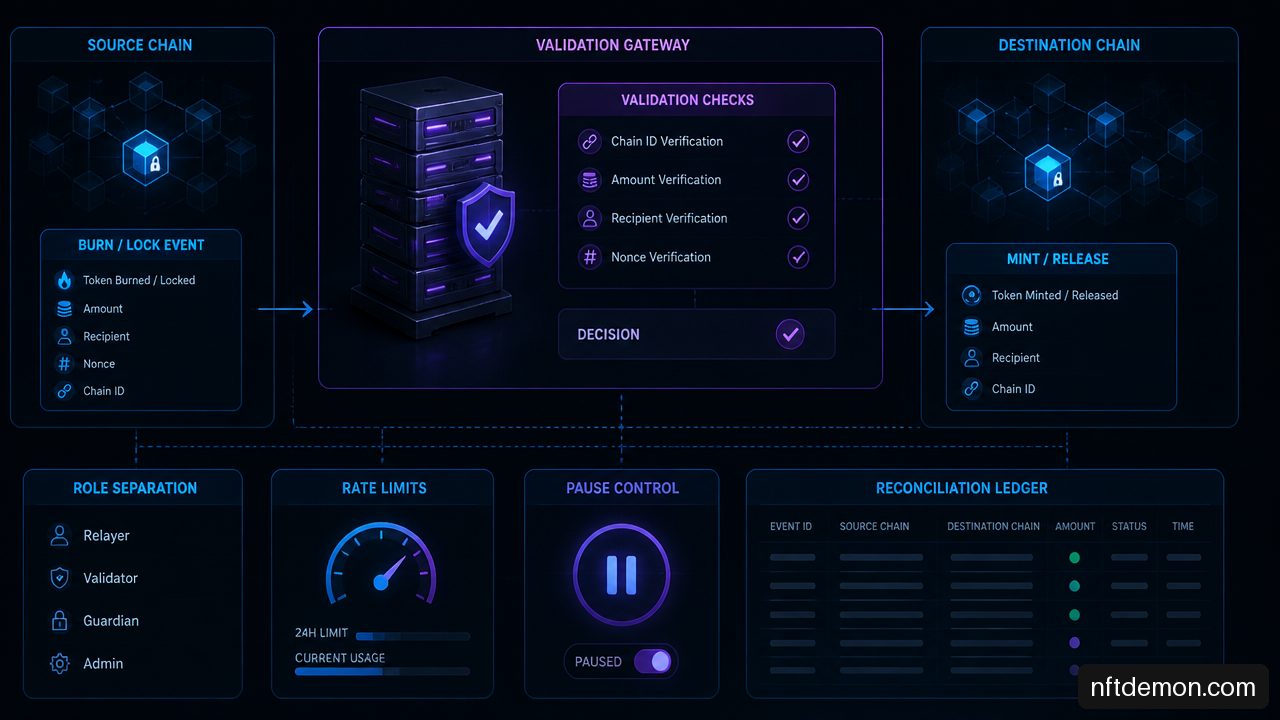
The most common governance mistake is treating a migration as one application with one administrator. It is actually a temporary high-value process that needs distinct authorities.
| Role | Permitted Action | Control Objective |
|---|---|---|
| Migration executor | Process verified migration messages | Cannot change route configuration or upgrade code |
| Pause authority | Stop new source deposits or destination execution | Can contain an incident but cannot mint or release assets |
| Configuration authority | Change allowlists, caps, or route parameters | Subject to timelock and independent approval |
| Upgrade authority | Modify proxy implementation where unavoidable | Delayed, disclosed, and separated from routine operations |
| Reconciliation authority | Publish and verify accounting reports | No direct ability to move user assets |
| Recovery authority | Resolve predefined failed states | Limited to deterministic cases and documented evidence |
Use multisignature approval where appropriate, but do not confuse a multisignature wallet with a complete control model. If the same signer set can pause, upgrade, alter source validation, and mint, it remains a concentrated failure point.
This role model should also inform enterprise architecture review. Enterprise Blockchain Architecture Security and Scalability is relevant because chain capacity, node design, monitoring, and governance permissions can all affect how a migration behaves under stress.
Stage the Rollout and Reconcile Every Route
An unrestricted public launch is rarely the right first move. A staged rollout provides evidence that the accounting and monitoring model works under live conditions while limiting potential loss.
- Dry run: execute end-to-end transfers with test assets and production-like controls.
- Controlled pilot: allowlisted addresses, low route caps, and manual reconciliation after each batch.
- Limited public phase: predefined caps, automatic alerts, and an available pause authority.
- Expanded operation: raise limits only after reconciliation remains consistent across a defined observation window.
- Migration closeout: revoke temporary roles, disable obsolete routes, and publish final supply and reserve accounting.
There is no universal safe cap or rollout duration. The appropriate limit depends on liquidity, token economics, finality assumptions, and the organization’s ability to respond. For example, a token with a $5 million circulating value and thin destination liquidity may need a lower initial cap than a deeply liquid token, even if both use identical code. The decision should be based on potential loss during the time required to detect, pause, and contain an error.
A practical route ledger should record source locks or burns, destination mints or releases, fee adjustments, pending messages, failed execution attempts, and recovered balances. Reconciliation should distinguish between confirmed, pending, rejected, and manually recoverable states. Combining all unresolved transactions into one “pending” number hides useful risk information.
Build a Deterministic Partial-Completion Policy
Cross-chain transfers are not atomic across independent consensus mechanisms. The source action can finalize while the destination action is delayed, rejected, or unavailable. A migration must define what happens before this occurs.
A sound policy answers four questions:
- What proof establishes that the source burn or lock reached sufficient finality?
- How long can destination execution remain pending before escalation?
- Can the same authenticated message be retried safely, and how is duplicate execution prevented?
- Under what exact conditions can a user be refunded, compensated, or manually recovered?
Do not promise an automatic rollback unless the architecture actually supports one. A completed source-chain burn cannot simply be reversed on most blockchains. In many cases, the safest recovery is to retain the authenticated message, pause automated processing if needed, and allow a constrained retry after the destination issue is corrected.
Negative testing should simulate malformed payloads, duplicate messages, delayed messages, reordered deliveries, wrong-chain messages, wrong-token messages, amount mismatches, expired route configurations, revoked roles, failed destination mints, and source reorganization assumptions. The point is not merely to make the happy path work. It is to ensure the protocol fails closed.
Frequently Asked Questions
What Is the Safest Way to Migrate a Token Without Unrestricted Minting?
The safest practical approach is a route where destination issuance or release is bound to a verified, one-time source event and subject to caps, pauses, and independent reconciliation. If issuing new destination tokens is unacceptable, a lock-and-unlock design using prepositioned liquidity may reduce mint authority exposure, but it introduces reserve and inventory risk.
Can Destination Tokens Be Minted While Preserving Total Supply?
Yes. Burn-and-mint can preserve aggregate supply when each destination mint equals a finalized and verified source burn, and no message can execute twice. The relevant measure is not destination supply alone; it is source burns plus destination mints across every route and pending state.
Which Fields Must Be Validated Before Minting or Releasing?
Validate source chain, source contract, token identity, recipient, amount, destination contract, permitted function, route configuration, and a nonce or unique message ID. A valid proof for the wrong amount or wrong recipient is still an invalid migration instruction.
How Do Replay Attacks Affect Cross-Chain Migration?
A replay attack reuses a previously valid cross-chain instruction. Without durable processed-message tracking, one source burn or lock can produce multiple destination mints or releases. The destination contract should reject any message ID already marked as processed, including after pauses, retries, and upgrades.
Should Migration Roles Be Separate From Ordinary Bridge Roles?
Yes. One-time migration authority should be narrower than routine transfer authority and should expire or be revoked at closeout. Separating pause, configuration, upgrade, reconciliation, mint, and reserve-release powers reduces the impact of any single compromised key or operational error.
What Happens If Tokens Are Burned but the Destination Transaction Fails?
The source burn generally remains final. The protocol should retain an authenticated record of the source event and allow a controlled retry or recovery process that cannot duplicate minting. The recovery policy must be defined before launch, including evidence requirements, timeout handling, and who can authorize exceptional action.
Can a Migration Be Paused Without Trapping Users Permanently?
It can, if the design distinguishes between pausing new deposits and pausing destination settlement. A pause should preserve message records and provide a documented process for retrying valid pending transfers after remediation. Indefinite discretionary recovery authority is not a substitute for a clear state machine.
Sources and References
• Chainlink Documentation — Lock & Mint V1 → V2: https://docs.chain.link/ccip/evm/concepts/cross-chain-token/lock-mint-v1-to-v2
• Chainlink — Cross-Chain Bridge Risks: https://docs.chain.link/resources/bridge-risks
• SoK: Security of Cross-chain Bridges: Characteristics, Attack Surfaces, Defenses, and Open Problems: https://arxiv.org/html/2312.12573v1/
• 1inch — Why Crypto Bridges Still Get Hacked in 2026: https://1inch.com/blog/post/the-biggest-bridge-hacks-in-2026
NFT Demon Holdings helps enterprises scope, evaluate, and build blockchain programs — start with a free evaluation call.
Talk through your use case
Free evaluation call — objective, constraints, and fit, before any proposal.