Optimistic vs ZK rollup deployment for loyalty rewards
By Jeremy Ryan, Founder & CEO · September 2026
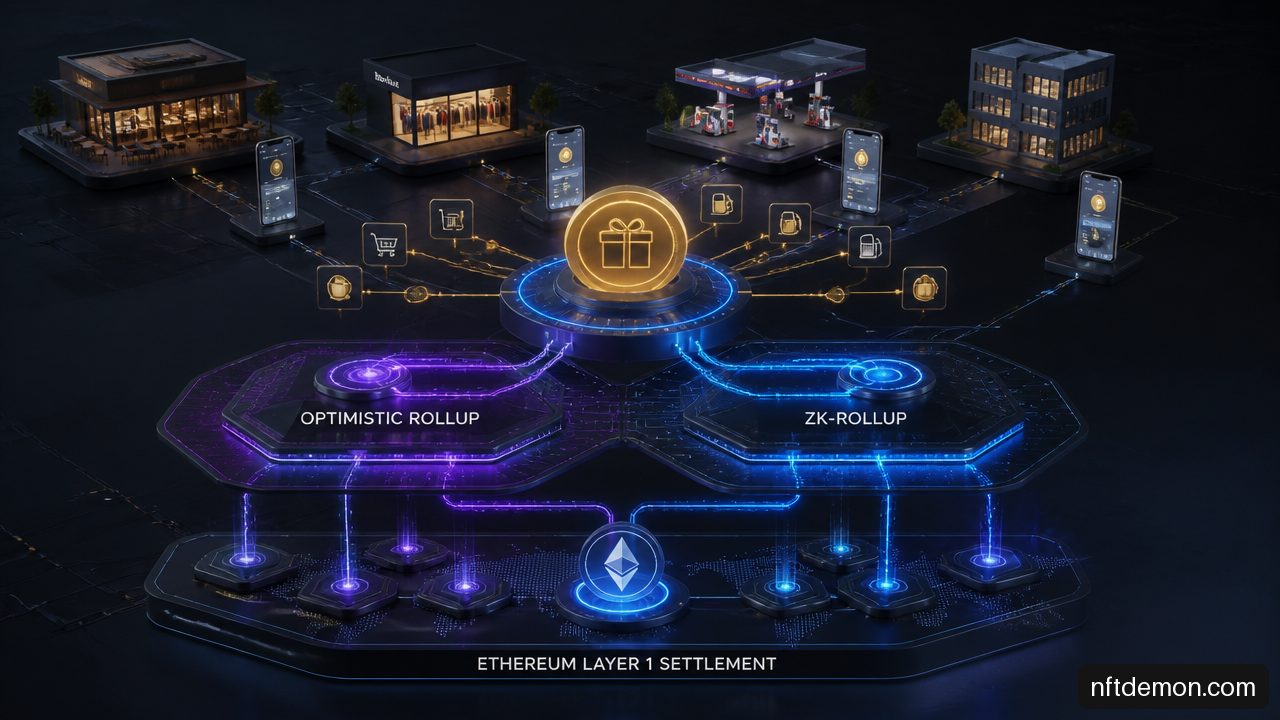
Optimistic vs zk-rollup deployment steps for high throughput loyalty reward ecosystems should begin with a business decision, not a protocol preference. The right architecture depends on what must feel instant to the customer, what can settle later between merchants, and how much operational complexity the organization can sustain.
Choose The Rollup Around Settlement Requirements
Start With The Customer Promise, Not Theoretical TPS
I would frame the decision around three loyalty events: earning, redemption, and settlement. These have different risk profiles, and treating them as identical blockchain transactions creates unnecessary friction.
A customer earning ten points after a coffee purchase can usually tolerate a short confirmation delay. A customer redeeming points for a limited inventory item, a gift card, or a travel benefit cannot. Merchant settlement has another standard again: finance teams may accept delayed finality if the ledger is complete, auditable, and reconcilable at close.
A rollup increases throughput by executing and batching transactions outside Ethereum Layer 1, then anchoring the resulting state to Layer 1. For loyalty programs, the practical advantage is not merely lower fees. It is the ability to process dense streams of small reward events without asking customers or merchants to pay a separate Layer 1 transaction cost for every action.
The selection question is straightforward:
| Business Requirement | Better Initial Fit | Why It Matters |
|---|---|---|
| Fast pilot using familiar Solidity tooling | Optimistic rollup | Usually offers a more familiar EVM development path and lower happy path overhead |
| Rapidly finalized cross chain settlement | Zk rollup | Validity proofs can provide stronger finality characteristics once verified |
| Consumer redemption backed by internal liquidity | Either architecture | The redemption path can remain instant without requiring a customer withdrawal to Layer 1 |
| High sensitivity to delayed dispute resolution | Zk rollup | Validity proof verification avoids reliance on a lengthy challenge window |
| Need to ship before custom proof infrastructure is justified | Optimistic rollup | Operational complexity can be lower at the outset |
This is why a simplistic “zk is faster” or “optimistic is cheaper” decision is not enough. A loyalty platform may handle millions of micro rewards while only a small percentage of balances ever leave the application. If redemption occurs inside the platform, the customer experience is governed primarily by sequencer inclusion, wallet design, inventory reservation, and merchant liquidity, not by Layer 1 withdrawal timing.
Model The Burst, Not The Daily Average
A daily transaction average hides the moments that break a loyalty system. Consider a retail promotion that runs for two hours. A platform may process a predictable baseline through most of the day, then receive a concentrated burst when a campaign opens, a live event ends, or an airline releases reward inventory.
I recommend modeling at least four workloads before selecting a stack:
- Reward issuance burst: Point credits submitted from point of sale, ecommerce, or partner APIs after purchases.
- Redemption burst: Customers consume rewards during inventory drops, seasonal promotions, or checkout windows.
- Correction burst: Reversals, returns, duplicate claim remediation, and campaign adjustments arrive after the original purchase events.
- Settlement burst: Merchants, brands, or treasury systems reconcile and settle liabilities at scheduled intervals.
For example, a platform that issues 50,000 reward events per hour may appear modest. If 20 percent of those events arrive in a ten minute campaign spike, the sequencer, event ingestion service, and idempotency controls must handle roughly 1,000 requests per minute before allowing for retries. The chain is only one part of the system. A payment or POS connector that retries indiscriminately can double credit points faster than a smart contract can protect against it.
This broader planning belongs beside blockchain scalability architecture for high throughput consumer applications. Throughput is an end to end property: API intake, queue depth, sequencer policy, contract writes, proof generation or batch posting, merchant reconciliation, and customer notification all matter.
Use Finality As A Policy Boundary
An optimistic rollup accepts a batch as valid unless someone challenges it. The operational consequence is not that every loyalty event is unsafe. It is that the platform must distinguish soft confirmation from economically final settlement.
Chainlink’s CCIP execution latency guidance for optimistic rollups describes a lifecycle that can include sequencer inclusion, Layer 1 batch posting, a challenge period, and eventual Layer 1 finalization. For an app, that means a reward can appear promptly in a customer account while its bridge related settlement remains delayed.
A zk rollup takes a different route. State transitions are accompanied by a cryptographic validity proof that is verified on chain. The result is particularly relevant when a loyalty balance is being used as collateral, exchanged for external value, or included in a tightly controlled settlement process.
Fair warning: fast finality on a zk rollup does not automatically mean instant application response. Proof generation, batch cadence, sequencer behavior, wallet signing, and the app’s own inventory checks still affect perceived speed.
Deploy The Loyalty Ledger And Transaction Flows
Build A Loyalty State Model That Can Be Reconciled
A reward balance should not be the only record kept. A production loyalty system needs an event trail that explains why a balance changed. The smart contract can maintain the authoritative onchain balance, while the application retains a structured event record tied to order IDs, merchant IDs, campaign IDs, customer identifiers, timestamps, and reversal references.
A practical contract design separates the following functions:
• Issue rewards: Credit points only when a validated merchant event is accepted.
• Reserve rewards: Temporarily lock points during a redemption checkout or inventory hold.
• Redeem rewards: Burn, transfer, or mark points as consumed after fulfillment conditions are met.
• Reverse rewards: Correct returns, fraud findings, expiration events, or duplicate credits through an explicit auditable action.
• Administer campaigns: Set issuance limits, eligibility periods, merchant permissions, and emergency controls.
Every issuance request should carry an idempotency key. A useful pattern combines merchant identifier, source transaction ID, reward rule version, and event type. If an ecommerce platform retries a webhook five times, the rollup application should recognize all retries as one event rather than minting five reward credits.
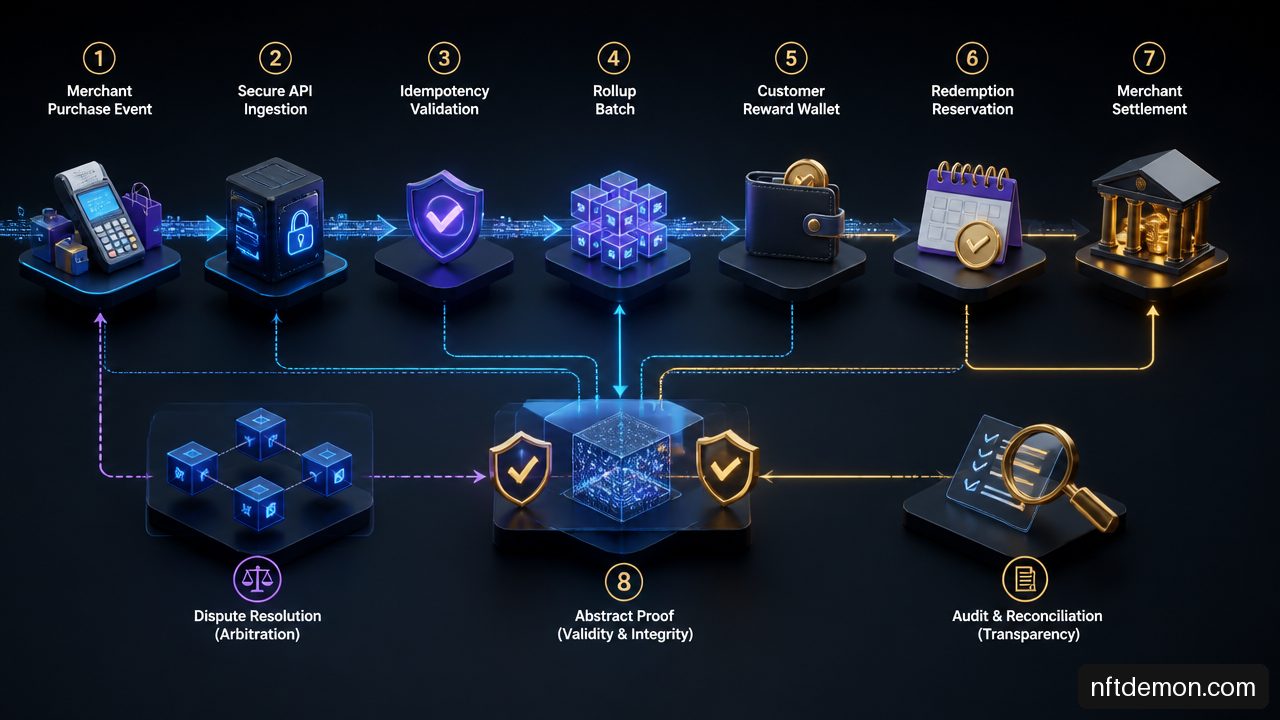
The deployment sequence should also make reconciliation possible before a finance team asks for it. For each batch, persist the rollup transaction reference, state root reference where available, source system records, and a deterministic mapping from offchain event ID to onchain event ID. A month end close should be able to answer: Which merchant transactions created this liability? Which balances were redeemed? Which adjustments remain disputed?
Optimistic Rollup Deployment Steps
For an optimistic rollup, I would deploy in stages rather than treating the chain launch as the finish line.
- Define confirmation tiers. Specify what customers see after sequencer inclusion, what merchants can fulfill immediately, and what requires Layer 1 settlement.
- Choose a compatible stack and deploy contracts. Test reward issuance, reservation, redemption, expiry, role management, and pause controls under realistic batch loads.
- Configure the sequencer and batch policy. Set inclusion expectations, transaction fee sponsorship rules, queue monitoring, and surge behavior for campaign peaks.
- Deploy bridge and liquidity controls. Keep customer redemptions inside the loyalty environment whenever possible. Use a funded treasury or merchant liquidity pool for external value redemptions rather than forcing a customer through a Layer 1 withdrawal.
- Set dispute operations. Assign monitoring, escalation authority, and a process for freezing high risk settlement while a challenge is unresolved.
- Run failure drills. Simulate sequencer outage, duplicate merchant feeds, a disputed batch, paused contracts, and a depleted redemption pool.
Cartesi’s documentation on optimistic rollup fraud proofs explains that these systems can use interactive or noninteractive proof approaches. The specific mechanism differs by stack, but the business implication is consistent: someone must be prepared to observe, escalate, and respond during the challenge process.
An optimistic implementation is often a sound choice when the loyalty currency is primarily closed loop, redemption is fulfilled from an internal pool, and the organization values EVM familiarity. Avoid relying on it as the sole path for a promise that requires customers to withdraw value quickly to Layer 1.
Zk Rollup Deployment Steps
A zk rollup deployment has the same product requirements but introduces proof system decisions. The extra work is justified when provable state transitions and quicker settlement assurances have material value for partners, auditors, or external redemption flows.
- Validate contract and virtual machine compatibility. Do not assume an existing Solidity application will deploy unchanged. Ethereum.org’s guidance on zk rollups and EVM compatibility notes that zk rollups are not readily EVM compatible, so a compatibility layer or specialized tooling may be needed.
- Specify the proving model. Determine who generates proofs, the expected batch cadence, acceptable proof delays, hardware requirements, and fallback behavior if proving capacity is constrained.
- Optimize the state transition circuit or supported application logic. Loyalty workloads are often repetitive: issue, reserve, redeem, reverse. That predictability can help, but every custom rule adds proving complexity.
- Test proof cost under bursts. Measure campaign load, not just isolated transactions. A reward platform can have low average volume yet expensive proof generation during promotion windows.
- Deploy verification and monitoring infrastructure. Monitor failed proofs, delayed batches, prover queues, and discrepancies between application events and verified state.
- Design external settlement deliberately. A proof can establish correctness, but it does not provide merchant liquidity, customer support processes, or compliance reporting by itself.
Zk deployment costs are not limited to transaction fees. They can include engineering time, specialized infrastructure, proving capacity, and more constrained development tooling. That is why I would avoid a zk first architecture when the program is still validating campaign mechanics and partner operations. Conversely, I would favor it when withdrawal latency, verifiable settlement, or formal integrity assurances are central to the commercial promise.
Operate For Reconciliation, Disputes, And Abuse Resistance
Keep Instant Redemption Off The Withdrawal Path
A seven day style challenge window often associated with optimistic withdrawals is poorly suited to a customer standing at checkout. The answer is not necessarily to reject optimistic rollups. It is to prevent bridge withdrawal from becoming the routine redemption journey.
Use a two tier model:
| Redemption Type | Customer Experience | Settlement Approach |
|---|---|---|
| Closed loop coupon, merchandise, or partner offer | Immediate | Reserve and redeem within the rollup application |
| Gift card or merchant credit | Immediate when liquidity exists | Platform or partner treasury funds the benefit, then settles later |
| Transfer to external wallet or Layer 1 asset | Delayed by architecture | Disclose timing clearly and apply risk controls |
| Large value or regulated redemption | Conditional | Apply identity, compliance, and review controls before release |
This model turns a bridge into a treasury and settlement component rather than a mandatory consumer interface. It also gives product teams an honest way to set expectations. A loyalty balance may be instantly usable in the program while still taking longer to become externally withdrawable value.
Prepare For Invalid Batches And Customer Disputes
A fraud proof is a protocol mechanism, not a complete customer support policy. The organization still needs a plan for what happens to fulfillment, balances, and merchant settlement if a batch is challenged.
The IACR paper Security of Ethereum Layer 2s describes how an optimistic fraud proof can revert an incorrectly computed batch and subsequent batches within a limited challenge period. In a loyalty setting, that can mean an apparently completed reward action needs business level remediation after a rollback.
I recommend documenting these operational rules before launch:
• Freeze only the affected settlement path where feasible, rather than pausing all reward earning.
• Preserve an immutable support record showing customer claim, merchant order, event identifiers, and chain status.
• Separate a protocol rollback from a commercial decision. A merchant may still honor a fulfilled reward while finance resolves the resulting liability separately.
• Use compensation controls carefully. Manual recrediting should be idempotent and tied to a case record, or the correction system becomes another source of duplicate rewards.
• Reconcile after every disputed batch and after any emergency pause, not only at month end.
Control Spam, Sybil Activity, And Merchant Feed Errors
Loyalty fraud is usually more mundane than cryptographic attacks. Attackers may create accounts to harvest sign up bonuses, replay referral actions, exploit an abandoned campaign rule, or pressure a merchant integration to resend purchases. The smart contract should enforce limits, but it cannot determine whether an offchain receipt was genuine without reliable upstream data.
Use layered controls:
- Eligibility controls: Device, account, identity, or membership signals appropriate to the program’s privacy and compliance model.
- Economic limits: Per campaign, per merchant, per customer, and per time period issuance caps.
- Source authentication: Signed merchant events, rotating credentials, scoped permissions, and webhook verification.
- Anomaly monitoring: Detect unusual issuance frequency, rapid reserve and release patterns, repeated reversals, and correlated accounts.
- Recovery authority: Role based ability to pause a campaign, disable a merchant integration, or quarantine a suspicious reward stream without disrupting the whole network.
These controls should be part of operational controls for a production blockchain deployment, not an afterthought added after the first campaign abuse incident.
Plan A Migration Without Promising A Seamless One
A program can begin on an optimistic rollup and later move to a zk rollup, but it should not be described as a push button upgrade. Smart contract assumptions, wallet support, bridge addresses, transaction history, and partner integrations can all change.
A sensible migration path may involve freezing new issuance briefly, producing a signed and auditable balance snapshot, allowing users to claim or map balances on the destination chain, and retaining a read only archive of the prior ledger. For a large loyalty ecosystem, dual running a limited set of campaigns before moving the entire balance base may reduce operational risk.
The deciding factor is not whether migration is technically possible. It is whether the future need for faster final settlement or stronger validity assurances is likely enough to justify designing portability into contracts, data pipelines, and customer terms from day one.
Key Takeaways
• Choose optimistic rollups when EVM oriented deployment speed, lower happy path complexity, and a closed loop reward model matter more than rapid Layer 1 withdrawal finality.
• Choose zk rollups when verified state transitions, settlement assurance, and externally meaningful redemption timing outweigh proof infrastructure and tooling complexity.
• Do not make customers bridge for routine redemptions. Internal liquidity, merchant settlement, and inventory reservation can preserve instant experiences on either rollup family.
• Model promotion spikes and correction traffic, not only daily transaction averages. Reward reversals and merchant retry behavior can be more disruptive than normal issuance volume.
• Treat reconciliation as a core protocol requirement. Idempotency keys, event records, state references, and close processes are as important as transaction throughput.
• Build a dispute playbook before launch. A fraud proof can correct chain state, but customer fulfillment and merchant liability still require operational decisions.
For decision makers, the practical goal is not to choose the most fashionable rollup. It is to deploy a reward system whose confirmation policy, redemption design, audit trail, and operating controls match the promises made to customers and partners. The discipline required for moving an enterprise blockchain application from pilot to production is what turns a technically valid design into a usable loyalty network.
Frequently Asked Questions
Which Is Better For A High Throughput Loyalty Rewards Platform?
Neither is universally better. I would select an optimistic rollup for a closed loop program that prioritizes rapid deployment and familiar EVM tooling. I would select a zk rollup when stronger proof based settlement and faster finality characteristics are central to partner trust, regulated value flows, or external redemptions.
How Do Reward Issuance And Redemption Differ Between The Two Architectures?
Reward issuance can feel fast on both because applications often acknowledge sequencer inclusion before Layer 1 settlement. The major difference appears when value must leave the rollup. Optimistic designs may require a dispute window before Layer 1 finalization, while zk designs verify state transitions using validity proofs. Inside a managed loyalty ecosystem, redemption can remain immediate if inventory and liquidity are available.
Can An Optimistic Rollup Support Instant Redemptions?
Yes, if the redemption remains within the program or is funded by a platform or merchant liquidity pool. An instant restaurant voucher, product discount, or gift card issuance does not need to wait for a customer to withdraw to Layer 1. The organization later reconciles the liability through its chosen settlement process.
What Happens If A Reward Batch Is Disputed Or Invalid?
The protocol may roll back invalid state according to its fault proof design. The application should then identify affected customers, reservations, merchant settlements, and fulfillment events. A preapproved remediation policy is essential because a technical rollback does not automatically decide whether a customer keeps a delivered benefit or how a merchant is reimbursed.
How Should Merchants Reconcile Offchain Sales With Onchain Reward Balances?
Each reward event should map to a merchant transaction ID, campaign rule version, customer reference, timestamp, and onchain transaction or event ID. Reconciliation should compare the merchant source record, the loyalty event ledger, and the rollup state. Idempotency keys are essential because retried APIs and duplicated webhooks are common sources of balance errors.
What Hidden Costs Should Be Modeled Before Deployment?
Model wallet support, fee sponsorship, sequencer operations, bridge liquidity, customer support, monitoring, merchant integration maintenance, audit logging, fraud controls, and recovery procedures. For zk rollups, include proving infrastructure and specialized engineering. For optimistic rollups, include dispute monitoring and the customer experience cost of delayed external withdrawals.
Can A Loyalty Program Migrate From Optimistic To Zk Later?
It can, but migration requires planning. The organization may need to snapshot balances, map or redeploy contracts, update partner integrations, preserve historical records, and guide users through wallet or chain changes. Designing portable event records and clear customer terms early reduces the cost of a later move.
Sources And References
• Ethereum.org — Zero-knowledge rollups: https://ethereum.org/developers/docs/scaling/zk-rollups/
• Cartesi Documentation — Optimistic Rollups: https://docs.cartesi.io/cartesi-rollups/1.5/core-concepts/optimistic-rollups/
• Chainlink CCIP Documentation — CCIP Execution Latency: https://docs.chain.link/ccip/ccip-execution-latency
• IACR ePrint — Security of Ethereum Layer 2s: https://eprint.iacr.org/2023/124.pdf
NFT Demon Holdings helps enterprises scope, evaluate, and build blockchain programs — start with a free evaluation call.
Talk through your use case
Free evaluation call — objective, constraints, and fit, before any proposal.