Blockchain scalability architecture for high throughput consumer applications
By Jeremy Ryan, Founder & CEO · September 2026

Blockchain scalability architecture for high-throughput consumer applications is not primarily a transaction-per-second contest. I would treat it as a product architecture decision: can the system absorb peak demand, confirm actions quickly enough for users, settle value securely, and keep operating costs predictable when attention spikes?
A consumer app can fail even when its underlying chain advertises impressive throughput. Wallet signing delays, overloaded RPC endpoints, sequencer queues, slow indexers, bridge failures, and expensive data publication can all turn a technically scalable protocol into a frustrating product. The right design separates these concerns instead of hoping one chain parameter solves all of them.
Choose Architecture by Workload, Not Marketing
The best architecture depends on what users do during the busiest minute, not what they do during an average day. A ticketing launch, a celebrity drop, a multiplayer game event, or a rewards campaign may generate an abrupt burst of writes that is several orders of magnitude larger than normal activity. I recommend modeling that burst first, including retries, failed signatures, bot traffic, and the read requests that follow every confirmed action.
A 2021 systematic review of blockchain scalability solution families identifies consensus improvements, sharding, and architectural redesign as major approaches. That framing matters because no universal mechanism solves every bottleneck. A payment application, social feed, and game may all need scale, but they stress the stack in materially different ways.
Match the Chain Model to the Transaction Pattern
| Workload Pattern | Primary Constraint | Strong Starting Architecture | When to Avoid It |
|---|---|---|---|
| Consumer payments and rewards | Low fees, rapid confirmation, predictable settlement | Rollup or high-throughput execution environment with base-chain settlement | Avoid a complex multichain route when assets can remain in one domain |
| Real-time games | Frequent state updates, low interaction latency | App-specific execution layer with selective on-chain commitments | Avoid placing every movement, animation, or temporary event on-chain |
| Social and creator platforms | Bursty writes, very high read volume, identity and ownership | Hybrid design with on-chain ownership and off-chain feeds, search, and media | Avoid treating the blockchain as a general-purpose database |
| Trading-style consumer flows | Ordering fairness, liquidity, rollback handling | Purpose-built execution environment with explicit sequencing rules | Avoid architecture choices where unclear finality can create user disputes |
| Regulated loyalty or closed ecosystems | Compliance controls, known participants, throughput | Permissioned or consortium network, potentially anchored to a public chain | Avoid it where open participation and public composability are core requirements |
For most consumer products, the practical default is not “put everything on-chain.” It is a split model: retain assets, balances, entitlements, settlement commitments, and audit-critical events on-chain; keep large media, recommendation logic, search indexes, ephemeral game state, and most analytics off-chain.
That boundary should follow the trust requirement. If a user must independently verify ownership, redeem a scarce entitlement, or transfer value without trusting the operator, that state belongs on-chain or must be cryptographically committed there. If the data can be recomputed, expires quickly, or requires high-volume querying, off-chain infrastructure is usually the better choice.
Evaluate L1s, Rollups, Appchains, and Permissioned Networks Honestly
Layer 1 systems provide their own consensus and settlement. They can be attractive where public liquidity, broad wallet support, and decentralized validation outweigh fee sensitivity. For a high-volume consumer app, however, direct L1 execution may become difficult to budget during congestion.
Layer 2 solutions, particularly rollups, execute transactions outside the base chain and post transaction data, proofs, or commitments back to it. This lowers execution costs and can increase throughput, but it does not make data availability or settlement free. The rollup still needs a credible way for users and validators to obtain the data necessary to verify state transitions.
An appchain can offer dedicated blockspace, custom fee policies, and application-specific sequencing. That control is useful when a product has sustained demand or unusual logic. The tradeoff is operational responsibility: validator design, bridging, wallet support, liquidity, monitoring, incident response, and migration planning become part of the product’s burden.
A permissioned design can be the most rational answer when participants are known, contractual accountability exists, compliance is strict, and public decentralization is not the product’s central value. It can deliver high throughput because governance and validator participation are controlled. Fair warning: a permissioned network should not be presented as censorship-resistant public infrastructure. Its trust model is different, and users should understand that difference.
Keep Single-Domain Composability Where It Matters
Sharding remains relevant because it divides processing or state across partitions. It can improve capacity, but cross-shard coordination can complicate application logic. Consumer products often suffer when a simple action requires asynchronous messages across several domains.
Some architectures pursue scale while preserving a single execution domain for developers. a16z describes an alternative scaling architecture built on vertical validation separation, using Flow as an example of a design intended for high-throughput applications without conventional sharding. The strategic point is broader than any one network: composability and developer ergonomics have business value when consumer actions combine wallets, assets, marketplaces, and application logic in a single flow.
I would choose a single-domain approach when cross-environment messaging would create visible delays or fragile state coordination. I would accept more modular separation when the workload is naturally independent, such as isolated game matches, regional reward campaigns, or batched loyalty redemptions.
Separate User Experience From Final Settlement
Consumer products should distinguish acknowledgment, execution confirmation, and economic finality. These are different clocks. Treating them as one creates either needless waiting or unsafe promises.
Design Three Clocks Instead of One
| Product Clock | What the User Sees | What the System Knows | Product Rule |
|---|---|---|---|
| Immediate acknowledgment | “Request received” | The wallet signature or request reached the service | Do not represent this as completed value transfer |
| Soft confirmation | “Action completed” or updated balance | A sequencer or network accepted the transaction | Allow reversible UI states where rollback remains possible |
| Settlement finality | “Finalized” | The transaction reached the architecture’s irreversible settlement threshold | Release irreversible withdrawals, high-value redemptions, or external fulfillment |
For example, a game can show a newly earned item immediately after the transaction enters a trusted execution queue. It does not need to wait for final settlement before updating the inventory screen. But if that item can be sold, bridged, or used to claim a physical product, the system should gate those irreversible actions until the required finality threshold is reached.
This is not just a technical distinction. It is a customer support decision. A product that marks a payment “complete” before it is economically final needs a clear recovery path if a transaction is reordered, rejected, or rolled back. Conversely, forcing users to wait through full settlement before showing every low-risk action makes the product feel broken.
Treat Finality and Rollback as Product Inputs
Finality needs should be classified by consequence, not by engineering habit. A low-value reaction, game move, or view count can tolerate eventual correction. A stablecoin withdrawal, scarce-ticket transfer, or regulated redemption usually cannot.
I recommend assigning each transaction category a policy with four fields:
- Maximum acceptable user-visible latency for the first success state.
- Required finality level before the action becomes irreversible.
- Rollback behavior if execution or settlement fails.
- Compensation authority if a user is affected by a system-side issue.
This forces leadership, product, legal, and engineering teams to agree on risk before launch. It also exposes hidden incompatibilities. A system promising instant global transfers and unconditional finality at negligible cost may be relying on assumptions that do not survive peak usage.
Use Data Availability as a Capacity Budget
High-throughput execution is only useful if the underlying data needed to verify transactions remains available. In modular stacks, the data availability layer publishes transaction data or commitments so independent parties can reconstruct and validate state. If that layer becomes expensive or congested, the application’s real throughput can fall even when execution is fast.
This is where many architecture comparisons become too shallow. The relevant question is not simply, “How many transactions can the sequencer process?” It is, “How much transaction data can the full system publish, retrieve, index, and settle at peak demand?”
Consider a social rewards app that batches thousands of micro-actions. Compressing execution may reduce direct gas costs, but each action can still generate signatures, metadata, receipts, index updates, and support-visible history. Efficient batching helps. So do compact transaction formats and carefully designed state transitions. Yet no amount of branding changes the fact that permanently available data has a cost.
Engineer the Full Consumer Infrastructure Stack
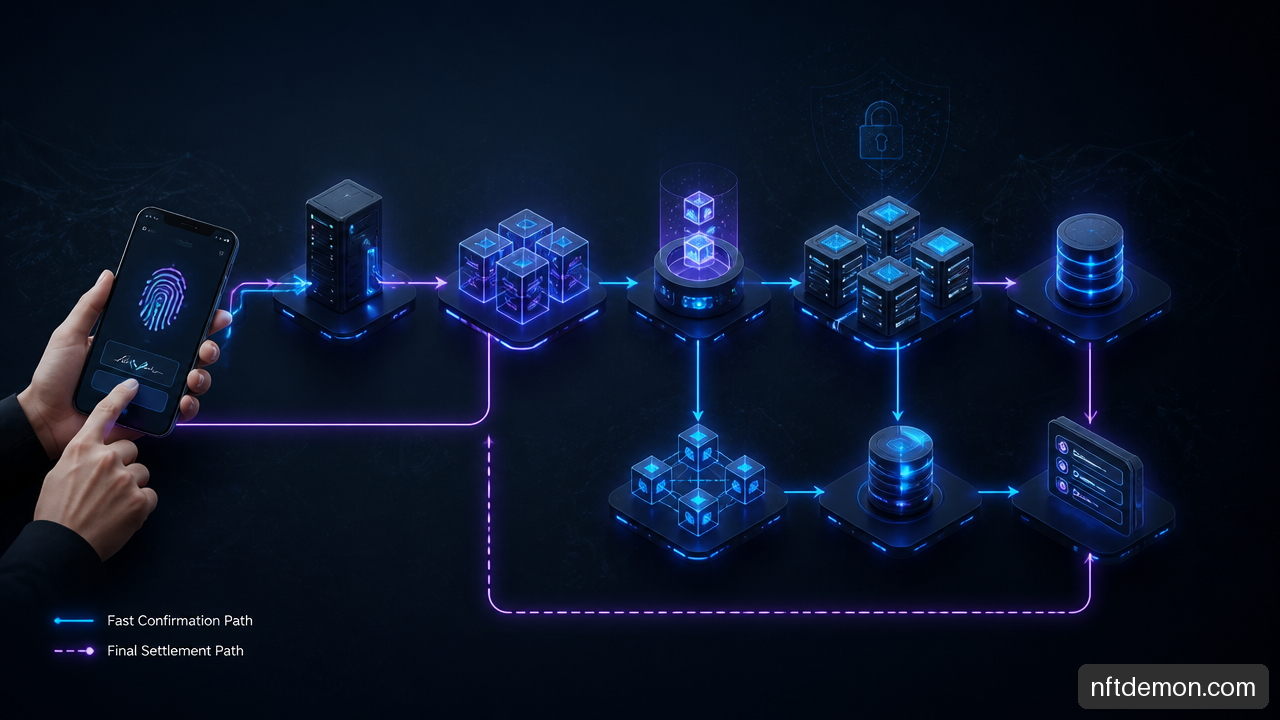
A blockchain transaction is only one component in a consumer interaction. The application must build a transaction, obtain wallet consent, submit it through an RPC provider, monitor execution, retrieve updated state, update the interface, and handle exceptions. At consumer scale, the weakest of these services often defines the experience.
OMG notes in its cloud customer architecture for blockchain data flows that blockchain systems need scalable messaging and transformation for very large transaction volumes in cloud environments. That requirement extends beyond nodes. It includes event pipelines, queues, databases, observability, and the APIs that connect them.
Build for Read Scale and Write Spikes Separately
Consumer dApps usually have many more reads than writes. A marketplace may receive thousands of asset views for every purchase. A game dashboard may render balances, inventory, rankings, and event history before a player submits one transaction. Sending all of those reads to a public RPC endpoint is an avoidable failure mode.
A resilient design typically separates:
• Transaction submission, with multiple RPC routes, queue visibility, idempotency keys, and retry policies.
• Read APIs, backed by indexed data stores optimized for application queries rather than raw chain scans.
• Event processing, which converts blocks, receipts, and application events into product-ready state.
• Reconciliation services, which compare indexed data with canonical chain state after reorgs, delays, or provider incidents.
• Observability, including queue depth, error rates, confirmation timing, failed signatures, index lag, and data publication cost.
The architecture should also prevent duplicate spending or duplicate minting when users retry. Idempotency keys, server-side intent records, and deterministic request handling matter here. If a user taps “buy” three times because the interface stalls, the system needs to know whether it has one transaction, three valid intents, or a wallet interaction that never reached the network.
Avoid a Bridge-Heavy Default
Inter-chain scalability can be useful, but every bridge introduces a separate trust, liquidity, monitoring, and recovery surface. The Temple CIS survey’s architecture scalability framing distinguishes scaling within a chain from scaling across chains. For consumer applications, that distinction should influence product scope: inter-chain expansion is not merely additional capacity; it is an operational dependency.
A bridge-heavy stack can fail in ways users do not understand. Transfers may be delayed by relayers, message verification may pause, liquidity may be fragmented, and customer support may have limited ability to resolve a transaction mid-route. For a launch product, I would keep core assets and primary user actions in one execution environment whenever possible.
Use bridging when it creates a clear commercial benefit, such as access to a necessary ecosystem, established liquidity, or a strategic distribution channel. Do not use it simply because a multichain diagram looks sophisticated.
Model the Real Cost Per Active User
Gas is not the total cost of a consumer blockchain product. The operating model should include execution fees, settlement fees, proof generation where applicable, data availability publication, RPC capacity, indexing, cloud databases, observability, fraud controls, wallet support, and incident response.
A useful planning equation is:
Fully loaded transaction cost = execution + data publication + settlement + infrastructure + support and recovery overhead.
This is especially important for sponsored transactions. If the application pays user gas, growth can turn a minor unit cost into a material operating expense overnight. Establish fee ceilings, admission controls, rate limits, and fallback rules before a campaign goes live. For instance, a rewards claim system may switch from instant individual claims to scheduled batching when peak demand exceeds the budget or data availability threshold.
Key Takeaways
Make the Architecture Serve the Product
• Design for peak concurrent demand, including retries and read traffic, rather than average daily transactions.
• Keep high-trust state on-chain, but move media, search, analytics, temporary state, and high-volume reads to conventional infrastructure.
• Use rollups when lower execution cost and base-layer settlement are valuable; use appchains when dedicated capacity and custom rules justify added operational ownership.
• Preserve a single execution domain when composability and simple user flows matter more than theoretical horizontal scale.
Make Latency, Finality, and Cost Explicit
• Separate immediate acknowledgment, soft confirmation, and final settlement in both user experience and risk policy.
• Treat data availability as a throughput and cost constraint, not a background implementation detail.
• Measure RPC latency, index lag, sequencer queue depth, failed transaction rates, and support tickets alongside chain-level metrics.
• Avoid bridge dependencies in the primary consumer journey unless they produce a clear, durable benefit.
FAQ
What Blockchain Architecture Is Best for a High-Throughput Consumer App?
For many consumer applications, a rollup or high-throughput execution environment paired with off-chain read infrastructure is a strong starting point. Choose an appchain when sustained volume, custom sequencing, or specialized fees justify operating a dedicated environment. Choose a permissioned network when known participants, compliance, and controlled governance matter more than public decentralization.
How Many Transactions Per Second Does a Consumer App Really Need?
There is no universal number. Calculate peak writes from concurrent users, actions per user, retries, automated traffic, and administrative operations. Then model reads separately, because consumer interfaces often produce far more read requests than transactions. A product expecting 10,000 users to act during a short event needs burst capacity, not just an attractive average TPS figure.
How Do Rollups Help Keep Consumer Fees Lower?
Rollups batch execution and publish results back to a settlement layer, allowing many actions to share underlying costs. They help most when the application can batch activity efficiently and control data size. They are less attractive when the application produces large amounts of data that must remain available or when cross-chain movement becomes a frequent user requirement.
What Is the Difference Between Execution, Consensus, Data Availability, and Settlement?
Execution applies transaction logic and changes state. Consensus determines transaction ordering and agreement among participants. Data availability ensures the transaction data required for verification can be retrieved. Settlement finalizes commitments and resolves disputes. A modular stack can assign these functions to different layers, but every function still needs a credible security and operating model.
When Should Transactions Stay Off-Chain?
Keep activity off-chain when it is temporary, easily recomputed, private, media-heavy, or too frequent to justify permanent publication. Examples include game movement, recommendation ranking, media delivery, and search. Keep transactions on-chain when independent verification, transferability, settlement, or auditability are central to the user promise.
What Bottlenecks Matter Besides the Blockchain Itself?
RPC providers, wallet connection flows, indexing pipelines, cloud queues, database reads, sequencer congestion, data availability costs, and bridge services can all become bottlenecks. A fast chain cannot compensate for an application that takes several seconds to load a balance or cannot explain whether a submitted transaction succeeded.
Is Sharding Still Relevant for Consumer Applications?
Yes, particularly when workloads can be partitioned with limited cross-partition coordination. It is less appealing when a consumer flow depends on synchronous composability across many assets and contracts. The practical question is whether partitioning reduces real workload contention without making the user journey slower or more error-prone.
Sources
• a16z — Exploring Architectures for Blockchain Scalability
• Temple CIS — A Comprehensive Survey of Blockchain Scalability
• OMG — Cloud Customer Architecture for Blockchain
• Birmingham City University Open Access — Scalable Blockchains - A Systematic Review
NFT Demon Holdings helps enterprises scope, evaluate, and build blockchain programs — start with a free evaluation call.
Talk through your use case
Free evaluation call — objective, constraints, and fit, before any proposal.