How to Design a Blockchain Proof of Concept That Reaches Production
By Jeremy Ryan, Founder & CEO · September 2026

A credible answer to how to design a blockchain proof of concept that can reach production is simple in principle: test the business assumption and the production constraints at the same time. A PoC should not be a polished transaction demo. It should be a deliberately narrow system that proves whether multiple parties can share trusted state, operate the network, integrate existing systems, and recover when something fails.
For decision makers, the central question is not, “Can we write data to a blockchain?” Nearly any capable team can do that. The question is whether the proposed architecture produces a measurable improvement over the current process without creating unacceptable security, privacy, governance, or operating costs.
Key Takeaways
• A production bound PoC begins with one disputed, duplicated, or reconciliation heavy workflow involving more than one independently accountable party.
• I recommend treating blockchain as a hypothesis, not a predetermined answer. If one organization should control the database and participants already trust that operator, a conventional system may be the stronger choice.
• Governance, identity, key custody, integration behavior, and recovery procedures belong in the first design. Deferring them usually turns a successful demo into an expensive redesign.
• The PoC should use explicit exit criteria for business value, security, operational readiness, and user acceptance testing, or UAT. “The demo worked” is not an exit criterion.
• A pilot should compare its results to the existing process. Writing valid blocks proves technical function; it does not prove commercial or operational value.
A small PoC is not a shallow PoC. Keep the workflow narrow, but test the hardest trust, ownership, and integration assumptions early.
Start With The Decision, Not The Chain
Define The Business Problem In Verifiable Terms
Start with a process map rather than a platform shortlist. Identify the participants, the asset or record being shared, the state changes, the current source of truth, and the cost of disagreement. Then specify the claim the PoC must prove.
Consider a product provenance workflow. A manufacturer, logistics provider, distributor, and retailer each maintain status records. The proposed ledger might record custody transfers and compliance attestations. The PoC claim should not be “a blockchain tracks shipments.” A more useful claim is: approved participants can resolve custody disputes from one shared record with less manual reconciliation than the current process.
That wording creates a testable baseline. Measure current dispute resolution time, exception volume, duplicate record rate, and staff effort. Then compare the PoC workflow with that baseline. Without comparison, a team can mistake technical novelty for improvement.
The Texas Department of Information Resources identifies DLT candidate screening, simple use case selection, business involvement, platform choice, and network configuration as core PoC decisions in its Blockchain Proof of Concept lessons learned. That framing matters because a PoC should reduce uncertainty, not merely create an attractive technology demonstration.
Reject Blockchain When The Trust Model Does Not Require It
A blockchain is often unsuitable when the real problem is poor data quality, weak process ownership, or an integration backlog. An immutable record will preserve bad input with impressive durability. It will not make false information true.
Use this decision filter:
| Decision Question | Blockchain Is More Plausible When | Avoid Or Reconsider When |
|---|---|---|
| Who controls the record? | Several parties need shared authority | One organization is clearly accountable |
| Why is reconciliation expensive? | Parties maintain conflicting records | The issue is internal process discipline |
| Is a shared history useful? | Audits, transfers, approvals, or settlement need evidence | A normal audit log meets the need |
| Can participants govern together? | Members can accept rules for access and disputes | No party will own operations or decisions |
| Is privacy manageable? | Only minimal proofs or references need to be shared | Sensitive data must be broadly replicated |
A permissioned blockchain is often appropriate where membership must be approved and participant roles are known. A public blockchain can fit use cases needing open verification, public settlement, or composable assets. A hybrid design can keep sensitive operational data controlled while anchoring selected proofs or settlement activity to a public network.
There is no universal winner. The correct network model follows the trust boundary, disclosure obligations, transaction economics, and governance model. If those elements are unknown, platform selection is premature.
Set A Scope That Can Fail Usefully
The first use case should cover one asset class, one state transition, a limited participant group, and one or two integrations. That is not a compromise. It is an experiment designed to make failure interpretable.
For example, test “transfer custody of serialized temperature sensitive shipments between two logistics partners” before attempting inventory, invoicing, customs documentation, payments, and customer portals in one release. If a custody transfer fails, the team can isolate whether the issue is the smart contract, identity policy, event ingestion, or business rule. In an oversized PoC, every defect has too many possible causes.
I recommend creating a short decision charter before code is written:
-
Define the business outcome and non blockchain baseline.
-
Name the participating organizations and accountable executives.
-
Specify the first workflow, exclusions, and success metrics.
-
Record the expected network model and data classification assumptions.
-
State the go, revise, and stop decisions available at the end of the PoC.
IBM presents discovery, build, and validation as defined stages in its five step blockchain PoC framework. Treating validation as a distinct phase prevents the common mistake of declaring victory as soon as a smart contract executes.
Design The Production Shape Before Building
Separate Trust, Integration, Identity, And Operations
A fragile PoC often places the user interface, integration code, smart contracts, administrative controls, and node access in one loosely managed application. It can demonstrate a flow quickly, but it hides the dependencies that become production incidents.
Instead, design a layered architecture from the outset:
| Layer | Production Responsibility | PoC Evidence To Produce |
|---|---|---|
| Application | User workflows, approvals, and exception handling | UAT results for real roles |
| Integration | APIs, queues, event delivery, and reconciliation | Duplicate, replay, and timeout tests |
| Trust Layer | Smart contracts, transactions, consensus, and finality | Rule enforcement and finality evidence |
| Identity And Privacy | Authentication, authorization, keys, and disclosure controls | Revocation and access tests |
| Operations | Nodes, RPC endpoints, indexers, logging, backup, and incident response | Monitoring and recovery exercises |
This separation makes accountability visible. The ledger may be the shared source of agreed state, but enterprise systems still own master data, reporting, customer records, and downstream actions. The integration layer must know what happens when an ERP system accepts an order but the blockchain transaction is delayed, rejected, or not yet final.
An event consumer should therefore be idempotent: processing the same valid event twice should not create two invoices or two custody changes. It should also track event position, verify finality rules, and reconcile missed events after a temporary outage. These details are not glamorous. They are often where production readiness is won or lost.
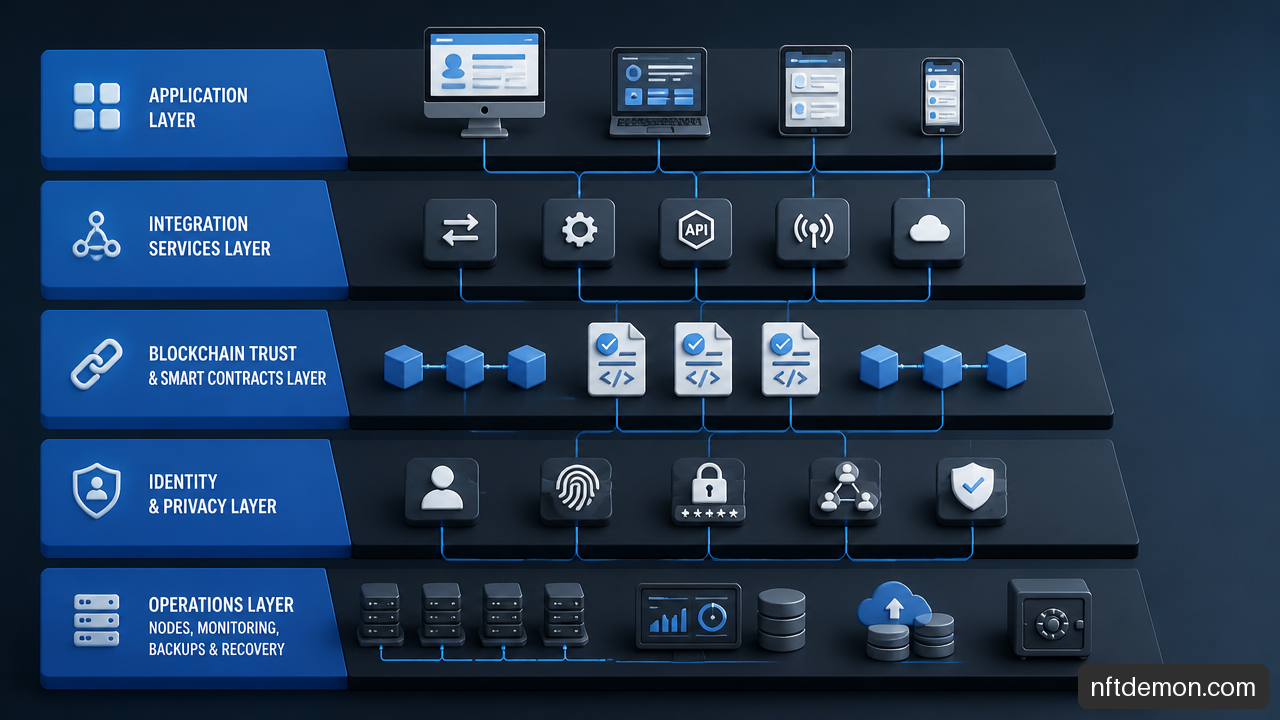
The Enterprise Blockchain Architecture Guide 2026 similarly describes production bound designs as requiring governance, identity, privacy, integration, rollback, recovery, and testing under degraded conditions. The practical implication is clear: a production PoC should test the seams between components, not just the ledger itself.
Make Governance A Precondition For Code
For a consortium, write down who may join, who may leave, who runs nodes, who pays operating costs, and who can approve software upgrades. Define the voting threshold for changes, the process for handling a disputed transaction, and the conditions under which a member can be suspended.
A smart contract can enforce certain rules, but it cannot settle every institutional question. For example, a contract may reject an unauthorized custody transfer. It cannot determine whether a participant’s stolen signing key should trigger emergency suspension, who has authority to approve that suspension, or how previously valid transactions should be treated.
At minimum, assign named ownership for:
• Network administration and node availability
• Smart contract release approval
• Identity issuance, renewal, revocation, and recovery
• Security incident coordination and emergency access
• Data retention, disclosure review, and compliance escalation
• Participant onboarding, member exit, and dispute procedures
Treat Identity And Data Disclosure As Core Requirements
A wallet address alone is not an enterprise identity model. Production systems usually need a way to connect an authorized organization, person, service account, or device to permitted actions. They also need revocation when an employee leaves, a vendor relationship ends, or a private key may be compromised.
Key management must answer uncomfortable questions before launch: Where are signing keys stored? Is hardware backed custody required? Who can initiate recovery? Can an emergency administrator suspend a credential without gaining routine transaction authority? How is the action audited?
Apply a retention and disclosure rationale to every field proposed for on chain storage. Record only what must be jointly verified. Keep personal data, documents, trade secrets, and mutable records off chain where practical, using hashes, pointers, or verifiable attestations where appropriate. A hash can demonstrate that a specific document version existed; it does not grant permission to disclose the underlying document.
Build A PoC That Tests Real Failure Modes
Design Smart Contracts For Change And Containment
Smart contracts should represent shared rules, not every business function. Keep policy that changes frequently in a controlled application or rules service when doing so does not weaken the shared trust requirement. Put the minimum critical state transition on chain: who can act, what conditions must be true, what event occurred, and what evidence is retained.
Each contract needs a threat model, automated tests, explicit upgrade authority, and a compensation path. A compensation path does not erase an immutable transaction. It creates an authorized corrective transaction that restores the intended business position while preserving the audit trail.
For instance, if a transfer is approved using a credential later found to be compromised, the process may suspend the credential, mark the transfer under review, and record a compensating state change after governance approval. The PoC should prove that this workflow is understandable to business users and acceptable to compliance stakeholders.
Avoid upgrade patterns that provide one administrator unrestricted control without clear oversight. Conversely, avoid making a contract permanently unchangeable when regulations, fee structures, or business rules are likely to evolve. The appropriate design depends on the harm of unauthorized change versus the harm of being unable to correct a defect.
Test The Unhappy Path Before The Pilot
Happy path testing proves only that cooperating systems work under ideal conditions. A production oriented PoC should deliberately inject failure.
| Failure Condition | What The PoC Must Verify |
|---|---|
| Duplicate event delivery | No duplicated settlement, invoice, or state transition occurs |
| Event replay after recovery | Consumers preserve order and safely identify prior processing |
| Delayed finality | Applications show pending status and avoid premature downstream action |
| RPC endpoint outage | Applications fail safely, retry appropriately, and alert operators |
| Indexer lag | Search and reporting expose freshness limits rather than misleading users |
| Revoked identity | New transactions are blocked while audit history remains available |
| Failed contract upgrade | Rollback or compensation authority and communications process work |
| Node or member outage | Network rules, service levels, and recovery responsibilities are clear |
Capacity testing should reflect the intended topology, including reduced node availability and slower dependent services. A laboratory measurement from one node on an uncongested network is not a production forecast. Where demand is uncertain, use a range. For example, test normal anticipated volume, a plausible peak, and a degraded scenario where one integration is delayed. The objective is not to predict every future transaction exactly. It is to reveal bottlenecks and establish realistic service targets.
Measure Feasibility, Acceptance, And Operational Fitness
A useful scorecard combines business, technical, security, and operational evidence:
-
Business outcome: reconciliation time, disputes, exception handling effort, or settlement cycle compared with the current method.
-
User acceptance: task completion, role based usability, training needs, and UAT approval for normal and exception workflows.
-
Technical behavior: transaction success rate, finality time, integration latency, data consistency, and smart contract test coverage.
-
Security and privacy: access control tests, key recovery exercise, audit logging, threat model findings, and disclosure review outcomes.
-
Operational readiness: node health, RPC availability, indexer freshness, alert coverage, backup restoration, and recovery time objectives.
A separate industry playbook discussing the PoC process repeats IBM’s emphasis on moving from opportunity definition through technology investigation, construction, dApp design, and measurement; see this PoC to production consultant playbook. The essential discipline is to make measurement decide the next investment, rather than using measurement as a post launch formality.
FAQ
What Problem Is A Blockchain PoC Supposed To Prove?
It should prove that a shared ledger improves a specific multi party workflow with measurable evidence. This may involve reducing reconciliation, creating verifiable custody history, enforcing joint approval rules, or improving auditability. It should also prove that participants can operate the model, not merely connect to a test network.
How Do You Know If Blockchain Is The Right Solution?
Choose blockchain when independent parties need synchronized state and no single party can credibly own the full record without creating trust or reconciliation costs. Avoid it when a central database, API integration, or better process governance solves the problem more simply. If the issue is bad input data, address data quality first.
What Makes A PoC Production Ready Instead Of Just A Demo?
A production ready PoC has tested identity lifecycle controls, key handling, integration failures, governance decisions, monitoring, recovery, and user acceptance alongside the core transaction. It also has documented go or no go criteria. A demo generally shows only the happy path.
Should The First Version Be Public, Permissioned, Or Hybrid?
Use a permissioned model when membership, confidentiality, and participant obligations must be controlled. Use a public network when open verification or public settlement is a requirement. Use hybrid architecture when some proofs need public verification but operational data must remain restricted. The choice should follow the trust and disclosure model, not marketing preference.
How Small Should The First Use Case Be?
Limit it to one high value state transition and the smallest participant group that can test the trust assumption. For example, validate transfer of custody between two organizations before including billing, insurance, customer service, and global partner onboarding. Keep the hard constraint, such as revocation or reconciliation, inside the small scope.
What Failure Modes Must Be Tested Before A Pilot?
Test duplicate messages, event replays, delayed finality, partial integration failure, unavailable RPC services, indexer delays, revoked identities, node outages, and failed upgrades. Also exercise backup and recovery. A pilot that has no answer for partial failure is usually only a larger demo.
How Do You Decide Whether To Move From PoC To Pilot?
Move forward only when the business result beats or plausibly can beat the baseline, users accept the workflow, security findings have owners and remediation plans, governance is approved, and operations can meet defined service objectives. If the ledger works but the consortium cannot agree on upgrade authority or data disclosure, pause rather than scaling a governance gap.
Sources
• Texas Department of Information Resources — Blockchain Proof of Concept (POC) Lessons Learned: https://dir.texas.gov/sites/default/files/DIR_Blockchain_POC_LessonsLearned.pdf
• IBM — 5 steps to a blockchain proof of concept (POC): https://assets.ctfassets.net/efnbmai9c55m/6UTVSweYfsBUBRZVvcoydi/58869cde358036084d40564c1bc54153/5_steps_blockchain_POC.pdf
• Kryptomindz — Enterprise Blockchain Architecture Guide 2026: https://kryptomindz.com/guides/enterprise-blockchain-architecture-guide/
• 7blocklabs.com: https://www.7blocklabs.com/blog/from-poc-to-production-enterprise-blockchain-consultant-playbook
NFT Demon Holdings helps enterprises scope, evaluate, and build blockchain programs — start with a free evaluation call.
Talk through your use case
Free evaluation call — objective, constraints, and fit, before any proposal.