Blockchain platform selection for financial institutions and governments
By Jeremy Ryan, Founder & CEO · September 2026
Blockchain platform selection criteria for financial institutions and governments should begin with a hard question: does this workflow actually require a shared, tamper evident ledger across organizations with different control interests? If the answer is no, a conventional database, secure API layer, or workflow platform may be less expensive, easier to govern, and simpler to audit.

- Start With the Use Case and Risk Ownership
- Evaluate Control, Privacy, and Settlement Certainty
- Test Operational Readiness, Integration, and Exit Options
- Key Takeaways
- Frequently Asked Questions
- Sources
Start With the Use Case and Risk Ownership
Apply a Negative Screen Before Comparing Platforms
We should not treat blockchain as a default modernization layer. It is most defensible when multiple parties need a common record, no single party should unilaterally rewrite that record, and reconciliation costs or settlement delays are material. Tokenized collateral movements, interagency credential verification, regulated asset servicing, and multiparty supply chain attestations can meet that test.
A single bank updating its own internal general ledger often does not. Nor does a government agency processing records that remain under one statutory custodian and are never independently validated by another organization. In those cases, distributed ledger technology can add node operations, cryptographic key management, smart contract assurance, and governance overhead without removing a meaningful trust problem.
A practical screening sequence is:
- Identify the independent parties that must write, validate, or rely on the record.
- Define the event that must be immutable, such as ownership transfer, entitlement issuance, payment instruction, or permit approval.
- Quantify the current reconciliation, dispute, delay, or audit burden.
- Determine whether legal authority permits shared validation and data replication.
- Compare the blockchain design against a centralized alternative with the same security and integration requirements.
A blockchain platform is justified by a distributed control requirement, not by the presence of data that could be digitized.
For federal use cases, the ACT IAC federal blockchain playbook recommends beginning with fitness for purpose and examining platform control, permissioning, consensus, smart contract languages, hosting, scalability, costs, and authorization requirements. That is a useful baseline because it moves procurement away from feature comparisons and toward deployability.
Define the Regulated Operating Model First
A platform decision is really a decision about operating authority. Financial institutions must establish who holds cryptographic keys, who approves policy changes, who operates validator infrastructure, who performs sanctions screening, and who can suspend an address or application when a legal order requires action. Governments must add records retention, public records obligations, procurement rules, data sovereignty, accessibility, and authority to operate considerations.
Write these requirements before issuing an RFP. Otherwise, a vendor can demonstrate high transaction throughput in a controlled environment while leaving core questions unanswered: Can an agency host the nodes in an approved environment? Can each participating bank control its own node? Can a compliance officer stop a workflow without granting unrestricted administrative power? Can forensic teams reconstruct an event sequence without exposing protected data to every participant?
The resulting requirements should assign a named risk owner for each control domain.
| Control Domain | Decision That Must Be Made | Common Failure Mode |
|---|---|---|
| Legal authority | Who may create, transfer, freeze, or retire a digital record? | Code permits actions that policy does not authorize. |
| Identity | How are institutions, users, and service accounts verified? | A wallet address is treated as sufficient institutional identity. |
| Data custody | What data is on chain, off chain, encrypted, or merely referenced? | Sensitive records are permanently replicated too broadly. |
| Operations | Who runs nodes, manages keys, and responds to incidents? | Responsibility is split across teams with no incident commander. |
| Change control | Who can approve upgrades and emergency actions? | Vendor or consortium rights are unclear until an outage occurs. |
Separate Permissioning From Governance
Permissioned is not the same as governed. A permissioned blockchain can restrict who joins the network while still leaving critical upgrade rights, validator admission decisions, or smart contract controls concentrated in one vendor or consortium administrator.
We should evaluate at least four separate rights:
• Access rights: Who can read, submit, validate, and administer transactions?
• Validator rights: Who can operate consensus nodes, and what happens if a validator fails or becomes noncompliant?
• Upgrade rights: Who can change protocol code, smart contract templates, cryptographic libraries, or fee policies?
• Policy enforcement rights: Who can impose transaction limits, freeze assets, revoke credentials, or respond to court orders?
This distinction matters most when multiple regulated entities participate. A securities settlement network, for example, may be permissioned at the participant level but still need independent control for each member institution. If every member depends on one operator’s infrastructure and upgrade schedule, the network may be technically distributed while remaining operationally centralized.
Evaluate Control, Privacy, and Settlement Certainty
Match Network Access to Institutional Trust Boundaries
Public networks can offer broad composability, external liquidity, and an established developer ecosystem. Permissioned networks can offer controlled membership, tailored confidentiality, and more direct policy enforcement. Neither is automatically better for regulated use.
The key question is whether the workflow needs open participation or a defined legal perimeter. A government benefit credential may require verified issuers and constrained access. A tokenized asset program may need controlled issuance and investor eligibility while still requiring interoperability with public liquidity or wallet infrastructure. Hybrid architectures can be appropriate, but they add bridge, oracle, identity, and monitoring risks that need independent review.
A regulated finance network evaluation framework from Digital Asset separates network access, independent security, privacy, infrastructure independence, independent control, composability, finality, and native token requirements. The separation is useful because these are not interchangeable. A network can have restricted access but weak participant independence, or strong privacy but poor interoperability.
Score Privacy by What Each Party Can Actually See
Privacy claims need a transaction level test, not a marketing label. Ask the vendor to demonstrate what a validator, participant, auditor, hosting provider, and unauthorized network member can see before and after transaction execution. Also test metadata. Transaction counterparties, timestamps, transaction size, and workflow frequency can reveal commercially sensitive information even when payloads are encrypted.
| Privacy Level | What Participants Commonly See | Best Fit | Primary Trade Off |
|---|---|---|---|
| Transparent | Full transaction data and history | Public attestations and low sensitivity records | Broad replication may expose business or personal data. |
| Sharded | A defined subset of records | Segmented agency or consortium workflows | Cross shard audit and reconciliation can become complex. |
| Transaction level | Only parties to a transaction receive its details | Bilateral trades and confidential payments | Auditors need explicitly designed access paths. |
| Sub transaction level | Different parties see different fields in one workflow | Complex asset servicing and regulated data sharing | Implementation and assurance are more demanding. |
For example, an asset transfer may allow a custodian to see the full position, a regulator to see the required reporting fields, and another participant to see only its own entitlement. That is materially different from encrypting an entire transaction and hoping that later reporting requirements can be satisfied.
Treat Finality as a Settlement Control
Raw transactions per second can be misleading. For regulated settlement, the decisive question is when a confirmed state becomes irreversible under the network’s rules. Probabilistic finality means confidence rises as more blocks or confirmations accumulate. Deterministic finality means the protocol identifies a point at which valid transactions cannot be reversed without breaking the established consensus assumptions.
A payment workflow may tolerate a confirmation window if downstream systems wait before releasing value. A delivery versus payment process, margin calculation, or government disbursement with strict accounting cutoffs may require a clearer and faster finality condition. The system design must specify what happens between submission, ordering, finality, and posting to systems of record.
Fair warning: instant deterministic finality does not eliminate operational risk. A valid but fraudulent transaction can still be final if identity controls, approval policies, or smart contract logic are weak. Finality protects settlement certainty; it does not replace fraud controls.
Test Security Beyond the Consensus Mechanism
Consensus mechanism selection affects fault tolerance, latency, validator incentives, and energy profile. It does not prove that the overall platform is secure. Institutional risk often concentrates elsewhere: key compromise, privileged administrator misuse, flawed smart contracts, insecure APIs, dependency vulnerabilities, cloud misconfiguration, or inadequate monitoring.
Security testing should include technical controls and operating evidence. The Fireblocks institutional buyer guidance identifies evidence such as third party penetration testing, cryptographic audits, documented disaster recovery and business continuity tests, secure software development documentation, SOC 2 Type II reporting, and ISO 27001 certification as procurement inputs. These artifacts do not guarantee safety, but they make unsupported security claims easier to challenge.
Test Operational Readiness, Integration, and Exit Options
Run Performance Tests That Mirror the Real Workflow
Performance testing should replicate the full path, not only consensus throughput. Measure identity checks, policy engine calls, smart contract execution, database reads, message queues, API gateways, custody approvals, reporting exports, and reconciliation with existing systems. A platform may process thousands of simple ledger writes while struggling with a realistic workflow that requires document verification and multiple approvals.
Build test cases around peak conditions and failure conditions:
- Normal transaction volume with representative transaction sizes.
- End of day, month end, benefit cycle, or market stress peaks.
- Validator loss, cloud region disruption, and delayed external services.
- Key rotation, certificate expiry, and planned software upgrades.
- A disputed transaction requiring audit reconstruction and policy review.
Transaction throughput should be scored alongside latency, finality, recovery time, data growth, and the operational labor required to keep the network healthy. A lower throughput platform with predictable finality and manageable recovery may be preferable to a faster system that cannot meet a regulated recovery objective.
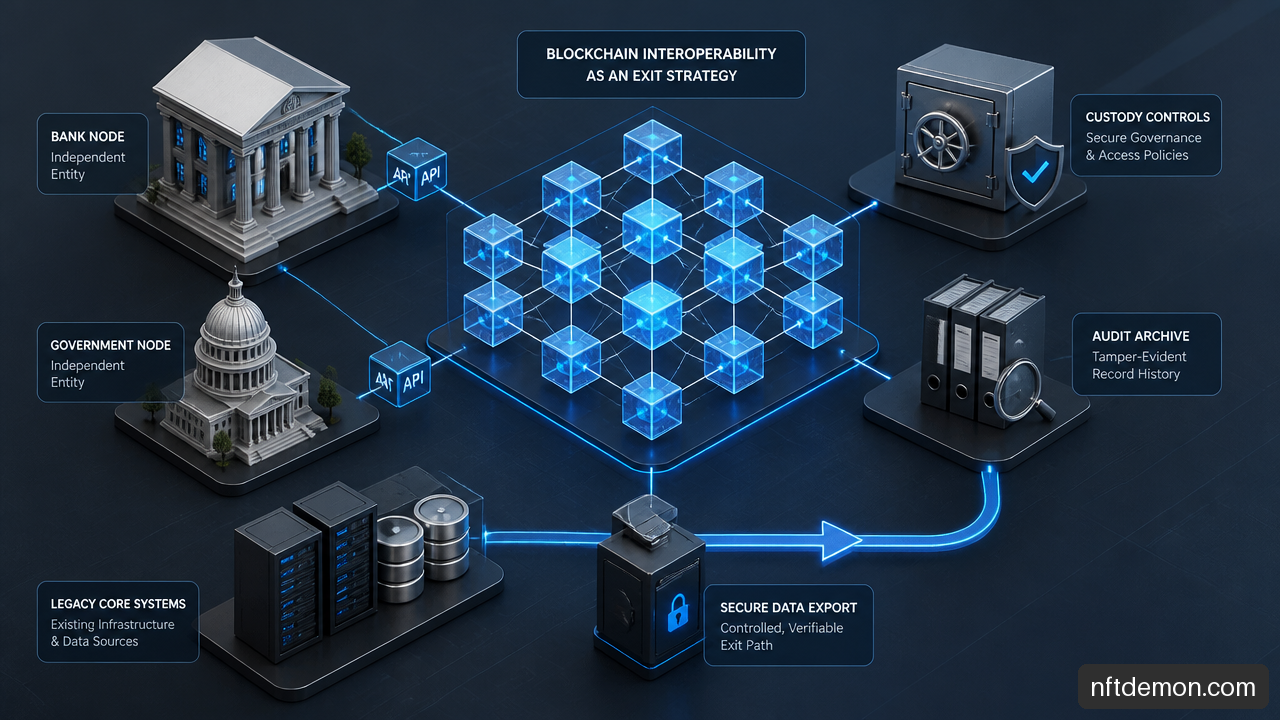
Design Interoperability as an Exit Strategy
Interoperability is often presented as a way to connect networks. For institutions, it is also an exit strategy. A platform that cannot export authoritative records, preserve signatures and timestamps, migrate smart contract state, or connect through documented APIs can make a future change prohibitively expensive.
We should require an exit architecture before launch. That architecture should identify which data remains authoritative, how off chain records map to on chain identifiers, how keys and certificates are transferred or retired, and how historical proof can be retained after a network migration. Contract terms should address data portability, source code escrow where appropriate, service continuity, support obligations, and assistance if the vendor is acquired or discontinues a product.
Consider a consortium that adopts a proprietary ledger for tokenized deposits. If one participant later needs to connect its treasury workflow to another network, it should not have to rebuild every integration or surrender transaction history to a central operator. Open standards and mature APIs reduce this risk, though they do not eliminate semantic differences between networks.
Evaluate Smart Contract and Custody Lifecycle Risk
Smart contract languages and tooling determine who can safely maintain the system after launch. Procurement teams should ask whether the language has mature static analysis, test frameworks, audited libraries, code review practices, and available engineering talent. A concise language can still create a long term risk if few developers can review critical contract logic.
Tokenized asset workflows require additional controls. Issuance rules, transfer restrictions, investor eligibility, corporate actions, redemption, freezes, and reporting obligations must be represented consistently across the smart contract, transfer agent process, custody model, and compliance workflows. If the code permits a transfer that the legal agreement forbids, the system has not achieved operational compliance.
The custody model deserves equal attention. Determine whether keys are held directly by the institution, a qualified provider, a multi party control scheme, or an end user wallet. Then test how approvals scale when an employee is unavailable, a signer is compromised, or a regulator requests a hold. Policy workflows should be enforceable in the transaction path, not documented only in a procedure manual.
Use a Weighted Procurement Scorecard and Evidence Gate
There is no single universal U.S. rubric for both governments and financial institutions. A weighted scorecard is more defensible when it reflects the actual mission, legal obligations, and residual risks. Capco’s Project AGOR selection framework groups protocol features, performance metrics, security considerations, cost analysis, and governance mechanisms in one institutional evaluation. Governance belongs in the scorecard from the beginning, not after a technical pilot succeeds.
| Evaluation Area | Illustrative Weight | Evidence Gate Before Production |
|---|---|---|
| Regulatory and legal fit | 25% | Documented control mapping, retention approach, and legal authority review |
| Governance and independent control | 20% | Decision rights, upgrade process, validator rules, and dispute procedure |
| Security and resilience | 20% | Audit artifacts, penetration tests, incident process, and DR or BCP test results |
| Privacy and identity | 15% | Demonstrated data visibility model, access controls, and audit access |
| Performance and finality | 10% | Representative load tests, failure tests, and finality definition |
| Integration and exit | 10% | API documentation, data export test, migration plan, and support commitments |
Weights will vary. A government identity program may assign more weight to privacy, hosting, and authorization. A tokenized collateral network may prioritize finality, independent control, custody, and interoperability. The discipline is not in choosing identical percentages; it is in documenting why each weight reflects a known institutional risk.
Key Takeaways
Selection Principles for Decision Makers
• Start with the trust and reconciliation problem. If one organization controls the workflow, blockchain may be the wrong answer.
• Score governance separately from permissioning. Participant access does not explain who controls upgrades, validators, or emergency actions.
• Define privacy at the field and metadata level. “Confidential” is not a sufficient procurement requirement.
• Score finality separately from transaction throughput when settlement certainty, accounting, or legal obligations are involved.
• Treat interoperability, data portability, and infrastructure independence as protections against vendor and network lock in.
• Require evidence before production approval: security assessments, resilience testing, documented operating controls, and demonstrable integration behavior.
A Practical Decision Standard
A platform is ready for a regulated pilot only when its control model, privacy model, finality semantics, and operating responsibilities are documented and testable. It is ready for production only when those promises survive representative workload, incident, audit, and migration tests.
Frequently Asked Questions
How Do Financial Institutions Choose a Blockchain Platform?
Financial institutions should begin with the business event being recorded and the parties that need independent trust in it. They should then score legal fit, identity and custody controls, privacy, finality, security evidence, integration, governance, and lifecycle cost. The highest throughput platform is not necessarily the best fit for settlement, custody, or asset servicing.
Is a Permissioned Blockchain Better Than a Public Blockchain for Regulated Use?
Not always. Permissioned networks are often suitable where known participants, controlled data visibility, and explicit operating rules are necessary. Public networks may be appropriate when open composability, broad distribution, or external liquidity are requirements. The decision depends on the legal perimeter, confidentiality model, control requirements, and risk tolerance.
What Security Criteria Matter Most in Blockchain Procurement?
Assess key management, privileged access, smart contract assurance, identity controls, API security, node hardening, vulnerability management, incident response, and disaster recovery. Request evidence rather than relying on architecture diagrams. A consensus mechanism alone does not address these broader risks.
How Should Governments Evaluate Hosting and Authorization Requirements?
Government teams should determine whether the hosting environment, service providers, identity model, logging, data location, and operational controls can satisfy the agency’s authorization process. For U.S. federal deployments, FedRAMP fit may be a deployment constraint for cloud components, but it does not automatically authorize the entire blockchain solution or the agency’s application.
Why Does Finality Matter More Than Throughput for Some Workflows?
Throughput measures how many transactions a system can process. Finality determines when a transaction can be treated as settled. In regulated payments, securities workflows, or accounting processes, a lower throughput platform with explicit deterministic finality may be more useful than a faster platform that requires a long confirmation window.
How Can an Institution Reduce Blockchain Vendor Lock In?
Require documented APIs, portable data exports, independent node operation where feasible, transparent governance, migration procedures, and contractual exit obligations. Test an export and reconciliation exercise during procurement. If historical records cannot be verified outside the vendor environment, the exit risk is substantial.
What Evidence Should a Vendor Provide Before Production Deployment?
Request security audit results, penetration test summaries, secure development lifecycle documentation, incident response procedures, disaster recovery and business continuity test evidence, governance documents, performance test results, integration specifications, and a clear statement of operational responsibilities. The evidence should match the proposed deployment, not merely a generic product description.
Sources
• ACT-IAC — Blockchain Playbook for the U.S. Federal Government: https://www.actiac.org/system/files/2021-09/Blockchain%20Playbook%20w%20Integration%20Phase%20FINAL.pdf
• Digital Asset Holdings — Blockchain Network Evaluation for Regulated Finance: https://www.canton.network/hubfs/Blockchain%20Network%20Evaluation%20for%20Regulated%20Finance,%20eBook,%20Mar%202024-1.pdf
• Capco — Project AGOR: https://www.capco.com/-/media/CapcoMedia/CAPCO/Intelligence-2025/CE/PDFs/Whitepaper_Project-AGOR_2025.ashx
• Fireblocks — Why Fireblocks: Core Value: https://www.fireblocks.com/report/buyers-guide-banks-financial-institutions
NFT Demon Holdings helps enterprises scope, evaluate, and build blockchain programs — start with a free evaluation call.
Talk through your use case
Free evaluation call — objective, constraints, and fit, before any proposal.