Blockchain operating model for ownership, compliance, and support
By Jeremy Ryan, Founder & CEO · September 2026

A blockchain operating model for technology ownership compliance and support defines who makes decisions, who operates the platform, who verifies compliance obligations, and who responds when technology or assets are at risk. It is not a policy document stored in a governance portal. It is the practical system that connects wallets, nodes, smart contracts, compliance workflows, support tickets, audit evidence, and executive authority.
For decision makers, the central question is simple: when a blockchain transaction, key, validator, smart contract, or compliance alert creates risk, who has the authority to act? If the answer depends on an emergency meeting or a chain of informal messages, the operating model is incomplete.
Key Takeaways
• Separate ownership from oversight. Technology teams should operate the platform, while compliance and legal teams define obligations and approve exceptions within their authority.
• Treat keys as controlled production infrastructure. Wallet governance, HSM or MPC protection, signer approval rules, recovery procedures, and access reviews belong in the operating model.
• Keep the compliance control plane off chain where appropriate. Identity verification, sanctions screening, case management, tax support, and evidence retention often require systems that should not be written permanently to a decentralized ledger.
• Connect every material operational event to evidence. A smart contract upgrade, validator restart, emergency pause, wallet policy change, and compliance escalation should produce linked records across ticketing, monitoring, approvals, and retained logs.
• Define authority before an incident. Emergency pause rights, withdrawal restrictions, key compromise actions, and communications authority should be predetermined, not negotiated under pressure.
• Choose a support model based on accountability, not convenience. Internal operation, managed service, and consortium models can all work, but each creates different control boundaries, service levels, and third party oversight duties.
Design The Operating Model Around Control Planes
Define The Operating Model Before Selecting Tools
Blockchain governance establishes rules and decision making structures. An operating model turns those rules into repeatable work. It specifies ownership, approval paths, systems of record, support coverage, service levels, evidence requirements, and escalation procedures.
I would frame the model around four connected control planes:
| Control Plane | Primary Question | Typical Systems | Accountable Function |
|---|---|---|---|
| Technology | Does the network, node stack, wallet service, and integration operate correctly? | Nodes, APIs, CI/CD, monitoring, SIEM | Technology owner |
| Asset and Key | Who can sign, transfer, recover, or restrict assets? | HSM, MPC, wallet policy engine, custody tools | Treasury or custody owner |
| Compliance | Is activity permitted, monitored, investigated, and documented? | Screening, KYC, case management, GRC | Compliance owner |
| Legal and Business | Is the activity authorized, contractually sound, and aligned with product intent? | Contracts, entity records, product governance | Legal and business owner |
This distinction matters because an on chain transaction is only one event in a broader business process. A wallet may be technically able to transfer an asset, for example, while compliance has determined that the destination requires review. The wallet service should enforce that decision through a policy control rather than expecting an operator to remember it.
A ledger can record that a transfer occurred. It cannot determine whether the transfer should have been permitted, reported, paused, or linked to a verified legal entity.
Keep On Chain And Off Chain Responsibilities Separate
A common design error is to assume blockchain data can replace every compliance system. It cannot. Public and permissioned ledgers are useful for transaction integrity, asset tracking, and smart contract state. They are usually poor locations for personally identifiable information, investigative notes, sanctions review rationale, confidential legal analysis, or internal incident records.
A more defensible architecture uses an on chain and off chain boundary:
Business Request
      ↓
Identity, Entity, And Policy Checks
      ↓
Compliance Decision And Approval Record
      ↓
Wallet Or Smart Contract Policy Enforcement
      ↓
On Chain Transaction Or State Change
      ↓
Monitoring, Reconciliation, Ticket, And Evidence Archive
The on chain layer should contain only what the network needs to execute and validate activity. The off chain layer should retain identity records, beneficial ownership evidence, approval metadata, risk decisions, exception cases, and communications. A cryptographic reference or transaction hash can connect the two without placing sensitive files directly on the ledger.
This design is especially relevant where a program handles regulated activity. The Financial Action Task Force states that virtual asset service providers should use risk based AML and counter financing of terrorism controls, including Travel Rule related information sharing. That means transaction execution and customer information exchange need clearly assigned operational owners, not just technically valid blockchain transfers. See the FATF guidance on virtual asset controls.
Recognize What Blockchain Does Not Prove
Blockchain can show control of an address or token at a specific point in time. It does not inherently prove the real world identity of the signer, the beneficial owner of a legal entity, the purpose of a transfer, or whether an address is subject to restrictions.
Consider a supplier that receives tokenized equipment rights through a corporate wallet. The ledger may show the wallet received the rights. It does not establish whether the wallet is controlled by the contracted supplier, a sanctioned party, an unauthorized employee, or a different entity following a corporate acquisition. Legal entity diligence and beneficial ownership verification remain necessary.
Assign Technology Ownership With A Practical RACI
Name One Accountable Technology Owner
The enterprise should designate one accountable technology owner for each blockchain service, not merely each vendor or application. That owner is responsible for service health, technical architecture, dependency mapping, lifecycle decisions, and support readiness. The role may sit in a product, platform engineering, digital assets, or enterprise architecture function, but the accountability should be explicit.
Compliance should not be made accountable for uptime. Technology should not be made accountable for interpreting every regulatory requirement. Blurring those roles creates a predictable failure pattern: technical staff approve a risky exception because a transaction is urgent, or compliance staff are expected to diagnose node drift during an outage.
Use A RACI That Covers Day To Day Operations
The following model can be adapted for a permissioned network, a public chain application, or a custody enabled product. RACI means Responsible, Accountable, Consulted, and Informed.
| Activity | Technology | Security | Compliance | Legal | Support Operations | Business Owner |
|---|---|---|---|---|---|---|
| Network and node availability | A/R | C | I | I | R | I |
| Wallet access policy | R | A/R | C | C | I | I |
| Customer or counterparty screening | I | C | A/R | C | R | I |
| Smart contract release | A/R | C | C | C | I | C |
| Emergency smart contract pause | R | C | C | C | R | A |
| Material policy exception | C | C | A/R | C | I | A |
| Regulatory record retention | C | C | A/R | C | R | I |
| Vendor performance review | A/R | C | C | C | R | I |
The table is not a substitute for judgment. It does, however, force difficult questions into the open. For instance, an emergency pause may be technically executed by engineering, but the business owner may need accountability for the commercial decision to halt a marketplace or settlement flow. If the asset or transaction class has regulatory implications, compliance and legal should have defined consultation rights before normal changes and immediate notification rights during emergencies.
Establish Decision Rights For Exceptions
Every operating model needs an exception process because blockchain activity rarely fits perfectly into standard workflows. A high value transfer may need expedited review. A critical vulnerability may require an emergency smart contract pause. A consortium member may request a node configuration deviation.
A workable exception record should identify:
- The requested action and affected assets, contracts, wallets, or nodes.
- The risk owner and decision maker.
- The compliance, security, and legal checks completed or temporarily deferred.
- The time limit, compensating controls, and required follow up.
- The ticket number, approval record, and transaction or deployment reference.
Fair warning: emergency authority should be narrow. Broad unilateral authority to pause contracts, override wallet controls, or rotate keys may solve one urgent problem while creating another. The appropriate design often uses threshold approvals, time bounded emergency powers, and post incident review by an independent control function.
Build Controls And Audit Evidence Into Daily Operations
Map US Obligations To Operational Controls
The exact obligations depend on the organization, asset type, customer model, and regulatory status. Still, US organizations can map common risk areas to named controls rather than leaving them as policy statements.
| Obligation Area | Operational Control | Evidence To Retain | Primary Owner |
|---|---|---|---|
| AML and sanctions | Pre and post transaction screening, case escalation, hold rules | Screening results, case notes, approvals, disposition | Compliance |
| Recordkeeping | Immutable event references plus retained off chain books and records | Transaction IDs, reconciliations, tickets, reports, retention schedule | Compliance and Operations |
| Custody and safeguarding | Segregated wallets, signer limits, reconciliations, recovery controls | Wallet policies, access reviews, balances, recovery tests | Custody or Treasury |
| Tax and reporting support | Transaction classification and data extraction workflow | Source data, calculation inputs, adjustments, approvals | Finance and Tax |
| Third party oversight | Vendor due diligence, SLA monitoring, audit rights, exit planning | Contracts, performance reports, risk assessments | Technology and Procurement |
For regulated firms, recordkeeping is not satisfied by saying that a blockchain is immutable. The SEC’s rules require broker dealers to retain accurate books and records; the relevant operational implication is that blockchain events must be reconciled to complete, retrievable business records. The SEC recordkeeping rules for broker dealers provide the regulatory foundation for this principle.
Build An Evidence Preservation Workflow
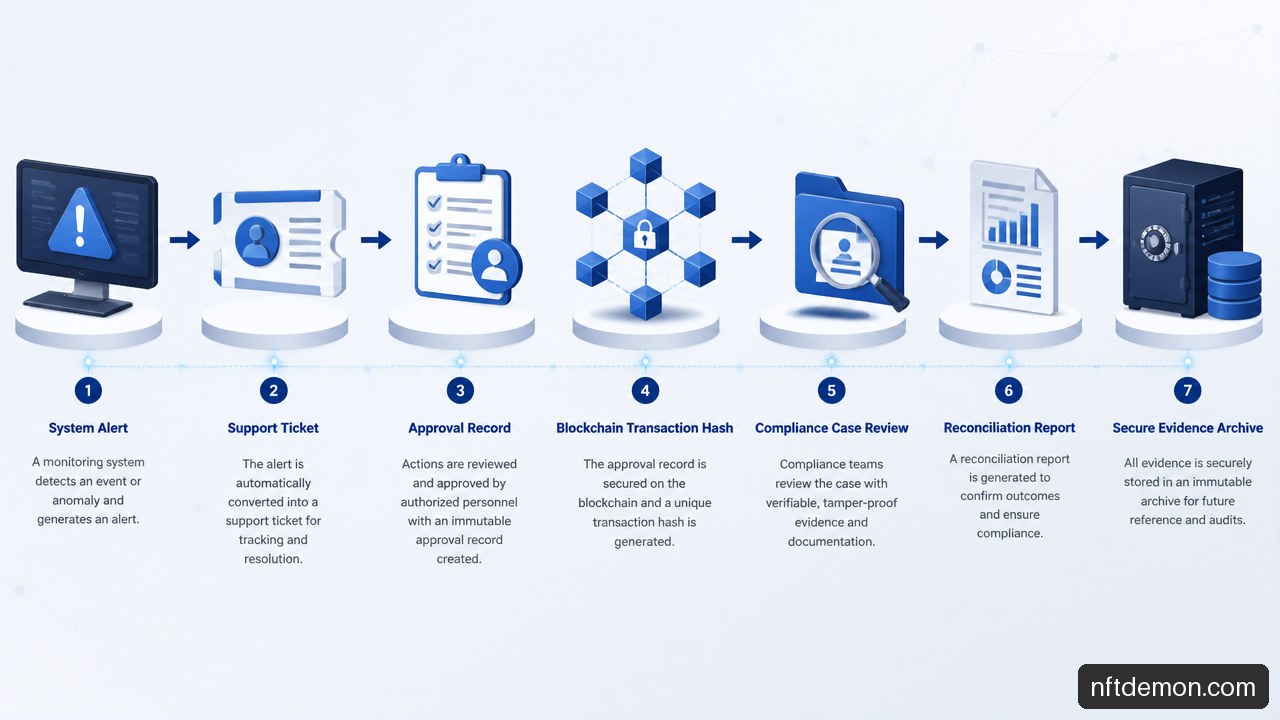
An audit ready workflow connects technical evidence to the business decision that caused it. The target is a chain of custody for events, not a folder full of screenshots created shortly before an audit.
- Detect the event. Monitoring identifies a failed node, anomalous transaction, wallet policy violation, smart contract alert, or access change.
- Open a controlled ticket. The ticket receives a unique ID, severity, time stamp, asset or service scope, and named owner.
- Preserve raw evidence. Retain relevant logs, transaction hashes, signer events, node metrics, API responses, and monitoring alerts with access restrictions.
- Capture the decision. Record approvals, exception rationale, compliance disposition, and legal escalation where required.
- Reconcile the outcome. Confirm whether the ledger state, internal records, customer impact, and financial records agree.
- Close with review. Document root cause, corrective actions, control changes, and evidence retention status.
This process becomes valuable when several systems disagree. Imagine a transaction succeeded on chain, but the customer portal showed it as pending because an indexer was delayed. Support needs the transaction reference and node health data. Finance needs reconciliation status. Compliance needs to know whether a customer communication or suspicious activity review is necessary. One ticket should link these records rather than forcing each function to reconstruct the timeline independently.
Govern Keys As A Support And Compliance Issue
Private keys are not just a security concern. They determine who can create irreversible blockchain actions. NIST identifies key management as foundational to protecting systems dependent on cryptographic keys, which is why key custody must be integrated into support processes rather than treated as a separate specialist function. Review NIST key management guidance for the underlying control context.
A mature key governance model generally includes:
• Named key owners and designated backup approvers.
• Segregation between key creation, policy approval, transaction initiation, and final signing.
• HSM or MPC based controls when risk, transaction value, or regulatory expectations justify them.
• Scheduled access reviews and immediate removal procedures for role changes.
• Tested recovery processes that do not require a single unavailable employee.
• Clear rules for compromised keys, including address quarantine, signer rotation, customer communications, and reconciliation.
Choose A Support Model And Prepare For Failure
Compare Internal, Managed, And Consortium Support
The best support model depends on the organization’s risk appetite, internal operating maturity, required control visibility, and the network’s governance structure.
| Support Model | Best Fit | Main Advantage | Main Trade Off | Essential Control |
|---|---|---|---|---|
| Internal operation | High value or highly regulated services | Direct control and faster internal coordination | Requires specialized staffing and on call coverage | Tested runbooks and segregation of duties |
| Managed service | Limited internal blockchain operations capacity | Faster access to platform expertise | Vendor dependency and reduced direct visibility | Contractual SLAs, evidence access, exit plan |
| Consortium split responsibility | Shared industry network or permissioned ecosystem | Costs and governance distributed among members | Authority can become slow or ambiguous | Member voting, escalation, and liability rules |
A managed provider does not transfer accountability. For banks, the OCC states that institutions must manage third party risk when relying on outside providers. That principle applies directly when node hosting, wallet infrastructure, transaction monitoring, or operational support are outsourced. The OCC third party risk management guidance is particularly relevant to service ownership, contractual oversight, and ongoing monitoring.
Choose internal operation when the organization needs direct command over keys, release cycles, sensitive data, or incident response. Choose managed support when service boundaries are precise and the provider can supply evidence, response commitments, security controls, and transition support. Choose consortium support when shared network legitimacy matters more than unilateral speed, but only after voting rights and emergency authority are written down.
Define Service Levels That Reflect Blockchain Failure Modes
A generic infrastructure SLA is insufficient. Blockchain support teams must distinguish between availability, finality, data integrity, and asset control.
| Failure Mode | Immediate Action | Escalation Trigger | Recovery Evidence |
|---|---|---|---|
| Validator or node outage | Fail over, assess consensus and transaction impact | Quorum risk or prolonged degradation | Node logs, incident timeline, validation status |
| Node drift or stale indexer | Halt dependent processing, compare against authoritative chain state | Material balance or transaction mismatch | Reindex record, reconciliation report |
| Key compromise suspicion | Freeze relevant policies, rotate signers, investigate access | Unauthorized signing or exposed credentials | Signer logs, rotation proof, impact assessment |
| Oracle failure | Pause affected contract function or apply approved fallback | Incorrect pricing, settlement, or trigger condition | Oracle data, contract state, approval record |
| Smart contract defect | Invoke approved pause or containment process | Asset loss risk, exploit evidence, incorrect state transition | Audit logs, deployment record, remediation plan |
Support teams should define severity by business impact, not just technical alerts. A node can be unavailable with no customer impact if redundant infrastructure is functioning. Conversely, a functioning node can create a severe incident if it submits incorrect oracle data or executes an unauthorized signer request.
Adjacent industry commentary on digital asset custody repeatedly emphasizes transaction monitoring, sanctions screening, Travel Rule implementation, and scalable compliance operations rather than relying on on chain automation alone. This reinforces the need for integrated operational workflows described in Fireblocks’ discussion of custody compliance operations.
Control Smart Contract Changes And Emergency Actions
Smart contract upgrades should follow the same discipline as high risk production releases, with extra attention to irreversibility and asset impact. A standard release path typically includes code review, independent security testing where warranted, change approval, deployment simulation, controlled release, monitoring, and reconciliation.
Emergency changes require a separate path. The operating model should predefine whether a contract can be paused, who can initiate the pause, how many approvers are required, what happens to pending transactions, and who authorizes restoration. “Rollback” needs careful wording: public blockchain transactions generally cannot be reversed in the technical sense. Recovery may instead involve a compensating transaction, migration, contract replacement, or legal and operational remediation.
Frequently Asked Questions
What Is A Blockchain Operating Model For Technology Ownership, Compliance, And Support?
It is the documented system for assigning decision rights, operational responsibilities, support workflows, controls, service levels, and evidence retention across blockchain technology. It converts broad governance principles into day to day actions for wallets, nodes, smart contracts, compliance reviews, and incidents.
Who Should Own Blockchain Technology In An Enterprise?
A named technology owner should be accountable for platform architecture, reliability, integrations, lifecycle management, and technical support. Business, compliance, security, legal, and treasury functions should retain authority over their own decisions rather than transferring all accountability to engineering.
How Do You Assign Compliance Responsibility For A Blockchain Platform?
Compliance should own policy interpretation, monitoring requirements, escalation criteria, case disposition, and retained compliance evidence. Technology should implement the controls and provide reliable data. Legal should advise on applicability and material exceptions. The split should be documented in a RACI and tested through incident exercises.
What Audit Evidence Should Be Retained For Blockchain Operations?
Retain transaction references, wallet and signer logs, node and monitoring logs, change tickets, approval records, reconciliation reports, screening results, incident records, and access reviews. The evidence should be searchable and linked by a common ticket, transaction, deployment, or case identifier.
Does Blockchain Remove The Need For Beneficial Ownership Checks?
No. A blockchain address indicates cryptographic control, not necessarily the verified legal identity or natural person who ultimately owns or controls an entity. Beneficial ownership and legal entity verification must remain in off chain onboarding and compliance workflows.
How Should Smart Contract Upgrades And Emergency Changes Be Handled?
Use a formal change process for normal upgrades and a tightly limited emergency process for urgent containment. Define approval thresholds, pause authority, testing requirements, customer communication triggers, and the recovery approach before deployment. Do not assume a completed transaction can simply be rolled back.
What Happens If A Blockchain Node Fails Or Becomes Out Of Sync?
Support should determine whether the issue affects consensus participation, transaction submission, indexing, balances, or customer visible data. The team may fail over, resynchronize, pause dependent workflows, and reconcile against authoritative chain state. A node restart alone is not evidence that downstream systems are correct.
How Do Permissioned And Consortium Blockchain Support Models Differ?
A permissioned network may be operated primarily by one enterprise, allowing clearer internal authority. A consortium network distributes control among members, so support obligations, upgrade votes, incident communications, validation rules, and liability boundaries require more detailed agreements. Consortium governance can improve shared legitimacy but may slow emergency decisions.
Sources / References
• OCC — Third-Party Relationships: Risk Management Guidance: https://www.occ.treas.gov/news-issuances/bulletins/2023/bulletin-2023-17.html
• SEC — Recordkeeping Rules for Broker-Dealers: https://www.sec.gov/rules/final/34-38245.txt
• FATF — Updated Guidance for a Risk-Based Approach to Virtual Assets and VASPs: https://www.fatf-gafi.org/en/publications/Fatfrecommendations/Updated-Guidance-RBA-VASP-2021.html
• NIST — Key Management: https://csrc.nist.gov/projects/key-management/key-management-guidelines
• fireblocks.com: https://www.fireblocks.com/blog/digital-asset-custody-compliance-banks
NFT Demon Holdings helps enterprises scope, evaluate, and build blockchain programs — start with a free evaluation call.
Talk through your use case
Free evaluation call — objective, constraints, and fit, before any proposal.