Blockchain integration architecture for ERP, CRM, and identity systems
By Jeremy Ryan, Founder & CEO · September 2026
Blockchain integration architecture for ERP CRM and identity systems should add a shared trust layer without displacing the applications that already run the business. ERP remains the financial and operational system of record. CRM remains the customer engagement system of record. Identity platforms remain responsible for authentication, lifecycle management, and access policy.
The ledger should instead record the business events that multiple parties need to verify independently: a supplier certification, custody transfer, approved rebate, warranty activation, regulated approval, or contract milestone. I would treat blockchain as a controlled evidence layer, not a duplicate database with a more complicated interface.
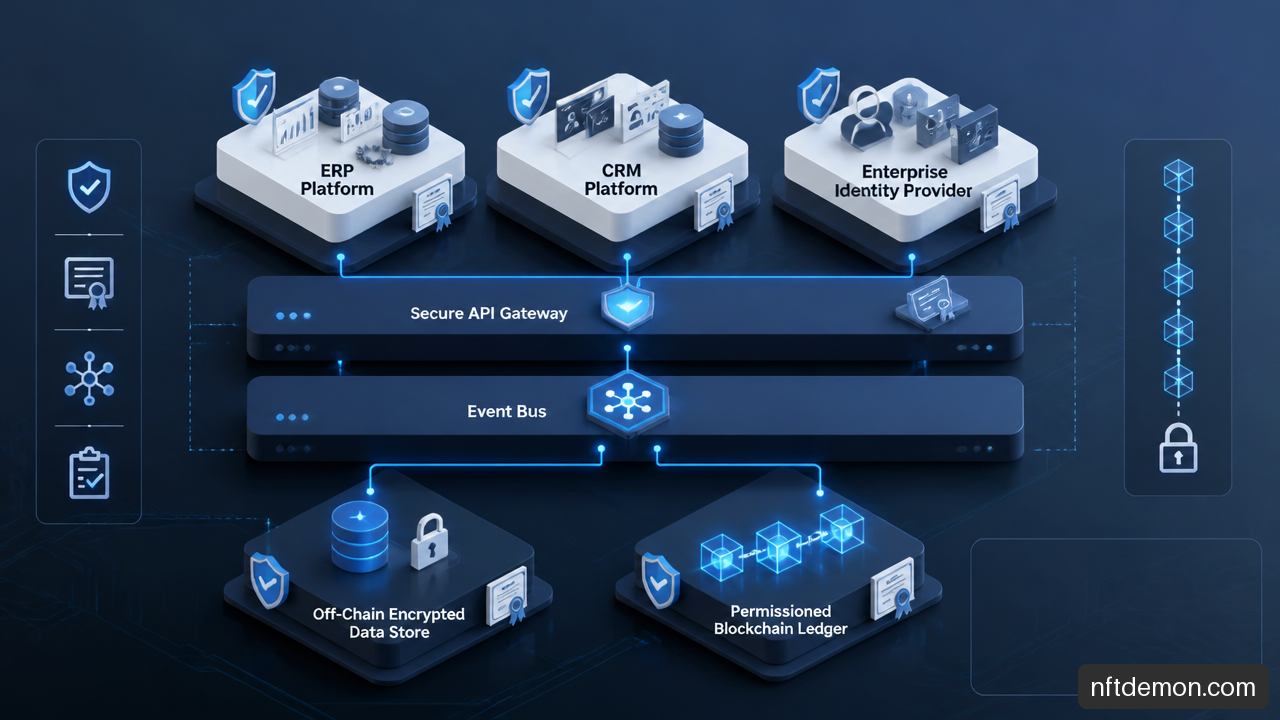
Reference Architecture for Enterprise Integration
A durable design separates transactional ownership from shared verification. This matters because ERP and CRM platforms are optimized for internal process execution, while a permissioned blockchain is optimized for agreed state transitions among approved organizations.
The Four Trust Boundaries
The reference architecture has four boundaries that should remain explicit:
| Layer | Primary Responsibility | Data It Should Handle | Data It Should Avoid |
|---|---|---|---|
| ERP and CRM systems | Core process execution and master records | Orders, invoices, customer profiles, inventory, service cases | Direct private key custody and consensus logic |
| Integration layer | Translation, routing, retries, validation, monitoring | Events, canonical payloads, correlation IDs, error states | Permanent ownership of business master data |
| Blockchain transaction layer | Shared validation and tamper evident state transitions | Hashes, identifiers, approvals, attestations, transaction status | Bulk documents, personal data, detailed pricing records |
| Identity and key services | Authentication, authorization, certificates, signing policy | User attributes, roles, certificates, secrets, revocation status | Uncontrolled application level signing keys |
At the center sits an event broker or enterprise service bus. ERP and CRM applications publish a business event when a meaningful state change occurs. An adapter then validates the event, converts it to a canonical format, checks idempotency, and decides whether a blockchain transaction is required.
For example, an ERP purchase order approval may create an internal event. That event does not automatically belong on a ledger. If the approval triggers a supplier commitment shared with outside parties, the adapter can submit a compact transaction containing the purchase order reference, approved status, timestamp, authorized organization, and hash of the supporting record. The full purchase order stays in ERP.
The OMG describes API adapters and ESB connections for secure enterprise blockchain integration, including transformation services and enterprise directory support for authentication and authorization. That is the practical dividing line: enterprise applications communicate through governed interfaces rather than attempting to speak directly to a blockchain network.
API Calls Versus Event Driven Flows
Both API based and event driven patterns have a place. The wrong choice usually creates unnecessary coupling.
| Pattern | Best Fit | Strength | Main Risk |
|---|---|---|---|
| Synchronous API | A user needs an immediate ledger verification before proceeding | Clear request and response behavior | User workflows can stall if blockchain services are unavailable |
| Event driven messaging | High volume state changes, asynchronous workflows, multi system propagation | Resilient decoupling and controlled retries | Requires strong monitoring and reconciliation |
| Batch submission | Periodic attestations, end of day proofs, lower urgency processes | Reduces transaction overhead | Delayed visibility and harder exception handling |
Use synchronous calls sparingly. A CRM agent verifying whether a warranty was activated might need a near immediate response. A warehouse system posting thousands of inventory movements generally should publish events to a broker and let a downstream adapter process them asynchronously.
The essential mechanism is an outbox pattern. When ERP or CRM commits a business change, it writes an outbound event to a local, durable outbox in the same database transaction. A publisher later sends that event to the broker. This prevents a common failure where an order is saved but the notification disappears during an outage.
The Adapter Is More Than a Connector
Legacy SAP, Oracle, Microsoft Dynamics, and custom applications often cannot safely call smart contracts directly. The adapter becomes a controlled boundary with defined responsibilities:
- Extract the relevant ERP or CRM event and associated record version.
- Transform proprietary fields into a stable, canonical business payload.
- Remove fields that violate data classification rules.
- Validate authorization, contract version, and schema compatibility.
- Submit the transaction through a gateway or blockchain loader.
- Store the transaction ID, result, and correlation ID for later reconciliation.
- Route failures to retry, exception, or manual review workflows.
A modular adapter model is reflected in an arXiv architecture for extractors, transformers, middleware, blockchain loaders, and runtime status visibility. The important architectural lesson is not the specific use case. It is the separation of concerns. Transformation logic, retry behavior, and observability are operational functions that should not be embedded in smart contracts.
A smart contract should validate shared business state. It should not become an undocumented integration platform, a document repository, or a replacement for enterprise workflow controls.
Data Placement and Identity Controls
Data placement and identity design determine whether a blockchain project becomes auditable infrastructure or a permanent privacy problem. The basic rule is straightforward: place only what counterparties need to independently verify on chain.
A Practical On Chain and Off Chain Classification Model
“Keep sensitive data off chain” is incomplete advice. Decision makers need field level rules.
| Data Class | Recommended Location | Rationale |
|---|---|---|
| Transaction hash and immutable event ID | On chain | Establishes proof that a defined record version existed |
| Organization ID, product ID, shipment ID | On chain when pseudonymous or non sensitive | Supports shared reconciliation and traceability |
| Approval state and signer reference | On chain | Creates a verifiable cross organization state transition |
| Customer names, emails, addresses, phone numbers | Off chain | Reduces privacy exposure and deletion conflict |
| Detailed invoices, contracts, clinical records, attachments | Off chain | Avoids storage bloat and access control complications |
| Encryption keys and raw credentials | Never on chain | Keys require rotation, revocation, and tightly restricted custody |
| CRM interaction notes and sales intelligence | Usually off chain | These records are sensitive, change frequently, and rarely need shared consensus |
An on chain hash proves integrity only when the organization can reliably reconstruct the exact source payload used to produce it. That means defining canonical serialization rules. If one system hashes a date as 09/14/2026 and another uses 2026-09-14, the records may be semantically identical but cryptographically different.
For records that must be shared selectively, store an encrypted document in an approved off chain repository, place a content pointer and hash on the ledger, then enforce access through application and identity controls. An Infosys ERP integration model describes an application layer that retrieves pointer referenced data and validates it across blockchain and data store layers. This split is often more usable than trying to put documents into the ledger itself.
Four Identity Domains, Not One
Identity is commonly oversimplified as “connect SSO to blockchain.” That solves only one portion of the design. A complete architecture distinguishes four identity domains.
| Identity Domain | Example | Required Control |
|---|---|---|
| Workforce identity | Procurement manager approving a supplier milestone | SSO, MFA, role based access, joiner mover leaver lifecycle |
| Customer identity | Customer viewing a warranty or loyalty record | Consent, privacy controls, account recovery, customer IAM policy |
| Node and operator identity | Organization operating a permissioned ledger node | PKI certificates, node authorization, certificate rotation |
| Transaction signing identity | Service or authorized individual submitting a ledger transaction | Hardware protected keys, signing policy, limits, revocation |
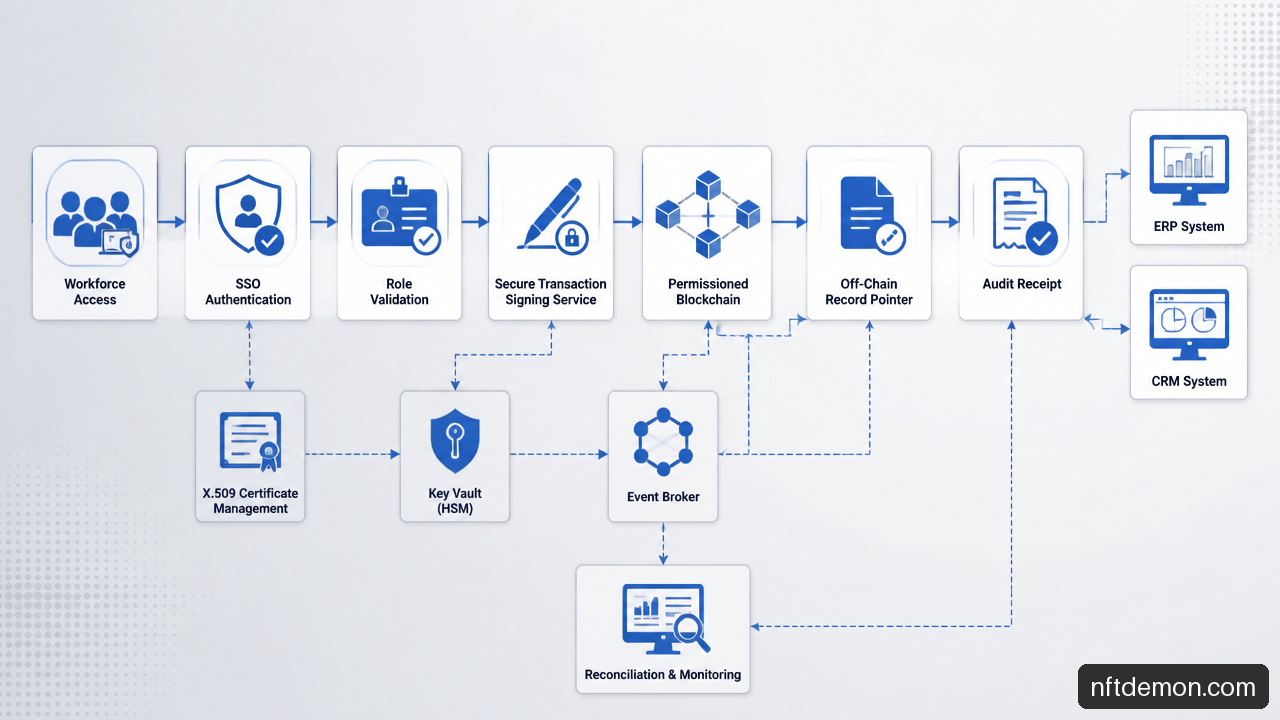
These domains may be linked, but they should not be collapsed. A workforce user authenticated through Active Directory or another identity provider does not necessarily need direct custody of a blockchain private key. The application can request a policy controlled signing action from a secure signing service after identity, role, and transaction context are evaluated.
For a purchase approval, the signing policy might require all of the following:
• The requester is authenticated through enterprise SSO.
• The requester holds the procurement approver role for the relevant cost center.
• The transaction amount falls within delegated authority.
• The organization certificate is valid and has not been revoked.
• The smart contract version accepts the submitted schema.
Fair warning: service identities are often the overlooked risk. Integration services need their own least privilege authorization, short lived credentials where feasible, secret rotation, and transaction limits. A service account that can submit unrestricted ledger updates is a concentrated control failure.
Certificates, Revocation, and Recovery
Permissioned networks commonly use PKI and X.509 certificates to identify organizations, nodes, and authorized participants. The operational lifecycle is more important than the initial issuance.
A sound process includes issuance approval, certificate inventory, expiration alerts, scheduled rotation, emergency revocation, and replacement testing. If a supplier organization is removed from a consortium, its node access and transaction signing rights should be revoked quickly, while its historical transactions remain available for audit.
Account recovery needs similar thought. A customer who loses access to a portal should recover through the customer identity process, not by attempting to alter historical ledger evidence. The architecture should preserve the relationship between an old credential and a new credential through a controlled, auditable reassignment event.
Reliability Governance and Delivery
The hard part is rarely submitting the first transaction. The hard part is keeping ERP, CRM, middleware, identity services, and the ledger aligned through outages, upgrades, personnel changes, and disputes between participating organizations.
Preventing Duplicate Writes and Sync Drift
Distributed systems are usually eventually consistent. A blockchain transaction may succeed after the originating ERP session times out, or an event may be redelivered after a broker restart. Designs must expect this rather than treating it as an exception.
Use these controls together:
• Business idempotency keys derived from a stable source event ID, record version, and transaction type.
• Correlation IDs that follow the event from ERP or CRM through middleware, signing, blockchain submission, and reconciliation.
• Transactional outboxes so published events are tied to committed source system changes.
• Inbox or deduplication stores so the adapter can ignore a valid redelivery rather than creating another ledger state change.
• Reconciliation jobs that compare source records, integration state, and blockchain transaction receipts.
Consider a shipment confirmation. The ERP commits shipment S-1042, publishes an event, and the adapter submits it to the ledger. The network accepts the transaction, but the adapter crashes before writing the receipt back to ERP. Without idempotency, a retry can produce an unnecessary second transaction. With an idempotency key, the adapter queries the ledger or its submission registry, discovers that S-1042 version 7 already completed, and records the original receipt.
The recovery path should be explicit:
- Detect the mismatch through monitoring or scheduled reconciliation.
- Classify it as pending, duplicate, rejected, or semantically conflicting.
- Retry only safe, idempotent operations.
- Send conflicts to a business exception queue with source record, payload hash, and transaction evidence.
- Correct source data through the normal ERP or CRM process, then submit a compensating event if needed.
Do not overwrite ledger history to hide a business correction. Record the correction as a new state transition that references the earlier transaction.
Governance Is an Architecture Component
A permissioned blockchain shared across legal entities requires more than technical access control. It needs a governance model that answers who can join, who can deploy smart contract updates, who approves schemas, who pays for operations, and how disputes are handled.
The Springer framework for selecting blockchain interoperability approaches recommends evaluating value type, integration goals, centralized or distributed approach, integration mode, and protocol. For enterprise leaders, that is a useful sequence before committing to a platform.
A consortium should maintain a change advisory process covering at least these decisions:
| Decision Area | Governance Question | Practical Control |
|---|---|---|
| Membership | Who may read, write, validate, or operate nodes? | Membership agreement and certificate policy |
| Data schema | Can new fields be introduced without breaking adapters? | Versioned canonical schema and compatibility tests |
| Smart contracts | Who approves a new business rule? | Multi party approval, source review, staged deployment |
| Incident response | Who can pause a harmful workflow? | Defined emergency authority and post incident review |
| Evidence retention | How long are receipts and off chain records retained? | Retention schedule aligned to legal and operational needs |
Schema versioning deserves special attention. Adding an optional field may be backward compatible. Changing the meaning of approved, changing a product identifier, or altering a hash algorithm is not. Contract versions should coexist during migration, and adapters should reject payloads that do not declare a supported version.
When Blockchain Is the Wrong Choice
Blockchain is justified when multiple organizations need shared, durable evidence and no single party should unilaterally rewrite the record. It is often unnecessary when one organization already controls the workflow and trusted APIs plus conventional audit logs meet the actual requirement.
| Use Blockchain When | Prefer Conventional Integration When |
|---|---|
| Suppliers, distributors, regulators, or partners need independent verification | One enterprise owns all users, data, and dispute resolution |
| Parties need to agree on a shared state transition | The need is primarily internal reporting or database replication |
| Historical evidence must be hard to alter without detection | High volume operational data needs millisecond response times |
| Governance can be defined across participants | Participants cannot agree on data ownership or operating rules |
A loyalty CRM program illustrates the distinction. If a brand alone issues and redeems points, a conventional database is usually simpler. If points are redeemed across several independent merchants, and each merchant needs a common view of issuance and redemption, a permissioned ledger may be worth evaluating.
Key Takeaways
• Treat blockchain as a shared evidence and state transition layer, while ERP, CRM, and IAM retain their core system of record roles.
• Place hashes, references, approvals, and shared statuses on chain. Keep personal data, documents, detailed commercial records, and keys off chain.
• Separate workforce, customer, node, and transaction signing identities. SSO alone does not replace certificate lifecycle or key management.
• Use adapters for transformation, idempotency, retries, transaction submission, and observability. Do not force these responsibilities into smart contracts.
• Design for event redelivery, partial failure, and reconciliation from day one. A successful ledger transaction is not enough if ERP or CRM never records the receipt.
• Establish consortium rules for membership, schema changes, smart contract versioning, emergency actions, and evidence retention before expanding the network.
Frequently Asked Questions
What Is Blockchain Integration Architecture for ERP CRM and Identity Systems?
It is a layered design that connects ERP and CRM applications to a blockchain network through governed APIs, adapters, and event services, while identity platforms authenticate users and authorize transaction signing. The goal is selective shared verification, not replacing every enterprise database with a ledger.
When Does Blockchain Make Sense for ERP or CRM Integration?
It makes sense when independent organizations must verify the same event, such as custody transfer, supplier compliance, shared settlement status, or cross merchant redemption. Avoid it when a single enterprise controls the workflow and a conventional database plus audit logging provides sufficient accountability.
What Should Stay On Chain Versus Off Chain?
Keep compact, non sensitive evidence on chain: hashes, IDs, timestamps, approvals, and state changes. Keep personally identifiable information, CRM notes, invoices, contracts, attachments, and encryption keys off chain. Store pointers and hashes so authorized systems can retrieve and verify off chain records.
How Do SAP, Oracle, or Dynamics Environments Connect to Blockchain?
They typically connect through an integration layer rather than direct smart contract calls. The layer extracts source events, transforms formats, validates business rules and identity context, submits transactions through a gateway, and returns receipts for reconciliation.
How Do SSO, Active Directory, and Certificates Fit Together?
SSO and directory services establish who a workforce user is and what enterprise role they hold. Certificates identify authorized organizations, nodes, or blockchain participants. Secure signing services can connect the two by allowing a valid enterprise identity and role to request a policy approved transaction signature.
How Do You Prevent Duplicate Writes and Sync Drift?
Use transactional outboxes, idempotency keys, correlation IDs, deduplication records, and recurring reconciliation. When a timeout leaves transaction status uncertain, query the ledger and integration registry before submitting again. Treat corrections as compensating events rather than edits to historical evidence.
How Should Smart Contracts Interact With Enterprise Workflows?
Smart contracts should enforce shared validation rules and record agreed state transitions. ERP and CRM should retain complex workflow orchestration, user interfaces, reporting, approvals, and master data management. This boundary keeps contract code smaller, more reviewable, and less exposed to changing internal process logic.
Sources and References
• OMG — Cloud Customer Architecture for Blockchain: https://www.omg.org/cloud/deliverables/CSCC-Cloud-Customer-Architecture-for-Blockchain.pdf
• Springer — An enterprise framework for blockchain interoperability: https://link.springer.com/article/10.1007/s12525-025-00869-6
• arXiv — Integration Adapter Architecture for Food Traceability Blockchain: https://arxiv.org/html/2603.26306v1
• Infosys — Integrating Blockchain with ERP for a Transparent Supply Chain: https://www.infosys.com/oracle/white-papers/documents/integrating-blockchain-erp.pdf
NFT Demon Holdings helps enterprises scope, evaluate, and build blockchain programs — start with a free evaluation call.
Talk through your use case
Free evaluation call — objective, constraints, and fit, before any proposal.