Blockchain governance framework for consortium members
By Jeremy Ryan, Founder & CEO · September 2026

A blockchain governance framework for consortium members and technology operators turns shared ownership into an operating system for decisions, accountability, and controlled technical execution. I recommend designing it before production launch, not after the first membership dispute, failed upgrade, or security incident exposes unclear authority.
A consortium network is not governed merely because several organizations run nodes. It is governed when those organizations can answer harder questions: Who approves a new member? Who can suspend a validator? Who pays for an emergency patch? Who owns contributed code? Who decides whether a protocol change is routine maintenance or a commercial redesign?
The World Bank notes that consortium blockchain access, membership, and accountability depend on clear governance rules. Its discussion of blockchain governance and regulation reinforces a central operational point: member admission is a governance decision with legal, commercial, and security consequences, not a technical provisioning task.
Separate Strategic Authority From Technical Authority
The most useful design principle is simple: consortium members decide what the network is allowed to become; technology operators decide how approved work is safely executed. Without this separation, an operator may become a de facto owner of the network, or every low risk infrastructure task may become trapped in a board vote.
A governance framework should distinguish between authority to set policy, authority to approve risk, authority to execute work, and authority to independently verify outcomes. The University of Houston Clear Lake identifies decision process, accountability, verifiability, trust, incentives, security and privacy, and effectiveness as core governance attributes in its study of consortium blockchain governance attributes. Those attributes are practical design tests, not abstract ideals.
Establish Four Accountable Bodies
A mature consortium generally needs four distinct functions, even if a smaller network assigns several functions to the same people under documented conflict controls.
| Governance Function | Primary Authority | Typical Decisions | What It Must Not Do Alone |
|---|---|---|---|
| Governance board | Strategic and commercial control | Membership policy, annual budget, major protocol changes, business scope | Directly administer nodes or override security evidence without process |
| Technical steering committee | Technical direction and risk review | Architecture standards, release approval, interoperability policy, technical exceptions | Change commercial terms or admit members unilaterally |
| Technology operator | Execution and service reliability | Node deployment, monitoring, backup validation, approved patches, incident containment | Alter consensus rules, membership rights, or economic rules without approval |
| Independent auditor or assurance function | Verification | Control testing, log review, evidence review, conflict reporting | Operate production infrastructure or approve its own findings |
The board should represent the organizations carrying legal, financial, or market exposure. The technical steering committee should include qualified technical and security representatives, but it should not become a shadow board. Its mandate is to determine whether a proposal can be implemented safely and whether its dependencies, privacy implications, and rollback conditions are known.
Technology operators may be consortium members, third party providers, or a jointly funded service entity. The governance framework must state which role applies in each case. An operator that is also a member has an inherent conflict: it may benefit commercially from a technical decision it is asked to implement. Require disclosure, recusal where appropriate, and independent release verification for material changes.
Use A Decision Rights Matrix, Not Vague Committee Charters
A committee charter saying that a group “oversees technology” is not enough. I recommend a decision rights matrix that identifies one accountable decision maker, required consultation, approval threshold, execution owner, and evidence retained for each recurring decision.
| Decision | Board | Technical Steering Committee | Operator | Auditor |
|---|---|---|---|---|
| Admit a voting member | Approves | Reviews technical readiness | Provisions only after approval | Verifies records |
| Add a nonvoting participant | Approves policy exception when needed | Validates integration | Onboards | Reviews access evidence |
| Routine infrastructure patch | Informed | Sets preapproved boundaries | Executes | Samples evidence |
| Protocol or smart contract change | Approves major change | Recommends release | Deploys approved release | Verifies controls |
| Security incident containment | Receives escalation | Advises on risk | Acts immediately within emergency authority | Reviews response |
| Suspend a node | Confirms extended suspension | Assesses impact | Executes temporary isolation | Reviews justification |
The distinction between approval and execution protects both sides. Members retain legitimate control over shared assets and risk. Operators gain enough delegated authority to keep the network functioning.
Choose Voting Thresholds By Irreversibility And External Impact
One vote per member is often politically attractive, but it is not automatically effective. The threshold should reflect the decision’s reversibility, financial impact, effect on member rights, and regulatory exposure.
A practical policy can divide decisions into three classes:
- Routine operational actions use delegated authority. Examples include replacing a failed server, renewing a certificate, or applying a previously approved low risk patch.
- Material technical changes require technical committee approval plus a qualified board vote. Examples include changing endorsement policy, modifying smart contract logic, or adding a new interoperability endpoint.
- Constitutional changes require supermajority approval, and sometimes unanimous consent. Examples include changing voting rights, reallocating IP ownership, altering liability caps, or changing the consortium’s stated purpose.
A 50 percent threshold may work for ordinary budget items. It is usually too weak for a rule that changes another member’s access rights or financial exposure. Conversely, unanimity can make a consortium fragile when one inactive member can block necessary remediation. A sensible compromise is a supermajority of eligible voting members, paired with participation requirements and an escalation rule for persistent nonresponse.
Governance should make major control changes difficult enough to be legitimate, but not so difficult that the network cannot be defended or repaired.
Control The Full Membership Lifecycle
Membership is not a single onboarding event. It is a sequence of controlled states: candidate, approved, probationary, active, suspended, exiting, and removed. Treating it this way avoids a frequent weakness in permissioned networks, where credentials are issued promptly but commercial, legal, and operational readiness are incomplete.
Fraunhofer’s enterprise blockchain consortium formation taxonomy supports the need to address technical, organizational, legal, and governance design together. A node can be technically capable while the prospective member remains unsuitable because its data rights, sanctions screening, funding commitment, or insurance position is unresolved.
Define Admission Gates Before Access Is Granted
The admission process should produce a documented decision rather than an informal sponsor endorsement. A practical sequence is:
- Application and sponsorship: The candidate identifies its legal entity, intended role, business purpose, and sponsoring member if sponsorship is required.
- Due diligence: The consortium reviews ownership, regulatory status, security posture, conflicts of interest, and ability to meet operating obligations.
- Legal accession: The candidate signs the consortium agreement, data terms, IP license schedules, confidentiality terms, and fee commitments.
- Technical readiness: The operator verifies identity controls, key management, network connectivity, logging, incident contacts, and any required integration test.
- Probationary operation: The participant has restricted permissions or nonvoting status until it meets agreed evidence requirements.
- Activation: Voting, transaction, or validator rights activate only after the accountable authority records approval.
Probation is particularly useful when a new participant needs production data access but has not yet demonstrated stable node operations. It should have a defined time limit. An indefinite probation state is simply ambiguity in formal clothing.
Suspension And Exit Need More Precision Than Admission
Suspension should be available when a node is compromised, a member breaches a material obligation, or a regulator requires action. Yet suspension can disrupt transactions, data availability, and shared workflows. The policy should therefore distinguish temporary technical isolation from member removal.
For example, an operator may immediately isolate a node that shows unauthorized administrator activity. That emergency action should not automatically terminate the member’s contractual rights. The board can later determine whether the incident was operator error, a member control failure, or a broader network issue.
Exit procedures should address at least four items:
• Revocation of certificates, keys, API credentials, and privileged access
• Retention or deletion of data subject to contract and applicable law
• Transfer, retirement, or replacement of node responsibilities
• Settlement of fees, IP rights, open disputes, and continuing confidentiality duties
A member leaving a consortium should not retain unnoticed technical pathways into the network. Equally, the consortium should not erase records needed for auditability merely because a commercial relationship ended.
Make Change Management Safe And Decisive
Permissioned blockchain changes are governance sensitive because code, consensus configuration, access policies, and business rules can be tightly connected. A small smart contract edit can alter settlement behavior. A validator configuration change can affect availability. An identity provider change can unintentionally exclude a member.
The answer is not to require a board vote for every patch. It is to classify changes by risk and establish a release path before urgency arrives.
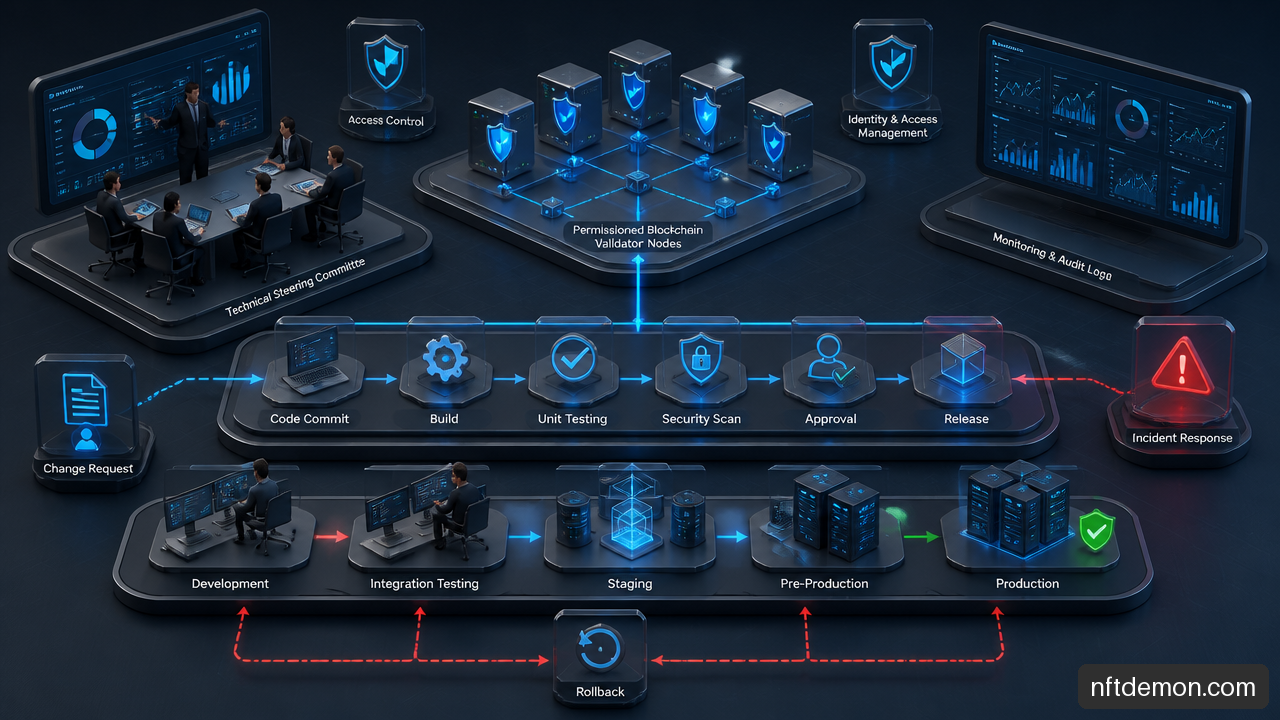
Separate Routine Patches From Protocol Changes
| Change Class | Example | Approval Path | Testing And Rollback Expectation |
|---|---|---|---|
| Standard maintenance | Operating system patch within approved baseline | Operator under delegated authority | Maintenance window, evidence of testing, verified backup |
| Controlled technical change | New monitoring agent or API version | Technical steering committee | Test environment, member notice, rollback plan |
| Material protocol change | Smart contract rule change or consensus policy update | Committee recommendation plus qualified board vote | Formal test window, member acceptance criteria, staged rollout |
| Emergency change | Active exploit mitigation or urgent key revocation | Operator acts under emergency authority, then escalates | Immediate containment, recorded rationale, postincident review |
A change becomes material when it alters member rights, transaction finality, data visibility, economic allocation, legal exposure, or interoperability commitments. Routine work can be delegated only where those boundaries are explicit.
Require Evidence Before A Release, Not Just Approval
A valid approval should reference the exact release artifact, implementation window, test results, affected members, rollback trigger, and named accountable operator. Otherwise, a board may approve a concept while an operator deploys a materially different implementation.
For a contentious protocol change, require a defined test period. Members should validate their integrations against a release candidate and report exceptions. The technical steering committee then records whether exceptions are blocking, acceptable with mitigation, or outside the approved scope.
A rollback procedure matters most when a release changes shared state. In some blockchain architectures, reversing executed transactions may be impossible or commercially unacceptable. In that case, the policy should define compensating transactions, account reconciliation, or temporary transaction holds rather than promise a literal rollback. Fair warning: the correct recovery method depends on the chain design and the business process connected to it.
Make Incident Authority Fast But Reviewable
During a suspected compromise, the operator needs authority to isolate nodes, revoke credentials, pause integrations, preserve logs, and activate incident communications. Waiting for a full member vote can turn a contained event into a network wide exposure.
Emergency authority should have constraints:
• It applies only to defined security, availability, or legal emergencies.
• It permits containment, not permanent policy changes.
• It requires escalation to the technical steering committee within a specified period.
• It requires a written incident record and independent review after stabilization.
This protects against both delay and overreach. The operator can act quickly, but cannot quietly use an incident as a route to redesign the network.
Connect Compliance, Funding, And Legal Accountability
Technical governance cannot be legally enforceable if contracts say one thing while smart contracts, access control, and operational procedures do another. The governance framework should connect these layers directly.
DLA Piper identifies stakeholder representation, IP ownership and licensing, and funding mechanics among the issues addressed in blockchain consortium governance guidance. These terms are often postponed to commercial negotiations, but they affect whether the network can survive disagreement.
Align The Legal Documents With The Technical Rules
Before launch, the consortium should maintain an integrated document set:
| Document | Governance Purpose | Operational Connection |
|---|---|---|
| Consortium agreement | Defines purpose, representation, voting, liability, and disputes | Matches actual membership and decision processes |
| Operating rules | Defines service levels, node duties, incident response, and audit rights | Becomes the operator runbook baseline |
| IP and data schedules | Defines code ownership, licenses, data use, and derived outputs | Controls repositories, APIs, storage, and access permissions |
| Security standard | Defines identity, key management, logging, vulnerability handling, and assurance | Produces auditable operator evidence |
| Funding policy | Defines fees, reserve levels, procurement, and spending approvals | Controls invoices, shared services, and emergency expenditure |
For U.S. operations, regulatory compliance should be assessed against the consortium’s actual activity rather than the label “blockchain.” Relevant obligations may arise from privacy rules, cybersecurity commitments, sector regulations, sanctions controls, records retention, consumer protection requirements, or financial services obligations. There is no single U.S. governance template that resolves every use case.
Consider a healthcare data consortium and a trade finance consortium. Both may use permissioned access control, but their data handling, audit expectations, participant eligibility, and incident notifications could be materially different. Governance must reflect the regulated process, not merely the distributed ledger technology.
Prevent Funding And IP Disputes From Becoming Technical Blockers
Funding policy should specify who contributes, how cost shares change when membership changes, who can approve unbudgeted spending, and what happens if a member does not pay. If the operator is funded by a subset of members, that funding relationship should not grant those sponsors undisclosed control over shared technical decisions.
IP terms should distinguish at least three categories:
- Preexisting IP contributed by a member or operator before the consortium begins.
- Consortium developed IP created specifically for the network.
- Member data and outputs produced through use of the network.
The rights needed to operate, maintain, and transition the network should survive operator replacement. Otherwise, a commercial dispute with the operator can become an availability crisis.
Use Hybrid Governance For Most Consortiums
On chain governance can record votes, approvals, configuration states, and policy attestations in a tamper evident form. Off chain governance handles legal agreements, confidential deliberation, dispute mediation, regulatory notifications, and decisions requiring human judgment.
Most consortiums benefit from a hybrid model. Use on chain mechanisms when auditability and automated enforcement add value. Use off chain mechanisms when legal enforceability, confidentiality, or nuanced negotiation is required. Avoid putting sensitive personal information, confidential commercial terms, or private board deliberations directly on chain merely because the platform can store them.
Key Takeaways
• Separate authority from execution. Members should control purpose, rights, membership, major risk, and commercial commitments. Operators should execute approved work and act rapidly within bounded emergency authority.
• Use a role matrix. Every recurring decision needs an approver, executor, consulted parties, evidence requirement, and escalation path.
• Treat membership as a lifecycle. Admission, probation, active participation, suspension, exit, and removal should each have defined legal and technical controls.
• Classify changes by risk. Routine maintenance should move quickly. Protocol, smart contract, access, and consensus changes require stronger review, member notice, testing, and recovery planning.
• Make operator obligations auditable. Minimum controls should cover node hardening, privileged access, key management, monitoring, logging, backup validation, incident response, and independent review.
• Link the legal and technical layers. IP, funding, liability, data rights, and regulatory compliance must match the permissions and workflows enforced by the network.
FAQ
What Is A Blockchain Governance Framework For Consortium Members And Technology Operators?
It is the combined set of legal agreements, decision rules, role assignments, technical standards, and escalation procedures governing a permissioned blockchain network. It defines who may participate, who can approve changes, who operates infrastructure, and how the consortium proves accountability.
Who Should Sit On The Governance Board Versus The Technical Steering Committee?
The governance board should include representatives authorized to make strategic, financial, legal, and membership decisions for participating organizations. The technical steering committee should include people responsible for architecture, cybersecurity, interoperability, data controls, and release risk. A board member can sit on both groups, but conflict management becomes more important when that person’s organization also operates critical infrastructure.
How Do Members And Operators Split Decision Rights?
Members approve decisions that change network purpose, rights, liabilities, membership, funding, or material business rules. Operators execute approved releases, maintain nodes, monitor performance, and contain incidents. Operators should receive delegated authority for standard maintenance but not unilateral authority to alter protocol rules or member privileges.
How Should New Members Be Approved?
Use a formal workflow covering sponsorship, due diligence, legal accession, technical readiness, probation, and activation. Approval should be recorded by the authorized body, while the operator should provision credentials only after that decision is complete. This prevents a technically connected entity from becoming an unofficial participant before contractual and security conditions are met.
What Is The Best Way To Handle Protocol Upgrades In A Permissioned Consortium?
Classify the change first. If it affects smart contract behavior, consensus configuration, transaction finality, data visibility, or member rights, treat it as a material protocol change. Require a proposal, impact assessment, test environment results, defined approval threshold, member acceptance period, deployment plan, and recovery procedure. Avoid calling a change “maintenance” simply because the code diff is small.
What Happens When Members Disagree On A Governance Decision?
The framework should move disputes through predefined stages: technical fact finding, committee recommendation, board vote, structured mediation, and a final contractual remedy if needed. For deadlocks, use a fallback rule such as a time bound mediation process, a neutral expert determination for technical questions, or a defined supermajority vote after a second review. The right fallback depends on the consequence of delay.
How Do You Prevent One Member Or Operator From Controlling The Network?
Avoid concentrating voting rights, validator control, release signing authority, administrative credentials, and audit functions in one organization. Use separation of duties, independent log review, multi party approval for material changes, shared key control where appropriate, and transparent records of decisions. Decentralization here is less about the number of nodes than the distribution of meaningful control.
What Security Controls Should Technology Operators Maintain?
At minimum, operators should maintain documented node baselines, strong identity and access management, protected key handling, privileged access logging, vulnerability and patch management, monitoring, backup validation, incident response procedures, and evidence retention. The exact baseline depends on the network’s risk profile, but a control that cannot be evidenced later is difficult for the consortium to govern effectively.
Sources
• World Bank — Blockchain Governance and Regulation as a Road Map for Blockchain Integration
• University of Houston Clear Lake — Governance Attributes of Consortium Blockchain Applications
• Fraunhofer — A Taxonomy for the Formation of Enterprise Blockchain Consortia
• DLA Piper — Key Issues in Governance for Blockchain Consortium 2019
NFT Demon Holdings helps enterprises scope, evaluate, and build blockchain programs — start with a free evaluation call.
Talk through your use case
Free evaluation call — objective, constraints, and fit, before any proposal.