Blockchain consulting vendor due diligence checklist for executive buyers
By Jeremy Ryan, Founder & CEO · September 2026
Selecting a blockchain advisor is not simply a procurement exercise. A blockchain consulting vendor due diligence checklist for executive buyers should test whether the firm can challenge the business premise, deliver safely on the chosen stack, and leave your organization more capable than it was before the engagement.

Key Takeaways
Treat The Vendor Decision As A Risk Decision
I recommend treating the selection process as a decision about controllable risk, not a contest between polished capability decks. The strongest vendor is not necessarily the firm with the longest blockchain services menu. It is the one that can prove the right capability for your use case, team, technical environment, and regulatory exposure.
A defensible evaluation should require evidence in five areas:
• A measurable business problem that may actually warrant blockchain rather than a conventional database, workflow platform, or API integration.
• Named personnel with defined responsibilities, availability, and substitution controls.
• Chain and protocol experience relevant to the exact architecture under consideration.
• Secure development, privacy, compliance, and incident response practices proportionate to the project risk.
• Clear ownership, knowledge transfer, support, and exit terms that prevent avoidable vendor dependency.
Use Proof, Not Assurances
A consulting engagement should reduce uncertainty before it creates irreversible technical or commercial commitments.
Ask vendors to show artifacts, not merely describe methods. A credible response may include an architecture decision record, a threat model, a sample release plan, anonymized remediation evidence, a staffing plan, and a transition checklist. A vague promise to provide “end to end blockchain expertise” is not comparable to proof that a team has operated the target protocol, integrated enterprise identity systems, or remediated smart contract findings.
Fair warning: no checklist can turn a poorly framed project into a sound investment. If the business case is thin, the correct answer may be a limited discovery engagement or a decision not to use blockchain at all.
Start With The Business Case And Engagement Boundary
Confirm That Blockchain Is The Right Architecture
Before comparing vendors, define the decision that blockchain is meant to improve. Typical candidates include multi party reconciliation, provenance across organizations that do not share a trusted operator, programmable settlement, tokenized rights, and verifiable credentials. These are not automatic blockchain wins.
I would require each bidder to explain the alternative architecture it considered and why it rejected it. For example, a retailer tracking internal inventory may gain little from a distributed ledger if one company controls all data and participants already trust its systems. A shared product provenance network involving manufacturers, logistics partners, regulators, and distributors may have a stronger case, but only if governance and data quality are solved as well.
Use this initial screen:
| Business Question | Strong Vendor Response | Warning Sign |
|---|---|---|
| What decision improves? | Defines a measurable workflow, cost, control, or settlement outcome | Focuses only on token features or market visibility |
| Why blockchain? | Compares centralized and distributed options with explicit tradeoffs | Assumes a chain is required before discovery begins |
| Who operates it? | Identifies network governance, node ownership, and escalation rights | Treats governance as a later technical detail |
| What is irreversible? | Identifies immutable records, contract execution, and settlement finality | Dismisses rollback, dispute, or correction scenarios |
The business case should establish a baseline. If a vendor claims reconciliation will improve, ask for the current exception rate, processing time, dispute volume, or operating cost. Without a baseline, projected return on investment becomes difficult to test and easy to overstate.
Separate Advisory, Build, Audit, And Legal Work
“Blockchain consulting” can mean radically different services. An executive buyer should define the engagement boundary before issuing a request for proposal. Otherwise, one vendor may price a strategy workshop while another includes architecture, software delivery, security testing, and production support. The proposals will look comparable while covering different risks.
| Service Category | Primary Deliverable | What It Does Not Replace |
|---|---|---|
| Strategy consulting | Business case, operating model, roadmap, vendor selection support | Production engineering or legal advice |
| Implementation delivery | Architecture, integrations, smart contracts, applications, deployment | Independent security assurance or formal legal opinions |
| Security review | Threat model, code assessment, findings, re test results | Ownership of product design or operational support |
| Legal and regulatory counsel | Legal analysis, regulatory interpretation, filing guidance where applicable | Technical architecture or compliance operations |
A vendor can coordinate across these areas, but the contract should state where accountability begins and ends. If a consultant designs a token model but does not provide legal advice, require a formal legal review gate before any public issuance, marketing, payment flow, or wallet launch. Do not let “compliance aware” become a substitute for legal analysis.
Define The Decision Gates Before Work Starts
A disciplined engagement has gates that can stop, redirect, or authorize the next phase. This matters because blockchain programs can accumulate sunk cost quickly: a proof of concept becomes a pilot, then a public commitment, then an operational system with weak governance.
Set at least four gates:
- Problem validation: Confirm the business process, stakeholders, data ownership, and success metrics.
- Architecture approval: Approve the chain choice, privacy model, integration pattern, governance model, and cost assumptions.
- Security and compliance readiness: Verify testing scope, regulatory analysis, operational controls, and incident responsibilities.
- Production authorization: Confirm support coverage, monitoring, release controls, handoff assets, and executive risk acceptance.
A vendor should be comfortable with a gate that produces a no go decision. Resistance to that possibility is useful information.
Assess Delivery Capability Beyond The Sales Presentation
Diligence The Named Team, Not The Brand
The sales lead may be capable, but the delivery team determines the outcome. Require a named staffing schedule that identifies the engagement lead, solution architect, smart contract engineer, application engineer, security lead, product owner, and program manager where relevant. For each role, ask for allocated capacity, location or working hours, start date, backup coverage, and approval rights for substitutions.
This is more than an administrative concern. A project can fail quietly when the architect who made critical decisions is replaced after contract signature, leaving a new team to infer rationale from incomplete diagrams. Include a contractual right to review or reject substitutions for key roles, especially during discovery, architecture, and release preparation.
Ask for recent examples tied to the same technical conditions, not just the same industry label. “Financial services blockchain experience” is broad. A better question is: Which team members have recently delivered on this permission model, chain environment, wallet pattern, custody arrangement, and integration stack?
Demand Protocol Specific Evidence
Blockchain capability is not interchangeable across platforms. A team experienced with a permissioned ledger may not be prepared for public chain transaction management, wallet signing, gas controls, bridge exposure, or upgradeable smart contract patterns. Likewise, a public chain development shop may not understand enterprise identity, data segregation, audit logging, or private network governance.
For the proposed stack, request evidence covering:
• Network architecture, node operation, validator or provider dependencies, and service level assumptions.
• Smart contract deployment, upgrade authority, administrative key management, and rollback or pause mechanisms.
• Wallet design, signing policy, recovery flows, transaction approval thresholds, and segregation of duties.
• Integration patterns for enterprise resource planning, customer identity, payment, event streaming, and reporting systems.
• Production monitoring, alerting, incident triage, and change management.
A useful test is to present a failure scenario. Consider a supply chain application whose records are committed on chain, but a partner submits erroneous product data. Ask how the system corrects the business record without pretending the original transaction never happened. A qualified vendor should discuss append only correction patterns, off chain evidence, role based authority, audit trails, and dispute governance. “We can delete it” is usually a sign that the architecture has not been thought through.
Inspect The Delivery Method And Commercial Model
Strong delivery methods make assumptions visible early. Ask how the vendor moves from discovery to a working release, what artifacts are reviewed at each step, and which decisions require your approval. The answer should address design, engineering, security, testing, release, and operational handoff.
Compare pricing on total exposure, not the initial statement of work alone. Fixed price work can offer budget certainty when requirements are stable. Time and materials may be more appropriate for discovery where the organization is testing feasibility. A hybrid model can work when discovery is capped and later implementation is released against defined milestones.
Look closely at exclusions. Common surprises include cloud expenses, node provider fees, third party audits, penetration testing, transaction fees, legal review, incident support, travel, and change requests caused by vague acceptance criteria. A lower initial proposal may become expensive if it omits the controls required for production.
Test Security, Compliance, And Operational Resilience
Map Security Evidence To Recognized Control Functions
Security diligence should cover the whole delivery lifecycle, not just whether a vendor has a security page on its website. The NIST Cybersecurity Framework 2.0 organizes cybersecurity activity around Govern, Identify, Protect, Detect, Respond, and Recover. That structure provides a practical way to evaluate a blockchain consultant’s controls.
| Control Function | Evidence To Request | Executive Question |
|---|---|---|
| Govern | Risk ownership, escalation path, policy exceptions, decision rights | Who accepts residual risk before launch? |
| Identify | Asset inventory, data map, threat model, dependency register | What keys, contracts, APIs, and vendors are critical? |
| Protect | Access control, key management, secure coding, environment separation | Who can deploy, upgrade, or transfer value? |
| Detect | Logging, monitoring, alert thresholds, anomaly review | How will unauthorized activity be discovered? |
| Respond | Incident plan, notification terms, communication roles | Who leads during a compromised key or contract exploit? |
| Recover | Backups, rebuild procedures, recovery tests, continuity plan | Can operations resume without the original vendor? |
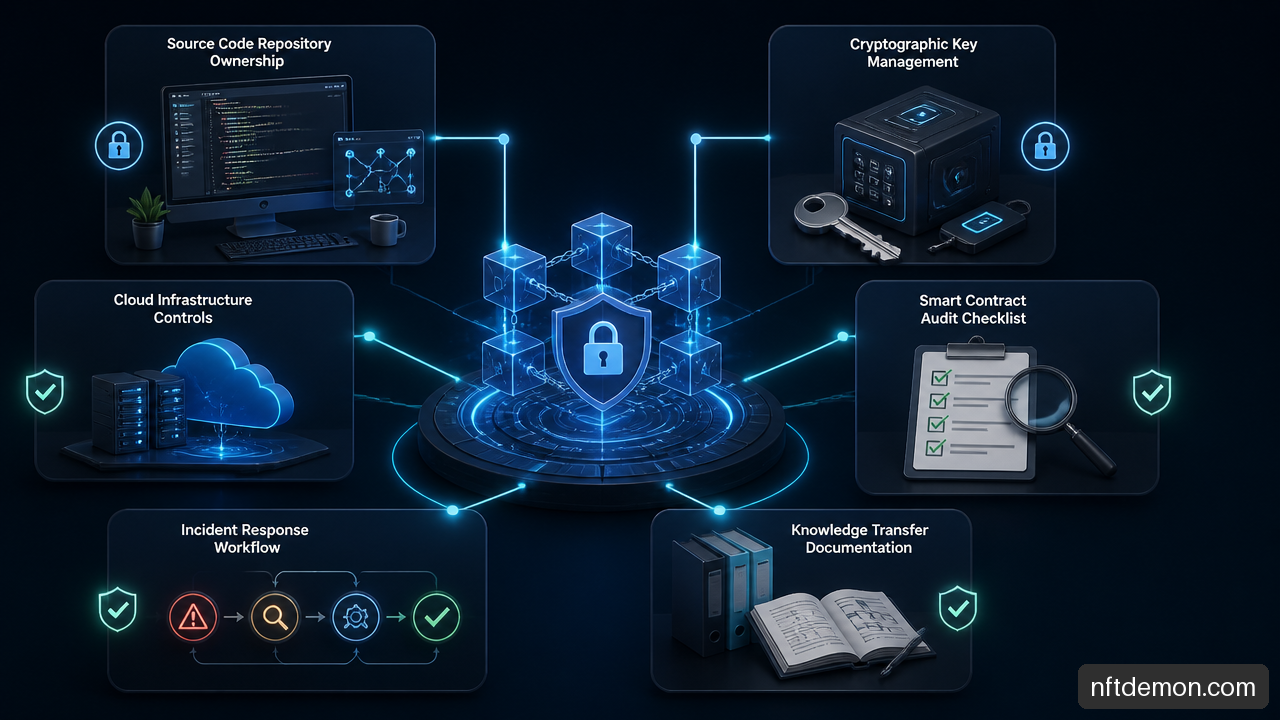
When code is in scope, require secure development evidence. The NIST Secure Software Development Framework defines secure development practices relevant to blockchain applications and smart contract delivery. In practical terms, ask to see how security requirements are defined, how threat modeling happens, how vulnerabilities are tracked, and how build artifacts are traced back to approved source code.
Define Smart Contract Audit Boundaries And Remediation Ownership
A smart contract audit is not a universal guarantee. It reviews a defined codebase, at a point in time, under stated assumptions. The executive question is not simply, “Will there be an audit?” It is, “What exactly will be reviewed, what will not be reviewed, and who owns remediation?”
The contract should specify:
• The exact repositories, commit hashes, deployed dependencies, libraries, and infrastructure components in scope.
• Whether the review includes business logic, access control, upgrade authority, oracle dependencies, integrations, and transaction simulations.
• Severity definitions, remediation timelines, re test requirements, and criteria for accepting unresolved findings.
• The party responsible for fixing defects and the party responsible for verifying the fixes.
• Whether post deployment changes, configuration changes, and contract upgrades trigger a new review.
Avoid a vendor that presents an audit as a checkbox while retaining sole discretion over what findings are fixed. For high value or public facing systems, independence may be appropriate: the builder can test continuously, while a separate specialist reviews the final scope. This depends on budget and risk tolerance, but independence can reduce the incentive to minimize findings.
Evaluate Privacy, Financial Crime, And Token Exposure Early
Immutable records create a design constraint. Personal data, sensitive commercial terms, and records subject to retention limits should generally not be placed directly on a ledger without a specific reason and governance review. The vendor should explain data minimization, off chain storage, encryption, access controls, retention rules, and how corrections or deletion requests are handled in surrounding systems.
If the engagement touches token issuance, payments, wallet flows, cross border counterparties, or custody, add a compliance workstream before implementation. The U.S. Treasury Office of Foreign Assets Control supports sanctions screening diligence where consulting touches value transfer or counterparties. Ask the vendor how the design identifies screened parties, handles beneficial ownership questions where relevant, and escalates potential matches.
Money movement deserves separate scrutiny. FinCEN’s Money Services Business registration guidance supports diligence on whether a model could implicate money transmission and anti money laundering obligations. A consultant should not make the legal determination for your organization unless qualified to do so, but it should flag the issue and define the legal review required.
Token economics also require a legal checkpoint. The SEC Investor Bulletin on Digital Assets supports the need to assess whether a token model may raise securities law issues. If a bidder promises that a token is “clearly compliant,” request the legal basis and independent counsel review rather than accepting a sales assurance.
Score Proposals, Control Lock In, And Govern Delivery
Use A Weighted Scorecard With Evidence Thresholds
A weighted scorecard prevents a charismatic presentation from outweighing delivery risk. Weight categories according to your program. A public token or wallet program may give security and compliance more weight. An internal provenance pilot may prioritize integration and governance.
| Evaluation Category | Suggested Weight | Minimum Evidence |
|---|---|---|
| Business and architecture fit | 20% | Alternative analysis, success metrics, architecture rationale |
| Named team and relevant delivery record | 20% | Role plan, availability, same stack examples |
| Security engineering and smart contract assurance | 20% | Threat model, SDLC evidence, audit and remediation plan |
| Compliance, privacy, and governance | 15% | Data map, escalation process, legal issue register |
| Commercial clarity and operating support | 15% | Full cost model, service levels, support plan |
| Knowledge transfer and exit readiness | 10% | Source access, documentation, transition obligations |
Do not allow a high score in one category to erase a critical failure in another. For instance, a vendor may score highly on product design but should be excluded if it cannot explain who controls administrative keys or refuses to commit to source code access.
Build Exit Rights Into The First Contract
Vendor lock in often starts with practical dependency rather than an explicit restrictive clause. The vendor holds the deployment credentials, controls the cloud account, owns undocumented automation, or is the only party that understands the contract upgrade process. If the relationship ends, your organization inherits code without the ability to operate it.
Require an exit package from day one:
- Source code, infrastructure definitions, build scripts, documentation, and configuration records stored in repositories your organization controls or can access.
- Clear intellectual property rights for custom deliverables and a documented inventory of third party components and licenses.
- Credential ownership rules, including administrative keys, cloud accounts, node services, domains, and signing authorities.
- Knowledge transfer sessions, runbooks, architecture decision records, and a defined transition period.
- Post termination support rates and obligations for critical incidents, handoff, and defect remediation.
The most practical safeguard is a handoff rehearsal before production. Have an internal team or alternate provider deploy a nonproduction release using the vendor’s documentation. If the process cannot be repeated without live assistance, the exit plan is incomplete.
Govern The Engagement After Selection
Selection is the start of diligence, not the end. Establish an executive steering cadence and a delivery operating rhythm. Monthly executive reviews should focus on decision gates, risk acceptance, budget movement, regulatory questions, and unresolved dependencies. Weekly delivery reviews should cover milestones, defects, architecture decisions, security findings, and blockers.
Set measurable acceptance criteria. “Working prototype” is not sufficient. A production readiness criterion could require documented recovery procedures, monitoring alerts tested against a defined scenario, successful remediation of critical findings, approved access control, and a completed legal review for the applicable model.
I would also preserve a formal risk register owned jointly by the buyer and vendor. Each item should have a description, owner, consequence, mitigation, decision date, and escalation path. This converts abstract concern into a management mechanism.
Frequently Asked Questions
What Should An Executive Due Diligence Checklist Include For A Blockchain Consulting Vendor?
Include business case validation, engagement boundaries, named staffing, protocol specific capability, secure development practices, smart contract audit scope, privacy design, token and payment compliance screening, commercial terms, operational support, and exit rights. The checklist should require evidence for each category rather than relying on marketing claims.
How Do You Tell Whether A Blockchain Consultant Is Actually Qualified?
Ask for recent examples involving the same chain type, integration pattern, governance model, and operating conditions as your proposed project. Then verify which named team members performed the work. Firm wide credentials are less useful than evidence that the assigned architect and engineers can deliver on your exact stack.
What Evidence Should A Vendor Provide Before You Sign An MSA?
Request a staffing plan, architecture approach, project assumptions, security process, incident response commitments, insurance information where your procurement process requires it, data handling practices, sample reporting, commercial exclusions, intellectual property terms, and a source code and transition plan. For code delivery, also request a description of source control, build integrity, vulnerability handling, and release approval practices.
What Should Buyers Verify About Smart Contract Audit Coverage?
Verify the scope, repository version, severity model, remediation owner, re test process, and treatment of unresolved findings. Confirm whether administrative functions, upgradeability, external dependencies, and deployment configuration are included. An audit that excludes the deployed configuration may leave material operational risk outside the review.
How Do Privacy And Data Retention Issues Affect Vendor Selection?
They affect architecture from the beginning. A vendor should minimize personal and sensitive data stored on chain, document what remains off chain, and explain correction, retention, access, and encryption controls. If the project requires deletion or correction rights, the design must address those obligations without claiming that immutable ledger entries can simply be erased.
What Should Executive Buyers Check If The Project Involves Tokens, Payments, Or Wallet Flows?
Require a documented issue register covering sanctions exposure, money transmission and anti money laundering considerations, token classification questions, custody responsibilities, wallet controls, transaction approvals, and cross border operations. The consultant should identify issues and coordinate with qualified counsel; it should not offer unsupported guarantees about regulatory outcomes.
How Do You Avoid Vendor Lock In In A Blockchain Consulting Engagement?
Control repositories, credentials, documentation, infrastructure definitions, and deployment processes from the start. Contract for intellectual property rights, transition assistance, and knowledge transfer. Test the arrangement by having someone other than the vendor reproduce a nonproduction deployment before launch.
Sources
- NIST Cybersecurity Framework 2.0 — https://www.nist.gov/cyberframework
- NIST Secure Software Development Framework (SSDF), SP 800-218 — https://csrc.nist.gov/pubs/sp/800/218/final
- U.S. Department of the Treasury Office of Foreign Assets Control — https://ofac.treasury.gov/
- FinCEN Money Services Business Registration — https://www.fincen.gov/money-services-businesses
- SEC Investor Bulletin on Digital Assets — https://www.sec.gov/oiea/investor-alerts-and-bulletins/ib_coins
NFT Demon Holdings helps enterprises scope, evaluate, and build blockchain programs — start with a free evaluation call.
Talk through your use case
Free evaluation call — objective, constraints, and fit, before any proposal.