A Blockchain Business Case Template for Cost Savings
By Jeremy Ryan, Founder & CEO · September 2026

A blockchain business case template for evaluating operational cost savings should prove one point before it asks for investment: the proposed distributed ledger reduces the total cost of a business process more than it adds in technology, integration, security, and governance overhead. I recommend treating blockchain as a shared operating model, not a feature. If the business problem does not involve multiple parties, duplicated records, costly reconciliation, or disputed process state, a conventional database may be the less expensive answer.
Table of Contents
• Build The Business Case Around A Measurable Operating Problem
• Establish The Baseline Before Estimating Savings
• Model Total Cost Of Ownership And Financial Returns
• Use A Pilot To Prove Or Reject The Savings Case
Build The Business Case Around A Measurable Operating Problem
A blockchain business case is credible when it begins with a process failure that has a known annual cost. The technology decision comes later. In practical terms, the strongest cases involve several organizations maintaining separate versions of the same transaction, asset, document, or entitlement. Each party then spends money matching records, checking evidence, resolving exceptions, and retaining audit documentation.
The National Institute of Standards and Technology explains that blockchain designs differ materially by architecture, permissioning, consensus mechanism, security model, and performance characteristics. Those choices affect both operating costs and technical limits, as outlined in NIST’s Blockchain Technology Overview. A business case that labels every option simply “blockchain” hides the economics that decision makers need to evaluate.
Use The Right Decision Rule Before Funding Discovery
The first decision is not public versus permissioned blockchain. It is whether a blockchain is necessary at all.
Use blockchain when several independent parties need a synchronized record, cannot rely on one party to operate the master database without dispute, and incur measurable costs reconciling records or validating state.
The U.S. Government Accountability Office notes that blockchain has use cases and limitations, including interoperability challenges, and that conventional databases may suffice in some circumstances. That necessity test should be explicit in the business case, not an afterthought. Review the GAO’s assessment of blockchain applications and limitations before assuming decentralization creates value.
Avoid blockchain when any of the following conditions apply:
• One organization already owns the authoritative record and counterparties accept its control.
• The process has low transaction volume and low reconciliation effort.
• Most errors originate from inaccurate source data rather than disagreement among parties.
• A workflow engine, API integration, electronic data interchange upgrade, or conventional shared database can solve the same problem with less coordination.
• Legal, privacy, or retention requirements cannot be satisfied without placing sensitive data where participants should not access it.
For example, an internal procurement approval workflow may have manual delays, but it usually does not need a replicated ledger. A modern workflow platform connected to the enterprise resource planning system may eliminate the delay at lower cost. By contrast, a freight process involving shippers, carriers, warehouses, insurers, and customs documentation may generate repeated matching work across organizational boundaries. The second scenario is more likely to justify a shared ledger.
Complete The Core Template Fields
The following template can be used for an investment memo, steering committee review, or pilot charter. It forces the team to connect every claimed saving to a mechanism.
| Template Field | What To Document | Decision Question |
|---|---|---|
| Business problem | Current process breakdown, affected parties, annual transaction volume | Is the problem expensive enough to warrant change? |
| Current process owner | Process, finance, technology, risk, and partner owners | Who can validate the baseline? |
| Shared state requirement | Data elements each participant must verify | Do multiple parties need the same trusted record? |
| Savings mechanism | Disintermediation, automation, reduced reconciliation, fewer errors, or reduced audit effort | What exactly causes the saving? |
| Proposed architecture | Permissioned, public, or hybrid model; validator and identity design | Does the architecture fit control and cost requirements? |
| Baseline metrics | Cost per transaction, cycle time, exception rate, audit effort, disputes | What is the business as usual benchmark? |
| TCO estimate | One time implementation and recurring operating costs | Are costs complete over the evaluation period? |
| Financial case | ROI, payback, net present value, and sensitivity scenarios | Does the conservative case clear the investment threshold? |
| Pilot design | Scope, participants, measurement method, stop or scale criteria | What evidence is needed before rollout? |
| Governance and controls | Participant rules, dispute process, key management, privacy, retention, monitoring | Who bears the recurring coordination cost? |
Attribute Savings Instead Of Combining Them
A common failure is describing all benefits as “efficiency.” That word cannot be audited. I recommend assigning each projected dollar of savings to one primary mechanism.
• Disintermediation: A third party, duplicate verification step, or manual broker role is removed or materially reduced.
• Automation: Smart contracts or rule based workflows execute routine validation, release, notification, or settlement steps.
• Reduced reconciliation: Participants stop comparing separate records because they use a controlled shared state.
• Lower exception handling: Fewer mismatches, missing documents, duplicate entries, and disputes require manual review.
• Audit and compliance efficiency: Authorized users can retrieve a traceable record faster, provided controls and source data quality support reliance on that record.
The distinction matters because each mechanism has different evidence requirements. Smart contracts may automate a clean transaction path, for instance, but they do not automatically reduce exceptions caused by incorrect shipment data, fraudulent documents, or disputed commercial terms. NIST’s description of tamper evident records does not mean the original input was correct. The controls around data entry still determine whether the ledger contains reliable business information.
Establish The Baseline Before Estimating Savings
The baseline is where a financial model becomes defensible. Do not start with an assumed percentage reduction in labor. Start with observed process data over a representative period, then determine which tasks would actually disappear, which would merely change, and which new responsibilities would be created.
The Institute of Internal Auditors has framed blockchain’s value most strongly around multi party shared records where reconciliation costs are high. A BlockStart DLT assessment resource referencing that shared source of truth rationale reinforces why reconciliation effort should be measured before a ledger is proposed.
Measure Cost, Time, And Defects Together
Labor hours alone are not enough. A process can have low direct labor cost yet create substantial economic damage through delayed settlement, inventory holds, duplicate payments, customer disputes, or compliance remediation.
Capture the baseline at transaction level where possible:
| Metric | Calculation | Why It Matters |
|---|---|---|
| Fully loaded cost per transaction | Annual process labor, systems, vendor fees, and overhead divided by volume | Establishes the unit economics to improve |
| Manual touchpoints | Average human interventions per transaction | Shows where automation may remove work |
| Reconciliation hours | Hours spent matching records across systems and counterparties | Tests the shared ledger hypothesis |
| Exception rate | Exceptions divided by total transactions | Reveals how much work sits outside the happy path |
| Exception resolution cost | Total handling cost divided by exception count | Quantifies the value of preventing or routing defects |
| Cycle time | Median and high percentile completion time | Identifies settlement, service, or working capital impact |
| Audit retrieval effort | Hours required to locate evidence and prove transaction history | Tests traceability claims |
| Error recovery cost | Credits, reversals, write offs, disputes, and rework | Prevents labor only savings estimates |
A useful baseline separates routine processing from exceptions. Consider a trade document workflow with 100,000 annual transactions. If 95 percent complete routinely, automating the routine path may save time. Yet if the remaining 5 percent require legal review, document correction, and counterparty communication, those exceptions can consume most of the total processing cost. The business case should therefore model both the frequency and cost of exceptions.
Compare The Future State Against A Real Alternative
The relevant comparison is not blockchain versus doing nothing. It is blockchain versus the best plausible non blockchain improvement.
For each option, model the same process scope and same service expectations. If a conventional integration hub can synchronize records among trusted partners, include it. If a workflow redesign can remove duplicate approvals, include it. This avoids rewarding blockchain for savings that any modernization project could deliver.
A useful comparison contains three alternatives:
-
Business as usual: Continue current systems, manual reconciliation, and existing vendor arrangements.
-
Conventional modernization: Improve APIs, workflow automation, master data controls, or a centrally managed shared database.
-
Blockchain enabled process: Use a permissioned, public, or hybrid ledger with defined participant roles and integration boundaries.
The outcome may favor blockchain, particularly when no party can credibly own the central record. It may also favor conventional modernization. Rejecting blockchain after a disciplined analysis is a successful decision, not a failed innovation exercise.
Separate Architecture Choices From Marketing Labels
Permissioned systems generally substitute variable public network fees with costs for identity administration, nodes, access management, governance, and participant support. Public blockchains may offer broad interoperability and externally verifiable settlement, but their fee variability, data exposure considerations, throughput constraints, and control model require careful analysis.
| Architecture | Primary Cost Drivers | Best Fit | Primary Caution |
|---|---|---|---|
| Permissioned ledger | Integration, validator operations, identity, governance, onboarding | Known participants with regulated or confidential workflows | Coordination cost can grow with consortium size |
| Public blockchain | Transaction fees, smart contract security, custody, monitoring, compliance | Open settlement, tokenized assets, public verification needs | Fees and operating assumptions may be volatile |
| Hybrid model | Bridge design, integration, security controls, dual operating processes | Selective public proof with private business data | Complexity can erase the expected benefit |
Model Total Cost Of Ownership And Financial Returns
A blockchain business case should cover a three to five year period and distinguish costs that occur once from costs that scale with transaction volume, participant count, or regulatory obligations. This separation is essential. A small pilot can look inexpensive while a production consortium becomes costly as partners join.
The GAO has cautioned that implementation, maintenance, and interoperability costs must be weighed against benefits. An enterprise blockchain ROI market analysis discussing that GAO cost consideration is a useful reminder that technical feasibility does not establish financial viability.
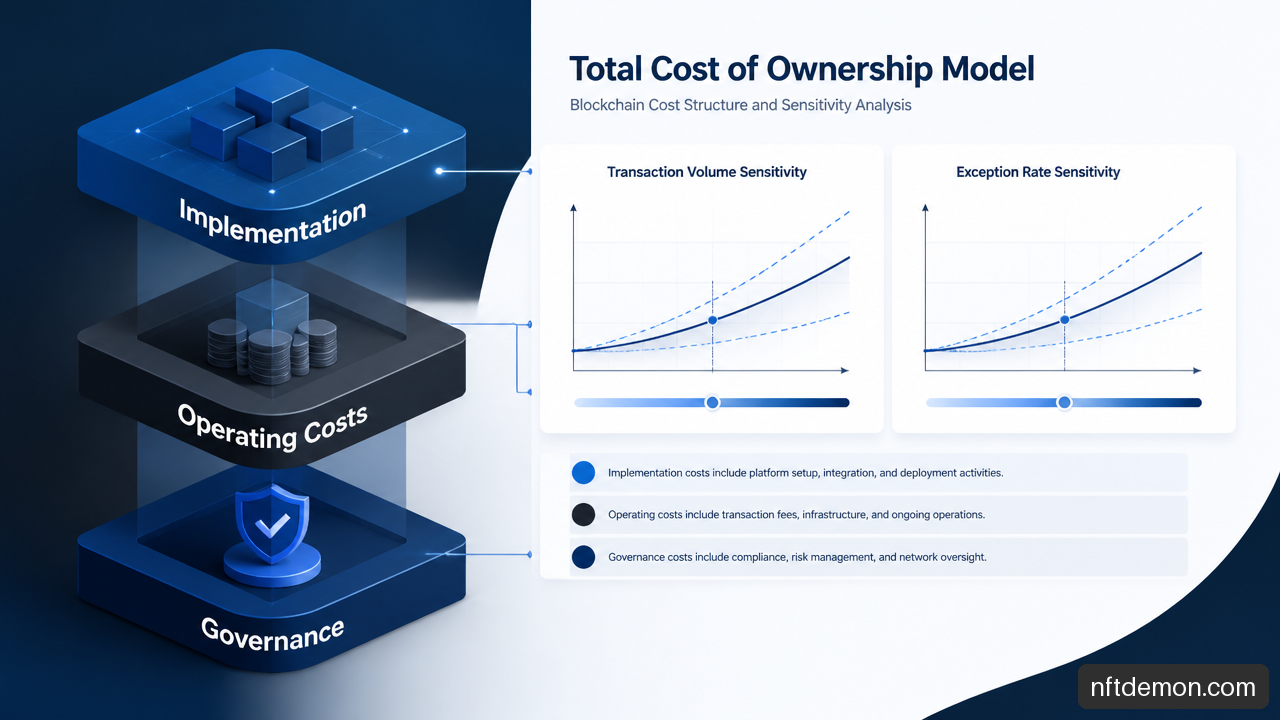
Build The TCO Model In Three Layers
Layer one: fixed implementation costs are incurred regardless of near term volume.
• Process redesign and requirements analysis
• Solution architecture, smart contract development, testing, and security review
• ERP, payment rail, identity, document management, and partner system integration
• Data migration, operating procedures, training, and control design
• Legal, privacy, records retention, and financial control review
Layer two: variable operating costs change with transactions or usage.
• Public network fees, where applicable
• Transaction validation, infrastructure capacity, and cloud consumption
• Customer or partner support per onboarded organization
• Exception investigation, dispute management, and remediation
• Monitoring, audit evidence production, and incident response workload
Layer three: governance costs grow with the number and diversity of participants.
• Consortium meetings, policy changes, voting procedures, and release approvals
• Participant due diligence, identity issuance, access revocation, and key recovery
• Service level management, liability allocation, and dispute escalation
• Change management when regulations, commercial rules, or system interfaces change
These categories are particularly important for U.S. organizations subject to privacy, records retention, financial reporting, and cybersecurity obligations. If a ledger becomes business critical, backup procedures, disaster recovery, access reviews, key management, and incident response are not optional operating details. They are recurring costs.
Calculate ROI With Conservative Assumptions
Use the following core calculations:
Annual gross savings = avoided labor + avoided vendor fees + reduced error recovery cost + reduced reconciliation cost + measurable audit savings
Annual net benefit = annual gross savings − annual recurring blockchain costs
ROI = cumulative net benefit ÷ total investment cost × 100
Payback period = initial investment ÷ annual net benefit
For capital allocation, add discounted cash flow and net present value. The model should also identify savings that are cash releasing versus capacity creating. Reducing 10,000 staff hours is not automatically a cash saving if employees are reassigned without avoided hiring, contractor reduction, or lower overtime. It may still be valuable capacity, but it should not be presented as realized expense reduction.
Run Sensitivity Tests On The Variables That Matter
Do not use a single ROI output. Test the assumptions most likely to change after rollout.
| Scenario Variable | Conservative Case | Base Case | Upside Case |
|---|---|---|---|
| Transaction volume | Lower than forecast | Expected volume | Higher adoption and volume |
| Partner participation | Partial use of shared workflow | Majority participation | Near universal participation |
| Exception rate reduction | Small decline | Measured target decline | Major prevention of recurring defects |
| Integration effort | Extended interfaces and remediation | Planned interfaces | Reusable integrations lower marginal cost |
| Governance overhead | More meetings and onboarding support | Defined operating model | Mature charter and standardized onboarding |
A supply chain consortium illustrates the risk. The model may assume 20 carriers use the shared workflow. If only six connect their systems and the rest continue sending emails and spreadsheets, reconciliation work remains. The ledger can then become another system to reconcile rather than the shared source of truth it was intended to be.
Use A Pilot To Prove Or Reject The Savings Case
A pilot should not be a technology demonstration. It should be a controlled measurement exercise designed to validate a small number of cost assumptions. Choose one transaction type, a limited partner group, and a process that has enough volume to produce meaningful data without exposing the organization to broad operational risk.
Define Success Thresholds Before Building
Write the stop, revise, and scale decisions into the pilot charter. A practical threshold structure might include:
• Scale: The pilot achieves the target reduction in reconciliation hours and exception handling cost, meets security and control requirements, and produces a projected payback within the approved investment horizon.
• Revise: The workflow improves, but integration cost, partner onboarding, or exception rates prevent the financial threshold from being met. Redesign the operating model before expanding.
• Stop: The measured improvement is not materially better than conventional modernization, participant adoption is inadequate, or governance overhead eliminates net savings.
The pilot should measure a delta against the baseline rather than relying on participant impressions. Compare the same transaction type, volume range, and service level where possible. If seasonality affects volume or error patterns, retain a parallel control sample from the current process.
Treat Smart Contracts As Controlled Automation
Smart contracts can reduce manual work by enforcing predefined logic: validate an approved status, confirm a required document, release a payment instruction, or notify a downstream party. Their economic value comes from reliably removing routine decisions, not from being deployed on a ledger.
Choose smart contract automation when rules are stable, data inputs are trusted, and exception paths can be clearly defined. Avoid automating decisions that require judgment, ambiguous legal interpretation, or data from unreliable sources. In those cases, the contract should route work to a human reviewer rather than force an incorrect outcome.
A treasury example makes the boundary clear. A smart contract may validate that an approved internal payment request contains required fields and has met defined authorization conditions. It cannot determine whether the underlying invoice reflects a legitimate commercial obligation unless reliable upstream controls exist. The cost model must include the human review that remains necessary.
Key Takeaways
• A blockchain business case should begin with a measurable multi party operating problem, not with a technology preference.
• The best savings candidates have high reconciliation effort, duplicate records, recurring verification work, and costly exception handling.
• Separate projected savings into disintermediation, automation, reduced reconciliation, lower error recovery, and audit efficiency.
• Compare blockchain against business as usual and the best conventional modernization alternative.
• Model fixed implementation costs, variable operating costs, and consortium governance costs separately.
• Use baseline metrics that include exception rate, cycle time, recovery cost, and audit effort, not only staff hours.
• A pilot should have predefined scale, revise, and stop thresholds based on measured operational deltas.
Frequently Asked Questions
What Should A Blockchain Business Case Template Include For Operational Cost Savings?
It should include the current process cost, shared record requirement, baseline transaction volume, reconciliation hours, exception rate, proposed architecture, savings mechanisms, total cost of ownership, financial metrics, governance model, compliance requirements, integration scope, and pilot success thresholds. The template should also identify the best non blockchain alternative.
How Do You Calculate Blockchain ROI For Operational Savings?
Calculate annual gross savings from avoided labor, reduced reconciliation, lower error recovery, reduced vendor costs, and measurable audit efficiency. Subtract recurring operating, security, infrastructure, and governance costs. Divide cumulative net benefit by total investment cost. Use conservative volume, adoption, and exception reduction assumptions rather than a single optimistic forecast.
What Baseline Metrics Should Be Measured Before Proposing Blockchain?
Measure fully loaded transaction cost, manual touchpoints, reconciliation hours, exception rate, exception resolution cost, cycle time, audit retrieval effort, and error recovery cost. The baseline should cover a representative period and separate routine transactions from high cost exceptions.
When Does Blockchain Not Make Financial Sense?
Blockchain is usually a weak choice when one trusted organization can operate the record, reconciliation costs are low, participant adoption is uncertain, or a conventional database and API model can solve the problem more cheaply. It also may not make sense when sensitive information cannot be adequately protected within the proposed design.
How Do Permissioned And Public Blockchains Differ In Cost Structure?
Permissioned ledgers commonly concentrate cost in integration, identity, administration, validator operations, and consortium governance. Public chains may shift more cost toward transaction fees, custody, smart contract assurance, and monitoring. The lower apparent infrastructure cost of either option can be misleading if onboarding and compliance work are excluded.
How Should Governance Costs Be Modeled In A Blockchain Consortium?
Model governance as a recurring operating expense. Include participant onboarding, identity management, access reviews, policy updates, release approval, dispute handling, legal coordination, meetings, and support. Estimate these costs by number of participants and expected change frequency, not as a one time project task.
How Should A Pilot Be Designed To Test Savings Claims?
Select one process, limited participants, a defined transaction sample, and measurable before and after metrics. Set a specific target for reduced reconciliation time, lower exception cost, or faster completion. Include a control group or comparable baseline where possible, and decide in advance what outcome triggers scale, redesign, or termination.
What Are The Most Common Mistakes In Blockchain Business Cases?
The most common mistakes are assuming automation equals savings, ignoring exception handling, omitting integration costs, treating governance as free, counting reassigned labor as cash savings, using broad adoption assumptions, and failing to compare blockchain with a conventional modernization option.
Sources/References
• National Institute of Standards and Technology — Blockchain Technology Overview: https://nvlpubs.nist.gov/nistpubs/ir/2018/NIST.IR.8202.pdf
• U.S. Government Accountability Office — Blockchain: Applications, Limitations, and Considerations: https://www.gao.gov/products/gao-22-105301
• blockchain-council.org: https://www.blockchain-council.org/blockchain/how-to-build-a-blockchain-business-case-roi-kpis-cost-breakdown/
• axis-intelligence.com: https://axis-intelligence.com/enterprise-blockchain-roi-market-reality/
• blockstart.eu: https://www.blockstart.eu/wp-content/uploads/BS-WP2-D2.7-BlockStart-DLT-Assessment-Tool-final-version.pdf
NFT Demon Holdings helps enterprises scope, evaluate, and build blockchain programs — start with a free evaluation call.
Talk through your use case
Free evaluation call — objective, constraints, and fit, before any proposal.