Web3 technology strategy for film, music, and publishing
By Jeremy Ryan, Founder & CEO · November 2026

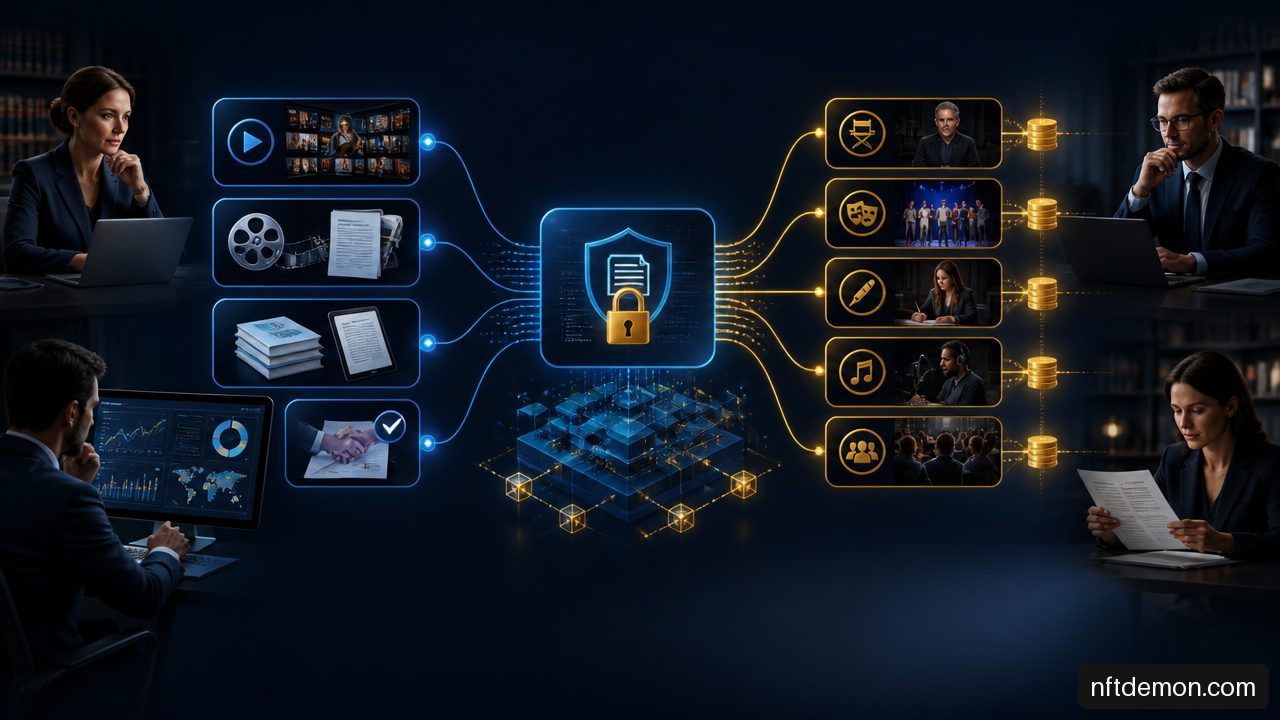
A durable web3 technology strategy for film music and publishing companies should begin with rights data, not token speculation. I recommend treating blockchain as a controlled workflow and audit layer first: a way to reconcile ownership, licenses, usage reports, approvals, and payments across parties that do not share one trusted system. NFTs, fan memberships, and tokenized products can follow when they solve a defined commercial problem.
For decision makers, the question is not whether Web3 is innovative. The useful question is narrower: where does a distributed, programmable record materially outperform the current combination of spreadsheets, emails, rights databases, collecting-society reports, accounting tools, and legal agreements?
- Rights Data Before Tradable Tokens
- Designing Rights, Licensing, And Royalty Workflows
- Selecting The Right Web3 Architecture
- Launching A Measurable Pilot
- Key Takeaways
- Frequently Asked Questions
Rights Data Before Tradable Tokens
Start With The Operational Bottleneck
I would start with the workflow that causes the most expensive delay, rather than with a chain or a collectible format. In entertainment, the strongest early candidates are usually fragmented chain of title, slow license approvals, uncertain royalty allocation, and inconsistent metadata between commercial partners.
A film company may know it has acquired a synchronization license, for example, yet still struggle to verify the exact territory, term, media window, approval condition, master recording, and composition rights attached to that license. A music publisher may receive usage reports that cannot be confidently matched to writer shares. A book publisher may manage permissions for excerpts, translations, audio editions, and adaptations across disconnected systems.
A blockchain record does not make bad data accurate. It can, however, make data changes, approvals, version history, and payment instructions easier to audit across authorized participants. That distinction matters.
The strategic objective is not to put copyright on a blockchain. It is to make rights decisions, evidence, and settlement rules more reliable across organizations.
Separate The Rights Before You Automate Them
Entertainment rights should never be modeled as one generic “ownership” field. Each right has its own scope, restrictions, participants, and commercial consequences. For film music, the composition and the sound recording are distinct assets. Film music clearance generally requires both the publishing right for the composition and the master right for the recording; failing to secure required clearances can delay distribution contracting.
A production-grade rights model should separate at least the following objects:
| Rights Object | What It Represents | Why It Must Be Separate |
|---|---|---|
| Underlying work | Song, screenplay, manuscript, or audiovisual work | May have multiple writers, publishers, and territorial interests |
| Master recording | Specific recorded performance | Often owned or controlled separately from the composition |
| Synchronization license | Permission to pair music with moving images | Requires defined media, territory, term, and approval conditions |
| Publishing right | Copyright interest in composition or text | Drives writer and publisher royalty allocation |
| Distribution right | Permission to distribute an edition or production | Varies by channel, geography, language, and release window |
| Revenue participation interest | Contractual entitlement to revenue | Is not automatically copyright ownership |
A token should not collapse these distinctions. A fan NFT representing access to a director’s commentary, for instance, is not a transfer of screenplay rights. A token granting early album access is not a master-right assignment. A revenue participation interest may create securities, tax, consumer-protection, and transfer-restriction issues that a collectible does not.
Keep Legal Authority And Sensitive Data Off Chain
I recommend placing the legal agreement, personally identifiable information, confidential deal terms, unreleased creative files, and mutable rights documentation in controlled storage. The blockchain can hold a cryptographic hash, a document reference, timestamp, approval status, and version identifier.
This structure produces an evidence trail without publishing the contract itself. If the agreement changes, the system records that version two supersedes version one. It does not pretend that an old record disappears merely because a deal was amended.
That correction model is essential. Rights are disputed. Licenses expire. Writers challenge splits. A producer’s authority may be limited. A territory can be added or removed. Immutable history is useful only when accompanied by a clear process for supersession, dispute flags, revocation, and human review.
For organizations considering public-facing products, NFT strategy consulting for global brands is relevant because digital ownership strategy should distinguish customer value from legal ownership claims before a product reaches the market.
Designing Rights, Licensing, And Royalty Workflows
Map The Workflow, Not Just The Asset
Smart contracts are most useful when they express business rules that are already understood, approved, and repeatable. They are less useful when a deal is still under negotiation or relies on subjective creative approval.
A royalty waterfall can be modeled as a sequence: revenue arrives, recoupable costs are validated, reserves are applied, participants receive allocations, and exceptions are flagged. Yet the contract code can only execute against the data it receives. It cannot independently determine whether a streaming statement is complete, whether a cue sheet is accurate, or whether a license was renewed.
Industry proposals commonly place rights records, licensing data, and payment instructions into smart-contract systems, as described in an overview of entertainment smart-contract structures. The commercial value comes from disciplined workflow design, not from storing every contract clause on chain.
Build The Oracle And Reconciliation Layer
An oracle is the service that brings verified external information into a blockchain workflow. For entertainment companies, it may import streaming reports, theatrical receipts, broadcast logs, book-sales data, distributor statements, bank confirmations, or rights-status changes.
This is the operational center of gravity. Consider a streaming royalty workflow:
- A distributor sends a usage and revenue report.
- The ingestion service validates file format, work identifiers, reporting period, and duplicate entries.
- Matching logic links reported use to the applicable work, master, territory, and license.
- Exceptions are routed to a rights operations team rather than paid automatically.
- Approved revenue enters the royalty waterfall.
- The ledger stores the approved event, allocation logic, payment instruction, and reconciliation record.
A proposed academic royalty-tracking design uses blockchain, smart contracts, and cryptographic hashes to link deposits, works, and transactions, as summarized in a discussion of hash-linked royalty models. That is a useful architecture pattern, but it should not be mistaken for proof that all source data will be correct.
Fair warning: an oracle can become a new single point of failure if one vendor controls ingestion, matching, and dispute resolution without transparent controls. Use dual approvals for material corrections, retain raw source files, log transformation rules, and define how participants challenge an imported event.
Model Film, Music, And Publishing At Different Levels
A shared platform can support all three sectors, but it should not force them into one simplistic schema.
| Sector | Core Rights Challenge | Practical Web3 Use Case | Avoid This Mistake |
|---|---|---|---|
| Film | Chain of title, music clearance, territorial distribution | License evidence, approval trail, rights expiration alerts | Treating a film as one indivisible rights asset |
| Music | Split ownership, master and publishing separation, usage matching | Royalty rule registry, split confirmation, statement reconciliation | Paying automated splits before source reports are validated |
| Publishing | Editions, translations, excerpts, audio, adaptation rights | Permission tracking, rights-window registry, provenance records | Assuming a token replaces publishing contracts |
Rachona describes proposed applications including tokenized film rights, blockchain-based music-rights projects, and direct digital publishing models in a review of entertainment tokenization concepts. The relevant takeaway is not that every catalog should be tokenized. It is that different commercial models require different legal and technical designs.
Selecting The Right Web3 Architecture
Choose A Ledger Only After Defining Governance
The first architecture decision is governance: who can write records, who can view them, who resolves disputes, and who bears the cost of operating the system?
A permissioned blockchain is often appropriate for rights administration because participation can be limited to approved publishers, labels, studios, distributors, collection partners, and auditors. It supports controlled access, clearer governance, and confidentiality. A public blockchain may be more appropriate for a fan-facing collectible, membership pass, or interoperable digital merchandise program where public verification and customer portability matter.
| Decision Factor | Permissioned Blockchain | Public Blockchain |
|---|---|---|
| Participant access | Restricted to approved entities | Broadly accessible network |
| Confidentiality | Stronger operational control | Requires careful off-chain privacy design |
| Rights administration | Better suited to consortium workflows | Usually less suitable for sensitive deal data |
| Fan collectibles | Possible but less interoperable | Often useful for portable customer assets |
| Governance burden | Shared rules must be negotiated | Network rules are external to the company |
Use a conventional shared database instead when one company controls the workflow, counterparties do not need independent verification, and auditability can be handled through existing contracts and logs. Blockchain adds complexity. It earns its place when multiple parties need a common, tamper-evident event history but cannot reasonably rely on one party’s private database.
Separate Token Models Before Legal Review
The word “token” obscures material differences. Legal, finance, and product teams should classify the proposed product before selecting technical features.
• Collectible NFT: A digital collectible, artwork, poster, scene, lyric artifact, or limited edition item. It may convey community status or perks, but it does not inherently transfer copyright.
• Access token: A credential for gated premieres, archival material, presales, fan communities, events, or educational content.
• Governance token: A voting mechanism for limited community decisions. It should not imply control over corporate or copyright decisions unless governance rights are explicitly structured.
• Tokenized license: A digitally represented permission subject to contractual limits on duration, territory, media, transferability, and use.
• Revenue participation interest: A claim on revenue that may introduce far more serious regulatory, tax, disclosure, and investor-suitability questions.
I would avoid a revenue-bearing token pilot until counsel has determined the applicable legal characterization, transfer restrictions, disclosures, investor eligibility, and reporting obligations. A fan who buys a commemorative NFT should not be left guessing whether it is a collectible, a license, or an investment product.
For teams that do proceed with a customer-facing program, Enterprise NFT strategy with measurable outcomes provides a useful framing: commercial objectives and measurement should be determined before supply, utility, or marketplace mechanics.
Launching A Measurable Pilot
Define A Narrow Pilot With A Real Decision At The End
I recommend a pilot limited to one catalog segment, rights type, territory, or settlement problem. A strong first pilot might cover a defined group of film-music licenses, a back-catalog royalty reconciliation workflow, or a controlled membership product tied to one release.
The pilot should answer a business decision such as: Should this workflow be expanded, redesigned, or stopped? If it cannot answer that question, it is a demonstration rather than a strategy.
Measure the baseline before deployment. The available evidence does not establish reliable industry-wide benchmarks for settlement speed, administrative savings, or royalty accuracy, so no company should assume generic percentage improvements. Measure internal performance instead.
| Metric | Baseline Measure | Pilot Target | Why It Matters |
|---|---|---|---|
| License clearance cycle | Days from request to approved evidence | Reduced elapsed time for defined rights | Tests workflow efficiency |
| Metadata exception rate | Percentage of records needing manual correction | Fewer unmatched or conflicting records | Tests data quality |
| Royalty reconciliation time | Days to resolve statement discrepancies | Faster exception handling | Tests operational value |
| Payment traceability | Ability to trace payment to approved source event | Complete audit trail for pilot transactions | Tests governance value |
| Fan conversion or retention | Product-specific participation measure | Measurable commercial behavior | Tests audience value |
Establish Recovery Paths Before Going Live
The most credible Web3 systems are designed around failure, not just happy-path automation. Before launch, define who can pause payment execution, correct an identifier, revoke an expired license, approve an amended split, and respond to a security incident.
A minimum control framework should include:
• Role-based access for legal, rights, finance, operations, and technical administrators.
• Multi-party approval for high-value payment rules and rights-status changes.
• Off-chain document retention with verifiable references to on-chain records.
• A dispute queue that prevents contested funds from being distributed prematurely.
• Key-management, wallet-recovery, and vendor-exit procedures.
• Reconciliation between the ledger, accounting platform, bank records, and source reporting system.
Legacy integration must be treated as a launch requirement. A rights registry that cannot exchange data with cue sheets, royalty systems, accounting platforms, distributor reports, and existing catalog databases creates yet another silo. It may look technically elegant while making rights operations harder.
For a public project, Planning an NFT project from concept to launch can help product teams sequence legal scope, utility design, technical delivery, and marketplace decisions without treating the mint as the whole project.
Key Takeaways
• Begin with a specific rights, metadata, licensing, or settlement bottleneck. Do not begin with a token format.
• Represent composition, master, synchronization, publishing, territory, term, and revenue participation as separate data objects.
• Keep legal agreements, confidential data, and mutable rights documentation off chain while anchoring approved versions and event history.
• Treat oracles, reconciliation, and exception management as core infrastructure because external usage and payment data drives the workflow.
• Use permissioned systems when confidential multi-party rights coordination is the primary goal; consider public networks when customer portability and public verification create value.
• Distinguish collectibles, access credentials, tokenized licenses, governance mechanisms, and revenue interests before legal review.
• Measure the pilot against internal baselines. Claimed industry-wide Web3 efficiency figures are not a substitute for operational evidence.
Frequently Asked Questions
What Web3 Problem Is Most Valuable For A Film, Music, Or Publishing Company?
The most valuable problem is usually fragmented rights data that delays licensing, reconciliation, or payment decisions. Start where multiple organizations need to verify the same record but currently rely on disconnected systems and manual follow-up. A fan NFT program may be commercially useful, but it is not automatically the highest-value first use case.
Should A Company Start With Blockchain Rights Records, Smart Royalties, NFTs, Or Fan Memberships?
Start with rights records and workflow reconciliation if operational friction is the issue. Start with fan memberships or collectibles if the objective is customer engagement and the legal rights are already clear. Smart royalties should come later, after source reports, approval rules, and exception handling are reliable.
Can A Smart Contract Legally Transfer Copyright?
Not by itself. A smart contract can record or execute predefined instructions, but legal transfer depends on the governing agreement, applicable law, authorized parties, signatures or formalities where required, and accurate chain of title. The ledger record should support legal documentation, not replace legal analysis.
What Information Should Remain Off Chain?
Keep confidential contracts, personal data, unreleased files, bank details, private negotiation notes, and sensitive commercial terms off chain. Store a hash, version reference, status, timestamp, and permissioned pointer where an auditable record is needed.
How Are Streaming, Theatrical, Broadcast, And Book-Sales Events Verified?
They must enter through controlled data-ingestion and reconciliation processes, often called oracle services. The system should retain raw reports, validate identifiers and periods, flag anomalies, and require human approval for disputed or material events before automated settlement occurs.
Is A Permissioned Blockchain Better Than A Public Blockchain For Entertainment Rights?
Often, yes, for sensitive rights administration. A permissioned network gives approved participants more control over access and governance. A public blockchain may be better for consumer-facing collectibles or access passes, provided privacy, customer support, wallet design, and consumer disclosures are handled carefully.
Can Smart Contracts Handle Complex Royalty Waterfalls And Recoupment?
They can execute predefined calculations once trusted revenue and status data arrives. They should not be expected to resolve ambiguous contract language, unapproved expenses, disputed shares, audit claims, or missing reports. The practical design is automated calculation plus an exception workflow, not fully autonomous finance.
How Should A Company Measure Return On Investment From A Web3 Pilot?
Measure the original operational or commercial problem. Compare pre-pilot and pilot results for clearance time, exception volume, reconciliation workload, payment traceability, legal review effort, customer conversion, or retention. If the solution does not improve a defined metric or reduce a material risk, do not scale it simply because it uses blockchain.
Sources And References
• chainscorelabs.com — https://chainscorelabs.com/use-cases/music-streaming-and-creator-monetization/digital-rights-and-licensing-administration/smart-royalty-waterfalls-for-complex-deals
• rachona.com — https://www.rachona.com/blockchain-smart-contracts/
• legal500.com — https://www.legal500.com/intelligence/canada/media-telecoms-it-entertainment/smart-entertainment-on-the-blockchain
NFT Demon Holdings helps enterprises scope, evaluate, and build blockchain programs — start with a free evaluation call.
Talk through your use case
Free evaluation call — objective, constraints, and fit, before any proposal.