Venture capital tokenization, what actually changes
By Jeremy Ryan, Founder & CEO · October 2026
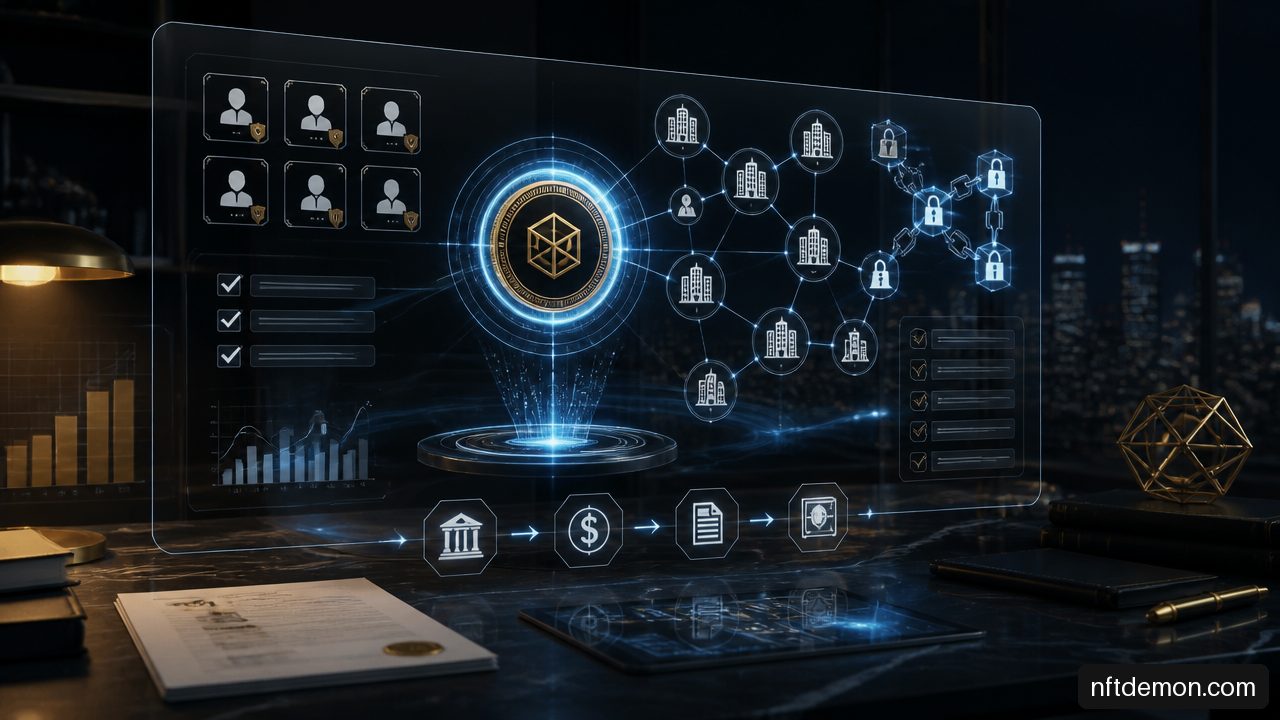
Venture capital tokenization can modernize how fund interests, special purpose vehicles, and private-company exposure are issued and administered. It does not, however, turn an illiquid venture portfolio into a liquid public market simply by putting ownership records on a blockchain. For decision makers, the real question is more disciplined: which legal rights, operational workflows, and investor controls become better when represented through tokenized infrastructure?
- Key Takeaways
- What Venture Capital Tokenization Really Represents
- Choosing The Right Tokenized Investment Structure
- How A Tokenized Venture Fund Operates
- Liquidity, Compliance, And The Limits Of The Model
- Frequently Asked Questions
Key Takeaways
The Token Is Not The Investment By Itself
A token is usually a digital record of a legal interest, contractual right, beneficial ownership claim, or economic entitlement. The underlying legal documents still determine what the investor owns, how distributions work, whether voting rights exist, and when transfers are permitted.
The blockchain can provide a shared ledger for ownership and workflow events. It does not replace the fund partnership agreement, operating agreement, subscription documents, securities disclosures, tax obligations, or investor suitability requirements.
Tokenization Works Best When It Solves A Defined Problem
Tokenization is most defensible when a fund has a clear operational use case: a global but qualified investor base, frequent transfer requests, multiple feeder vehicles, recurring distribution workflows, or a need for stronger auditability across administrators, custodians, and investors.
It is less compelling when the fund has a small, stable LP base, infrequent reporting, no credible secondary-transfer plan, and no appetite for additional compliance or systems integration. Technology should reduce friction in a known process, not create a more elaborate version of the same paperwork.
The core principle: venture capital tokenization is an operating-model decision before it is a blockchain decision.
What Venture Capital Tokenization Really Represents
Separating Legal Rights From The Blockchain Record
Venture capital tokenization refers to representing an interest connected to a venture investment through blockchain-based digital assets. The structure may involve an LP interest in a fund, a feeder fund position, an SPV interest, a sidecar allocation, or exposure tied to a specific portfolio company.
The distinction matters. A token holder may not directly own shares in the startup held by a venture fund. Instead, the holder may own an interest in an entity that owns those shares, or a contractual claim to economic returns from that entity. The token is the record or transfer mechanism. The legal vehicle is where the enforceable rights typically sit.
For example, an investor might receive tokens representing units in a Delaware LLC formed to invest in one growth-stage company. The LLC, not the token holder directly, owns the portfolio-company shares. If the company exits, proceeds flow to the LLC, then to investors based on the governing documents and tokenized ownership record.
This architecture can be useful because it makes ownership units easier to track, divide, and control. It also means the legal stack must be designed first. As Finextra’s overview of tokenized VC design notes, investor rights, governance, distributions, capital calls, custody, redemption, transfer rules, identity, and technology integration all need to be addressed.
Why Smart Contracts Matter, And Where They Stop
A smart contract is software deployed on a blockchain that executes predefined actions when specified conditions are met. In a tokenized fund, it may help administer whitelists, record transfers, calculate token balances, block restricted wallets, or initiate approved distribution instructions.
The useful word is help. Smart contracts do not independently know whether a private company’s valuation changed, whether a capital call has been satisfied through a bank transfer, or whether a transfer complies with every securities law in a buyer’s jurisdiction. Those facts arrive from off-chain parties such as fund administrators, legal teams, identity vendors, custodians, and valuation committees.
That creates an oracle problem. The on-chain ledger can be immutable, but the accuracy of NAV updates, distribution data, investor status, and corporate-action records still depends on the quality of the off-chain information supplied to it. A fund that automates incorrect data has not created efficiency. It has created a faster route to operational error.
Access Is Not The Same As Democratization
Tokenization can divide a large investment interest into smaller units. That may lower a minimum subscription threshold in some structures. Yet private-market securities can remain restricted to accredited, professional, qualified, or otherwise eligible investors depending on jurisdiction and offering structure.
A smaller unit size also does not change venture capital’s risk profile. Investors may still face a long holding period, uncertain valuation, capital-loss risk, limited information rights, and complex tax treatment. Broader access is possible in principle, but “democratization” is too broad a claim unless the fund has actually established lawful access, appropriate disclosures, investor education, and protection mechanisms for the intended audience.
For organizations evaluating adjacent digital-ownership initiatives, NFT strategy consulting for global brands can help frame the broader question: what rights does a digital asset confer, and how are those rights communicated without ambiguity?
Choosing The Right Tokenized Investment Structure
Full Funds, Feeders, SPVs, And Sidecars
The vehicle selected determines who invests, what they own, how reporting works, and which workflows need tokenization. Brickken describes tokenized structures that can represent fund shares, capital commitments, or portfolio investments through funds, SPVs, or sidecars. Those are not interchangeable choices.
| Structure | What The Token Usually Represents | When It May Fit | Primary Trade Off |
|---|---|---|---|
| Full venture fund | Interest in a diversified fund | Managers seeking a unified LP record across a multi-year fund | Complex capital calls, portfolio valuation, and broad governance requirements |
| Feeder fund | Interest in a vehicle that invests into a master fund | Separate investor groups or jurisdictions need tailored access | Adds another legal and administrative layer |
| Single-deal SPV | Interest in one specific investment vehicle | A defined co-investment or concentrated opportunity | Concentration risk and limited portfolio diversification |
| Sidecar | Interest in a parallel vehicle alongside a main fund | Oversubscribed deals or a subset of investors need additional allocation | Can complicate allocation policy and investor fairness |
A full-fund model is appropriate when the manager wants tokenization to support the central LP relationship. It should be avoided if the firm cannot reconcile token balances with capital-account records, notices, tax reporting, and transfer approvals throughout a fund’s life.
An SPV often provides the cleaner starting point. It confines the legal rights, valuation basis, and investor thesis to one deal. Consider a fund manager with strong demand for a specific late-stage allocation but no need to redesign the entire flagship fund. A tokenized SPV may test onboarding, custody, whitelisting, and investor communications without forcing a wholesale migration of fund administration.
A Structure Should Follow The Economic Reality
The wrong structure can create investor confusion. A token linked to a diversified fund should not be marketed as if it represents direct startup ownership. A tokenized sidecar should not imply access to the manager’s full portfolio. Clear language on ownership, fees, waterfall economics, voting, redemption, transferability, and conflicts is essential.
Decision makers should also map what remains off-chain. Most venture fund economics, including management fees, carried interest, expenses, distribution waterfalls, and GP authority, continue to be governed through legal agreements and accounting systems. The blockchain layer should mirror and support those obligations, not contradict them.
How A Tokenized Venture Fund Operates
The Lifecycle From Subscription To Distribution
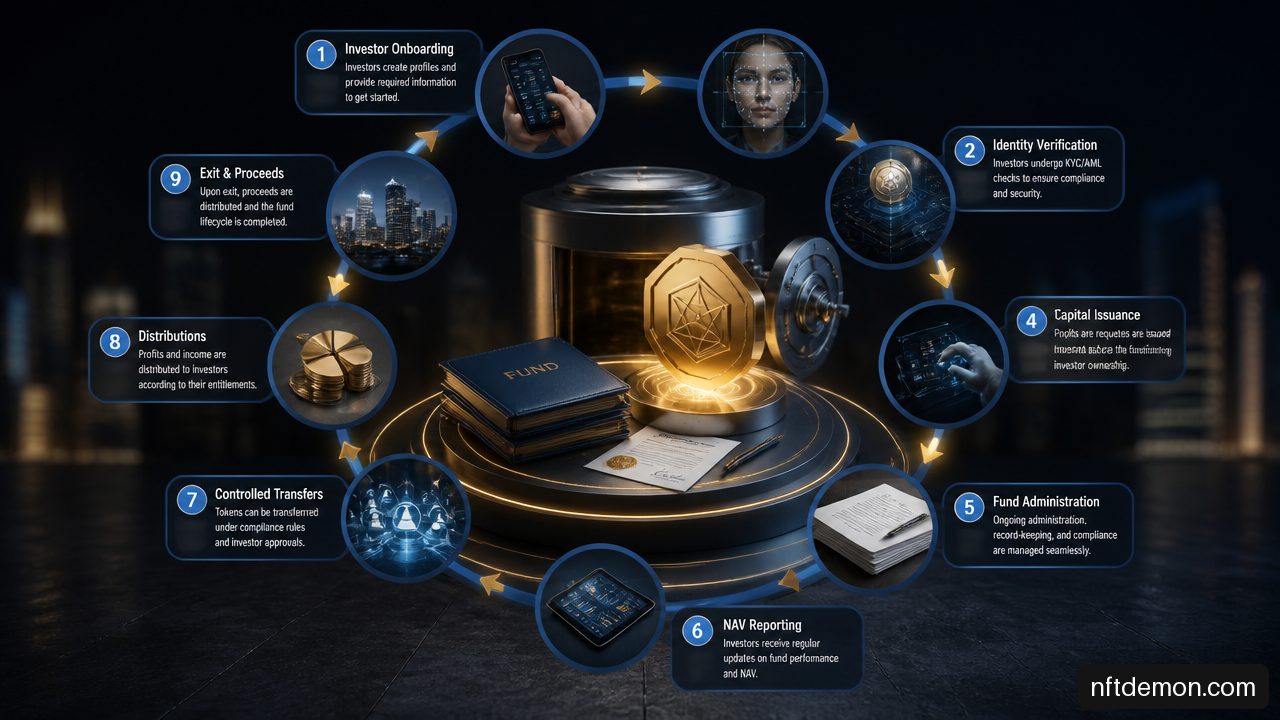
A viable implementation has to work during ordinary fund operations, not just at issuance. The lifecycle typically includes the following sequence:
- Vehicle formation and legal design: The GP establishes the fund, feeder, SPV, or sidecar and defines the rights associated with each tokenized unit.
- Investor onboarding: Investors complete identity verification, eligibility checks, sanctions screening, subscription documentation, and wallet registration.
- Issuance and allocation: Tokens are minted or allocated to approved wallets after the subscription closes or capital is received, depending on the structure.
- Capital administration: Capital calls, payment status, unfunded commitments, distributions, expenses, and capital-account records are reconciled with the token ledger.
- Reporting and valuation: The administrator calculates NAV or other relevant values using off-chain fund data, then communicates the approved record to investors and any on-chain reporting layer.
- Transfers and secondary activity: A proposed buyer is screened, approved, and added to the whitelist before a transfer can settle, subject to lockups, consent rights, and applicable law.
- Wind-down and final distributions: Exit proceeds, reserves, tax documents, final expenses, and token retirement are handled according to fund documents.
Capital Calls Are A Stress Test
Closed-end venture funds commonly call capital over time rather than collecting the full commitment on day one. This creates a practical challenge for tokenization. Does the investor receive tokens for their total commitment, their contributed capital, or a separate record for each funded amount?
There is no single answer. A commitment-based model may represent an investor’s full obligation but requires robust controls around defaults, dilution, and forfeiture provisions. A funded-capital model is simpler from a payment perspective but may not convey the full economics of a partnership interest.
Fair warning: a token balance alone should not become the authoritative source for capital-account accounting unless the fund’s administrator, legal documents, and systems architecture explicitly support that result. Reconciliation is not glamorous, but it is where many otherwise polished tokenization concepts become fragile.
Custody, Identity, And Operating Ownership
A tokenized vehicle needs explicit answers to basic operational questions. Who controls investor wallets? Can investors self-custody? What happens if a private key is lost? Can a restricted token be frozen after fraud, death, court order, or sanctions designation? Who can upgrade the smart contract, and under what governance process?
These are governance questions disguised as technical questions. A self-custody model may appeal to sophisticated digital-asset investors, while an institutional investor may require qualified custody, account controls, and formal recovery procedures. The right answer depends on investor expectations, regulatory requirements, and the fund’s risk tolerance.
Organizations building this capability should treat it as part of a broader operating model rather than an isolated token project. Creating an enterprise blockchain operating model is a useful framework for assigning ownership across legal, finance, security, data, and technology functions.
Liquidity, Compliance, And The Limits Of The Model
Tokenization Does Not Automatically Create Liquidity
Liquidity requires more than a transferable token. It requires eligible buyers, willing sellers, lawful transfer pathways, credible pricing, settlement infrastructure, and enough supply and demand to produce meaningful activity.
A tokenized LP interest may be easier to process than a paper assignment, especially if investor eligibility and transfer approvals are embedded in the workflow. But it can still be difficult to sell. Venture portfolios are valued infrequently, their holdings may be subject to transfer restrictions, and prospective buyers may disagree sharply about risk and price.
Consider a tokenized SPV holding shares in a private software company. The token can be transferred technically in minutes. Yet if the issuer requires consent, the buyer must be accredited, the company’s shareholder agreement restricts transfers, and no buyer accepts the latest valuation, the practical liquidity remains near zero.
Available industry coverage does not provide an independently verified dataset showing that tokenization consistently improves venture returns, produces deep secondary-market liquidity, or reduces total fund-administration costs. Those are outcomes to test against a specific structure, not assumptions to build into an investment memo.
Transfer Restrictions Are A Feature, Not A Failure
For private securities, transfer restrictions are often necessary investor-protection and compliance controls. Smart contracts can support wallet whitelisting, geographic restrictions, lockups, holding periods, and transfer-agent approvals. The token may be programmable precisely because it should not move freely to every wallet.
That can frustrate investors expecting public-crypto market behavior. Clear disclosure is the remedy. A tokenized venture interest should state whether transfers are prohibited, limited to approved windows, subject to GP consent, restricted to particular investor categories, or available only through specific venues.
The legal perimeter also varies by jurisdiction. Securities regulation, anti-money-laundering controls, tax reporting, privacy obligations, custody rules, and marketing restrictions should be reviewed before issuance. Enterprise blockchain strategy consulting is particularly relevant when compliance architecture needs to be designed alongside the technology stack.
What Decision Makers Should Measure Before Launch
A readiness assessment should use measurable operating criteria rather than broad claims about innovation:
• Investor profile: How many investors need digital onboarding, wallet support, transfer capability, or fractional allocations?
• Transfer demand: Are secondary transfers likely enough to justify whitelisting and settlement infrastructure?
• Valuation cadence: Can the fund produce consistent, governed valuation updates without implying false real-time pricing?
• Administrator integration: Can fund accounting, CRM, compliance, tax, custody, and reporting systems reconcile with the token ledger?
• Regulatory perimeter: Which investor types, jurisdictions, exemptions, resale rules, and marketing limitations apply?
• Control model: Who has authority to approve transfers, correct errors, suspend wallets, distribute funds, and update smart contracts?
A strong launch plan has a recovery path. It defines how an incorrect wallet address is handled, how a compromised account is frozen, how a disputed transfer is investigated, and how off-chain records prevail if there is a mismatch. Those details create institutional credibility far more effectively than a glossy token issuance announcement.
Frequently Asked Questions
What Is Venture Capital Tokenization?
Venture capital tokenization is the use of blockchain-based tokens to represent an interest connected to a venture fund, feeder fund, SPV, sidecar, or private investment. The token generally records or enables administration of rights defined in legal agreements; it does not erase the underlying legal structure.
Is A Tokenized VC Investment Legally Different From A Traditional LP Interest?
Not necessarily. The legal nature of the interest depends on the offering documents, entity structure, jurisdiction, and investor rights. Tokenization may change recordkeeping, transfer processes, custody, and automation, but it does not automatically change whether the interest is treated as a security or private-market investment.
Does Tokenization Make Venture Capital Investments Liquid?
No. It can make permitted transfers easier to administer, but actual liquidity requires qualified buyers, legal transferability, credible valuation, and active market demand. A technically transferable token can still have no practical buyer.
Should A Manager Tokenize A Full Fund Or Start With An SPV?
An SPV can be the more controlled starting point when a manager wants to test investor onboarding, custody, compliance workflows, and token transfer controls around one investment. A full-fund model may fit managers with recurring investor activity and the operational capacity to integrate tokenization across the entire fund lifecycle.
Who Can Buy Tokenized Venture Fund Interests?
Eligibility depends on the offering structure and jurisdiction. Many tokenized venture products will remain limited to accredited, professional, qualified, or otherwise approved investors. Smaller token units do not automatically make a private offering available to retail investors.
How Are Valuations And NAV Reflected On-Chain?
Usually through approved off-chain information from the GP, fund administrator, valuation committee, or another authorized party. Blockchain can preserve a record of a published value, but it does not independently determine the fair value of an illiquid private company.
Can Smart Contracts Automate Capital Calls And Distributions?
They can automate parts of the workflow, such as notices, payment instructions, eligibility checks, and distribution calculations. Bank payments, tax withholding, accounting reconciliation, and exception handling may still require off-chain systems and human approvals.
Sources
• Brickken — Venture Capital Tokenization Platform: https://www.brickken.com/venture-capital-tokenization
• Finextra — Tokenized Venture Capital: How VC Can Digitize Fund Interests and Private Investments in 2026: https://www.finextra.com/blogposting/32941/tokenized-venture-capital-how-vc-can-digitize-fund-interests-and-private-investments-in-2026
• RWA.io — Venture Capital Tokenization: LP Interests On-Chain: https://www.rwa.io/post/venture-capital-tokenization-lp-interests-on-chain
• Business Wire — SPiCE VC Executes Third Investor Payout: https://www.businesswire.com/news/home/20250624244931/en/SPiCE-VC-Executes-Third-Investor-Payout-Solidifying-Position-as-Top-Performing-VC-in-Blockchain-Sector
• PR Newswire — ARK Invest Tokenizes ARK Venture Fund with Securitize: https://www.prnewswire.com/news-releases/ark-invest-tokenizes-ark-venture-fund-arkvx-with-securitize-302888300.html
NFT Demon Holdings helps enterprises scope, evaluate, and build blockchain programs — start with a free evaluation call.
Talk through your use case
Free evaluation call — objective, constraints, and fit, before any proposal.