Tokenizing real estate for investment, what investors must know
By Jeremy Ryan, Founder & CEO · October 2026

Tokenizing real estate for investment can make a property interest easier to divide, administer, and potentially transfer. It does not, by itself, turn an illiquid building into a liquid public-market security or give token holders direct title to land. The investment thesis depends on the property, legal structure, investor rights, operating economics, and actual exit options—not on the blockchain alone.
For decision makers, the useful question is not “Should this property be tokenized?” It is: What investor claim is being created, how will it be governed, and does tokenization improve the capital-raising or ownership model enough to justify the added operational burden?
- How Tokenized Real Estate Actually Works
- Where Tokenization Helps—and Where It Does Not
- How To Underwrite A Tokenized Property Offering
- Building A Compliant Operating Model
- Frequently Asked Questions
- Sources And References
How Tokenized Real Estate Actually Works
Start With The Legal Claim, Not The Token
A real-estate token is a blockchain-recorded digital unit tied to a defined legal or economic interest. Deloitte’s explanation of tokenized real estate describes tokenization as creating fractional digital representations of real-estate assets that may improve transferability. That distinction matters: a digital representation is not automatically a deed, a mortgage interest, or a direct ownership interest in a building.
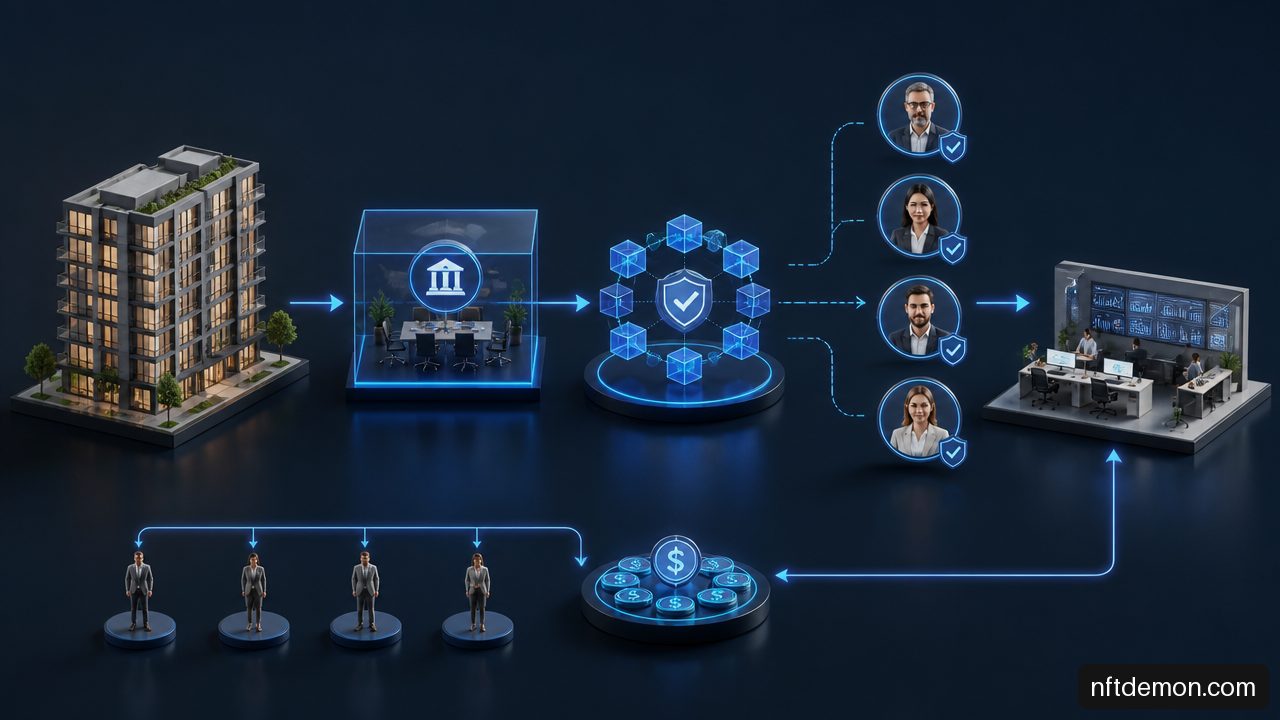
In many practical structures, an LLC or special-purpose vehicle, often called an SPV, holds title to the property. Investors buy tokens that represent an interest in that entity, a right to a share of distributable income, a debt claim, or another contractual entitlement. The token is therefore part of a chain of rights:
- The land-title registry records the legal owner of the property.
- The SPV or LLC holds that title and enters into leases, financing, insurance, and management agreements.
- The issuer creates tokens under governing documents that define investor rights.
- A token registry records who holds the digital units.
- The investor agreement determines what a token holder receives in a sale, refinancing, distribution, or dispute.
Fair warning: possession of a token in a digital wallet does not answer the most important question: what can the holder legally enforce if the sponsor fails, the property is sold, or a transfer is blocked?
The IJRPR review of tokenized real-estate platforms notes that tokenization commonly involves a legal entity, property due diligence, programmed rights, and an issuance process. That is the correct order of thinking. A high-quality smart contract cannot repair weak title, inflated valuation, excessive leverage, or poor property management.
What Smart Contracts Do Under The Hood
Smart contracts are blockchain programs that execute pre-set instructions when specified conditions are met. In real-estate tokenization, they can help record issuance, restrict transfers, calculate allocations, and distribute available cash to approved wallets.
Consider a rental property owned by an SPV. Rent arrives in the SPV’s bank account, not directly on-chain. The manager must still reconcile rent, pay insurance, property taxes, repairs, debt service, and reserves. Only then can the issuer determine distributable cash. A smart contract may automate the final allocation to token holders, but it cannot independently verify that the property manager correctly categorized a $40,000 roof repair or accurately reported vacancy.
That limitation is not a flaw; it is a design reality. Real estate produces off-chain facts. Good systems establish controls around those facts before using automation.
Token terms may also encode approved-wallet requirements, voting procedures, distribution rules, and transfer restrictions. Hedera’s overview of real-estate token structures explains that transfer rules, distributions, and governance rights can be built into the structure. I would still treat the operating agreement, subscription documents, and offering materials as controlling unless the legal documentation explicitly says otherwise.
Securities Compliance Is A Design Constraint
Many real-estate tokens are likely to be treated as securities because investors contribute capital to a common enterprise with an expectation of returns generated largely by others. The exact classification depends on the jurisdiction, offering terms, investor rights, and facts of the transaction. It should be assessed by qualified counsel rather than assumed from the token’s branding.
This affects who may invest, how the offering is marketed, what disclosures are required, and when tokens may be transferred. A token may be technically transferable at any hour, yet contractually restricted to verified wallets, eligible investors, or approved venues. Investor accreditation can also determine access to private offerings.
For enterprises, compliance should be embedded in the product architecture rather than added after launch. That means identity verification, sanctions screening where applicable, investor eligibility checks, jurisdiction controls, transfer approval logic, records retention, and escalation paths for failed transactions. A Blockchain operating model for ownership compliance becomes particularly relevant when a token’s on-chain lifecycle must match legal obligations and investor support processes.
Key Takeaways
• Tokenization digitizes a defined claim; it does not automatically create direct property ownership.
• Liquidity is conditional. A token can transfer only when securities rules, platform controls, and actual buyer demand allow it.
• Net cash flow matters more than advertised yield. Property expenses, leverage, reserves, taxes, and fees determine distributions.
• Smart contracts automate rules but do not replace legal documents, property management, or independent oversight.
• The strongest use cases begin with a business problem: fragmented ownership, costly administration, limited investor access, or an inefficient capital-raising process.
Where Tokenization Helps—and Where It Does Not
Fractional Access Is Real; Liquidity Is Not Guaranteed
Tokenization can lower the unit size of an investment. Instead of asking one buyer to commit millions of dollars to a building, an issuer may divide the economic interest into smaller units. Some offerings advertise entry points around $50 to $100, although minimums, eligibility requirements, and fees vary materially. Forbes’ discussion of tokenized property ownership and income also notes that advertised yields and stablecoin distributions are offering-specific, not proof of representative net returns.
Lower minimums may help an investor diversify across geographies or property types. They may also help an issuer reach a broader pool of capital. But accessibility is not the same as suitability. A $100 minimum can make a complex, illiquid private investment easier to purchase, which increases the need for clear disclosures rather than reducing it.
Liquidity requires a willing buyer, an approved transfer mechanism, reliable price discovery, and compliance clearance. A marketplace with few participants may offer no practical exit. If a holder wants to sell 5,000 tokens but the only bid is far below the issuer’s last valuation, the investor must choose between accepting a discount and remaining invested.
Tokenized Property Compared With Alternatives
The best vehicle depends on the investment objective. If an investor wants daily liquidity and broad diversification, a listed REIT may be a better fit. If a sponsor wants a bespoke ownership model for a single stabilized asset, tokenization may be more relevant.
| Option | Typical Investor Exposure | Liquidity Profile | Governance And Disclosure | Best Fit |
|---|---|---|---|---|
| Direct ownership | Direct title or partnership interest | Usually slow and transaction-heavy | Highly negotiated; investor bears operating responsibility | Control-oriented owners with substantial capital |
| Public REIT | Shares in a diversified real-estate company or portfolio | Often market-traded on business days | Public-market reporting and corporate governance | Investors seeking broad exposure and simpler exits |
| Real-estate crowdfunding | Interest in a specific deal or sponsor vehicle | Often limited until a sale, refinance, or redemption | Platform and offering dependent | Investors seeking deal-level exposure |
| Private real-estate fund | Interest in a pooled fund | Typically limited, often subject to lockups | Fund documents define priorities and reporting | Investors seeking manager-led diversification |
| Tokenized real estate | Tokenized equity, debt, revenue right, or beneficial interest | Potentially transferable, but highly conditional | Legal documents plus token rules govern rights | Sponsors needing fractional administration or programmable ownership |
Tokenization can reduce administrative friction when there are many investors, recurring distributions, and clear transfer policies. It may be a poor fit for a simple two-party acquisition, an asset with unresolved title issues, or a sponsor without the resources to maintain compliance, custody support, and investor communications.
Stablecoins Add A Separate Layer Of Risk
Some structures distribute income in stablecoins. This can shorten settlement steps and simplify global payment workflows for investors who already use digital wallets. It also introduces additional questions: Can the stablecoin be redeemed reliably? Who bears conversion fees? What happens if the investor sends assets to an unsupported wallet? Must investors report gains or losses when converting the payment to fiat currency?
A prudent offering should disclose whether distributions are paid in fiat, stablecoin, or investor-selected rails; who pays transaction costs; what occurs during network congestion; and how payment errors are handled. The underlying apartment building may be stable while the payment method remains operationally complex.
How To Underwrite A Tokenized Property Offering
Analyze The Property Before The Protocol
I would apply conventional real-estate underwriting first. Tokenizing a weak deal only makes the weak deal easier to distribute.
Review the property’s revenue durability, tenant concentration, lease expirations, occupancy, comparable rents, debt terms, tax exposure, insurance coverage, capital-expenditure needs, and manager incentives. For development projects, add construction risk, permitting status, contractor arrangements, contingencies, and refinancing assumptions.
A simple cash-flow sequence helps expose whether a stated yield is meaningful:
- Start with scheduled rental income.
- Subtract vacancy and credit loss.
- Subtract operating expenses, property taxes, insurance, and management fees.
- Set aside reserves for repairs, replacements, and unexpected costs.
- Pay debt service and any senior obligations.
- Apply the distribution waterfall to the remaining cash.
- Subtract platform, custody, token-transfer, and investor-level fees where relevant.
The result is closer to net distributable cash flow. It is not necessarily the investor’s after-tax return.
For example, a property may advertise an 8% gross rental yield. If vacancy, repairs, debt service, reserves, and fees consume half of the gross income, investor distributions can be substantially lower. Conversely, total return might improve if the property appreciates—but appreciation is uncertain, and sale costs, debt payoff, and preferred-return rights may reduce the proceeds available to common token holders.
Read The Waterfall And Governance Terms
The rental-income waterfall determines who is paid first. Senior lenders are generally paid before equity investors. Preferred equity may receive distributions before common equity. The manager may receive asset-management fees, acquisition fees, performance incentives, or reimbursement rights before ordinary token holders receive a distribution.
The investor should be able to answer these questions from the documents:
• Who can approve a refinance, major renovation, property sale, or new debt?
• Can the sponsor issue more tokens or admit new investors?
• What vote threshold applies to a sale or manager replacement?
• Are token holders entitled to information rights, audited financial statements, or periodic valuation updates?
• What happens if additional capital is needed after a casualty loss or major repair?
• Is there a conflict-of-interest policy for sponsor affiliates, contractors, and property managers?
A token holder may have economic rights without meaningful operational control. That can be reasonable when investors want passive exposure, but it should be explicit. Governance ambiguity becomes expensive when the building needs a new roof, a lender demands a reserve increase, or the sponsor proposes a discounted sale.
Evaluate Technology, Custody, And Recovery Procedures
Technology diligence should focus on the real failure points: wallet access, identity linkage, transfer approvals, contract upgrade authority, data reconciliation, and customer support.
Ask whether the smart contract has been independently reviewed, who controls administrative keys, whether transfers can be paused, and how the issuer handles a lost wallet or a deceased investor. A pause function can protect investors after an exploit; it can also create concentration risk if one party can freeze holdings without transparent safeguards.
For enterprises considering broader digital ownership programs, NFT strategy consulting for digital ownership can help frame the larger question: whether the token is a functional ownership instrument with enforceable rights, rather than a digital wrapper around vague promises.
Building A Compliant Operating Model
Design From The Asset Backward
A durable tokenization program starts with the asset and investor outcome, then selects technology. The recommended sequence is practical:
- Define the capital objective: raise equity, issue debt, create co-investment access, or automate administration for existing owners.
- Select the legal entity and document the exact investor claim.
- Complete title, valuation, financial, insurance, environmental, and property-level due diligence.
- Determine offering eligibility, investor verification, transfer restrictions, tax reporting, and jurisdictional requirements.
- Build the token registry, wallet policy, smart-contract logic, payment workflow, and support procedures.
- Test distributions, voting, transfer denials, wallet recovery, audit trails, and incident response before issuance.
- Launch with periodic reporting that reconciles on-chain balances with off-chain financial records.
This sequence avoids a common mistake: treating token minting as the beginning of the project. Minting is usually one of the later steps. The real work is legal structuring, underwriting, operational controls, and investor communication.
Decide Whether A Secondary Market Is Credible
Do not market continuous liquidity unless there is a credible mechanism behind it. A secondary-market plan should identify the venue, eligible buyers, transfer-review process, settlement method, expected market-maker role if any, pricing methodology, and contingency if the platform stops operating.
If no robust resale market exists, the offering should be presented as a long-duration investment whose primary exit may be a refinance, issuer redemption, or property sale. That is not necessarily a defect. Many successful private real-estate investments are illiquid. The defect is suggesting that blockchain removes the economic reality of finding a buyer.
Measure Outcomes That Matter
Decision makers should define measurable outcomes before committing budget. Relevant metrics may include investor onboarding time, reconciliation effort, distribution-processing cost, percentage of transfers completed without manual remediation, investor-reporting timeliness, and capital raised from qualified participants.
Avoid measuring success primarily by token count or social attention. Those figures say little about compliance quality, investor understanding, or property performance. Enterprise NFT strategy for measurable outcomes offers a useful parallel: digital ownership initiatives should be evaluated against operational and commercial objectives, not novelty.
Frequently Asked Questions
What Does Tokenizing Real Estate For Investment Mean?
It means creating blockchain-based tokens that represent a defined interest connected to real estate. That interest may be equity in an LLC, a beneficial interest, a debt claim, a share of revenue, or another contractual right. The governing documents—not the token label—determine what the investor owns.
Does A Token Give Me Direct Ownership Of The Property?
Usually, no. In many structures, an SPV or LLC owns the property while token holders own interests in the entity or rights under an agreement. Direct title is recorded through the applicable land-title system, which is generally separate from the blockchain token registry.
Can I Sell Real-Estate Tokens Whenever I Want?
Not necessarily. Transfers may be limited by securities rules, lockups, investor eligibility, approved-wallet requirements, platform policies, and a lack of buyers. A token can be transferable in theory while remaining difficult to sell in practice.
Are Tokenized Real-Estate Investments Available To Non-Accredited Investors?
Some may be, depending on the offering structure and jurisdiction. Others may be limited to accredited investors or another defined investor class. Review the offering documents and eligibility requirements before assuming access.
How Are Rental Income And Sale Proceeds Distributed?
The issuer generally receives property cash flow, pays expenses and senior obligations, funds reserves, then distributes the remaining amount according to the waterfall. Sale proceeds follow a similar order, often after debt repayment, transaction costs, and any preferred-return or sponsor-promote provisions.
How Should I Evaluate An Advertised Yield?
Determine whether it is gross rent, net property income, projected cash distribution, or total-return estimate. Then identify vacancy assumptions, debt service, reserves, management fees, platform charges, taxes, and the duration of the estimate. A stated yield without a defined calculation is not enough for an investment decision.
What Happens If The Property Needs Major Repairs Or Becomes Vacant?
Distributions may decline or stop. The sponsor may use reserves, borrow funds, defer work, seek additional investor capital, or sell the asset. The documents should explain who decides, whether token holders can be diluted, and what priority applies if new capital is needed.
Sources And References
• Deloitte Insights — Tokenized real estate: https://www.deloitte.com/us/en/insights/industry/financial-services/financial-services-industry-predictions/2025/tokenized-real-estate.html
• Hedera — Real estate tokenization: Transforming property investment: https://hedera.com/learning/real-estate-tokenization/
• Forbes — How Real Estate Tokenization Opens New Paths For Ownership And Income: https://www.forbes.com/sites/digital-assets/2026/03/17/how-real-estate-tokenization-opens-new-paths-for-ownership-and-income/
• IJRPR — Global Trends in Tokenized Real Estate Platforms and their …: https://ijrpr.com/uploads/V7ISSUE1/IJRPR58899.pdf
NFT Demon Holdings helps enterprises scope, evaluate, and build blockchain programs — start with a free evaluation call.
Talk through your use case
Free evaluation call — objective, constraints, and fit, before any proposal.